Automotive MEMS Oscillator Market Insights
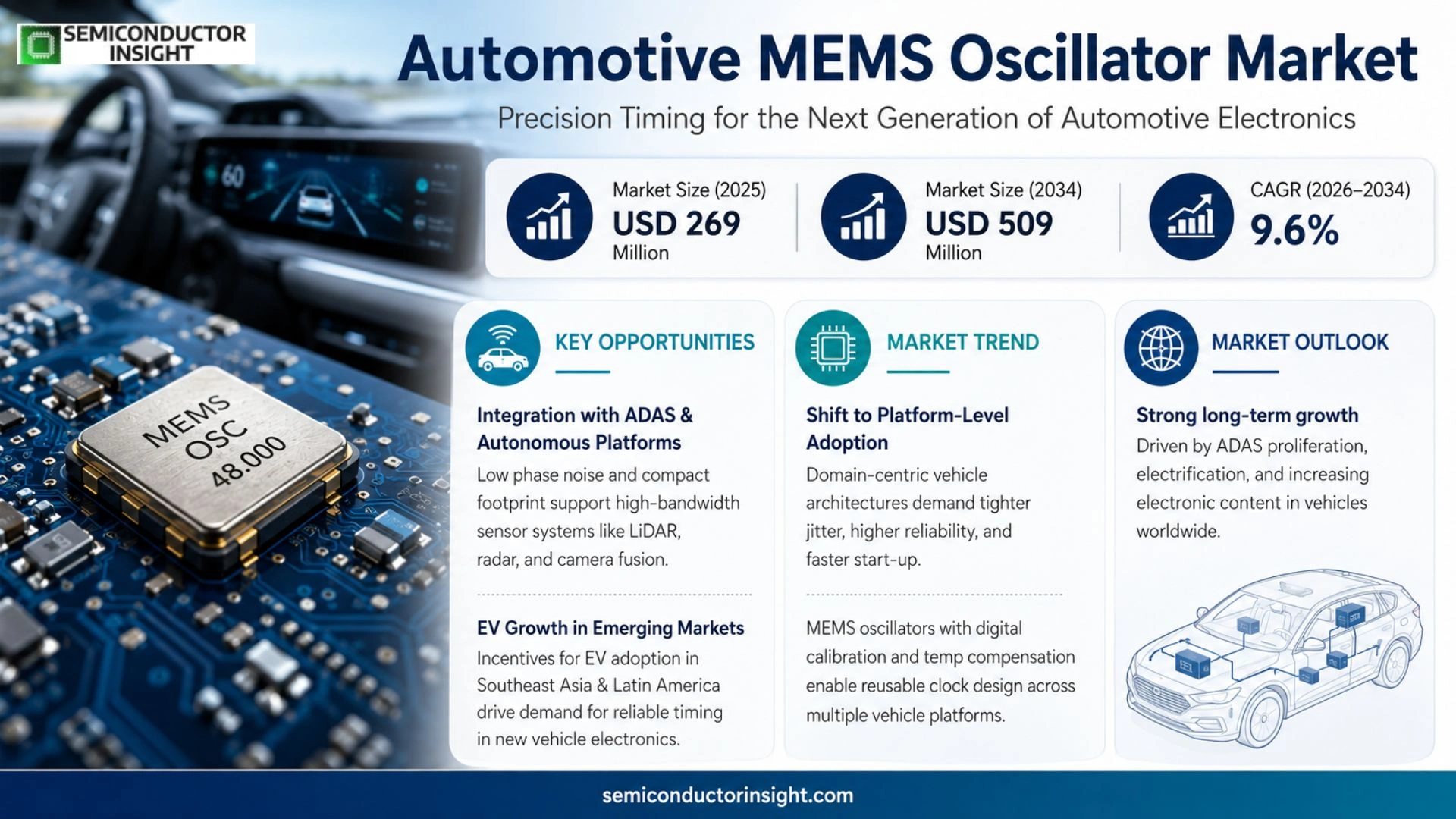
Automotive MEMS Oscillator market size was valued at USD 269 million in 2025. The market is projected to reach USD 509 million by 2034, exhibiting a CAGR of 9.6% during the forecast period.
An automotive MEMS oscillator is a high‑reliability timing device built around a silicon MEMS resonator integrated with sustaining driver circuitry. It delivers stable reference clocks under harsh vehicle conditions, addressing shock‑vibration robustness, wide temperature‑swing consistency, predictable long‑term drift, and part commonality across multiple ECUs. Digital calibration and temperature compensation enable precise jitter control for domain controllers, Ethernet links, ADAS sensors, infotainment systems, battery‑management units and electrified powertrain applications. Because modern vehicles rely on domain‑level computing and high‑speed interconnects, manufacturers prioritize components that combine mechanical robustness with programmable frequency settings, allowing reuse across platforms while satisfying automotive qualification standards.
MARKET DRIVERS
Electrification of powertrains
Automakers are shifting more than 30% of new model line‑ups to hybrid or fully electric architectures. This transition raises the need for precise timing references that can survive wide temperature swings and vibration levels. MEMS oscillators meet those specifications, making them a preferred choice for on‑board control units.
Stringent safety and emissions regulations
Regulatory bodies across North America, Europe and Asia have tightened requirements for electronic stability control and advanced driver‑assistance systems. Compliance testing often mandates frequency stability tighter than 10 ppm, a threshold that ceramic resonators struggle to achieve. MEMS solutions deliver that stability, allowing manufacturers to certify vehicles more quickly.
➤ Adoption of over‑the‑air (OTA) updates is prompting OEMs to standardize on high‑reliability oscillators, a trend that reinforces the position of Automotive MEMS Oscillator Market.
Supply‑chain resilience is another catalyst. Unlike quartz components that depend on fragile crystal growth, MEMS devices are fabricated in silicon fabs, enabling faster scale‑up when production volumes spike. This manufacturing advantage translates into lower lead times for tier‑1 suppliers.
MARKET CHALLENGES
Cost sensitivity in mass‑production segments
While MEMS oscillators offer technical superiority, their unit price remains above traditional ceramic alternatives. For high‑volume powertrain modules, cost differentials can affect total vehicle pricing, prompting some OEMs to retain legacy parts in lower‑priced models.
Other Challenges
Qualification timelines
Automotive qualification cycles can extend beyond 18 months. Integrating a new MEMS part requires extensive reliability testing, which can delay program launches and increase development budgets.
MARKET RESTRAINTS
Limited awareness among tier‑2 suppliers
Many component distributors outside the primary tier‑1 network are still accustomed to sourcing quartz resonators. This knowledge gap slows market penetration, as OEM engineering groups often default to familiar parts during early design phases.
Stringent qualification standards
The automotive sector enforces AEC‑Q100 and ISO‑26262 compliance. Achieving these certifications for MEMS oscillators demands additional testing resources, which can deter smaller vendors from entering the space.
MARKET OPPORTUNITIES
Integration with ADAS and autonomous platforms
Advanced driver‑assistance systems rely on synchronized sensor arrays and high‑speed communication buses. MEMS oscillators, with their low phase noise and compact footprint, are well‑suited to support the bandwidth demands of lidar, radar, and camera fusion modules.
Emerging markets and vehicle electrification incentives
Governments in Southeast Asia and Latin America are rolling out subsidies for electric vehicle adoption. As fleet turnover accelerates, the demand for reliable timing sources in new vehicle electronics is expected to rise, opening a sizable addressable market for MEMS technology.
Automotive MEMS Oscillator Market Trends
Shift to Platform‑Level Adoption
The dominant automotive architecture is moving from a dispersed collection of ECUs toward domain‑centric computing. This structural change forces timing subsystems to meet tighter jitter budgets and more stringent start‑up reliability. MEMS oscillators, with their digital calibration and temperature‑compensated designs, fit naturally into a reusable clock library that can be instantiated across multiple vehicle platforms. OEMs are therefore favouring a single part‑number strategy that reduces inventory complexity and secures second‑source resilience. Early introductions are concentrated in less timing‑critical domains, but the momentum accelerates as validation data demonstrate comparable phase‑noise performance to traditional quartz devices.
Other Trends
Supply‑Chain Resilience and Pricing Dynamics
Production capacity for automotive‑grade timing devices recently surpassed 300 million units, while sales volumes sit near 240 million units annually. The average selling price hovers around US$1.22, delivering gross margins in the 20‑30 % band. These economics enable Tier 1 suppliers to negotiate long‑term contracts that blunt the impact of raw‑material volatility. At the same time, manufacturers are investing in wafer‑level hermetic packaging and automated calibration stations, which tighten tolerances without inflating cost. The net effect is a more predictable cost structure that aligns with OEMs’ platform‑cost‑down initiatives.
Emerging Focus on Integrated Programmability
Looking ahead, configurability is becoming a decisive differentiator. By exposing output frequency, drive strength, and voltage domain as software‑defined parameters, MEMS oscillators can be re‑programmed in‑field to support over‑the‑air updates or platform migrations. This capability dovetails with functional‑safety standards that demand traceable failure‑mode reporting and self‑check routines. As vehicle electronics become ever more software‑centric, the ability to align timing behaviour with firmware releases reduces redesign cycles and shortens time‑to‑market for new models. For Automotive MEMS Oscillator Market, this trend translates into deeper integration with system‑level design tools and a broader role in high‑speed SerDes and Ethernet timing channels.
COMPETITIVE LANDSCAPE
Key Industry Players
Automotive MEMS Oscillator Market – Competitive Overview
The segment is dominated by a handful of firms that have leveraged deep expertise in silicon resonator design and automotive qualification to secure long‑term supply contracts with Tier‑1 OEMs. SiTime, with its proprietary MEMS‑based timing platform, commands the largest share of high‑volume modules used in chassis‑control and power‑train ECUs, thanks to its aggressive pricing and a global test infrastructure that meets ISO‑26262 requirements. Microchip follows closely, differentiating itself through a broad portfolio that blends MEMS oscillators with its line of MCU‑centric reference designs, enabling customers to consolidate parts‑numbers across multiple vehicle platforms. Epson and Würth Elektronik eiSos occupy the premium tier, supplying ultra‑low jitter parts for radar‑grade communications where phase‑noise specifications remain unforgiving; their focus on hermetic packaging and temperature‑compensated calibration has earned them credibility in safety‑critical domains.
Beyond the top tier, a cluster of niche specialists intensifies competition in specific form‑factor or voltage segments. TXC Corporation and Nihon Dempa Kogyo excel in compact 1.2 × 1.0 mm packages favored by infotainment modules, while Abracon and KYOCERA AVX provide robust solutions for battery‑management systems that demand high reliability under wide temperature swings. Emerging entrants such as IQD Frequency Products and Skyworks Solutions are expanding their MEMS timing lines to address the growing need for programmable frequency blocks in autonomous‑driving compute clusters. CTS Corporation and Taitien round out the field with regional strengths in Europe and Southeast Asia, respectively, often acting as second‑source providers that enhance supply‑chain resilience for global automotive programs.
List of Key Automotive MEMS Oscillator Companies Profiled
- SiTime
- Microchip Technology
- Epson
- Würth Elektronik eiSos
- TXC Corporation
- Nihon Dempa Kogyo (NDK)
- Abracon
- KYOCERA AVX
- IQD Frequency Products
- CTS Corporation
- Skyworks Solutions
- Taitien
- Analog Devices
- Qorvo
Segment Analysis:
| Segment Category | Sub-Segments | Key Insights |
| By Type |
|
DFN Packages are favored for their compact footprint and ease of automated placement, enabling tighter PCB real‑estate management.
|
| By Application |
|
ADAS Systems drive the demand for ultra‑stable timing due to safety‑critical sensor fusion and radar processing.
|
| By End User |
|
OEM Tier‑1 Suppliers prioritize components that can be qualified once and reused across multiple programs.
|
| By Package |
|
Standard Leadless packages are gaining traction because they support high‑density board layouts and automated solder‑reflow.
|
| By Voltage |
|
1.8 V emerges as the preferred operating voltage for mixed‑signal domains due to its balance of power efficiency and noise immunity.
|
Regional Analysis: Automotive MEMS Oscillator Market
North America
OEMs prioritize MEMS oscillators for their resilience to temperature swings typical of power‑train environments, accelerating migration from quartz‑based devices. The convergence of ADAS and autonomous driving platforms further incentivizes integration of high‑precision timing to support sensor fusion algorithms.
A robust domestic semiconductor ecosystem cushions the region against global shortages, allowing tier‑1 suppliers to maintain lean inventories while offering just‑in‑time delivery to assembly plants across the United States and Mexico.
Federal safety standards mandating tighter synchronization of braking and steering actuators compel manufacturers to select timing solutions with sub‑nanosecond jitter performance, reinforcing the value proposition of MEMS technology.
Leading North American players leverage strategic partnerships with design houses and university research labs, creating a pipeline of proprietary oscillator IP that can be licensed to emerging vehicle platforms worldwide.
Europe
European automotive clusters, especially in Germany and France, are harnessing MEMS oscillators to meet the European Union’s stringent emissions and safety directives. The region’s shift toward high‑voltage electric drivetrains forces a re‑evaluation of timing architectures, with manufacturers valuing the compact footprint and low power draw of MEMS solutions. Collaborative research initiatives under Horizon Europe foster cross‑border innovation, translating academic breakthroughs into production‑ready designs. While the supply chain is more fragmented than in North America, strong regulatory alignment ensures a consistent demand signal across premium and mass‑market segments.
Asia‑Pacific
Asia‑Pacific emerges as the fastest‑growing arena for Automotive MEMS Oscillator Market, driven by massive vehicle production volumes in China, Japan, and South Korea. Domestic automakers are integrating MEMS timing modules within connected‑car platforms to satisfy consumer expectations for seamless infotainment and over‑the‑air updates. Governmental push for autonomous pilot programs in urban centers creates a fertile testing ground for high‑precision oscillators. However, the region contends with a heterogeneous supplier landscape, where local foundries compete on cost while Western players emphasize performance and reliability, prompting a gradual consolidation among key stakeholders.
South America
In South America, Brazil and Argentina lead the regional uptake of MEMS oscillators as automotive manufacturers modernize legacy fleets. The adoption curve is moderated by price sensitivity, yet the demand for reliable timing in newly introduced hybrid models justifies incremental price premiums. Trade agreements facilitating component imports from North America and Europe reduce lead times, while local technical universities begin to contribute research on vibration‑tolerant oscillator designs suited for the region’s diverse road conditions.
Middle East & Africa
The Middle East & Africa region reflects a niche but strategically important segment of Automotive MEMS Oscillator Market. Wealth‑driven demand for luxury electric vehicles in the Gulf states fuels early integration of MEMS timing devices, particularly in high‑performance power‑train controllers. In Africa, emerging automotive assembly hubs leverage MEMS oscillators to meet the reliability standards required for off‑road and commercial fleets. Collaborative projects with global OEMs aim to establish local assembly lines, which could gradually lift the region’s share in the broader market.
Report Scope
This market research report provides a comprehensive analysis of the Automotive MEMS Oscillator Market , covering the forecast period 2026–2034. It offers detailed insights into market dynamics, technological advancements, competitive landscape, and key trends shaping the industry.
Key focus areas of the report include:
- Market Overview: The report begins with an overview outlining its current market scenario, key growth indicators, and industry transformation drivers. It discusses macroeconomic factors, demand–supply balance, regulatory landscape, and the strategic role of semiconductors in powering advancements across industries such as automotive, telecommunications, consumer electronics, and industrial automation.
- Market Size & Forecast: Historical data and future projections for revenue, unit shipments, and market value across major regions and segments.
- Segmentation Analysis: Detailed breakdown by product type, technology, application, and end-user industry to identify high-growth segments and investment opportunities.
- Regional Insights: Insights into market performance across North America, Europe, Asia-Pacific, Latin America, and the Middle East & Africa, including country-level analysis where relevant.
- Competitive Landscape: Profiles of leading market participants, including their product offerings, R&D focus, manufacturing capacity, pricing strategies, and recent developments such as mergers, acquisitions, and partnerships.
- Technology Trends & Innovation: Assessment of emerging technologies, integration of AI/IoT, semiconductor design trends, fabrication techniques, and evolving industry standards.
- Market Drivers & Restraints: Evaluation of factors driving market growth along with challenges, supply chain constraints, regulatory issues, and market-entry barriers.
- Stakeholder Insights: Insights for component suppliers, OEMs, system integrators, investors, and policymakers regarding the evolving ecosystem and strategic opportunities.
Primary and secondary research methods are employed, including interviews with industry experts, data from verified sources, and real-time market intelligence to ensure the accuracy and reliability of the insights presented.
FREQUENTLY ASKED QUESTIONS:
What is the current market size of Automotive MEMS Oscillator Market?
-> Automotive MEMS Oscillator market is projected to reach USD 509 million by 2034, exhibiting a CAGR of 9.6% during the forecast period.
Which key companies operate in Automotive MEMS Oscillator Market?
-> Key players include SiTime, Würth Elektronik eiSos, Microchip, Epson, TXC Corporation, Nihon Dempa Kogyo, Abracon, Taitien, KYOCERA AVX, IQD Frequency Products, CTS Corporation, Skyworks Solutions.
What are the key growth drivers?
-> Key growth drivers include the need for clock consistency and jitter management in high‑speed automotive networks, platform‑level cost reduction and long‑term supply security, electrification and rising electronic content in vehicles, and the requirement for robust timing under harsh temperature and vibration conditions.
Which region dominates the market?
-> Asia-Pacific holds the largest share driven by high vehicle production volumes and rapid adoption of advanced driver‑assist systems, while North America and Europe also represent significant markets.
What are the emerging trends?
-> Emerging trends include greater programmability and parameterization of MEMS oscillators, integration of digital calibration and temperature‑compensation modules, and tighter co‑optimization of clock‑tree design with high‑speed automotive interfaces.

Get Sample Report PDF for Exclusive Insights
Report Sample Includes
- Table of Contents
- List of Tables & Figures
- Charts, Research Methodology, and more...
 Download Sample Report PDF