Ultra-Small MEMS Oscillator Market Insights
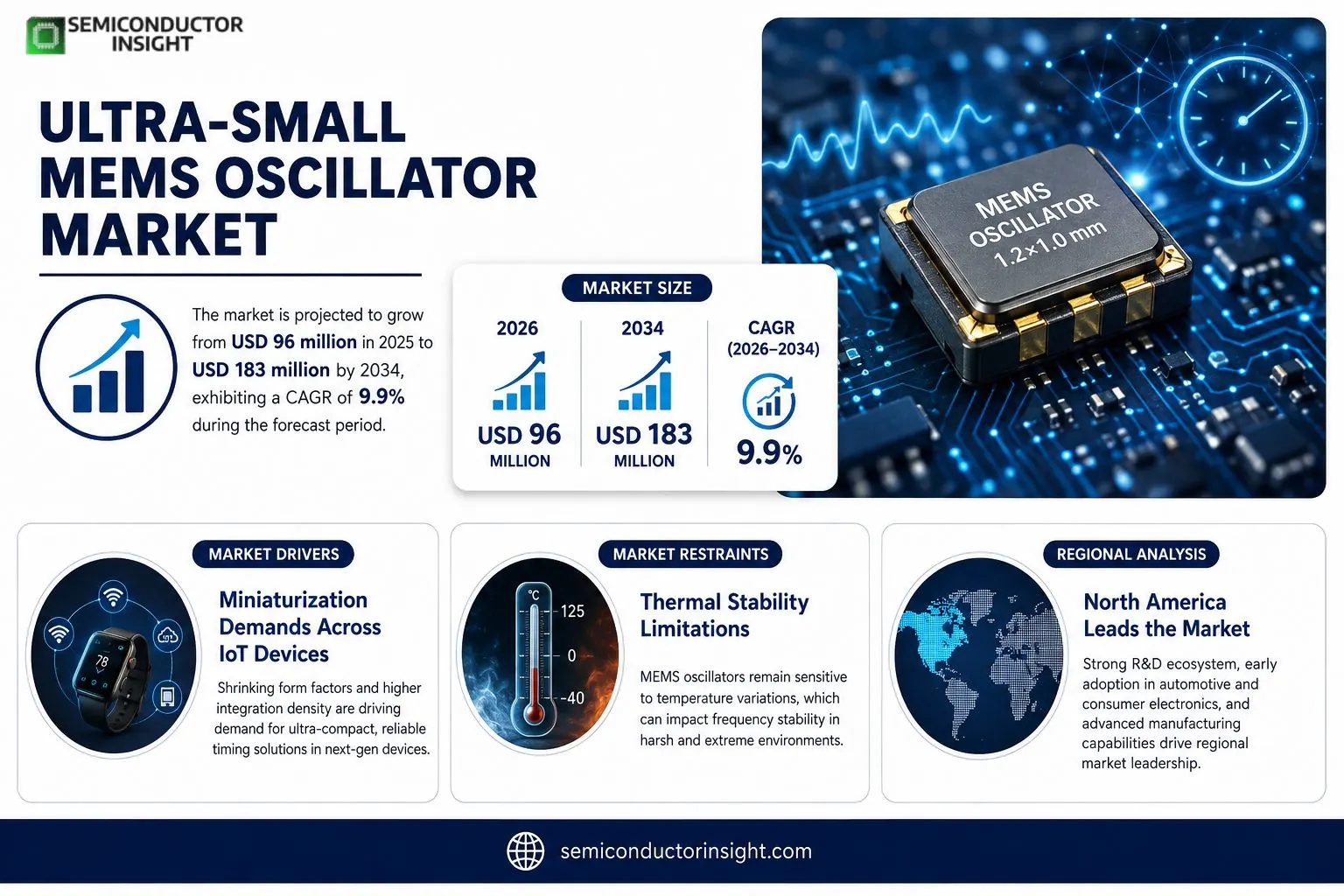
Ultra-Small MEMS Oscillator market was valued at USD 96 million in 2025. The market is projected to grow from USD 96 million in 2025 to USD 183 million by 2034, exhibiting a CAGR of 9.9% during the forecast period.
Ultra‑small MEMS oscillators are highly integrated timing devices that combine a silicon MEMS resonator with CMOS driver circuitry to deliver stable reference clocks from footprints as small as 1.2 × 1.0 mm. They replace conventional quartz crystals where board space, shock resistance, and supply‑chain predictability are criticalexamples include wearables, true‑wireless earbuds, compact smartphone modules, IoT endpoints, automotive electronics, and industrial controllers.The market is gaining momentum because device miniaturization persists across consumer electronics and automotive segments while manufacturers seek more robust timing solutions that tolerate vibration and temperature extremes. Recent activity includes SiTime’s launch of a programmable TCXO family in Q1 2024 and Microchip’s acquisition of a wafer‑level vacuum packaging firm to boost production capacity. Other notable participantsNXP Semiconductors, Murata Manufacturing, Kyocera Corporation and Rakonare expanding their portfolios through new temperature‑compensated offerings and joint development programs aimed at data‑center and high‑speed interconnect applications.
MARKET DRIVERS
Miniaturization Demands Across IoT Devices
Ultra-Small MEMS Oscillator Market is gaining traction as manufacturers of wearable sensors, smart home hubs, and edge‑AI modules require timing components that occupy less than 1 mm². Shrinking form‑factors free up board real estate, enabling higher integration density and lower overall device weightattributes that directly influence product differentiation in crowded consumer segments.
Advances in Manufacturing Yield
Recent refinements in wafer‑scale batch processing have cut per‑unit defect rates by roughly 30 %, allowing suppliers to price ultra‑compact oscillators competitively against traditional crystal solutions. The improved yield translates into tighter price points, which in turn accelerates adoption in cost‑sensitive markets such as mass‑market wearables.
➤ “Yield improvements are the silent catalyst that turns a niche component into a mainstream choice,” notes a senior engineer at a leading MEMS foundry.
Because timing accuracy remains non‑negotiable for wireless protocols, the combination of miniature size and reliable performance positions these oscillators as the preferred choice for next‑generation connectivity, prompting OEMs to redesign product roadmaps around this capability.
MARKET CHALLENGES
Cost Pressures in High‑Volume Production
Even with yield gains, the capital expenditure required for dedicated MEMS fabs stays high, and economies of scale are only realized after substantial run‑lengths. Small‑batch customers often encounter a price premium that rivals crystal‑based alternatives, limiting the market’s ability to penetrate price‑elastic segments.
Other Challenges
Supply Chain Vulnerabilities
The reliance on specialized silicon wafers and proprietary packaging materials creates a bottleneck when semiconductor shortages recur. Any disruption ripples through the oscillator supply chain, compelling OEMs to maintain higher safety stocks.
MARKET RESTRAINTS
Thermal Stability Limitations
Ultra‑small MEMS oscillators exhibit heightened sensitivity to temperature fluctuations, which can degrade frequency stability in harsh environments. While calibration techniques exist, they add design complexity and may not meet the stringent specifications demanded by aerospace or industrial IoT applications.
Regulatory Certification Hurdles
Achieving compliance with FCC, CE, and automotive safety standards often requires extensive testing cycles. The additional certification timeline can delay time‑to‑market, discouraging early‑stage adopters who prioritize rapid product launches.
Design Complexity for System Integration
Integrating a sub‑millimeter oscillator into heterogeneous PCB layouts demands precise layout rules and sophisticated simulation tools. Smaller teams lacking dedicated RF expertise may face steep learning curves, which can increase development costs.
MARKET OPPORTUNITIES
Emerging Wearable and Medical Segments
Health‑monitoring wearables and implantable devices are moving toward continuous data collection, requiring ultra‑low‑power timing cores that do not compromise patient comfort. The minute footprint of MEMS oscillators aligns with the trend toward sub‑cutaneous form factors, opening sizable revenue streams for vendors that can certify biocompatibility.
Automotive Radar Integration
Advanced driver‑assistance systems (ADAS) increasingly rely on high‑frequency radar modules where precise clocking is critical. An oscillator that fits within the constrained radar module envelope can reduce BOM weight and simplify system architecture, making it attractive to Tier‑1 automotive suppliers.
Customizable Frequency Solutions
Clients are requesting frequency‑tunable MEMS oscillators that can be programmed post‑manufacturing, allowing a single part to serve multiple product lines. Firms that develop robust tuning algorithms and secure over‑the‑air update mechanisms will capture a differentiated niche in the broader timing‑device ecosystem.
Ultra-Small MEMS Oscillator Market Trends
Integration‑Driven Timing Platforms
The Ultra‑Small MEMS Oscillator Market is being reshaped by designers who now demand a single timing part that can replace several discrete components. In wearable earbuds, compact smartphones and IoT edge nodes, the footprint advantage of a silicon resonator is no longer sufficient; engineers look for built‑in digital calibration, programmable frequency ranges and voltage‑domain flexibility that simplify board layout. This shift forces manufacturers to expand their product portfolios beyond bare‑metal oscillators, adding on‑chip temperature‑compensation engines and software‑defined configuration registers. Companies that can deliver a calibrated, drop‑in‑compatible part while keeping the average selling price near US$1.20 enjoy margin heads of 20‑30 %, a clear incentive to invest in wafer‑level vacuum packaging and high‑throughput test rigs.
Other Trends
Supply‑Chain Resilience and Dual‑Sourcing
Recent disruptions in quartz crystal supply have prompted OEMs to view MEMS timing as a hedge against component shortages. This perception is driving contracts that bundle multiple MEMS families from a single fab, ensuring continuity of supply for automotive and industrial customers who cannot tolerate lead‑time volatility. The resulting concentration of business among a handful of vertically integrated players creates a competitive environment where depth of portfolio and ability to guarantee long‑term wafer capacity matter more than the nominal size of the package.
Higher‑Stability and Programmable Solutions for Automotive
Automotive electronics are pushing the Ultra‑Small MEMS Oscillator Market toward tighter temperature ranges and stricter functional‑safety certifications. Engineers are demanding MEMS TCXOs that can maintain sub‑ppm stability from –40 °C to 125 °C while supporting on‑the‑fly frequency trimming to meet evolving PHY requirements. Vendors that combine refined compensation models with automated binning achieve the reliability levels needed for infotainment, advanced driver‑assist systems and next‑generation telematics. The commercial payoff appears as larger order volumes and longer‑term supply agreements, encouraging suppliers to lock in wafer‑level processes and to broaden their test‑software suites for automotive‑grade qualification.
COMPETITIVE LANDSCAPE
Key Industry Players
Ultra‑Small MEMS Oscillator Market: Competitive Overview
Microchip Technology dominates the ultra‑small MEMS oscillator segment by leveraging a vertically integrated design‑to‑fab pipeline that couples silicon resonators with proprietary driver ICs. This approach yields a portfolio that spans standard, temperature‑compensated and high‑stability parts, allowing OEMs to consolidate bill‑of‑materials while preserving performance targets for wearables and IoT modules. The company’s scale in wafer‑level vacuum packaging reduces unit cost below $1.30, supporting its ability to capture the majority of the 86 million units shipped in 2025. Competition at the top tier is defined more by calibration depth, frequency‑hopping flexibility and supply‑chain resilience than by raw die size, a shift that rewards firms with mature test automation and diversified fab partnerships.Beyond the leaders, a cluster of specialist manufacturers sharpen the market’s edge. SiTime and NXP Semiconductors each offer programmable frequency‑selection platforms that address the growing demand for software‑defined timing in automotive gateways and data‑center interconnects. Murata and Kyocera focus on hermetically sealed packages optimized for harsh‑environment applications, while smaller outfits such as TXC, Rakon and Abracon provide niche temperature‑compensated devices that cater to legacy quartz replacements in compact smartphones. European players like CTS Corporation and Würth Elektronik add value through customized form‑factor engineering for industrial controllers, whereas Asian firms including Seiko Epson and Nihon Dempa Kogyo maintain a strong foothold in high‑volume consumer electronics through aggressive pricing and deep regional distribution networks.
List of Key Ultra‑Small MEMS Oscillator Companies Profiled
- Microchip Technology Inc.
- SiTime Corporation
- NXP Semiconductors
- Murata Manufacturing Co., Ltd.
- Kyocera Corporation
- TXC Corporation
- Rakon Limited
- Abracon LLC
- Seiko Epson Corporation
- Nihon Dempa Kogyo Co., Ltd.
- onsemi
- Crystek Corporation
- CTS Corporation
- Würth Elektronik eiSos
- Skyworks Solutions
Segment Analysis:
| Segment Category | Sub-Segments | Key Insights |
| By Type |
|
Temperature‑Compensated MEMS Oscillator is emerging as the dominant type because it blends miniaturization with robust temperature performance.
|
| By Application |
|
Wearable electronics lead this application segment due to relentless device miniaturization and the need for shock‑resistant timing.
|
| By End User |
|
Consumer device OEMs dominate because they prioritize ultra‑compact, cost‑effective timing solutions while maintaining acceptable performance.
|
| By Technology |
|
Wafer‑level vacuum packaging is the technology cornerstone, providing the environmental protection needed for ultra‑small form factors.
|
| By Performance Tier |
|
High‑Stability tier attracts markets where jitter and aging are critical, such as automotive safety systems and high‑speed data‑center modules.
|
Regional Analysis: Ultra-Small MEMS Oscillator Market
North America
Federal communications authorities have issued tighter phase‑noise limits for 5G millimeter‑wave modules, prompting manufacturers to adopt ultra‑small MEMS oscillators that meet spectral purity requirements while preserving board space. Certification pathways now prioritize devices that demonstrate temperature‑compensated stability, encouraging suppliers to embed calibration routines directly into silicon.
Recent disruptions in wafer‑fab capacity have led companies to diversify sourcing across multiple foundries, mitigating risk of single‑point failures. Inventory strategies emphasize safety stock of key micro‑machined components, and partnerships with specialized packaging firms ensure timely delivery of hermetically sealed modules.
Device makers in the automotive and aerospace sectors are increasingly specifying ultra‑small MEMS oscillators for timing‑critical subsystems, attracted by the combination of reduced mass and improved shock resistance. These applications benefit from the ability to embed the oscillator directly onto printed‑circuit boards, eliminating the need for separate housings.
Established semiconductor giants are leveraging legacy lithography lines to produce cost‑effective MEMS solutions, while niche players focus on differentiated packaging and ultra‑low‑power operation. The competitive mix forces continuous innovation and price pressure across the market.
Europe
European manufacturers are capitalizing on stringent automotive safety directives that require reliable timing sources for advanced driver‑assistance systems. Local chip designers are integrating ultra‑small MEMS oscillators into modular platforms that serve both passenger‑vehicle and commercial‑fleet segments. Collaboration between research institutes and automotive consortia accelerates standardization, helping suppliers align product specifications with emerging functional‑safety standards. The result is a growing preference for MEMS timing solutions that can endure the thermal cycles typical of vehicular environments, providing a distinct edge over legacy quartz components.
Asia‑Pacific
In the Asia‑Pacific corridor, rapid consumer‑device turnover fuels demand for compact timing modules that can be mass‑produced at scale. Foundries in Taiwan and Singapore have refined nano‑imprint techniques, lowering per‑unit cost and enabling manufacturers to embed ultra‑small MEMS oscillators within ultra‑thin smartphones and wearable gadgets. Simultaneously, regional governments are channeling subsidies toward nano‑electronics research, encouraging start‑ups to pursue innovations such as on‑chip temperature compensation. This convergence of manufacturing efficiency and policy support positions the region as a burgeoning source of volume‑driven growth for the market.
South America
South American markets are experiencing a gradual shift as telecom operators upgrade infrastructure to support IoT deployments in smart‑city projects. The requirement for densely packed sensor nodes with reliable timing has opened opportunities for ultra‑small MEMS oscillators that balance performance with affordability. Local distributors are forming alliances with North‑American vendors to import calibrated devices, while regional engineering firms adapt designs to meet tropical humidity standards, ensuring long‑term reliability in harsh climates.
Middle East & Africa
The Middle East & Africa region is witnessing early adoption of ultra‑small MEMS oscillators within defense and satellite communication programs. Harsh desert temperatures and dust exposure demand timing components that retain precision without extensive shielding, a niche where MEMS technology excels. Partnerships between regional aerospace agencies and semiconductor firms facilitate technology transfer, allowing local manufacturers to embed native MEMS solutions into satellite payloads and ground‑station equipment, thereby reducing reliance on imported legacy timing parts.
Report Scope
This market research report provides a comprehensive analysis of the Ultra-Small MEMS Oscillator Market , covering the forecast period 2026–2034. It offers detailed insights into market dynamics, technological advancements, competitive landscape, and key trends shaping the industry.
Key focus areas of the report include:
- Market Overview: The report begins with an overview outlining its current market scenario, key growth indicators, and industry transformation drivers. It discusses macroeconomic factors, demand–supply balance, regulatory landscape, and the strategic role of semiconductors in powering advancements across industries such as automotive, telecommunications, consumer electronics, and industrial automation.
- Market Size & Forecast: Historical data and future projections for revenue, unit shipments, and market value across major regions and segments.
- Segmentation Analysis: Detailed breakdown by product type, technology, application, and end-user industry to identify high-growth segments and investment opportunities.
- Regional Insights: Insights into market performance across North America, Europe, Asia-Pacific, Latin America, and the Middle East & Africa, including country-level analysis where relevant.
- Competitive Landscape: Profiles of leading market participants, including their product offerings, R&D focus, manufacturing capacity, pricing strategies, and recent developments such as mergers, acquisitions, and partnerships.
- Technology Trends & Innovation: Assessment of emerging technologies, integration of AI/IoT, semiconductor design trends, fabrication techniques, and evolving industry standards.
- Market Drivers & Restraints: Evaluation of factors driving market growth along with challenges, supply chain constraints, regulatory issues, and market-entry barriers.
- Stakeholder Insights: Insights for component suppliers, OEMs, system integrators, investors, and policymakers regarding the evolving ecosystem and strategic opportunities.
Primary and secondary research methods are employed, including interviews with industry experts, data from verified sources, and real-time market intelligence to ensure the accuracy and reliability of the insights presented.
FREQUENTLY ASKED QUESTIONS:
What is the current market size of Ultra-Small MEMS Oscillator Market?
-> Ultra-Small MEMS Oscillator Market was valued at USD 96 million in 2025 and is expected to reach USD 183 million by 2034, at a CAGR of 9.9% during the forecast period.
Which key companies operate in Ultra-Small MEMS Oscillator Market?
-> Key players include Microchip Technology Inc., SiTime, NXP Semiconductors, Seiko Epson Corporation, Murata Manufacturing, Kyocera Corporation, TXC Corporation, Nihon Dempa Kogyo, onsemi, Rakon, Abracon LLC, Taitien Electronics, Crystek Corporation, CTS Corporation, Skyworks Solutions, Renesas Electronics Corporation, Würth Elektronik eiSos, among others.
What are the key growth drivers?
-> Key growth drivers include continued device miniaturization, rising demand for mechanical and environmental robustness, and heightened focus on supply‑chain resilience and second‑source strategies.
Which region dominates the market?
-> Asia-Pacific is the fastest‑growing region, while Europe remains a dominant market.
What are the emerging trends?
-> Emerging trends include smaller footprints, stronger programmability, higher‑stability tiers, and increased integration of MEMS timing into automotive and industrial safety‑critical applications.
Get Sample Report PDF for Exclusive Insights
Report Sample Includes
- Table of Contents
- List of Tables & Figures
- Charts, Research Methodology, and more...
 Download Sample Report PDF