Crystal Oscillator Market Insights
Crystal Oscillator market size was valued at USD 3533 million in 2026 to USD 6542 million by 2034, exhibiting a CAGR of 9.2% during the forecast period.
Crystals and oscillators are core components within electronic systems for generating stable frequency signals. Their fundamental principle relies on the piezoelectric effect of quartz crystals: an applied electric field induces mechanical vibrations, while those vibrations generate an electric field, enabling high‑precision frequency references.The market expands because demand for high‑frequency communications, automotive electronics and AI‑driven computing continues to rise. Technological advances such as GaN‑based oscillators delivering a 450‑fold power‑density boost above 60 GHz, Epson’s miniaturised OCXO (OG7050CAN) that cuts volume by 85 % and power consumption to 0.2 W, and AI‑controlled OCXOs from Saisi Technology reducing phase noise to –123.5 dBc@1 Hz illustrate innovation pressure. Key players actively shaping the landscape include Epson Corp., SiTime Inc., TXC Corporation, NDK Ltd., Murata Manufacturing Co., Microchip Technology Inc., and Rakon Limited.
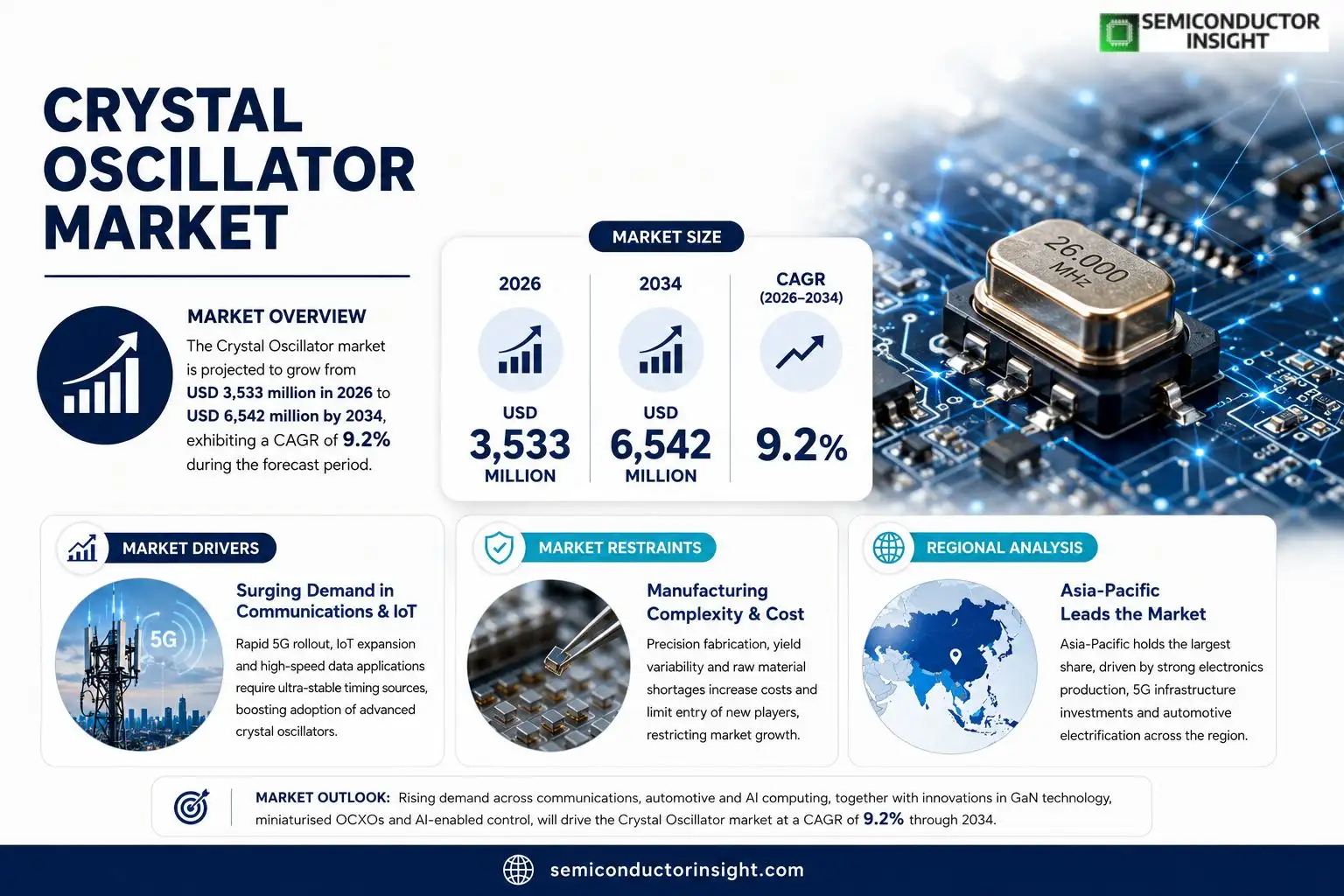
MARKET DRIVERS
Technology Adoption in Consumer Electronics
The surge in premium smartphones, wearables, and IoT devices has heightened the demand for ultra‑stable timing sources. Manufacturers are opting for crystal oscillators because they deliver the frequency accuracy needed for high‑speed data processing while keeping bill of material costs manageable. This shift directly fuels growth in the Crystal Oscillator Market.
Regulatory Push for Precision Timing
Governments and standards bodies across North America and Europe are tightening specifications for electromagnetic compatibility and spectrum efficiency. Compliance requires timing components that can maintain tight tolerances under varying environmental conditions, prompting equipment makers to integrate higher‑grade crystal devices. The regulatory environment therefore acts as a catalyst for market expansion.
➤ “The convergence of consumer‑grade performance expectations and stricter timing regulations is reshaping supplier portfolios.”
Design houses are increasingly collaborating with oscillator suppliers early in the product development cycle. This collaborative approach reduces time‑to‑market and allows for customization that aligns with both performance targets and cost constraints, reinforcing the upward trajectory of the Crystal Oscillator Market.
MARKET CHALLENGES
Supply Chain Volatility
Raw‑material shortages, particularly for high‑purity quartz, have introduced lead‑time uncertainty for many manufacturers. When inventory buffers shrink, OEMs face the risk of production delays, which can erode margins and force substitution with less optimal timing solutions.
Other Challenges
Cost Sensitivity
End‑user pricing pressure forces component suppliers to compress margins. While advanced packaging and tuning techniques add value, they also elevate production expense, creating a tension between performance gains and price competitiveness.
MARKET RESTRAINTS
Manufacturing Complexity
Fabricating crystal resonators at sub‑micron tolerances requires specialized equipment and rigorous quality‑control protocols. The capital intensity of such facilities limits the entry of new players, preserving the market share of established manufacturers.Yield variability across production batches can lead to re‑work cycles that inflate unit costs, discouraging smaller OEMs from adopting the latest oscillator specifications.Furthermore, the need for frequent recalibration in harsh environments raises after‑sales service requirements, adding another layer of operational restraint.
MARKET OPPORTUNITIES
Emerging 5G Infrastructure
Roll‑out of 5G networks introduces a new class of base‑station equipment that relies on ultra‑low‑phase‑noise oscillators for carrier aggregation and beamforming. Suppliers that can deliver crystal solutions with tighter jitter specifications stand to capture a sizable share of this expanding segment.In parallel, the automotive sector’s transition to autonomous driving platforms calls for robust timing modules that can survive temperature extremes while maintaining precision. This creates a cross‑industry niche where performance and reliability are paramount.Finally, the convergence of edge computing and AI workloads at the device level requires synchronized clock distribution across heterogeneous processors. Crystal oscillators that integrate seamlessly with system‑in‑package architectures represent a lucrative avenue for differentiation.
Crystal Oscillator Market Trends
Material Innovations Driving High‑Frequency Performance
GaN‑based crystal oscillators have begun to dominate the high‑frequency segment, delivering power density that surpasses conventional quartz devices by several hundred times at frequencies above 60 GHz. The Stanford University GaN IMPATT oscillator, already integrated into millimetre‑wave communication links, illustrates how this material shift reduces size while boosting signal integrity. For manufacturers, the ability to supply components that meet the stringent thermal and phase‑noise requirements of 5G and emerging 6G backhaul networks translates into premium pricing opportunities and a defensive barrier against commoditized silicon alternatives. As the demand for high‑frequency modules climbs, the overall Crystal Oscillator Market is seeing a reallocation of revenue toward premium GaN offerings, while volume‑driven segments face pricing pressure.
Other Trends
Miniaturization through Integrated OCXO Designs
Epson’s OCXO OG7050CAN employs SC‑cut crystal units that shrink module volume by roughly 85 % and cut power draw to 0.2 W. The design leverages an integrated temperature‑compensation architecture, allowing a continuous output range from 1 MHz to 170 MHz without external circuitry. Customers in automotive infotainment and portable test equipment benefit from lower board space and extended battery life, prompting a shift in procurement specifications toward compact, low‑power units.
Intelligent Oscillation Management via Machine Learning
Recent deployments of AI‑based control loops, exemplified by Saisi Technology’s OCXO that uses machine‑learning models to lower phase‑noise to –123.5 dBc/Hz at 1 Hz offset, indicate a move toward self‑optimising oscillators. By continuously adjusting bias and load conditions, these devices maintain performance across temperature extremes, a capability prized in aerospace and edge‑computing environments. The emergence of such smart oscillators is likely to reshape supplier‑buyer negotiations, as end users demand firmware updates and data analytics services alongside the hardware, creating an ancillary revenue stream for firms that can integrate software expertise with precision crystal engineering. Consequently, companies that have already invested in AI‑ready platforms are positioned to capture a larger share of the Crystal Oscillator Market as customers migrate to predictive maintenance models.
COMPETITIVE LANDSCAPEKey Industry Players
Crystal Oscillator Market – Competitive Overview
The arena is dominated by a handful of firms that couple deep patent portfolios with high‑volume manufacturing. TXC Corporation and Murata Manufacturing command the bulk of mid‑range TCXO supply, leveraging cost‑effective silicon processing in Taiwan and Japan respectively. In the premium OCXO segment, Seiko Epson Corp. and SiTime differentiate through ultra‑low phase‑noise designs and integrated MEMS modules, enabling them to capture automotive‑grade and aerospace contracts. Microchip’s acquisition of IoT‑focused oscillator lines illustrates how diversified semiconductor players are expanding their timing‑module offerings to meet the surge in connected‑device demand. Collectively, these leaders shape pricing trends, set performance benchmarks, and steer the standard‑setting bodies that govern frequency‑control specifications.Beyond the headline names, a cluster of specialized manufacturers sustains a vibrant niche ecosystem. NDK and KCD focus on high‑frequency crystal units for telecommunications, while KDS supplies custom‑cut SC‑crystals for defense applications. Companies such as TKD Science, Hosonic Electronic, and Harmony provide low‑cost TCXOs for consumer gadgets, often acting as second‑tier suppliers to OEMs. Regional champions like Guoxin Micro and Zhejiang East Crystal dominate the Chinese mass‑production market, exploiting scale advantages to serve commodity‑grade segments. Smaller innovators—including Failong Crystal Technologies, Micro Crystal, Siward Crystal Technology, Rakon, Taitien, River Eletec Corporation, and others—pursue differentiated material science or packaging approaches, carving out loyal customer bases in niche verticals.
List of Key Crystal Oscillator Companies Profiled
- TXC Corporation
- Murata Manufacturing
- Seiko Epson Corp
- SiTime
- Microchip Technology
- NDK
- KCD
- KDS
- TKD Science
- Hosonic Electronic
- Harmony
- Failong Crystal Technologies
- Micro Crystal
- Siward Crystal Technology
- Rakon
- Taitien
- River Eletec Corporation
- Guoxin Micro
- Zhejiang East Crystal
Segment Analysis:
| Segment Category | Sub-Segments | Key Insights |
| By Type |
|
OCXO remains the premium choice for applications demanding ultra‑stable frequency references. Its superior thermal management and low phase‑noise characteristics make it indispensable for aerospace, defense, and high‑precision instrumentation.
|
| By Application |
|
Communications drives the most dynamic demand for crystal oscillators, especially as networks migrate to higher frequencies and tighter phase‑noise budgets.
|
| By End User |
|
Telecom Infrastructure is the leading end‑user segment, where network reliability hinges on precise timing.
|
| By Technology |
|
GaN‑based Oscillators are reshaping high‑frequency markets through exceptional power density and thermal performance.
|
| By Market Trend |
|
AI‑Enabled Adaptive Control is emerging as a pivotal trend, embedding machine‑learning algorithms directly within oscillator firmware.
|
Regional Analysis: Crystal Oscillator Market
Asia‑Pacific
Consumer wearables, automotive safety systems, and 5G base stations each call for tighter frequency stability, steering designers toward higher‑performance crystal oscillators. The appetite for miniaturization further narrows the viable design space, rewarding vendors that can deliver sub‑millimeter packages without compromising phase noise.
Emission standards and electromagnetic compatibility requirements in key APAC economies compel component suppliers to meet stringent test protocols. Compliance investments are becoming a prerequisite for market entry, especially for automotive and aerospace applications where certification timelines dictate product roadmaps.
The region’s vertically integrated wafer fabs and assembly houses mitigate material shortages that have hampered other markets. However, heightened reliance on rare‑earth metals introduces a secondary risk, prompting firms to explore alternative substrate technologies to safeguard continuity.
Legacy players are augmenting their portfolios with AI‑driven design tools, while a wave of niche entrants leverages advanced MEMS processes. The competitive calculus now hinges on the ability to co‑develop with end‑users, shortening validation loops and embedding unique frequency‑control algorithms.
North America
North America retains a sophisticated end‑user base that prizes reliability and long‑term support. The region’s emphasis on aerospace and defense drives specifications that exceed commercial thresholds, creating a premium segment where price elasticity is limited. Partnerships between semiconductor foundries and system integrators foster a collaborative environment, yet escalating labor costs are nudging some design activities offshore. Companies that can offer extended warranty programs and robust field‑service networks will likely capture a larger share of these high‑value contracts.
Europe
European markets are shaped by stringent environmental directives and a strong focus on energy efficiency. Manufacturers are compelled to adopt low‑power crystal oscillators for IoT deployments in smart cities, where battery longevity is a regulatory consideration. The region’s fragmented supply chain, spread across Germany, France, and the UK, encourages cross‑border collaborations, but Brexit‑related trade adjustments add a layer of complexity for firms negotiating component sourcing.
South America
In South America, the Crystal Oscillator Market is influenced by growing telecommunications infrastructure and a nascent automotive electronics sector. While the overall market size lags behind the leading regions, localized production incentives have attracted a handful of niche suppliers. Market participants must navigate currency volatility and import‑tax regimes, which can erode margin unless price‑optimization strategies are embedded early in the sales cycle.
Middle East & Africa
The Middle East & Africa region is witnessing a gradual rise in demand due to expanding data‑center footprints and defence modernization programs. Investment in aerospace testing facilities is prompting a selective uptake of high‑precision oscillators, while the broader African market remains driven by consumer electronics growth. Infrastructure constraints and limited local component manufacturers mean that many projects rely on imports, underscoring the importance of reliable logistics partners.
Report Scope
This market research report provides a comprehensive analysis of the Crystal Oscillator Market , covering the forecast period 2026–2034. It offers detailed insights into market dynamics, technological advancements, competitive landscape, and key trends shaping the industry.
Key focus areas of the report include:
- Market Overview: The report begins with an overview outlining its current market scenario, key growth indicators, and industry transformation drivers. It discusses macroeconomic factors, demand–supply balance, regulatory landscape, and the strategic role of semiconductors in powering advancements across industries such as automotive, telecommunications, consumer electronics, and industrial automation.
- Market Size & Forecast: Historical data and future projections for revenue, unit shipments, and market value across major regions and segments.
- Segmentation Analysis: Detailed breakdown by product type, technology, application, and end-user industry to identify high-growth segments and investment opportunities.
- Regional Insights: Insights into market performance across North America, Europe, Asia-Pacific, Latin America, and the Middle East & Africa, including country-level analysis where relevant.
- Competitive Landscape: Profiles of leading market participants, including their product offerings, R&D focus, manufacturing capacity, pricing strategies, and recent developments such as mergers, acquisitions, and partnerships.
- Technology Trends & Innovation: Assessment of emerging technologies, integration of AI/IoT, semiconductor design trends, fabrication techniques, and evolving industry standards.
- Market Drivers & Restraints: Evaluation of factors driving market growth along with challenges, supply chain constraints, regulatory issues, and market-entry barriers.
- Stakeholder Insights: Insights for component suppliers, OEMs, system integrators, investors, and policymakers regarding the evolving ecosystem and strategic opportunities.
Primary and secondary research methods are employed, including interviews with industry experts, data from verified sources, and real-time market intelligence to ensure the accuracy and reliability of the insights presented.
FREQUENTLY ASKED QUESTIONS:
What is the current market size of Crystal Oscillator Market?
-> Crystal Oscillator Market was valued at USD 3533 million in 2026 and is expected to reach USD 6542 million by 2034, growing at a CAGR of 9.2%.
Which key companies operate in Crystal Oscillator Market?
-> Key players include TXC Corporation, NDK, Seiko Epson Corp, KCD, KDS, SiTime, Microchip, TKD Science, Hosonic Electronic, Harmony, Murata Manufacturing, Failong Crystal Technologies, Micro Crystal, Siward Crystal Technology, Rakon, Taitien, River Eletec Corporation, Guoxin Micro, ZheJiang East Crystal.
What are the key growth drivers?
-> Key growth drivers include rising demand in communications (35% of market), automotive (28%), AI computing (18%), adoption of GaN crystal technology, miniaturised OCXOs and AI‑enabled oscillator control.
Which region dominates the market?
-> Asia dominates the market, propelled by China’s extensive production capacity, while Europe and the United States lead high‑end OCXO segments.
What are the emerging trends?
-> Emerging trends include GaN crystal oscillators with 450‑fold power‑density increase, ultra‑compact SC‑cut OCXOs, and AI‑driven phase‑noise reduction technologies.
Get Sample Report PDF for Exclusive Insights
Report Sample Includes
- Table of Contents
- List of Tables & Figures
- Charts, Research Methodology, and more...
 Download Sample Report PDF