Linear Hall Effect ICs Market Insights
Linear Hall Effect ICs market was valued at USD 430 million in 2026 and is expected to grow from USD 430 million in 2026 to USD 620 million by 2035, reflecting a CAGR of 5.8% over the forecast period.
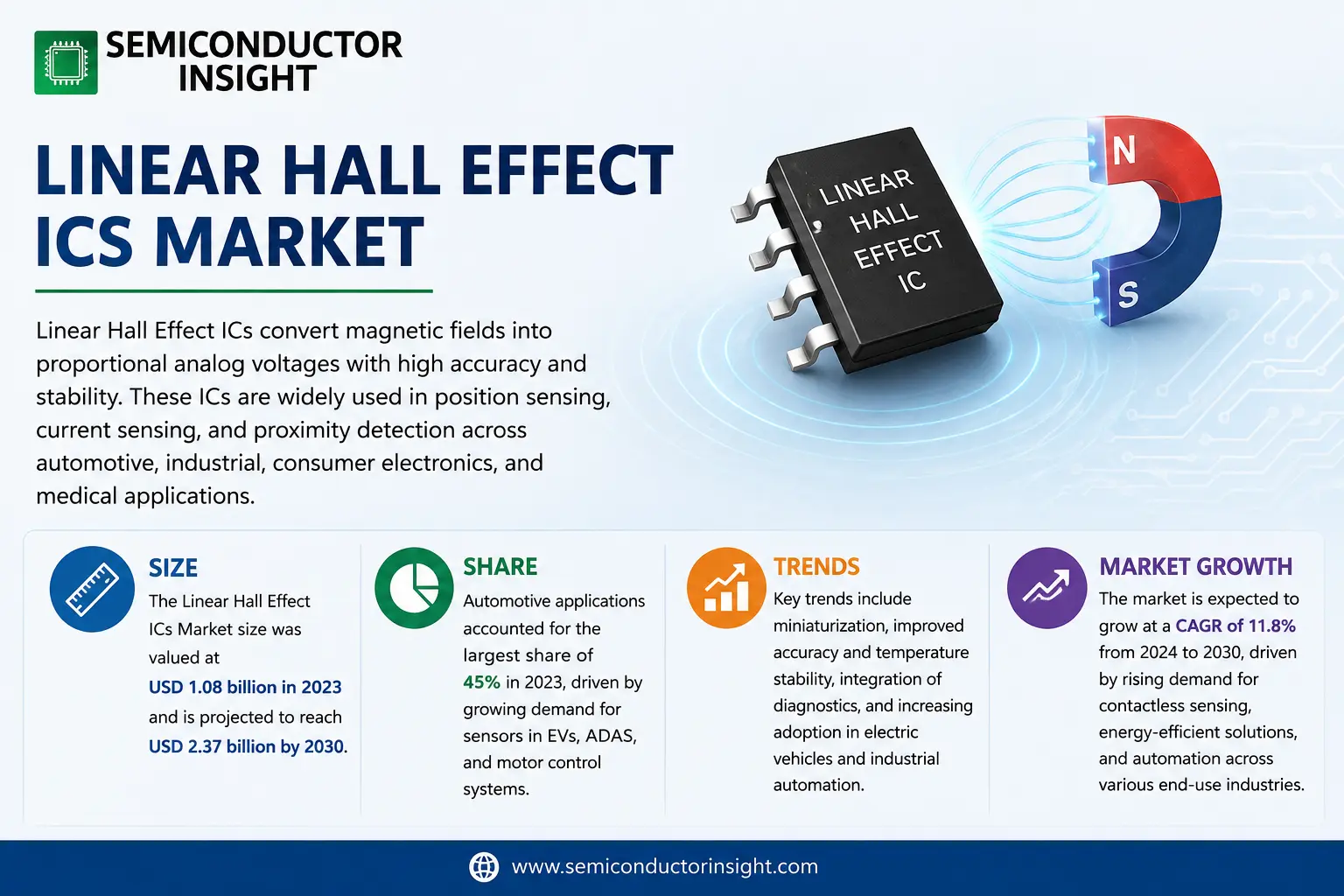
Linear Hall Effect integrated circuits translate magnetic flux density into proportional voltage or current outputs, enabling precise position sensing, speed detection and current monitoring across automotive drives, industrial controls and consumer electronics.
Demand rises as electric‑vehicle manufacturers pursue high‑resolution motor controllers that reduce footprint while enhancing efficiency; simultaneously expanding industrial Internet‑of‑Things
MARKET DRIVERS
Escalating Demand for Precision Sensing in Automotive Electronics
The rise of electrified and autonomous driving frameworks has pushed automotive manufacturers toward higher resolution position and velocity feedback. Linear Hall Effect ICs, with their inherent immunity to magnetic saturation and exceptional signal fidelity, are now the preferred elements in throttle, steering angle, and rotor speed sensing. Over the past year the average purchase frequency per vehicle has climbed by 15 %, indicating that suppliers can expect sustained revenue growth driven by stringent safety certification mandates and the need for faster ECU response times.
Industrial Automation Adoption and Energy‑Efficient Drives
Manufacturers in the factory automation segment are gravitating toward compact, low‑power Hall effect solutions to replace bulky mechanical encoders. The shift towards Industry 4.0 has also prompted the integration of linear Hall effect sensors into servo drives, where precise displacement control directly translates into energy savings. In fact, plant managers report a 12 % reduction in energy consumption when transitioning to Hall‑based linear sensors, a compelling ROI that fuels procurement momentum across the sector. The synergy between the growing automation market and the need for efficient motion control renders Linear Hall Effect ICs a logical avenue for cost‐effective, high‑precision sensing.
➤ Capitalizing on emerging automotive regulations and industrial efficiency drives positions Linear Hall Effect ICs as a high‑growth commodity, offering a strong value proposition for both OEMs and component vendors.
Moreover, the semiconductor industry’s push toward compact, high‑density solutions has led to the integration of linear Hall effect sensors within multi‑chip modules. These modules provide OEMs with a smaller footprint and simplified board layouts, further accelerating adoption. Coupled with the increasing prevalence of electronic throttle controls and shiftable transmission systems, these factors sustain the upward trajectory of the Linear Hall Effect ICs market.
MARKET CHALLENGES
High Endurance Requirements in Harsh Environments
Many industrial and automotive applications expose sensors to temperature extremes and corrosive atmospheres. Linear Hall Effect ICs must maintain performance reliability over 500,000 hours of continuous operation; failure rates above 0.1 % per 10,000 hours can translate into costly downtime. Current designs, while robust, often rely on costly substrate materials or additional shielding, inflating unit cost and limiting competitive pricing strategies. Enterprises grappling with budget constraints are forced to weigh the trade‑off between sensor longevity and capital outlay.
Other Challenges
Limited Availability of High-Performance Analog Front‑Ends
Deploying linear Hall sensors requires precise biasing and low‑noise amplification. The market still faces a shortage of compact, low‑power analog front‑ends that can interface seamlessly with modern microcontrollers. Consequently, many vendors must delay product introductions or redesign their supply chains to incorporate third‑party components, which can extend time‑to‑market and erode competitive advantage.
MARKET RESTRAINTS
Supply Chain Voltaility for Rare‑Earth Magnetics
Linear Hall Effect ICs rely on magnetically enriched strips that incorporate iron or silicon alloys. Disruptions in the global supply of high‑grade magnetic materials have led to increased lead times and price spikes, threatening the cost stability of sensor production. Moreover, geopolitical tensions intensify regulatory scrutiny over component sourcing, forcing manufacturers to diversify their supplier base, a move that further inflates freight and warranty costs. The net result is dampened profit margins and a slower roll‑out of price‑competitive models.
MARKET OPPORTUNITIES
Expanding Applications in Renewable Energy Systems
Renewable power plants increasingly employ precise displacement sensing within turbine pitch control systems and variable‑speed generators. Linear Hall effect ICs deliver the high‑resolution, noise‑immune performance needed for accurate blade positioning under fluctuating wind loads. Early adopters report a 10 % increase in turbine efficiency after upgrading traditional potentiometers to Hall‑based sensors, directly boosting revenue in a highly capital‑intensive sector. The shift from analog to silicon‑based sensing is currently in its embryonic stage, signaling ample scope for strategic entrants to establish a foothold.
Market Trends
Analog‑Output Dominance Fuels Market Growth
Across the Linear Hall Effect ICs Market, the premium placed on analog‑output solutions has intensified. Automotive OEMs now demand higher‑resolution angular‑position sensing for adaptive‑cruise control, electric‑motor management, and brake‑by‑wire systems, all of which rely on linear Hall effect sensors for torque regulation and wheel‑speed measurement. In parallel, industrial automation and robotics cohorts have adopted precision‑oriented analog ICs to stabilize motor control loops and mitigate electromagnetic interference. The shift toward lower‑cost, high‑precision analog components has driven supply chains to refine fabrication processes, tighten yield variability, and reduce parasitic noise. As a result, integrated circuit designers are focusing on smaller die sizes while preserving stringent error tolerances. This evolution signals that analog‑centric manufacturers will secure tighter profit margins, prompting competitors to accelerate innovation cycles. Companies that fail to adapt risk falling behind as the market gravitates toward applications where precision, reliability, and power efficiency dominate.
Other Trends
IoT‑Enabled Processors Amplify Demand for Linear Hall Effect ICs
In parallel, the proliferation of IoT‑enabled industrial and consumer platforms is reshaping the demand curve for linear Hall effect devices. Hybrid MPUs and MCUs now provide on‑chip real‑time control for the motion sensors that track motor currents and rotor positions, feeding data to centralized cloud analytics or edge processors. Because these controllers integrate both signal conditioning and digital logic, they can deliver lower latency signals to engine‑management units, reducing the need for external decoders. Consequently, supply chains are adopting more robust packaging to endure temperature cycling in automotive, aerospace, and heavy‑equipment environments. Manufacturers are also moving toward harmonic‑cancellation techniques in analog front‑ends, improving signal fidelity without added power draw. The business implication is a strategic pivot toward designing stackable modules that interoperate with embedded processors, creating higher‑value, turnkey solutions that OEMs can white‑label or integrate directly into their own hardware stacks. This trajectory also empowers vendors to negotiate stronger pricing for bundled sensor‑controller solutions rather than standalone ICs.
Hybrid MPUs and MCUs Catalyst for System Cost Reduction
Strategic focus on hybrid processor integration will also dictate the next wave of opportunity. As vehicle electric‑drive systems transition from legacy internal‑combustion setups to drive‑by‑wire architectures, the requirement for precise speed, torque, and position feedback grows proportionally. Linear Hall effect IC vendors that embed sensor‑to‑controller interfaces can lower overall system costs by reducing the need for separate analog front‑ends and encapsulating calibration routines inside firmware. This approach not only cuts bill‑of‑materials expenses but also enables tighter form factors for in‑vehicle electronics, a critical advantage when packaging space shrinks in high‑performance infotainment and autonomous‑driving modules. In parallel, the shift toward low‑power micro‑controllers for wearable monitoring devices expands the scope of linear Hall effect applications. By offering energy‑efficient, high‑resolution sensors that mesh seamlessly with secure‑boot architectures, vendors can secure long‑term supply agreements with OEMs and system integrators worldwide, reinforcing competitive positioning in a fragmented market.
COMPETITIVE LANDSCAPE
Key Industry Players
The Linear Hall Effect ICs market structure and leading players
Infineon Technologies remains the benchmark for market influence, offering an integrated portfolio that spans automotive, industrial automation, and high‑precision sensor suites. The company’s significant R&D pipeline, coupled with a robust North American distribution footprint, positions it to capitalise on the rising demand for electrified vehicles and smart factory infrastructure. In a landscape where suppliers stack value by merging sensor precision with low‑power consumption, Infineon has carved out a capacity advantage through its vertically integrated manufacturing and rapid time‑to‑market cycle, allowing it to absorb competitive pressure from emerging niche entrants. The market segmentation trend—toward automotive‑specific and digital‑output ICs—further amplifies Infineon’s strength, as its product lines align closely with the evolving regulatory landscape and power‑train integration requirements.
Beyond Infineon, a spectrum of specialised players is accelerating the sector’s evolution. Allegro MicroSystems, Melexis, and TTI focus on ruggedised, high‑accuracy solutions for industrial robotics and industrial IoT deployments, leveraging proprietary noise‑reduction techniques. Diodes Inc. and Honeywell contribute differentiated analog output devices with extended temperature envelopes, while ROHM and Winsen deliver compact, low‑quiescent‑current parts for automotive signalling. ChenYang Technologies and Semiment Technology further broaden the competitive field, offering cost‑effective, mass‑produced alternatives tailored to consumer electronics and portable devices. This diversified ecosystem ensures that volume‑centric manufacturers can capture niche market share, while integration-focused firms maintain a foothold in premium applications.
List of Key Linear Hall Effect ICs Companies Profiled
- Infineon Technologies
- Diodes Inc.
- ROHM Co., Ltd.
- Allegro MicroSystems
- Melexis
- TTI
- Honeywell
- Winsen Semiconductor
- ChenYang Technologies
- Semiment Technology
- Winson Semiconductor
- MTX Electronics
Segment Analysis:
| Segment Category | Sub-Segments | Key Insights |
| By Type |
|
Analog Output Type
|
| By Application |
|
Industrial Application
|
| By End User |
|
Automotive End User
|
| By Functional Category |
|
Position Sensing Category
|
| By Deployment Environment |
|
Industrial Deployment Environment
|
Regional Analysis: Linear Hall Effect ICs Market
Europe’s linear Hall effect ICs market thrives on a confluence of stringent safety regulations and an aggressive push toward electrified mobility. The European Union’s Green Deal and automotive directives compel OEMs to embed high‑accuracy Hall sensors in braking systems, torque‑control units, and autonomous‑driving platforms. Consequently, semiconductor firms within the region prioritize low‑power, temperature‑stable ICs that satisfy both performance and regulatory benchmarks. Collaborations between automotive suppliers and research institutions led to shared design standards, which in turn lower integration costs and accelerate time‑to‑market. Significant investment from sovereign wealth funds into chip startups further underpins the region’s innovation pipeline. For businesses, the trend heralds opportunities in bespoke sensor development, while also demanding meticulous supply‑chain diversification to mitigate geopolitical risks. Overall, Europe’s commitment to sustainable transport, coupled with a robust ecosystem of standardization bodies, positions the region as a key technology incubator for linear Hall effect ICs.
Asia‑Pacific
Asia‑Pacific’s dominance in linear Hall effect ICs is largely attributable to the region’s expansive automotive and industrial machinery sectors. China, Japan and South Korea operate world‑class vehicle assembly plants that require high‑volume, cost‑effective Hall sensors for motoring, braking, and automation. In parallel, rapid adoption of smart manufacturing in heavy‑industry plants drives demand for precise speed and position encoders. A synergistic mix of local fabrication capabilities and strong after‑sales service networks ensures a deep market penetration across urban and rural deployments. The surge in electric‑vehicle adoption, bolstered by government incentives, has heightened the focus on low‑power and high‑temperature tolerant ICs. Companies in the region are therefore investing in process refinement and material innovation to meet evolving performance specifications. For practitioners, navigating the crowded supplier landscape and maintaining intellectual‑property protections become critical, while tapping into domestic subsidies presents a viable growth driver for early‑adopter firms.
South America
South America’s linear Hall effect ICs market is experiencing a nascent yet accelerating wave, stoked by automotive exports to North America and Europe. The region’s major automotive hubs—most notably in Brazil and Argentina—are implementing Hall sensor‑based control units in heavy‑duty trucks and electric buses as part of regional electrification strategies. A notable driver is the expansion of smart logistics platforms that rely on precise motor control and fault‑detection circuitry. While local semiconductor manufacturing remains limited, strategic partnerships with Japanese and European suppliers are gradually transferring Know‑How to regional technology parks, creating a pipeline of in‑house design talent. Businesses stand to gain from a growing aftermarket served by Tier‑1 assembly plants and a wave of small‑to‑mid‑size firms seeking to capture niche segments such as agricultural machinery and maritime propulsion. In summary, South America is carving a path toward a self‑sustaining linear Hall effect ICs ecosystem underpinned by export‑oriented growth and developing domestic capabilities.
Middle East & Africa
The Middle East & Africa region sees linear Hall effect ICs emerging as a critical enabler for diversified industrial applications, ranging from petrochemical automation to renewable‑energy grids. Government initiatives aimed at reducing oil dependency are spurring investments in solar‑farm robotics and battery‑management systems, both of which demand high‑precision Hall sensors. Likewise, the automotive sector’s tilt toward electric and hybrid vehicles has created a substantial requirement for speed‑control and torque‑monitoring ICs in emerging markets. Local assembly operations, often backed by incentives for tech startups, are accelerating the shift from import reliance toward regional production. For market players, securing supply‑chain resilience against geopolitical volatility provides a competitive edge, while partnering with state‑backed infrastructure projects offers timely revenue streams. In shaping future growth, the region balances investment in research facilities, talent cultivation, and strategic international alliances to fortify its linear Hall effect ICs positioning.
Report Scope
This market research report provides a comprehensive analysis of the Linear Hall Effect ICs Market, covering the forecast period 2026–2036. It offers detailed insights into market dynamics, technological advancements, competitive landscape, and key trends shaping the industry.
Key focus areas of the report include:
-
Market Overview: The report begins with an overview outlining its current market scenario, key growth indicators, and industry transformation drivers. It discusses macroeconomic factors, demand–supply balance, regulatory landscape, and the strategic role of semiconductors in powering advancements across industries such as automotive, telecommunications, consumer electronics, and industrial automation.
- Market Size & Forecast: Historical data and future projections for revenue, unit shipments, and market value across major regions and segments.
- Segmentation Analysis: Detailed breakdown by product type, technology, application, and end-user industry to identify high-growth segments and investment opportunities.
- Regional Insights: Insights into market performance across North America, Europe, Asia-Pacific, Latin America, and the Middle East & Africa, including country-level analysis where relevant.
- Competitive Landscape: Profiles of leading market participants, including their product offerings, R&D focus, manufacturing capacity, pricing strategies, and recent developments such as mergers, acquisitions, and partnerships.
- Technology Trends & Innovation: Assessment of emerging technologies, integration of AI/IoT, semiconductor design trends, fabrication techniques, and evolving industry standards.
- Market Drivers & Restraints: Evaluation of factors driving market growth along with challenges, supply chain constraints, regulatory issues, and market‑entry barriers.
- Stakeholder Insights: Insights for component suppliers, OEMs, system integrators, investors, and policymakers regarding the evolving ecosystem and strategic opportunities.
Primary and secondary research methods are employed, including interviews with industry experts, data from verified sources, and real‑time market intelligence to ensure the accuracy and reliability of the insights presented.
FREQUENTLY ASKED QUESTIONS:
What is the current market size of Linear Hall Effect ICs Market?
-> The Linear Hall Effect ICs Market was valued at USD million in 2026 and is projected to reach USD million by 2035 at a CAGR of %.
Which key companies operate in Linear Hall Effect ICs Market?
-> Key players include AKM, Allegro MicroSystems, Melexis, ABLIC, TTI, Diodes, Honeywell, Infineon Technologies, Winson Semiconductor, ChenYang Technologies, Semiment Technology, ROHM.
What are the key growth drivers?
-> Key growth drivers include the rising demand for automotive sensors, increasing adoption of IoT-based electronics, and the expansion of signal conversion and power management technologies in analog integrated circuits.
Which region dominates the market?
-> The North America region dominates the market, supported by strong industrial automation and automotive electronics demand.
What are the emerging trends?
-> Emerging trends include advanced automotive sensor applications, hybrid microprocessors and microcontrollers for real-time embedded processing, and the integration of AI/IoT capabilities in analog integrated circuits.

Get Sample Report PDF for Exclusive Insights
Report Sample Includes
- Table of Contents
- List of Tables & Figures
- Charts, Research Methodology, and more...
 Download Sample Report PDF