IR Cut-Off Filters Market Insights
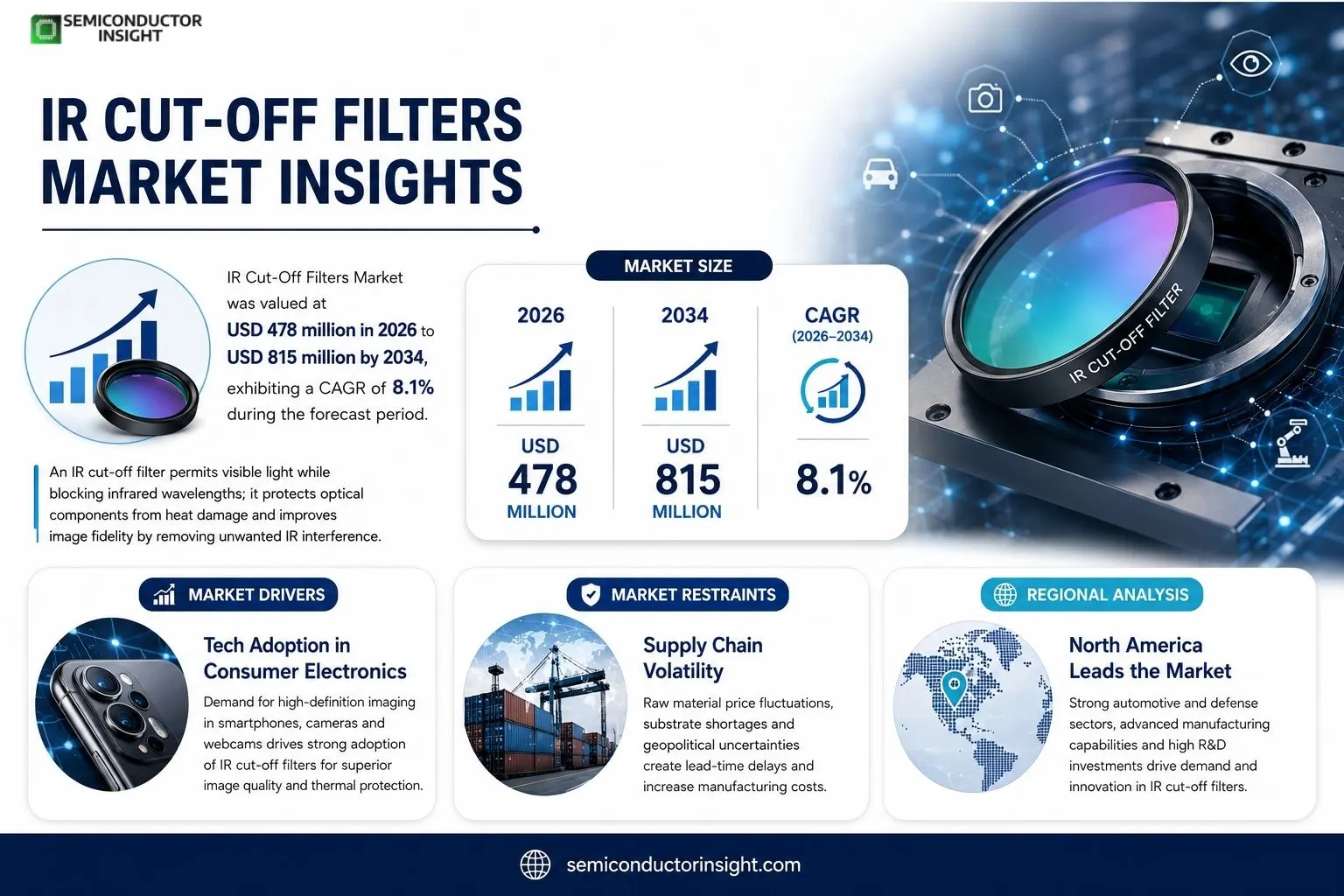
IR Cut-Off Filters Market size was valued at USD 478 million in 2026 to USD 815 million by 2034, exhibiting a CAGR of 8.1% during the forecast period.
An IR cut‑off filter permits visible light while blocking infrared wavelengths; it protects optical components from heat damage and improves image fidelity by removing unwanted infrared interference.Demand for these filters rises alongside the proliferation of digital imaging devicessmartphones, cameras and webcamsas well as automotive vision systems and industrial machine‑vision applications where precise color reproduction and thermal protection are essential.
MARKET DRIVERS
Tech Adoption in Consumer Electronics
High‑definition imaging has become a core differentiator for consumer‑grade smart devices. Infrared (IR) cut‑off filters, which block wavelengths beyond 700 nm, preserve chromatic accuracy and prevent blooming in low‑light scenarios. Genesis had already incorporated them into premium smartphone cameras, and manufacturers across the spectrum are now pushing the envelope. Consequently, the IR Cut‑Off Filters Market is benefiting from a steady surge in demand for compact, high‑performing optical components. The average feature density in new model releases continues to climb, with brands allocating additional silicon real‑time tracking capabilities that rely on supplemented cutoff filters. The transition toward 8K video and mixed‑reality experiences further magnifies the need for precise spectral rejection. This shift not only improves consumer satisfaction but also reinforces brand loyalty, driving repeat purchases and opening cross‑sell opportunities with accessory suppliers.
Automotive Vision Systems
The evolution of driver‑assist and autonomous platforms elevates the functional relevance of IR cut‑off filters within automotive vision kits. Night‑time cameras, adaptive infrared sensors, and thermal imaging modules frequently need to suppress stray IR during daylight operations, ensuring high‑contrast, artifact‑free frames for object detection algorithms. OEMs are investing in integrated filter systems that can toggle between daylight and night‑time modes via electronic or mechanical shutters, a feature that IR cut‑off modules are uniquely positioned to meet. Moreover, the push for safety‑grade sensors, mandated by emerging federal regulations, has spurred a technology race to enhance reliability under fluctuating illumination. Consequently, the automotive segment is increasingly outsourcing specialized filter fabrication, adding layers to the supply chain while boosting component performance across multiple vehicle classes. Economic incentives, coupled with the criticality of return‑on‑investment in driver safety, give this sector a deterministic traction vector that translates into sustained procurement volumes for IR cut‑off filter providers.
➤ Vehicle‑to‑cloud analytics now quantify visibility improvements, attributing a measurable defect‑reduction tier to precise spectral cutoff capabilities.
Industrial and scientific applications further cement the market’s trajectory. In semiconductor lithography, IR cut‑off filters mitigate unwanted photonic interference during ultraviolet microscopic mapping. Similarly, solar‑thermal collectors employ tailored spectral blockers to improve heat capture efficiency. Aerospace laboratories rely on uncompromised visible‑light data during sensor calibration, while specialty cameras for wildlife observation leverage these filters to moderate lunar and moonshine contributions in nocturnal footage. Each of these verticals has established a cost‑per‑unit threshold that supports scalability, yet they continue to push for higher rejection ratios and mechanical resilience. By aligning with stringent ISO and IEC standards, manufacturers can secure contracts that extend their reach into defense testing, space‑launch payloads, and maritime surveillance. Cumulatively, these philanthropic avenues drive both incremental sales and orders for custom-fabricated filter assemblies, reinforcing the IR Cut‑Off Filters Market as a multidisciplinary supplier ecosystem.
MARKET CHALLENGES
Supply Chain Volatility
material price swings, particularly in high‑purity quartz and cobalt‑based alloys, dilute margin optimization for filter producers. The recent surge in silicon wafer demand has throttled the availability of precision substrates, compelling manufacturers to adopt parallel sourcing strategies that increase inventory carrying costs. Moreover, geopolitical tensions in key supplier regions notably in the Middle East and Eastern Europe introduce compliance and logistics uncertainties that can impede delivery alignment with stringent OEM schedules. Even minor lead‑time fluctuations, resisting the demand‑sensing capacity of automotive OEMs, can cascade into longer order cycles, diminishing repeatability in revenue forecasting.
Other Challenges
Competitive Pressure from Low‑Cost Alternatives
Hybrid and off‑spec devices offer a cost‑effective shortlist for cost‑sensitive segments, encouraging some customers to defer upgrades or opt for substitute filter approaches. The proliferation of open‑source photonics kits coupled with DIY modifications further oxidizes the value proposition for conventional IR cut‑off filter sellers. Confronting these alternatives requires a dual approach: differentiate through stringent adherence to industry certification, and demonstrate measurable performance enhancements that justify premium pricing. Failure to effectively counterbalance these forces may erode market share, especially as mid‑tier brands aggressively stream product development resources toward lower‑priced generic variants.
MARKET RESTRAINTS
Regulatory Hurdles
Compliance displacement remains an inflexible entry bar for new entrants in the IR Cut‑Off Filters Market. The recently promulgated EU RoHS Directive and expanded production regulations in the United States necessitate comprehensive lifecycle assessments. These frameworks require manufacturers to document chemical traceability, phasing-out strategies for hazardous substances, and environmental footprints for each component. Obtaining certifications such as ANSI, CE, and UL, along with the industry‑specific ISO 9001 and ISO 14001, imposes additional certification cycles that translate to time‑to‑market delays, particularly for small‑to‑mid‑size enterprises. In addition, the temporary exemption of predictive weight-outs in the automotive segment could limit the momentum of smaller vendors, pushing them to scale for certification before securing sustained contracts.
MARKET OPPORTUNITIES
Edge‑Computing Integration
The convergence of edge‑computing platforms and advanced machine‑vision suites creates a fertile ground for specialized filter solutions. Increasing demand for on-device inference requires the seamless blending of optical precision and low‑power processing to enable real‑time analytics. IR cut‑off filters designed to correct for sensor saturation and dynamic range drift can reduce computational overhead, directly improving algorithmic latency and power budgets. Consequently, early movers in fabricating modular filter packages tailored for edge silicon can secure position as preferred suppliers for emerging AI‑powered laptops, drones, and robotic inspection systems. A focused R&D pursuit into stepped‑gradient coatings is poised to unlock additional value, supporting a higher absorption plateau while maintaining optical clarity needed for edge‑AI workflows.Collaborative ventures across optics, software, and services also broaden the competitive landscape. Tier‑1 OEMs frequently co‑develop filter firmware and calibration routines that embed predictive models for sunrise‑to‑sunset transitions, a feature that can turn a passive component into a scheduled service contract. The ability to present an end‑to‑end solutionfilter hardware, calibration suite, and analytics APIpositions suppliers to capture a larger share of the display and imaging budgets. Increased funding for quantum‑dot and adaptive‑lenticular technologies may also require bespoke cutoff layers to preserve color fidelity, presenting a new class of high‑margin components approaching Si‑based displays and large‑format projection systems.Pioneering the integration of broadband near‑IR rejection with active tuning elementssuch as MEMS actuated shutterscan open aftermarket service possibilities, particularly for high‑volume operators in surveillance, smart‑city, and industrial automation. By offering a modular, service‑oriented model that couples filter performance with maintenance provisioning, firms can generate recurring revenue streams distinguished from the traditional one‑off sales model. As the broader electronics ecosystem evolves toward sensor‑heavy deployments, the IR cut‑off filter niche stands ready to absorb demand from blends of hardware, software, and service confluence, thereby sustaining long‑term market resilience.
IR Cut-Off Filters Market Trends
Shifting Demand for High‑Resolution Imaging
Contemporary imaging stacks confront a new visual clarity imperative, and the IR Cut‑Off Filters Market is rapidly aligning with this evolution. As consumer devices increasingly blur the boundary between photography and professional cinematography, the need for filters that preserve color fidelity while rejecting infrared distortion has become a differentiator. Manufacturers are responding by tightening tolerance margins and scaling production of finer‑grid coatings that remain transparent to visible light yet aggressively block heat‑laden wavelengths. The ripple effect spreads through companion optics: lens assemblies, sensor mounts, and even display panels must accommodate the spectral cut‑off without sacrificing optical throughput. The resulting asset‑level shift positions IR cut‑off suppliers as foundational partners in the next generation of high‑definition capture solutions. This transition is evidenced by a sustained uptick in R&D spend and a growing number of co‑development agreements between filter suppliers and camera OEMs. The focus on sub‑micron phase control and anti‑reflection layers has accelerated, allowing filters to be less bulky and more energy‑efficientcritical for mobile platforms where thermal management is already a priority. Market participants who can deliver cost‑competitive, lightweight solutions are poised to capture the expanding share of imaging accessories.
Other Trends
Integration in Automotive Active Safety Systems
Automotive eye‑tracking systems and driver‑assistance modules now require infrared suppression at higher frame rates to avoid glare and ghosting. The IR Cut‑Off Filters Market is adapting by deploying roll‑off points tailored to automotive sensor spectra, thereby enhancing real‑time visibility in congested lighting conditions. This precision filtering reduces false positives in lane‑departure warnings and collision‑avoidance routines, directly contributing to driver confidence and regulatory compliance.
Expansion into Medical Spectroscopy
In clinical imaging, IR cut‑off elements protect delicate endoscopes and fluoroscopy components from damaging heat while ensuring that diagnostic imagery remains unaltered. Recent breakthroughs in polymer‑based substrates have enabled the creation of ultrathin filters suitable for handheld surgical tools. As hospitals prioritize minimally invasive procedures, the demand for high‑resolution, heat‑tolerant optics is rising, offering IR filter specialists a foothold in the lucrative medical device sector.
Rise of Customised Filter Technologies
Beyond these functional pivots, the market is witnessing a strategic shift toward customisation. Manufacturers are moving away from one‑size‑fits‑all spectral cut‑offs and instead offering tunable filters that can be engineered to specific wavelengths or application regimes. This approach aligns with enterprise clients who demand bespoke optics for niche cameras, such as microscope slide fluorescence or industrial vision rigs operating under extreme lighting. The ability to tailor insertion loss, stress‑induced birefringence, and edge steepness gives procurement teams a decisive edge when balancing performance needs against bandwidth constraints. Consequently, companies that accelerate digital design tools and offer rapid prototyping will attract those looking for rapid time‑to‑market and lower inventory risks. This trend signals a maturation of the IR Cut‑Off Filters Market, where differentiation is driven by engineer‑centric performance parameters rather than solely by price.
COMPETITIVE LANDSCAPEKey Industry Players
IR Cut-Off Filters Market – Competitive Landscape Analysis
OPTRONTEC, with an annual revenue that surpassed US$120 million last year, accounts for approximately 18 % of the IR cut‑off filter market. Its vertically integrated routefrom glass synthesis through advanced coating technologieshas granted the firm both pricing leverage and a cross‑segment reach into automotive, security, and mobile photography. The recent launch of a nanocrystalline glass line, backed by a US$35 million investment, positions OPTRONTEC to deliver tighter infrared rejection while maintaining cost competitiveness. As imaging devices become increasingly sophisticated, the company’s focus on precision optical design and real‑time thermal management feeds directly into the high‑performance expectations of top-tier camera manufacturers and automotive suppliers.Beyond OPTRONTEC, several niche operators have carved out influential footprints by targeting specific sub‑markets and geographies. Tanaka Engineering and Hermosa Optics channel research toward resin‑based filters that balance compactness and affordability, making them attractive for portable and wearable cameras. Edmund Optics leverages its established European distribution network to underpin its dominance in laboratory and high‑resolution scientific instrumentation. AGC, with a seasoned supply chain that links semiconductor photonics to optical fabrication, offers a uniquely stable production pipeline. In Asia, Viko Optics, Murakami, and QIMENG CRYSTAL MATERIAL emphasize low‑temperature processing techniques that suit the rigorous demands of industrial automation, while TAMA ELECTRONICS, Crystal‑Optech, and Hubei Wufang Photoelectric produce custom solutions for automotive and security camera systems tailored to emerging markets. Together, these players illustrate a fragmented yet highly differentiated competitive tableau, affording industry stakeholders a wide spectrum of sourcing and partnership possibilities.
List of Key IR Cut-Off Filters Companies Profiled
- OPTRONTEC
- Tanaka Engineering
- Edmund Optics
- AGC
- Viko Optics
- Murakami
- QIMENG CRYSTAL MATERIAL
- TAMA ELECTRONICS
- Crystal-Optech
- Hubei Wufang Photoelectric
- Hermosa Optics
Segment Analysis:
| Segment Category | Sub-Segments | Key Insights |
| By Type |
|
White Glass dominates the IR Cut‑Off Filter market due to its superior optical clarity, low cost and ease of integration into consumer imaging devices. The material’s ability to maintain high transmittance across the visible spectrum while efficiently blocking infrared radiation makes it the preferred choice for smartphones and high‑resolution cameras. Consistent quality across production batches ensures reliability in bulk deployment, fostering manufacturer confidence and widespread adoption. |
| By Application |
|
Mobile Phone stands out as the most influential application segment, driven by the proliferation of high‑end smartphones and the demand for crisp image capture in both daylight and low‑light scenarios. Integrating IR cut‑off filters enhances color fidelity, reduces heat‑induced noise, and aligns with consumer expectations for premium visual quality. The continual evolution of mobile sensor technology amplifies the need for meticulous filtering, reinforcing the segment’s pivotal role in the market’s growth trajectory. |
| By End User |
|
Consumer Electronics dominates the end‑user landscape, as the surge in handheld imaging devices necessitates precise color rendering and thermal management. The filter’s capacity to suppress infrared interference directly translates into superior user experience, fostering brand loyalty and justifying premium pricing. Additionally, consumer preference for high‑definition video content perpetuates demand, compelling manufacturers to embed advanced IR cut‑off solutions into future device generations. |
| By Technology |
|
Coating leads the technology segment by offering tailored infrared attenuation while preserving visible light transmittance. Advanced deposition techniques yield high resistance to environmental degradation, allowing filters to perform reliably in extreme temperature ranges. This technology aligns with the automotive and industrial sectors’ stringent reliability requirements, positioning it as a strategic differentiator for manufacturers aiming to secure long‑term contracts and enhance product durability. |
| By Material |
|
Glass exhausts the material segment with its exceptional optical homogeneity and thermal stability. Its predictable refractive index profile facilitates precise filter design, while its inherent scratch resistance ensures longevity in high‑frequency usage scenarios. Consequently, glass remains the material of choice for both consumer and industrial applications where image integrity and durability are paramount. |
Regional Analysis: IR Cut-Off Filters Market
North America
The region’s automotive sector is foregrounding active thermal management, driving demand for IR cut-off filters that mitigate sensor noise in autonomous systems. Concurrently, aerospace contractors seek filters capable of withstanding extreme thermal cycles, cementing the market’s growth trajectory.
Consolidation among mid‑tier optics manufacturers is accelerating. Strategic alliances are emerging to combine material science with embedded system integration, creating differentiated value propositions across automotive and defense verticals.
Innovations in porous silicon coatings and quantum dot additives are progressively enhancing transmission consistency and reducing thermal drift, positioning firms that master these technologies at the fore of the value chain.
Capital allocation is increasingly focused on high‑throughput fabrication lines, which lower unit costs while maintaining precision, a strategy that captures early adopter advantage in high‑volume applications.
Europe
European demand for IR cut‑off filters is fueled by stringent automotive safety mandates and a growing electric vehicle (EV) ecosystem that relies heavily on infrared vision systems for autonomous driving. The region’s commitment to sustainability has spurred research into low‑loss, recyclable filter materials, aligning environmental compliance with performance goals. Local manufacturing hubs, notably in Germany and Sweden, provide a reliable supply base that supports rapid deployment to automotive OEMs. Additionally, European defense contractors demand filters with high thermal stability for infrared surveillance equipment, creating a dual‑use market that amplifies overall volatility and promotes continuous innovation. The confluence of regulatory pressure, advanced manufacturing infrastructure, and investment in research equips Europe to maintain a steady contribution to IR cut‑off filter volumes.
Asia‑Pacific
Asia‑Pacific represents a dynamic growth band, propelled by rapid expansion in automotive production, especially in China and India, which are aggressively integrating autonomous driving features. The region’s maturity in electronics manufacturing enables high‑volume, cost‑effective production of IR cut‑off filters, meeting both automotive and surveillance sector needs. Emerging markets in Southeast Asia also exhibit rising demand for security applications in urban infrastructure, further broadening adoption. A talent pool in material science across universities supports continuous refinement of filter technologies, ensuring local corporations can compete ly. This mix of scale, affordability, and innovation drives a resilient growth trajectory for the IR cut‑off filter market across the region.
South America
South America is gradually ascending as a relevant market for IR cut‑off filters, primarily driven by Latin American automotive giants pursuing connectivity programs that necessitate robust infrared systems. While still nascent compared to the North, local governments are introducing incentives for manufacturers to adopt green technologies, indirectly supporting filter development. Regional trade agreements provide smoother access to high‑tech components, allowing South American firms to integrate advanced IR filtering solutions into their supply chains. The regional market is therefore poised for incremental growth, contingent on increased investment in manufacturing capabilities and matching R&D efforts.
Middle East & Africa
The Middle East & Africa region manifest potential through burgeoning defense and aerospace contracts that demand high‑precision infrared filtering. Desert‑climate challenges require filters with extreme temperature tolerance, prompting custom solutions that elevate regional expertise. Meanwhile, collaborations with Western partners and localized research centers are creating a foothold for domestic production of IR cut‑off filters. However, the market remains sensitive to geopolitical shifts and commodity price fluctuations, which can impact procurement cycles. Overall, the region’s focus on security technology maturation positions it to capture a niche share of the infrared filter market as capabilities mature.
Report Scope
This market research report provides a comprehensive analysis of the IR Cut-Off Filters Market , covering the forecast period 2026–2034. It offers detailed insights into market dynamics, technological advancements, competitive landscape, and key trends shaping the industry.
Key focus areas of the report include:
- Market Overview: The report begins with an overview outlining its current market scenario, key growth indicators, and industry transformation drivers. It discusses macroeconomic factors, demand–supply balance, regulatory landscape, and the strategic role of semiconductors in powering advancements across industries such as automotive, telecommunications, consumer electronics, and industrial automation.
- Market Size & Forecast: Historical data and future projections for revenue, unit shipments, and market value across major regions and segments.
- Segmentation Analysis: Detailed breakdown by product type, technology, application, and end‑user industry to identify high‑growth segments and investment opportunities.
- Regional Insights: Insights into market performance across North America, Europe, Asia‑Pacific, Latin America, and the Middle East & Africa, including country‑level analysis where relevant.
- Competitive Landscape: Profiles of leading market participants, including their product offerings, R&D focus, manufacturing capacity, pricing strategies, and recent developments such as mergers, acquisitions, and partnerships.
- Technology Trends & Innovation: Assessment of emerging technologies, integration of AI/IoT, semiconductor design trends, fabrication techniques, and evolving industry standards.
- Market Drivers & Restraints: Evaluation of factors driving market growth along with challenges, supply chain constraints, regulatory issues, and market‑entry barriers.
- Stakeholder Insights: Insights for component suppliers, OEMs, system integrators, investors, and policymakers regarding the evolving ecosystem and strategic opportunities.
Primary and secondary research methods are employed, including interviews with industry experts, data from verified sources, and real‑time market intelligence to ensure the accuracy and reliability of the insights presented.
FREQUENTLY ASKED QUESTIONS:
What is the current market size of IR Cut-Off Filters Market?
-> IR Cut-Off Filters Market was valued at USD 478 million in 2026 and is projected to reach USD 815 million by 2034, at a CAGR of 8.1% during the forecast period.
What is the projected market size and CAGR of IR Cut-Off Filters Market?
-> The market is expected to grow from USD 478 million in 2026 to USD 815 million in 2034, reflecting a compound annual growth rate of 8.1% across the forecast period.
What is an IR cut‑off filter and its primary function?
-> An IR cut‑off filter is designed to pass only visible light while blocking the passage of infrared light, thereby protecting system components from potentially damaging heat rays.
Which applications are the primary drivers for IR cut‑off filters?
-> Key application drivers include camera and imaging technology, consumer electronics, security and surveillance, automotive cameras, machine vision, optical systems, medical imaging, scientific research, environmental monitoring, and industrial automation.
Which industry segment dominates IR Cut-Off Filters Market in terms of revenue?
-> The camera and imaging technology segment accounts for the largest share of market revenue, driven by the widespread use of digital cameras, smartphones, and other imaging devices.
What regions are experiencing the fastest growth for IR Cut-Off Filters?
-> North America and Asia‑Pacific regions are witnessing rapid expansion due to high adoption rates in consumer electronics and automotive sectors, though specific growth rates are yet to be disclosed.
Who are the key players operating in IR Cut-Off Filters Market?
-> Major participants include OPTRONTEC, Tanaka Engineering, Hermosa Optics, Edmund Optics, AGC, Viko Optics, Murakami, QIMENG CRYSTAL MATERIAL, TAMA ELECTRONICS, Crystal‑Optech, and Hubei Wufang Photoelectric.
What are the main growth drivers and trends for IR Cut-Off Filters Market?
-> Key growth drivers include camera and imaging technology advancements, improved color accuracy, growing demand for consumer electronics, security and surveillance needs, automotive camera systems, machine vision automation, medical imaging clarity, industrial automation efficiency, environmental monitoring requirements, and customization capabilities.
Can IR Cut-Off Filters be customized for specific applications?
-> Yes, IR cut‑off filters can be tailored to specific wavelengths and application requirements, providing versatility across imaging, automotive, medical, and industrial sectors.
What environmental benefits do IR Cut-Off Filters offer?
-> By preventing infrared radiation from interfering with optical systems and imaging processes, IR cut‑off filters contribute to more accurate data collection, essential for environmental monitoring and analysis.
Get Sample Report PDF for Exclusive Insights
Report Sample Includes
- Table of Contents
- List of Tables & Figures
- Charts, Research Methodology, and more...
 Download Sample Report PDF