HVAC Temperature Sensor for Commercial Buildings Market Insights
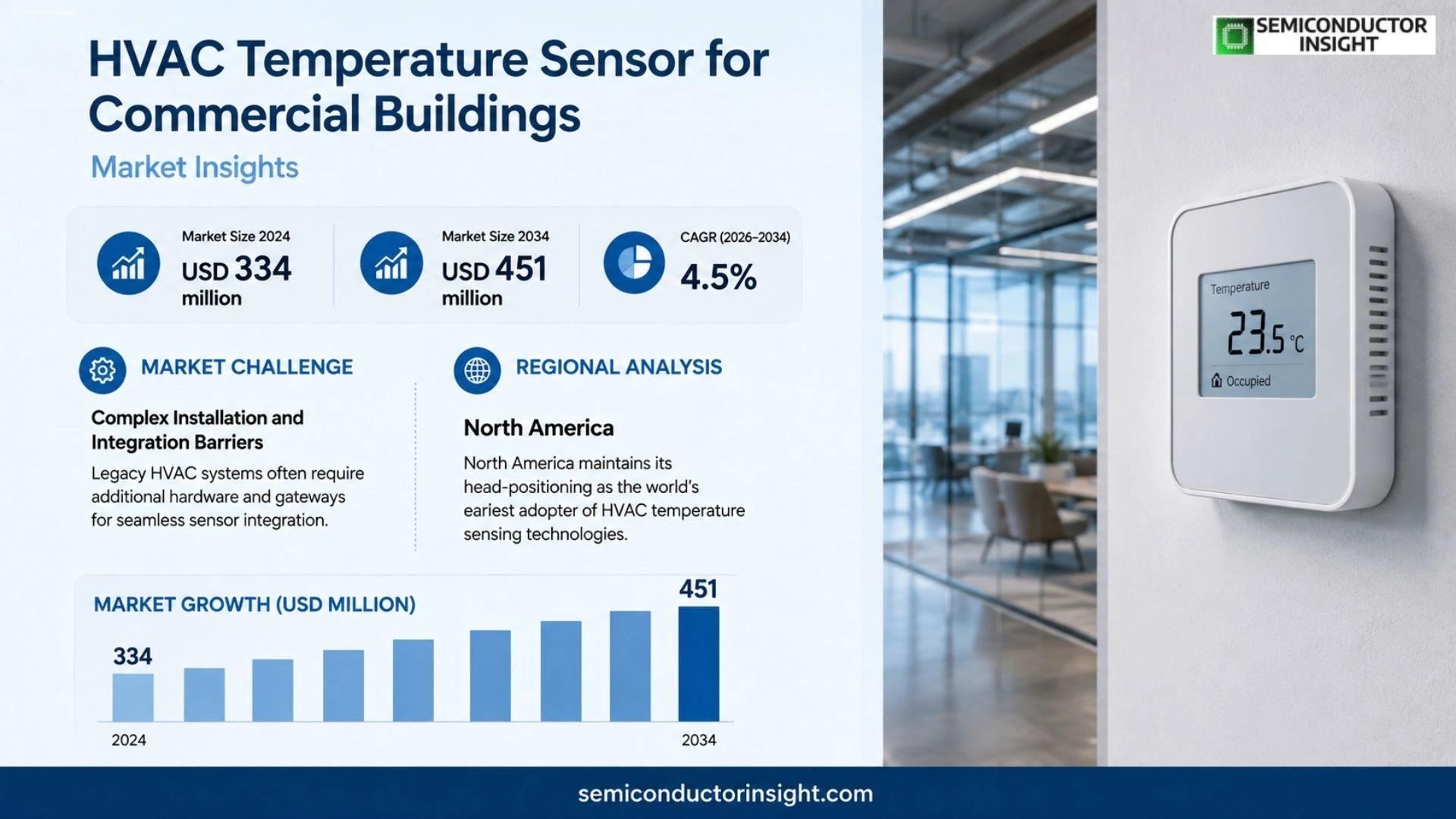
HVAC Temperature Sensor for Commercial Buildings market was valued at USD 334 million in 2024 and will reach USD 451 million by 2034, representing a CAGR of 4.5% during the forecast period.
A temperature sensor is a device that detects and measures hotness and coolness and converts it into an electrical signal. HVAC temperature sensors provide temperature measurement, control and compensation. HVAC temperature sensors allow technicians to easily monitor and adjust conditions to ensure the safety and comfort of the building’s inhabitants. HVAC temperature sensors include NTC thermistors, PTC thermistors, RTDs, thermocouples etc. These diverse sensor types enable precise control across varying environmental conditions.
MARKET DRIVERS
Demand‑Driven Energy Efficiency Adoption
Commercial facilities are tightening their operating envelopes, and the pressure to curtail energy consumption has turned HVAC Temperature Sensor integration into a top‑priority investment. In the United States, commercial HVAC energy usage accounts for roughly 30 % of total building electricity bills, and the modified International Energy Conservation Code now mandates more precise temperature control in new constructions. Block‑level temperature monitoring, achieved through advanced sensors, directly translates to envelope‑level energy savings of 8–10 % for mid‑market office towers. Because these savings accrue rapidly, tenants and developers have begun to price sensor upgrades into capital budgets, reshaping procurement cycles. The association of a robust sensor network with measurable lease value is clear: buildings that maintain tighter temperature control manage to command higher rents, while tenants benefit from consistent indoor comfort. Consequently, HVAC Temperature Sensor for Commercial Buildings Market is experiencing a sustained surge as property owners seek to align with regulatory expectations, stakeholder ESG mandates, and a landscape where operating cost competitiveness is paramount.
Technological Advancements in Sensor Accuracy
Text‑to‑digital conversion has never been more precise. Modern semiconductor radiation sensors now achieve ±0.2 °C resolution, a significant leap from the ±2 °C tolerance typical six years ago. This accuracy enables sub‑zone climate tailoring, reduces HVAC cycling, and markedly lowers wear on mechanical components. Moreover, algorithms that fuse sensor data with predictive load models can identify temperature drift before costly operational faults emerge. The cumulative effect is a measurable 5–7 % reduction in HVAC system downtime annually, a benefit that is attracting a leadership core of real‑time monitoring investors. In markets where the average commercial building houses more than 15 distinct temperature zones, sensor upgrades can generate a widespread ripple effect, reinforcing the case for a comprehensive upgrade cycle. As manufacturers are bundling sensors with cloud analytics platforms, the broader ecosystem of remote diagnostics is converging, creating a market synergy that underscores the attractiveness of HVAC Temperature Sensor for Commercial Buildings Market.
➤ Innovative sensor convergence delivers tangible energy savings while ensuring consistent occupant comfort. These dual benefits are accelerating ROI timelines for large‑scale commercial deployments.
Strategic Adoption Pathways are evolving from reactive retrofits toward proactive district‑wide sensor networks. High‑rise campuses and corporate campuses with interconnected floors tend to adopt centralized monitoring hubs, allowing operators to isolate off‑line zones immediately. The use of Bluetooth Low Energy (BLE) mesh topologies has reduced installation cable costs by up to 12 %, making it affordable for mid‑sized facilities to overspecify sensor density. Interoperability standards such as BACnet/IP and Modbus/RTU for sensor communication are being normalized, and this uniformity is lowering training and maintenance burdens. Finally, a portfolio of cost‑effective sensor sensors, ranging from rugged MEMS devices for HVAC coils to high‑resolution thermistors for indoor spaces, allows rollout strategies to be customized against both energy and asset performance metrics.
MARKET CHALLENGES
Complex Installation and Integration Barriers
The heterogeneity of existing HVAC architectures poses a stumbling block for new temperature sensor deployments. Legacy chillers, often lacking built‑in digital interfaces, require additional hardware such as analog to digital converters and proprietary gateways. Even among new‑build units, the disparity in sensor communication protocols,BACnet/IP, Modbus/TCP, and proprietary RTU stacks,means that system integrators must develop customized adapters, increasing both development time and cost. In the retail sector, where summer heat loads can spike 200 % during promotional periods, a retrofit cycle must accommodate short turnaround times, forcing firms to juggle installation windows with regular customer traffic. These combined factors generate a risk profile that can delay deployment and erode projected financial benefits. Moreover, on‑site technicians frequently lack formal training in sensor calibration, causing a latency of up to 20 % in optimal sensor performance post–installation. As a result, organizations hesitate to commit large capital outlays, and the adoption curve slows in highly time‑constrained environments such as airports and hospitals.
Other Challenges
Capital and Infrastructure Limitations
Large commercial properties often outsource HVAC ownership to third‑party operators. While operational cost control is a shared objective, up‑front capital is typically allocated to critical infrastructure upgrades rather than sensor enhancements. The typical payback period for a sensor upgrade ranges between 4–6 years, a timeframe that can exceed the contractual remuneration cycle of some service agreements. Furthermore, economies of scale in sensor acquisition are partially offset by fragmented vendor ecosystems, which inflate logistics and warranty support costs. Aside from financial hurdles, market participants are also contending with a shortage of skilled control engineers, a gap that broadens as the industry transitions toward data‑centric HVAC system management. This workforce mismatch can translate into extended commissioning periods, worsening customer satisfaction scores and creating a negative feedback loop that dampens enthusiasm for sensor adoption.
MARKET RESTRAINTS
Fragmented Market Segmentation Hinders Adoption
Within HVAC Temperature Sensor for Commercial Buildings Market, a pronounced vendor patchwork persists. Independent sensor manufacturers provide competing analog, digital, and hybrid output formats, each claiming proprietary supremacy. Consequently, a building operator may face the choice of purchasing from multiple sources to obtain complete coverage across all HVAC subsystems,air handlers, chillers, boilers, and economizers. This multiplicity inflates procurement costs, dilutes brand loyalty, and complicates aftermarket support. In the office sector, the prevalence of mixed‑manufacture controls,such as a Siemens chiller paired with a Honeywell VAV system,requires a plurality of gateway adapters, increasing the system’s maintenance footprint. The regulatory environment, too, has not yet prescribed a unified sensor calibration standard, allowing manufacturers to employ variable tolerance levels in the field. This deviation leads to calibration drift, mandating more frequent field checks that further stress operation budgets. The cumulative effect is a slower trajectory toward ubiquity, as capital barriers and technical disparity intersect, leaving many facilities behind the curve of improved precision and efficiency.
MARKET OPPORTUNITIES
Emergence of IoT‑Enabled Analytics Platforms
The convergence of low‑cost, high‑accuracy temperature sensors with cloud‑based analytics offers a transformative opportunity for HVAC Temperature Sensor for Commercial Buildings Market. Predictive frameworks that ingest temperature trajectories and correlate them with occupancy patterns can pre‑emptively adjust thermal set points, yielding up to 12 % in seasonal energy savings for commercial campuses. Simultaneously, the data archive generated by dense sensor arrays provides actionable insights for predictive maintenance, allowing operators to schedule capex interventions before component failures halt operations. Real‑time dashboards give facility managers a granular view of thermal hysteresis and HVAC load mismatches, opening a conduit for dynamic energy pricing strategies in markets with time‑of‑use tariffs. The adoption curve is poised to accelerate as APIs for popular building automation systems expose sensor data, enabling bundling of HVAC control and analytics into a single, turnkey service offering. For equipment manufacturers, this creates a pathway to generate subscription revenue streams through software licensing, while operators embrace a pay‑per‑use model that aligns capital expenditure with quantified performance gains. This layered ecosystem stands as a compelling proposition that will redefine cost structures and profitability horizons for commercial building stakeholders.
HVAC Temperature Sensor for Commercial Buildings Market Trends
Consolidation Around High‑Performance Sensor Portfolios
Recent data places the HVAC temperature sensor segment at a value of roughly US$334 million in 2024, with most forecast drivers centred on the push for tighter indoor climate control in high‑density office towers. The trajectory remains upward as system designers increasingly seek integrators that bundle sensor arrays with real‑time control algorithms. Within this cluster, the six‑letter incumbents,Siemens, Schneider, Johnson Controls, Honeywell, Danfoss Electronics and TE,have amplified market share by offering harmonised platforms that combine NTC, PTC and RTD technologies with proprietary data‑logging modules. Their competitive advantage lies in higher accuracy, lower drift and enhanced after‑sales support, which keeps end‑users locked into long‑term maintenance contracts and elevates unit economics for their distributors. Consequently, channel partners experience expanded cross‑sell opportunities, especially within building automation suites that now pivot on sensor‑driven cost savings.
Other Trends
Asia‑Pacific Consumption Dominance and Differential Growth
Asia‑Pacific remains the largest consumer base, recording a 35.6 % market share in 2022. The region’s growth is propelled by rapid construction of mixed‑use developments and an evolving regulatory requirement for ISO‑/IEC‑approved temperature monitoring. Still, the capital intensity and steep learning curve,particularly around multi‑layered RTD fabrication,form significant entry barriers for smaller suppliers. Consequently, the supply chain is dominated by a handful of OEMs that maintain proprietary production lines and rigorous quality controls. This concentration amplifies the impact of incremental sensor innovations on price elasticity: any lift in measurement accuracy or signal‑to‑noise ratio can translate into immediate premium pricing for end‑users seeking compliance with emerging energy‑efficiency mandates. The resultant premium margins sustain investment in R&D, feeding a virtuous cycle of feature upgrades.
Voltage‑Safety Compliance Drives Miniaturised RTD Platforms
Stricter voltage‑safety mandates across the EU and the U.S. have prompted miniaturised, low‑voltage RTD platforms that integrate directly with smart‑metering hardware. Manufacturers are now prioritising low‑power electronics that can transmit data over wireless protocols without compromising clock‑precision. This shift reduces EMI susceptibility and allows sensor assemblies to sit closer to high‑current HVAC actuators, thereby improving response times in demand‑response scenarios. For distributors, the move means caching fewer bulky units and focusing on systems that deliver actionable data; for OEMs, the emphasis shifts to supply‑chain resilience and faster time‑to‑market for new firmware releases. Long‑term, the trend indicates a move toward software‑defined sensing, where cloud‑based analytics can calibrate sensor arrays dynamically without hardware replacements. This evolution also opens avenues for predictive maintenance subscriptions.
COMPETITIVE LANDSCAPE
Key Industry Players
Competitive Landscape of HVAC Temperature Sensor for Commercial Buildings Market
In 2024 the HVAC temperature sensor sector for commercial buildings generated about US$334 million, with a concentration of enterprise power driving most of the growth. The top three manufacturers,Siemens, Schneider Electric and Johnson Controls,retain a combined share that eclipses 70 % of the high‑margin segment, largely through a diversified portfolio of NTC, PTC, RTD and thermocouple solutions and an unmatched service network that supports building automation initiatives. Their strategic investments in precision signal conditioning and digital integration tools have positioned them to capture the rising demand for smart building diagnostics, propelling them ahead of rivals. These leaders also consolidate value by bundling sensors with HVAC controls and control‑room dashboards, thereby reinforcing customer lock‑in and amplifying margins in a market that balances capital intensity with performance differentiation.
The remaining footprints are held by a quartet of niche specialists who have carved out niche markets within the HVAC value chain. Danfoss Electronics, TE Connectivity, KROHNE and Greystone Energy Systems focus on advanced process‑control applications, delivering tailored temperature‑sensing modules that excel in interface standardization and programmable logic controller (PLC) compatibility. BAPI, E+E Elektronik Ges.m.b.H, JUMO GmbH & Co. KG, Arcon, MiTec and others cater to cost‑sensitive segments such as supply‑air monitoring and legacy retrofits, offering modular, low‑cost solutions that maintain strict compliance with international safety standards. Their incremental market share is buoyed by proactive engagement in emerging regions such as Southeast Asia and India, where the regulatory emphasis on indoor air quality is spurring adoption of robust, low‑maintenance sensor technologies.
List of Key HVAC Temperature Sensor Companies Profiled
- Siemens
- Schneider Electric
- Johnson Controls
- Honeywell
- Danfoss Electronics
- TE Connectivity
- KROHNE
- Greystone Energy Systems
- BAPI
- E+E Elektronik Ges.m.b.H
- JUMO GmbH & Co. KG
- Arcon
- MiTec
- R&D
Segment Analysis:
| Segment Category | Sub-Segments | Key Insights |
| By Type |
|
Leading Segment NTC Thermistor description with qualitative insights only [Pointers preferred in bullets atleast 2-3]. • Widely used due to low cost and high reliability. • Provides accurate temperature measurement in a wide range of commercial HVAC systems. • Supports seamless integration with digital control platforms for energy efficiency. • Offers durability in high‑humidity environments typical of office and retail buildings. |
| By Application |
|
Leading Segment Office Building description with qualitative insights only [Pointers preferred in bullets atleast 2-3]. • Prioritizes precise temperature control to maintain occupant comfort and productivity. • Emphasizes integration with building automation systems for real‑time monitoring. • Supports demand‑response protocols to reduce peak electricity consumption. • Requires sensors with quick response and long service life to minimize maintenance costs. |
| By End User |
|
Leading Segment Commercial Real‑Estate Management description with qualitative insights only [Pointers preferred in bullets atleast 2-3]. • Focuses on ensuring consistent indoor climate across multiple properties for tenant satisfaction. • Values sensors that provide high accuracy and low maintenance downtime. • Seeks solutions that enable predictive maintenance and fault detection. • Prefers vendors offering comprehensive after‑sales support and firmware updates. |
| By Market Condition |
|
Leading Segment Emerging Market Adoption description with qualitative insights only [Pointers preferred in bullets atleast 2-3]. • Driven by increasing awareness of energy efficiency in new construction projects. • New entrants focus on cost‑effective sensors that meet international standards. • Collaboration with local distributors enhances market penetration. • Emphasis on offering sensor solutions that are easily integrated into existing HVAC control architectures. |
| By Technology Evolution |
|
Leading Segment Digital Signal Sensors description with qualitative insights only [Pointers preferred in bullets atleast 2-3]. • Offers higher precision and easier calibration compared to analog counterparts. • Enables seamless connectivity with room‑level monitoring platforms. • Supports customization of data logging intervals for enhanced energy analytics. • Promotes long‑term reliability with robust packaging suitable for demanding commercial environments. |
Regional Analysis: HVAC Temperature Sensor for Commercial Buildings Market
North America
The U.S. regulatory framework now mandates data transparency for large commercial projects, driving vendors to roll out multi‑point sensing arrays that feed live dashboards. Clients value the ability to correlate temperature data with HVAC load curves, thereby reducing inefficiencies that cost energy and degrade indoor air quality.
Early adopters see a clear return on investment when sensors cut energy use by more than 10 % annually. Building managers increasingly allocate capital toward sensor upgrades, confident that annual savings outweigh installation costs.
Pricing models are shifting from hardware‑only licenses to cloud‑based subscription bundles that include analytics, predictive alerts, and compliance reporting. Vendors with open APIs see higher uptake because they integrate seamlessly with existing BMS platforms.
Public‑private partnerships and municipal grants are earmarking fund for smart‑building retrofits, creating a pipeline of new sensor projects that keep forward‑looking developers ahead of the curve.
Europe
European commercial construction is increasingly driven by the EU’s ambitious climate, resilience and sustainability goals. Building operators are now focusing on granular control of HVAC systems, and sensor‑based temperature monitoring is positioned as a cornerstone of these efforts. In the region, the marriage of sensor data with building automation dashboards enables facility managers to reduce energy consumption while simultaneously improving occupant comfort. Moreover, stringent data‑protection regulations are compelling vendors to adopt secure communication protocols, which in turn drives higher trust among end users. Consequently, supplier ecosystems are expanding to accommodate both legacy HVAC infrastructures and cutting‑edge retrofit projects, reinforcing the narrative that sensor deployment is essential for compliance and competitive differentiation.
Asia‑Pacific
The Asia‑Pacific market is witnessing a steady uptick in sensor adoption as urban density rises and governments push for smarter cities. Rapid industrialization has spurred a need for advanced building monitoring systems, while a growing awareness of operational efficiency has made HVAC temperature sensors essential. The region’s manufacturing and logistics hubs are already incorporating sensor data into predictive maintenance algorithms to reduce downtime and maintenance costs. Suppliers focused on flexible, cost‑effective sensor solutions find favor in markets such as China, India, and Southeast Asia, where price sensitivity coexists with a strong push for digital transformation. The result is a heterogeneous yet accelerating adoption curve, with a clear shift toward integrated sensor ecosystems that bundle data analytics with real‑time control.
South America
South America’s commercial infrastructure is entering a new phase, as local governments begin to require precise environmental controls for new high‑rise developments. Although the market remains relatively nascent compared to North America and Europe, a growing segment of developers is investing in temperature sensors to meet energy‑coding standards. A key driver is the high humidity and volatility in the region’s climate, which makes sensor‑based temperature and airflow regulation crucial for occupant health and equipment longevity. Early adopters are noting that strategic sensor placement can effectively reduce HVAC wear and prolong equipment life expectancy, translating into lower life‑cycle costs. Consequently, a small but expanding cluster of affluent commercial tenants are mandating sensor‑enabled HVAC systems as part of their ESG strategies.
Middle East & Africa
In the Middle East, aggressive urbanisation and a commitment to renewable energy adoption have wrought a surge in HVAC sensor demand. Heat‑stressed environments drive facilities to re‑engineer cooling strategies, and precision temperature sensors provide the necessary data fidelity to implement variable refrigerant flow or thermal zoning. Meanwhile, African markets exhibit a mixture of emerging and established commercial projects, with an emphasis on resilient infrastructure that can support temperature regulation under rising ambient temperatures. In both contexts, the integration of sensor data into distributed control systems is viewed as a lever for extending equipment life and capturing cost savings under future climate‑resilient building codes. As regional players aim to align with international best practices, the proliferation of cost‑effective sensors is anticipated to grow, especially in rapidly expanding capital corridors.
Report Scope
This market research report provides a comprehensive analysis of the HVAC Temperature Sensor for Commercial Buildings Market , covering the forecast period 2026–2034. It offers detailed insights into market dynamics, technological advancements, competitive landscape, and key trends shaping the industry.
Key focus areas of the report include:
- Market Overview: The report begins with an overview outlining its current market scenario, key growth indicators, and industry transformation drivers. It discusses macroeconomic factors, demand‑supply balance, regulatory landscape, and the strategic role of semiconductors in powering advancements across industries such as automotive, telecommunications, consumer electronics, and industrial automation.
- Market Size & Forecast: Historical data and future projections for revenue, unit shipments, and market value across major regions and segments.
- Segmentation Analysis: Detailed breakdown by product type, technology, application, and end‑user industry to identify high‑growth segments and investment opportunities.
- Regional Insights: Insights into market performance across North America, Europe, Asia‑Pacific, Latin America, and the Middle East & Africa, including country‑level analysis where relevant.
- Competitive Landscape: Profiles of leading market participants, including their product offerings, R&D focus, manufacturing capacity, pricing strategies, and recent developments such as mergers, acquisitions, and partnerships.
- Technology Trends & Innovation: Assessment of emerging technologies, integration of AI/IoT, semiconductor design trends, fabrication techniques, and evolving industry standards.
- Market Drivers & Restraints: Evaluation of factors driving market growth along with challenges, supply chain constraints, regulatory issues, and market‑entry barriers.
- Stakeholder Insights: Insights for component suppliers, OEMs, system integrators, investors, and policymakers regarding the evolving ecosystem and strategic opportunities.
Primary and secondary research methods are employed, including interviews with industry experts, data from verified sources, and real‑time market intelligence to ensure the accuracy and reliability of the insights presented.
FREQUENTLY ASKED QUESTIONS:
What is the current market size of HVAC Temperature Sensor for Commercial Buildings Market?
-> HVAC Temperature Sensor for Commercial Buildings market will reach USD 451 million by 2034, representing a CAGR of 4.5% during the forecast period.
Which key companies operate in HVAC Temperature Sensor for Commercial Buildings Market?
-> Key players include Siemens, Schneider, Johnson Controls, and Honeywell, leading the market with superior performance and service.
What are the key growth drivers?
-> Key growth drivers include technological advancement, performance‑centric product innovation, high capital investment requirements, and strong demand for precise temperature control in large commercial buildings.
Which region dominates the market?
-> Asia‑Pacific dominates the market with a consumption share of nearly 35.60% in 2022, followed by North America with over 30%.
What are the emerging trends?
-> Emerging trends include integration of IoT and AI analytics for smart building applications, advanced sensor connectivity, and energy‑efficient HVAC solutions.

Get Sample Report PDF for Exclusive Insights
Report Sample Includes
- Table of Contents
- List of Tables & Figures
- Charts, Research Methodology, and more...
 Download Sample Report PDF