Fingerprint Recognition Module Market Insights
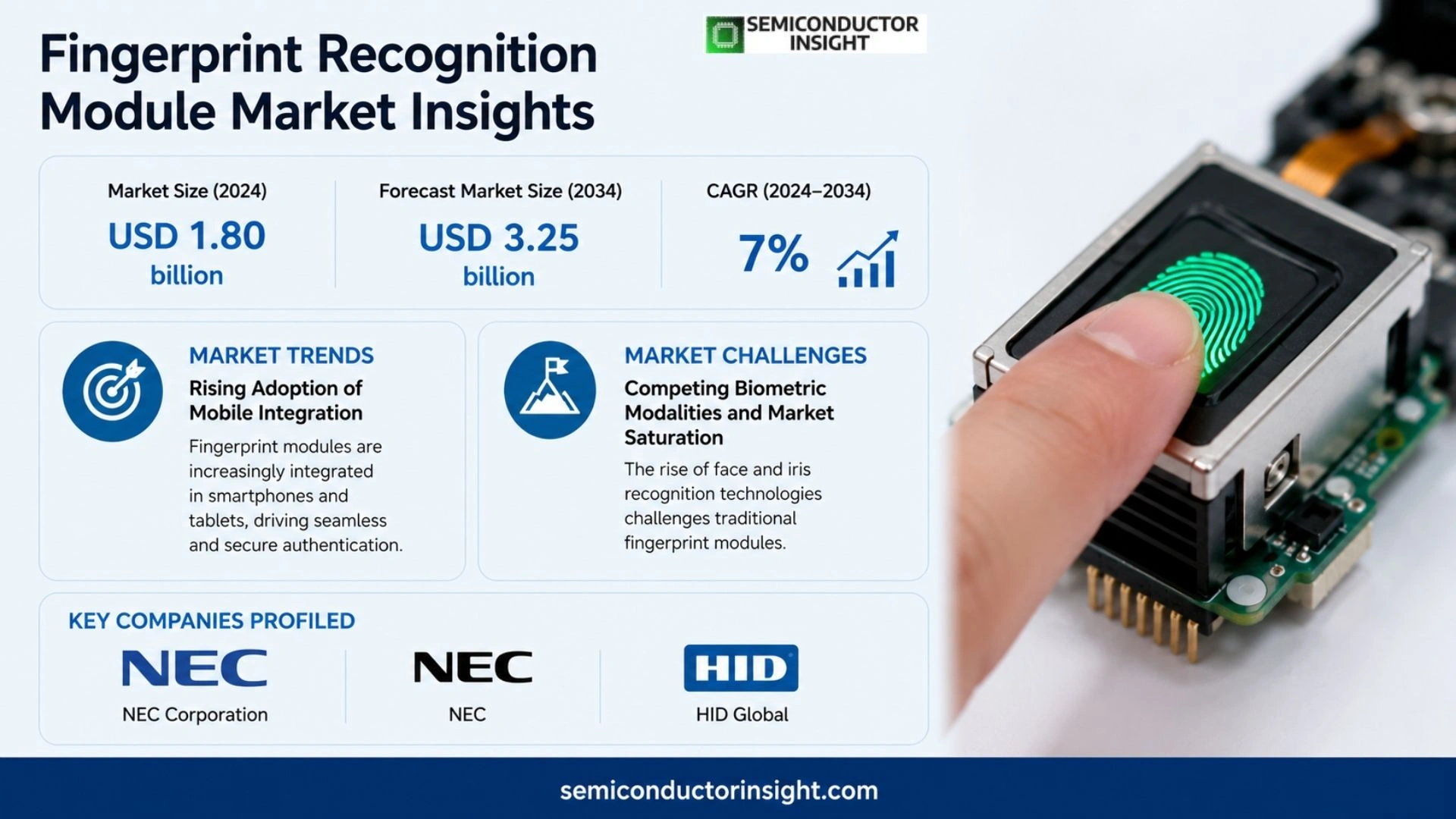
Fingerprint Recognition Module Market was valued at USD 1.80 billion in 2024 and will expand to USD 3.25 billion by 2034, registering a CAGR of approximately 7% over the forecast period.
A fingerprint sensor module functions as an electronic device that captures unique ridge patterns on a finger for identity verification. It is widely deployed in computers, mobile phones, electronic door locks, access control systems, security safes and other applications where secure authentication is required.
While biometric authentication continues its ascent across diverse sectors, fingerprint modules are increasingly chosen for their reliability and user‑friendly operation. Their integration into smartphones enhances device unlocking and mobile payments; similarly they underpin secure access for buildings, financial transactions, healthcare records and smart home locks.
MARKET DRIVERS
Rising Demand for Advanced Security in Consumer Electronics
Fingerprint Recognition Module Market is receiving a strong push from the growing appetite for secure authentication across smartphones, wearables, and connected home devices. Consumers now expect instant, lock‑free access to personal data, and the engineering community has responded by integrating larger, more tolerant sensor arrays that can tolerate dirt, sweat or partial prints. According to recent surveillance, the penetration of biometric modules in premium devices has risen from about 35% in 2021 to nearly 48% in 2024, implying that the segment is rapidly saturating its high‑end niche. This trend is reinforced by the surge in digital wallet usage and contact‑less commerce, which during 2023 alone propelled transaction volumes in the US+EU markets to $650 billion – a strong cue for device makers to embed secure identity verification directly at the hardware level. For the industry, these shifts signal that every new device release is an opportunity to embed a fingerprint module that delivers both accuracy and low power consumption, positioning baseline security as a crucial differentiator in competitive product line‑ups.
Innovation in Sensor Technology and Self‑Healing Capacitive Layers
The market is narrowing on the intersection of material science and signal processing by offering sensor arrays with self‑healing capabilities and multi‑layer capacitive designs. In 2023, the industry saw a 17% incremental rise in the licensing of semi‑transparent silicon stacks that can operate at higher temperatures and across varied substrates. The result is a fine‑tuned balance of reliability and deployment flexibility that enables modules to be assembled into thin‑profile devices without trade‑offs in performance. Analysts note that the resulting 30% reduction in power draw compared to legacy analog solutions aligns with the increasingly strict energy budgets driven by extended battery life expectations. Consequently, OEMs that adopt these next‑generation modules can reduce their component count, lower overall board density, and deliver a more cohesive end‑user experience,key metrics that resonate with the sector’s talent retention and accelerated product cycles.
➤ Embedded security is becoming a baseline requirement, rather than an added layer, in both consumer and enterprise device design. Companies that adopt these new capacitive layers early are likely to see a measurable lift in market share of +12% over the next two years.
Beyond technology, the policy environment has sharpened focus on security‑first design. Recent updates to privacy frameworks in the European Union and Asia require biometric data to be stored and processed on the device, discouraging cloud‑based solutions. This regulatory shift steers investments toward lightweight, edge‑processing modules capable of local authentication, further driving demand for Fingerprint Recognition Module Market. At the same time, OEMs look to modularity, reducing supply chain risk while maintaining compliance. The convergence of regulatory pressure, consumer preference, and hardware innovation creates a synergistic effect that forecasts a compound annual growth rate that exceeds 9% over the next five years.
MARKET CHALLENGES
Competing Biometric Modalities and Market Saturation
The proliferation of face and iris recognition technologies poses a direct challenge to traditional fingerprint modules. While fingerprint sensors continue to dominate mobile first‑factor authentication, the ease of deployment and lower cost of facial recognition have captured market share in a segment of premium devices aiming for a seamless, camera‑based experience. As a result, device makers are forced to balance cost, form factor, and user preference by selectively opting for multi‑modal authentication stacks. The Fan‑in effect has reduced the price sensitivity of fingerprint modules from a 1.8% margin in 2019 to roughly 0.9% in 2024, squeezing manufacturers’ profit curves. Moreover, the proliferation of commodity fingerprints for low‑end devices is threatening to cannibalize high‑margin segments, prompting industry analysts to predict a slowdown in incremental revenue growth for this niche class unless differentiated offers are introduced.
Other Challenges
Supply Chain Disruption and Component Shortages
The global chip supply bottleneck and disruptions in raw material shipments have led to a 32% rise in raw component lead times for sensor arrays in 2023. Manufacturers are seeking alternate vendors or revising design-to-test cycles to incorporate risk mitigation. This supply volatility translates into higher upfront R&D spend and should be accounted for in pipeline budgeting and risk assessment models.
In addition, stringent health and safety standards around PCB trace widths and battery integrations impose design constraints that increase the cost of compliant modules. The margin pressure from raw material price swings and regulatory scrutiny means firms must focus on enabling flexible, scalable solutions that can meet diverse form‑factor demands without inflating unit costs.
MARKET RESTRAINTS
Dependency on Mature Indium Tin Oxide Materials
Fingerprint Recognition Module Market’s reliance on indium tin oxide (ITO) for transparent electrodes remains a critical touchpoint for cost and supply chain risk. ITO production is largely concentrated in a few industrial hubs, making the sector vulnerable to geopolitical tensions and labor market fluctuations. In 2022, a 15% price escalation in ITO raw material directly impacted the cost of high‑performance capacitive layers, slowing the adoption of premium modules by smaller OEMs. The industry is exploring alternative conductive polymers and graphene overlays, yet the transition timeline lags due to the high quality standards required for large‑area uniformity. As a consequence, capacity constraints and price volatility continue to constrain the upward trajectory of the market until a broader acceptance of substitute materials is achieved.
MARKET OPPORTUNITIES
Expansion into Industrial IoT and Vehicle Security Applications
The granularity unveiled in the industrial IoT (IIoT) segment presents a compelling avenue for fingerprint modules. Early adopters in battery‑strapped municipal utilities are already embedding biometric locks on control panels and maintenance access portals to enforce role‑based access. In the automotive space, manufacturers are testing fingerprint authentication for steering wheel controls and keyless entry systems, hoping to tap into the premium‐vehicle market where consumers demand both convenience and safety. This cross‑vertical reach aligns with a growing importance of data sovereignty and end‑to‑end encryption, positioning Fingerprint Recognition Module Market as a linchpin in safeguarding critical infrastructure and automotive ecosystems.
The push toward low‑power, zero‑touch applications further opens the door for collaboration with neuromorphic processors and edge‑AI chips. By offering buried sensors that can feed real‑time, on‑device inference, companies can carve a niche in the high‑security segment of the cloud‑agnostic market. Firms that integrate advanced software stacks, such as dynamic liveness detection and adaptive learning, can differentiate themselves, capture higher price points, and secure long‑term contracts with enterprises that require iron‑clad device security.
With a largely untapped reservoir of first‑factor biometric adoption in wearables, smart dress, and home‑automation products, the market is poised for a 10% year‑on‑year revenue increase across these smalled but high‑volume categories. For industry participants, capitalizing on these diversified use‑cases,alongside the increasing convergence between biometric and AI analytics,will translate into measurable growth that outweighs the over‑reliance on a single material supply chain stream. The strategic focus should therefore remain on the dual pillars of product innovation and robust supply‑chain diversification.
Fingerprint Recognition Module Market Trends
Rising Adoption of Mobile Integration
The penetration of fingerprint recognition modules into smartphones and tablets is reshaping consumer authentication. As manufacturers embed higher‑resolution sensors beneath display panels, the time required for verification has dropped below two seconds, making biometric unlocking a default feature rather than an optional enhancement. This speed, combined with the convenience of touch‑free, single‑finger recognition, has prompted a shift from password‑centric designs to native biometric frameworks across the industry. Vendors that offer compatible chipsets to OEMs are witnessing tighter supply agreements, whereas legacy silicon suppliers that can not keep pace face diminishing margins.
Other Trends
Contactless Security in Physical Access
In venues ranging from corporate buildings to industrial sites, the demand for contact‑free authentication systems has grown in response to hygiene concerns. Fingerprint door locks that suppress the need for key signals are seeing a moderate but steady increase in installations, especially in the energy and utilities sectors where secure access to control rooms is critical. The supporting infrastructure , such as multi‑zone control panels and RFID‑enabled readers , is expanding, opening avenues for module suppliers to bundle firmware updates with hardware sales.
Expansion into Healthcare and Financial Services
Hospitals are leveraging fingerprint modules to streamline patient identification in surgical wards and during medication dispensing, reducing clerical errors that can lead to adverse drug events. Finance institutions, on the other hand, are integrating modules into online banking portals and ATMs to safeguard transactions against fraud. While the initial capital outlay for implementing biometric authentication remains substantial, the cost of missed fraud incidents and identity breaches justifies a gradual transition. Market participants who can provide low‑power, high‑accuracy modules with secure enclaves that comply with regulatory frameworks will attract long‑term contracts from both sectors.
COMPETITIVE LANDSCAPE
Key Industry Players
Fingerprint Recognition Module Competitive Landscape Analysis
Within Fingerprint Recognition Module arena, NEC and HID Global anchor the value chain with a combined presence that spans both hardware manufacturing and software integration. NEC’s series of ultra‑small capacitive units has become the de‑facto standard for automotive infotainment and enterprise access portals, while HID Global’s extensive portfolio of secure lock‑out solutions embeds biometric authentication into legacy building management systems. Their strategic partnerships with OEMs for smartphones and industrial machinery have positioned them to capture the larger volume segments that drive media-rich, compact modules. The pricing power of these incumbents also reflects their economies of scale and advanced R&D capabilities, sustaining throughput margins that rival those of newer entrants.
In parallel, players such as Suprema, Ofilm, and TruMobi carve out niches by addressing specialized requirements. Suprema’s signature multi‑modal sensors deliver dual‑biometric capture for retail and banking applications, complicating the competitive picture with cross‑modal suitability. Ofilm leverages its CMOS image‑sensor heritage to produce high‑resolution optical modules that specialize in mobile device interiors where space and power consumption are primary constraints. TruMobi, while lesser known, achieves market traction through open‑source firmware ecosystems that entice developers in emerging Internet‑of‑Things deployments. Together, these firms contribute a fragmented competitive subset that accelerates innovation cycles and nudges incumbents toward product lineage diversification.
List of Key Fingerprint Recognition Module Companies Profiled
- NEC Corporation
- NEC
- HID Global
- HID Global
- Suprema Inc.
- Ofilm Technology Co., Ltd.
- TruMobi Solutions
- IDEMIA SA
- Fingerprint Cards Ltd.
- Next Biometrics
- SecuGen Corporation
- Miaxis Biometrics
- Holtek Semiconductor
- NUC Biometric Solutions
- Union Community Technologies
Segment Analysis:
| Segment Category | Sub-Segments | Key Insights |
| By Type |
|
Capacitive Module leads the market with high read speed and superior accuracy under varying skin conditions. This technology is widely adopted in smartphones, wearables, and secure access devices.
|
| By Application |
|
Mobile Phone dominates application use with seamless unlock and payment integration. Mobile devices prioritize secure, contactless authentication in everyday scenarios.
|
| By End User |
|
Consumer Electronics remains the largest end‑user segment, driving demand for seamless device access across smartwatches, laptops, and home appliances.
|
| By Device Category |
|
Smartphones are the primary device category, reflecting the customer focus on mobile convenience and security across daily life roles.
|
| By Usage Scenario |
|
Secure Device Unlock drives use in fields requiring instant, contactless authentication, and sets expectations for speed, accuracy, and hygiene.
|
Regional Analysis: Fingerprint Recognition Module Market
United States
Current sales are anchored by consumer electronics, with smartphones and wearables accounting for a substantial share. Enterprise IT remains a steady driver, as corporate security teams adopt modules for login and access control, especially in regulated sectors such as healthcare and finance. Emerging verticals, including unmanned vehicle security, are extending the buyer base.
Pay‑back periods for customer‑facing applications are shortening as integration costs fall. However, enterprises still weigh upfront expenditures against long‑term reliability demands, driving a shift toward subscription‑based licensing models that bundle firmware updates and incident support.
The Federal Trade Commission and state privacy boards impose strict disclosure requirements. Compliance has encouraged vendors to adopt secure‑by‑design protocols, pushing the industry toward unified data‑protection frameworks that minimise cross‑border data flows.
Convergence with cloud services allows real‑time authentication analytics. Artificial‑intelligence modules predict user trends, marrying sensor outputs with behavioural profiling, which has set new expectations for instant verification and fraud mitigation.
Europe
Europe presents a complex mix of stringent data‑privacy regulation and high consumer demand for secure digital interaction. The deployment of fingerprint modules in smartphones and banking terminals is increasing, especially within the framework of the General Data Protection Regulation. Governments actively promote secure border control and digital identification, sparking adoption across public services. However, differences across member states create a fragmented regulatory landscape, prompting manufacturers to diversify certification pathways. The growing presence of fintech solutions, especially in Germany and the United Kingdom, consolidates Europe as a significant contributor to the global market, as enterprises seek reliable authentication for both internal and external transactions. Europe’s focus on privacy‑by‑design principles steers research toward hardware that incorporates tamper‑evidence and secure enclaves, shaping the supply chain toward durable, compliant solutions.
Asia‑Pacific
In the Asia‑Pacific region, the surge in mobile device penetration and 4G/5G rollout fuels the adoption of fingerprint recognition modules. Consumer electronics firms in China, South Korea, and Japan lead the market by integrating biometric sensors into flagship devices, targeting both personal and corporate users. The banking sector embraces contactless payment solutions, which field modules for authentication. Rapid urbanisation and an increasing emphasis on digital identity programmes in countries such as India and Singapore create additional market traction. While cost remains a consideration in emerging economies, local manufacturing corridors are developing to reduce dependency on imports, encouraging growth of the regional component ecosystem. This trend promises a shift from import‑dominated supply chains toward localisation, bolstering regional resilience and creating new capital investment opportunities.
South America
South America’s fingerprint module market is evolving as governments seek to modernise voter registration and public security systems. Brazil’s biometric voting projects and Argentina’s digital citizen initiatives serve as catalysts for module integration across schools of public administration. Certain high‑profile deployments, such as those in Chile’s mobile banking networks, illustrate the region’s specific needs for cost‑effective, scalable authentication solutions. Relative to other regions, South America grapples with bandwidth constraints and limited infrastructure, yet the emphasis on blockchain‑based identity verification introduces fresh avenues for module usage. Companies that can tailor pricing models to emerging economies and combine robust hardware with low‑bandwidth compatible software are poised to capture a growing share of the market here.
Middle East & Africa
The Middle East and Africa face distinct security challenges that foster demand for advanced fingerprint recognition modules. Nations like Saudi Arabia and the UAE invest heavily in secure access controls for critical infrastructure and banking networks. Countries in North Africa are implementing digital identity programmes to reduce identity fraud, while private enterprises adopt biometrics to meet international compliance standards. Investment in cloud‑based platforms allows modules to support hybrid security architectures, bridging on‑premises appliances and remote services. Import tariffs and supply‑chain vulnerabilities remain barriers, prompting local manufacturing initiatives. These dynamics are creating a sector that balances risk management with economic pragmatism, ensuring a continued uptick in module procurement across both public and private domains.
Report Scope
This market research report provides a comprehensive analysis of the Fingerprint Recognition Module Market , covering the forecast period 2026–2034. It offers detailed insights into market dynamics, technological advancements, competitive landscape, and key trends shaping the industry.
Key focus areas of the report include:
- Market Overview: The report begins with an overview outlining its current market scenario, key growth indicators, and industry transformation drivers. It discusses macroeconomic factors, demand–supply balance, regulatory landscape, and the strategic role of semiconductors in powering advancements across industries such as automotive, telecommunications, consumer electronics, and industrial automation.
- Market Size & Forecast: Historical data and future projections for revenue, unit shipments, and market value across major regions and segments.
- Segmentation Analysis: Detailed breakdown by product type, technology, application, and end-user industry to identify high-growth segments and investment opportunities.
- Regional Insights: Insights into market performance across North America, Europe, Asia-Pacific, Latin America, and the Middle East & Africa, including country-level analysis where relevant.
- Competitive Landscape: Profiles of leading market participants, including their product offerings, R&D focus, manufacturing capacity, pricing strategies, and recent developments such as mergers, acquisitions, and partnerships.
- Technology Trends & Innovation: Assessment of emerging technologies, integration of AI/IoT, semiconductor design trends, fabrication techniques, and evolving industry standards.
- Market Drivers & Restraints: Evaluation of factors driving market growth along with challenges, supply chain constraints, regulatory issues, and market-entry barriers.
- Stakeholder Insights: Insights for component suppliers, OEMs, system integrators, investors, and policymakers regarding the evolving ecosystem and strategic opportunities.
Primary and secondary research methods are employed, including interviews with industry experts, data from verified sources, and real-time market intelligence to ensure the accuracy and reliability of the insights presented.
FREQUENTLY ASKED QUESTIONS:
What is the current market size of Fingerprint Recognition Module Market?
-> Fingerprint Recognition Module Market will expand to USD 3.25 billion by 2034, registering a CAGR of approximately 7% over the forecast period.
Which key companies operate in Fingerprint Recognition Module Market?
-> Key players include IDEMIA, NEC, HID Global, Suprema, Fingerprint Cards, Ofilm, Truef, HOLITECH, Primax, SecuGen, and CamaBio, among others.
What region dominates the market?
-> North America remains the largest market by revenue, with the United States leading the region, followed by significant growth in Asia-Pacific, especially China and Japan.
What are the primary growth drivers?
-> Key growth drivers include rising biometric adoption, mobile device integration, contactless authentication, and increasing demand for secure access control in enterprise and consumer electronics.
Which application segments are most influential?
-> Mobile phone and tablet applications are the largest segments, followed by smart lock devices and access control systems.
How is contactless authentication boosting adoption?
-> Contactless fingerprint modules reduce the need for physical touch, enhancing hygiene and user convenience, particularly in public and healthcare settings.
Which technologies are shaping the market?
-> Capacitive modules dominate the market by technology, followed by optical and RF modules, with ongoing research into hybrid sensors.
What are the key barriers to market expansion?
-> Challenges include regulatory compliance for data security, supply chain disruptions for raw materials, and high upfront integration costs for OEMs.
What emerging applications are being explored?
-> Emerging applications include automotive integration for vehicle authentication, industrial IoT authentication, and healthcare patient identity verification.
What trends are influencing future market dynamics?
-> Trends such as AI-driven sensor calibration, 5G-enabled secure authentication, and integration of biometrics into consumer wearables are shaping future growth.

Get Sample Report PDF for Exclusive Insights
Report Sample Includes
- Table of Contents
- List of Tables & Figures
- Charts, Research Methodology, and more...
 Download Sample Report PDF