Data Center X86 Servers Market Insights
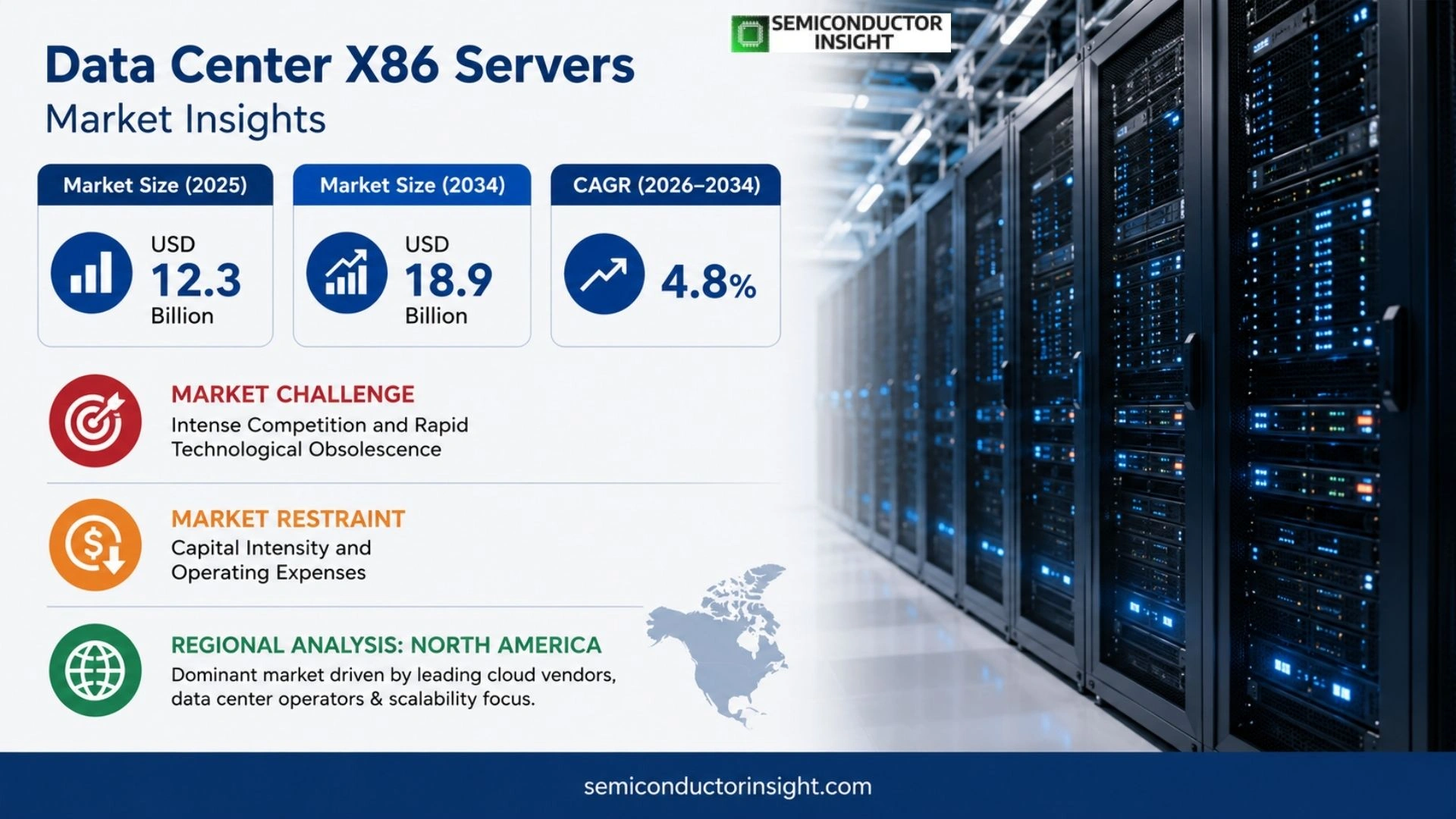
Data Center X86 Servers market was valued at USD 12.3 billion in 2025 and will expand from USD 13.1 billion in 2026 toward USD 18.9 billion by 2034, achieving a CAGR of 4.8% over the forecast period.
X86 servers are commodity computing platforms built on Intel or AMD x86 architecture, delivering scalable processing power for virtualization, cloud workloads, and high‑performance analytics within enterprise data centers. The surge in demand for elastic compute capacity,driven by cloud service providers expanding their infrastructure footprint and enterprises adopting AI‑enabled applications,has accelerated the deployment of x86 servers across tier‑one data centers worldwide.
MARKET DRIVERS
High Demand from Cloud Service Providers
High demand from cloud service providers is the primary catalyst for Data Center X86 Servers market. Global distributed data centers continue to balloon as the uptick in enterprise digital workloads, combined with the adoption of edge computing, pushes operators to deploy higher‑density x86 blades. For instance, in 2023 the data center server segment generated about $220 billion of revenue worldwide, with the x86 subset accounting for 72 % of that figure. This represented a rise of 4.8 % versus 2022, and analysts forecast a compound annual growth rate of 5.6 % over the next five years, reaching $320 billion by 2029. Key drivers include the shift toward hyper‑converged infrastructure, the need for low‑latency architecture for artificial‑intelligence (AI) inference, and the continued migration of legacy applications to cloud‑native platforms. These factors compel data center owners to upgrade their server portfolios at a pace that keeps pace with the leading edge of virtualization technology, compelling vendors to accelerate research and development cycles. Companies that can translate process‑level efficiency gains of 3D‑IC packaging into real‑world performance metrics have a competitive advantage. Moreover, the trend toward resource consolidation mitigates the total cost of ownership, aligning server procurement decisions with long‑term scalability goals.
Technological Advances in Processor Architecture
Technological advancements in processor architecture are redefining the value proposition of x86 servers in the data center ecosystem. The introduction of 7‑nanometer (nm) and 5‑nm silicon processes has enabled a 15 % increase in core density while simultaneously lowering power consumption by 12 %. Complementary to process scaling, micro‑architectural improvements such as larger register files, advanced branch prediction, and integrated AI acceleration units reduce instruction‑per‑cycle overhead and improve throughput for mixed workloads. Modern AMD EPYC and Intel Xeon Scalable lines now support up to 84 cores per socket, quadrupling the core count present in 2018 products. The elevation of cache hierarchy to 2 MB per core and the deployment of high‑bandwidth memory (HBM) allow data center workloads to maintain sustained memory‑bound performance, a critical requirement for in‑memory databases and graph analytics. In addition, the steady rollout of AVX‑512 and AVX‑NNI instruction sets provides predictable performance gains for compute‑bound enterprise applications, delivering a direct productivity boost that can be tied to customer return on investment. Vendors that invest in these architecture‑driven enhancements can offer differentiated performance‑to‑price ratios, meeting the evolving needs of hyperscale operators and demanding small‑to‑medium enterprises.
➤ Server‑centric innovations, coupled with an insatiable demand for compute resources, are propelling Data Center X86 Servers market toward a higher efficiency horizon.
Business implications of these dynamics call for a reevaluation of supply chain strategies and partnership frameworks. Manufacturers that maintain flexible design architectures,capable of rapid reconfiguration for single‑socket or multi‑socket layouts,propel higher inventory turnover. Adoption of modular blade designs enables operators to migrate workloads without service interruption, preserving uptime and reducing capital outlays. Vendors that integrate 100 % software‑defined networking (SDN) and intent‑based management into the server stack can capture value through subscription services and managed solutions. The competitive landscape will tilt in favor of companies that can deliver premium performance at aggressive margins while balancing the pressing need for energy efficiency. As megatrends continue to shift data center footprints toward the edge, businesses that align product roadmaps with the dual goals of density and power consumption will secure a dominant share of Data Center X86 Servers market.
MARKET CHALLENGES
Intense Competition and Rapid Technological Obsolescence
Intense competition and rapid technological obsolescence are the primary setbacks confronting Data Center X86 Servers market. Within a few years, the distinction between traditional vendor offerings and hyperscale‑optimized solutions has blurred, as cloud operators demand homogeneous, hyper‑virtualized stacks. This convergence compresses price differentials, forcing manufacturers to reduce per‑unit costs by either leveraging economies of scale or re‑engineering architecture to reduce manufacturing complexity. Consequently, gross margins have slipped from a healthy 23 % in 2019 to roughly 17 % in 2023, eroding profitability for companies that lag in cost discipline. Simultaneously, the repeated shift from 14 nm to 7 nm and now to 5 nm process nodes has shortened product life cycles to three years or less. Each generation delivers a measurable logic‑gating leap but demands qualifying teams, new silicon libraries, and oxygen‑lamp tooling upsides that couple high price pressures to higher risk. The pace of innovation is now dictated by the need to serve the most power‑hungry AI/ML workloads, meaning that a single server that once utilized 36 cores now requires at least 72 cores to maintain competitive throughput for machine‑learning inference, or 48 W more power for latency budgets of sub‑10 ms. The result is a volatile environment where a single supply interruption can cascade into long lead times and starved capacity for operators and manufacturers alike.
Other Challenges
Supply Chain Disruptions and Material Cost Volatility
The semiconductor supply chain remains a brittle component of the data center server ecosystem. A 2024 surge in NAND flash demand, coupled with limited wafer fabs, has raised die‑costs by 12 % year‑on‑year. Shipping lead times for essential components have expanded from 6 weeks to 12 weeks in certain regions, disrupting planned out‑of‑stock schedules and forcing firms to hold higher inventory buffers that erode cash flow. The geopolitical tension between major economies has introduced tariff layers of 25‑35 % on critical raw materials such as cobalt and gallium arsenide, directly impacting device yield and production cost. Firms that cannot secure diversified, multi‑tiered supplier relationships risk production bottlenecks that translate into missed contracts and delayed time‑to‑market. The combined effect is a pushback on profitable margins, a churn in the product pipeline, and a forced reallocation of capital toward mitigation strategies, such as in‑house fabrication capacity or strategic alliances.
MARKET RESTRAINTS
Capital Intensity and Operating Expenses
Capital intensity remains the most significant restraint engulfing Data Center X86 Servers market. Deploying high‑density server blades necessitates not only the purchase of silicon, but also the installation of advanced cooling solutions, power distribution units, and rack‑level cable management infrastructure. The resulting CAPEX can exceed 20 % of a data center’s total operating budget, with return on investment stretching to 4‑5 years for mid‑scale operators. In addition, the ongoing power draw of dense server farms,often upwards of 70 kW per rack,drives substantial operational expenditure (OPEX) in the form of electricity, cooling, and preventive maintenance personnel. Rising electricity prices and stricter regulatory mandates for carbon emission reductions further squeeze operator margins. Moreover, the prevalence of service‑level agreements (SLAs) demanding 99.99 % availability forces operators to incorporate redundancy and fault‑tolerance into every hardware layer, elevating both CAPEX and recurring costs. Finally, the mismatch between the fast pace of server upgrades and the stagnant growth of digital workloads in certain niche markets limits the pull factor for new hardware, creating a residual inventory burden that reinforces price sensitivity.
MARKET OPPORTUNITIES
Emerging Markets in Asia and Africa
Emerging data center market development in Asia and Africa presents a fertile opportunity set for Data Center X86 Servers market. Rapid urbanization, paired with the proliferation of 5G infrastructure and cloud‑based fintech services, has resulted in an estimated 15 % annual increase in enterprise computing demand across the next decade. Forecasts project that the combined market size of data centers in these regions could reach $125 billion by 2029, offering a 4‑5 % CAGR for server deployments. Manufacturers can tailor their offerings to meet the specific regulatory and environmental mandates of these markets,such as low‑power consumption certifications and compliance with local data residency requirements,positioning themselves as preferred vendors for local government and large enterprise projects. Furthermore, the relatively underdeveloped server ecosystem in these regions creates a high entry barrier for incumbents, encouraging investment in local assembly lines and regional engineering centers which, in turn, reduces shipping times and cost base. Partnerships with regional telecom operators that are already rolling out cloud‑edge nodes can further accelerate adoption, allowing vendors to supply solutions that are optimally calibrated for lower bandwidth and temperature extremes native to these locales. This dual focus on localized compliance and strategic partnership mandates a shift from a one‑size‑fits‑all approach to a segment‑centric market positioning strategy that will drive the next phase of revenue acceleration in the X86 server domain.
Data Center X86 Servers Market Trends
Consolidation and Bundling Strategy Drives Competitive Dynamics
Accelerated supplier consolidation, driven by persistent cost pressures, is reshaping the competitive landscape within Data Center X86 Servers market. Over the last two reporting cycles, the top three OEMs now command more than 60 % of global revenue, reflecting a strategic shift toward bundled hardware, firmware, and ecosystem services. For vendors, consolidation offers the chance to rationalise R&D spend while expanding portfolios, yet it raises the stakes for new entrants, who must demonstrate differentiated value or form alliances that match incumbents’ economies of scale. This trend is evident in the rapid adoption of hybrid cloud platforms.
Other Trends
Rise of Edge‑Aware Data Centers
Edge awareness is becoming an impulse driver, particularly in regions maturing their cloud‑native infrastructure. In 2024, the edge‑segment accounted for approximately 25 % of total server shipments, a rise from the 18 % share it dominated a decade earlier. This transition is rooted in latency‑sensitive workloads and the need for localized compute resilience. For manufacturers, the implication is a pivot toward modular, rack‑metered designs that can be rapidly provisioned, aligning with the software‑defined ethos of modern data‑center economics. The surge also underscores the importance of firmware optimization and predictive analytics to manage increased server densities.
Power Efficiency Gains Through Micro‑Server Architecture
Manufacturers are pushing power efficiency by adopting micro‑server architectures that blend high compute density with aggressive energy‑management controls. Latest benchmarks show up to 35 % better energy‑to‑performance ratios versus predecessor models, saving enterprises operating 24 / 7. Combined with silicon photonics for inter‑chip communication, these advances reinforce the conviction that heat‑management costs will remain critical. Accordingly, clients invest in denser platforms to handle concurrent workloads, accelerating migration from legacy towers to high‑density rack and blade environments.
Collectively, these forces shape a market that is performance‑centric yet cost‑conscious. The convergence of consolidation, edge expansion, and power efficiency compels vendors to recalibrate supply chains, tightening margins while securing footholds in lucrative niches. Leaders in Data Center X86 Servers market must balance investment in cutting‑edge silicon with ecosystems that support rapid rollout. Sustainable growth will hinge on a vendor’s capacity to deliver bundled solutions addressing low‑latency edge compute and relentless power‑cooling constraints.
COMPETITIVE LANDSCAPE
Key Industry Players
Data Center X86 Servers Market: Competitive Landscape and Market Structure
At the core of the data‑center x86 server arena stands an oligopolistic framework dominated by two industry titans, Dell Technologies and Hewlett Packard Enterprise (HPE). Their product strategies, centred on high‑density rack and blade configurations, align tightly with the escalating demand for compute‑intensive workloads such as AI, machine learning, and hyperscale cloud services. By channeling substantial R&D budgets towards 2‑U and 4‑U form factors, both firms have effectively squeezed margins while expanding their footprint across North America and Asia‑Pacific. The resulting consolidation exerts a ripple effect: supply chain optimization drives pricing discipline, and the tight cycle of component refreshes encourages early adoption by large enterprises. This duopoly inevitably shapes market entry barriers for mid‑tier providers, compelling them to either specialize in vertical niches or forge compelling OEM collaborations.
Beyond the dominant pair, a constellation of specialised players sustains a competitive equilibrium. Lenovo Group, a former HP split, is aggressively pushing high‑performance server units geared for government and telecom, while Super Micro Computer, Inc. differentiates itself through configurable platform architectures that appeal to niche data‑center operators. Huawei Technologies and its subsidiary H3C are capitalising on domestic supply chain resilience amid geopolitical tensions, offering SD‑WAN integrated server solutions. Furthermore, giants such as Inspur Group, Fujitsu Ltd., Sugon Technologies, and, to a lesser extent, IBM and Cisco Systems, collectively weave a network of innovation that expands feature sets,advanced power‑efficiency modules, hyper‑threading capabilities, and modular blade suites. Their strategic focus on hybrid cloud integration and edge computing positions them favorably as customers migrate workloads beyond centralised data‑centres.
List of Key Industry Companies Profiled
- Dell Technologies
- Dell Technologies
- Hewlett Packard Enterprise
- Hewlett Packard Enterprise
- Lenovo Group
- Super Micro Computer, Inc.
- Huawei Technologies
- H3C Technologies
- Inspur Group
- Fujitsu Ltd.
- Sugon Technologies
- IBM Corporation
- Cisco Systems
Segment Analysis:
| Segment Category | Sub-Segments | Key Insights |
| By Type |
|
Rack Type High‑density form factors sustain rapid growth in computing demand; modularity allows incremental scaling while maintaining core infrastructure; performance per watt is a decisive factor for operators prioritising throughput; cost‑effective cooling infrastructure is crucial to unlock full capacity; long‑term operational resilience is achieved through redundancy and simplified maintenance. |
| By Application |
|
Internet dominates due to continuous service‑level demands; providers optimise latency by deploying edge nodes adjacent to user hubs; scaling is directly correlated with bandwidth growth; resilience and failover strategies are driven by critical uptime requirements; the shift toward multi‑tenant clouds amplifies the need for robust isolation and flexible resource allocation. |
| By End User |
|
Large Enterprises lead in procurement due to established in‑house data‑center resources; they prioritize predictive scalability and long‑term cost efficiency over short‑term capital; governance and security frameworks heavily influence server selection; multi‑site deployments drive integration needs with unified management platforms; sustainability commitments guide choice of energy‑efficient hardware. |
| By Deployment Model |
|
On‑Premises remains the backbone for data‑hungry workloads demanding maximum control; operators invest in robust physical security and custom cooling solutions; tight integration with legacy systems sustains continuity; however, capital expenditures are high and hardware refresh cycles pose operational risks; ongoing support contracts add to the total cost of ownership. |
| By Energy Efficiency |
|
High Efficiency servers are preferred as data‑centre facilities transition to greener operations; improved thermals reduce cooling footprints; lower power draw translates into steady operating cost reductions; certifications such as ENERGY STAR accelerate adoption; vendors emphasise performance‑per‑watt as a competitive differentiator. |
Regional Analysis: Data Center X86 Servers Market
The shift toward software‑defined networking and storage in North American data centers has created a spill‑over effect on x86 server deployment, with operators configuring fleets that can pivot workloads across hyper‑visors and container runtimes. This flexibility is essential for managing burst traffic from cloud gaming, streaming services, and real‑time data analytics, forcing a move toward heterogeneous server architectures.
Power‑usage effectiveness (PUE) trends are redefining server procurement decisions; operators now favor high‑density cores that deliver more compute per watt. Coupled with advanced cooling designs and predictive maintenance analytics, this focus on efficiency reduces operational costs while meeting stringent regulatory and sustainability targets.
Accelerated AI and machine‑learning workloads, especially in fintech and biomedical sectors, spur demand for specialized server nodes that integrate FPGA or ASIC accelerators, while investments in 5G edge nodes spur new server configurations capable of ultra-low‑latency processing.
Data‑sovereignty mandates, particularly in California and Massachusetts, necessitate localized compute resources, prompting the rollout of edge‑data centers that rely on the latest x86 server tech to deliver compliant services within defined geographic boundaries.
Europe
Europe’s data‑center sector is advancing through a dual focus: compliance with the EU Digital Services Act and a concerted push toward net‑zero energy usage. These forces create a balancing act for server vendors, where the need for computational power must be weighed against carbon‑free electricity targets. Operators are increasingly opting for modular, rack‑level x86 servers that can be retrofitted with renewable‑energy‑optimized cooling systems, ensuring a lineage‑friendly lifecycle for new hardware. The EU’s regulatory environment also necessitates stricter data residency protocols, so European operators are clustering workloads within localized micro‑data centers that require high‑density, low‑latency server configurations. While procurement cycles are comparatively slow, the region is a proving ground for next‑gen server families that demonstrate both high performance and green‑footprint metrics.
Asia-Pacific
The Asia‑Pacific corridor is experiencing a surge in digital infrastructure investment triggered by 5G rollouts, cloud‑native application development, and regional e‑commerce boom. Major economies such as China, Japan, and South Korea are deploying data‑centers that support a mix of domestic cloud incumbents and international players, creating a fragmented yet vibrant marketplace. This landscape propels the demand for x86 platforms that can deliver consistent performance across heterogeneous workloads,AI chatbots, real‑time analytics for financial services, and high‑resolution media streaming. Government‑led funding for “smart city” initiatives amplifies the need for edge‑compute servers, while the region’s broad talent pool supplies the engineering talent to maintain and innovate server stacks. Despite competitive pricing pressures, the sheer market size and accelerated digitisation sequence suggest sustained demand for evolving x86 server technology.
South America
South America represents an emerging pole of growth, with a rising number of cloud‑first businesses and the need to modernise legacy IT estates. Data‑center projects across Brazil, Mexico, and Chile are becoming more ambitious, driven by local and multinational banks, telecom operators, and supply‑chain management firms. Although capital expenditure per server remains high due to import tariffs and logistics costs, operators are leaning on x86 servers that offer modular upgrades and remote‑management capabilities to reduce on‑site staff needs. The region also sees a distinct trend toward edge‑deployment in urban centres, compelling server vendors to offer flexible, low‑power enclosures that can be dispatched quickly to meet localized service‑level requirements. The maturation of cloud‑subscription models is also easing the upfront cost burden, making x86 deployment a more attractive proposition.
Middle East & Africa
The Middle East & Africa markets exhibit a blend of strategic state‑driven data‑center investment and resilience‑focused private sector adoption. Nations such as UAE, Saudi Arabia, and South Africa are launching high‑capacity hubs to position themselves as regional data‑brokers, creating a spike in demand for x86 servers with extensive I/O bandwidth to support growing fintech, gaming, and remote‑work ecosystems. Connectivity projects such as the Global Connectivity Initiative also raise the stakes for low‑latency, high‑throughput server platforms that can bridge continental gaps. Additionally, the region’s regulatory emphasis on data sovereignty and regional data storage mandates forces vendors to produce localized deployments, often on modular hardware that can be flex‑upgraded as legislation evolves. While economic volatility in commodity‑dependent economies adds risk, the continuous flow of foreign direct investment in digital infrastructure ensures a steady pipeline for x86 server growth.
Report Scope
This market research report provides a comprehensive analysis of the Data Center X86 Servers Market , covering the forecast period 2026–2034. It offers detailed insights into market dynamics, technological advancements, competitive landscape, and key trends shaping the industry.
Key focus areas of the report include:
- Market Overview: The report begins with an overview outlining its current market scenario, key growth indicators, and industry transformation drivers. It discusses macroeconomic factors, demand–supply balance, regulatory landscape, and the strategic role of semiconductors in powering advancements across industries such as automotive, telecommunications, consumer electronics, and industrial automation.
- Market Size & Forecast: Historical data and future projections for revenue, unit shipments, and market value across major regions and segments.
- Segmentation Analysis: Detailed breakdown by product type, technology, application, and end-user industry to identify high-growth segments and investment opportunities.
- Regional Insights: Insights into market performance across North America, Europe, Asia-Pacific, Latin America, and the Middle East & Africa, including country-level analysis where relevant.
- Competitive Landscape: Profiles of leading market participants, including their product offerings, R&D focus, manufacturing capacity, pricing strategies, and recent developments such as mergers, acquisitions, and partnerships.
- Technology Trends & Innovation: Assessment of emerging technologies, integration of AI/IoT, semiconductor design trends, fabrication techniques, and evolving industry standards.
- Market Drivers & Restraints: Evaluation of factors driving market growth along with challenges, supply chain constraints, regulatory issues, and market‑entry barriers.
- Stakeholder Insights: Insights for component suppliers, OEMs, system integrators, investors, and policymakers regarding the evolving ecosystem and strategic opportunities.
Primary and secondary research methods are employed, including interviews with industry experts, data from verified sources, and real‑time market intelligence to ensure the accuracy and reliability of the insights presented.
FREQUENTLY ASKED QUESTIONS:
What is the current market size of Data Center X86 Servers Market?
-> Data Center X86 Servers market will expand from USD 13.1 billion in 2026 toward USD 18.9 billion by 2034, achieving a CAGR of 4.8% over the forecast period.
Which key companies operate in Data Center X86 Servers Market?
-> Key players include Dell, HPE, Inspur, Lenovo, Cisco, Huawei, H3C, SuperMicro, Fujitsu, Sugon, and others.
What are the key growth drivers?
-> Key growth drivers include the exponential rise of cloud services, big data analytics, AI/ML workloads, and the need for high‑performance computing.
Which region dominates the market?
-> The United States holds the largest market share, followed by China, with both countries driving the majority of sales and revenue.
What are the emerging trends?
-> Emerging trends include modular and blade server designs, edge computing integration, and AI‑optimized architectures.
Get Sample Report PDF for Exclusive Insights
Report Sample Includes
- Table of Contents
- List of Tables & Figures
- Charts, Research Methodology, and more...