5G IoT Modules Market Insights
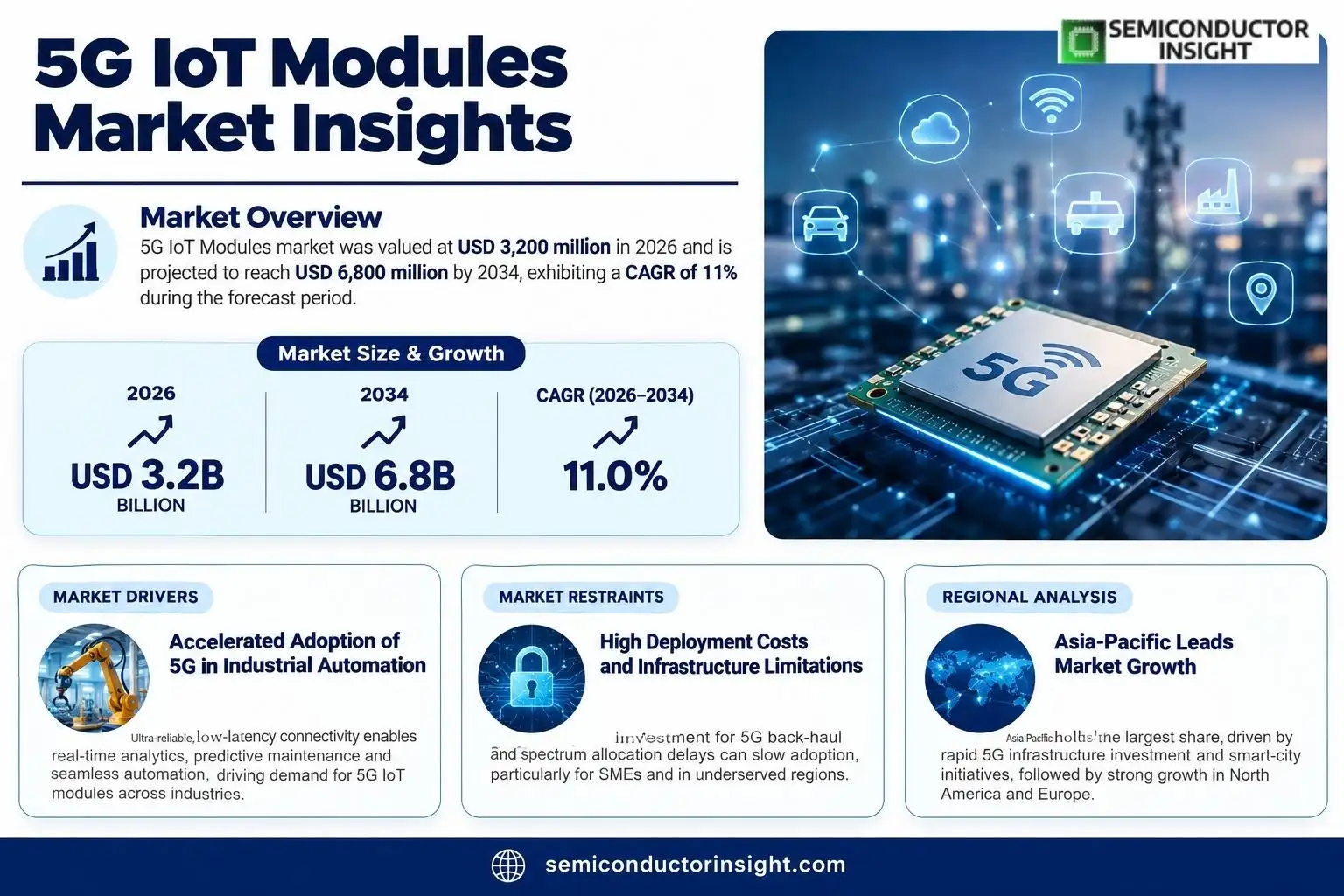
5G IoT Modules market was valued at USD 3,200 million in 2026 and is projected to reach USD 6,800 million by 2034, exhibiting a CAGR of 11% during the forecast period.
The modules integrate cellular radio front‑end componentsincluding antennas, power amplifiers and RF filterswith baseband processors and firmware stacks that deliver secure connectivity and minimal latency for embedded devices across industrial automation, asset tracking, telehealth, and automotive applications.The convergence of high‑speed connectivity with lightweight form factors allows operators to deploy networked solutions faster than ever before. As enterprises demand real‑time analytics from distributed sensors, the availability of ready‑to‑integrate modules reduces time-to-market and lowers development costs.
MARKET DRIVERS
Accelerated Adoption of 5G in Industrial Automation
Industrial sectors are increasingly deploying fixed and mobile endpoints that rely on ultra‑reliable, low‑latency links to streamline production lines, remote monitoring, and predictive analytics. The core benefit of a single connectivity layer that unifies data centers, edge servers, and field devices is a drastic reduction in operating complexity for manufacturers. Offline processing on embedded modules allows critical processessuch as real‑time quality inspection or adaptive control loopsto function even when back‑haul signals are temporarily compromised. In the automotive and logistics domains, layered integration of sensors and actuators with 5G back‑haul increases the throughput of gigasensor networks, thereby enabling more precise route optimization and safety‑critical service orchestration. The value proposition is further amplified by the fact that many vendors now offer pre‑validated 5G IoT modules that support world‑wide bands, reducing the configuration time from development to deployment to days rather than months. This accelerates digital transformation timelines and delivers measurable improvements in throughput, energy consumption, and maintenance cycles, positioning the 5G IoT Modules Market as a catalyst for operational excellence across advanced manufacturing and supply‑chain verticals.
Energy Efficiency and Cost Reduction in Device Deployments
Another decisive driver lies in the evolution of module power budgets. Modern 5G module architectures integrate adaptive spectrum management and low‑power states that shave kilowatts off cumulative device power drawa critical factor in large‑scale installations such as smart cities, where the density of IoT endpoints can exceed thousands per square kilometer. Moreover, the shift from subscription‑based cellular plans to flexible, pay‑per‑use contracts for edge devices allows operators to lock in cost predictability until scale is achieved. The combination of hardware efficiency and economic modularity reduces the total cost of ownership for both network operators and application developers, creating a virtuous cycle that encourages incremental adoption across non‑traditional use cases such as agricultural monitoring, remote health utilities, and utility grid management. As power budgets tighten and regulatory pressure mounts for greener deployments, manufacturers are converging on solutions that provide both compliance and performance, reinforcing a clear trend toward module‑centric design choices.
➤ Industry leaders forecast that higher density and lower power consumption will dominate the competitive criteria for next‑generation 5G IoT modules.
When the growth in connected devices approaches the 12 billion‑unit milestone, the sheer volume of real‑time traffic will necessitate microscopic latency windows. Edge‑side processing becomes essential to avoid congestion, further validating the case for integrated, low‑latency modules. For end‑users, this translates to new product linesultra‑quick video analytics in retail, autonomous asset tracking in warehouses, and high‑precision telematics in fleet managementthat were previously impossible under legacy LPWAN constraints. These market forces collectively heighten the strategic importance of a cohesive, ly supported device ecosystem, cementing the 5G IoT modules market as foundational to future‑proof digital infrastructures.
MARKET CHALLENGES
High Deployment Costs and Infrastructure Limitations
While network operators seek higher coverage, the capital required for widespread 5G back‑haul remains significant. In congested metropolitan areas, the densification of small cells to support massive MIMO deployments amplifies engineering and capital expenditures. For smaller enterprises, the upfront cost of procuring certified modules tailored to niche bands can be prohibitive, slowing adoption in sectors such as rural agriculture or under‑served industrial parks. Moreover, the interoperability gap between legacy gateway solutions and new 5G modules creates integration friction, demanding additional contract work and validation cycles that inflate the time‑to‑market. These barriers are compounded by a still‑evolving certification landscape, where regional regulatory bodies frequently update compliance criteria, making it challenging for vendors to maintain consistent product pipelines.Another obstacle emerges from the disparity in spectrum licensing across different geographies. Operators may secure high‑frequency bands only in a handful of markets, limiting the roll‑out of premium services and forcing players to juggle multiple hardware variants. The economic pressure to support such heterogeneity can deter smaller vendors and create a consolidation trend, potentially stifling innovation. Regulatory constraints, coupled with the administrative overhead of licensing, erect a costly entry point that slows horizontal scaling across the value chain.
Other Challenges
Spectrum Availability Constraints
Despite the promised benefits of millimeter‑wave bands for bandwidth, their limited propagation characteristics restrict coverage. In practice, this necessitates dense infrastructure, raising operational costs and influencing deployment decisions, especially in low‑density or geographically challenging regions.
MARKET RESTRAINTS
Limited 5G Spectrum Allocation
Governments across different regions allocate 5G spectrum on an ad‑hoc basis, leading to fragmentation that hampers the development of a homogeneous module ecosystem. Manufacturers must therefore design multi‑band, multi‑radix solutions that incur higher bill‑of‑materials (BOM) and longer validation cycles. The cost differential between certifiable modules for operations and single‑region solutions creates a barrier for small and midsize enterprises and angle the market toward a few large incumbents that can spread the expenses of frequent re‑certification.Data security issues also exert restraint. As more critical infrastructure becomes connected, the attack surface widens: any vulnerability in a 5G module could compromise supply chain integrity or expose sensitive telemetry. The need for hardened firmware, robust encryption, and certified authentication frameworks adds both complexity and cost to the design cycle. Shared perceptions regarding the trade‑off between performance and security often result in conservative deployments, which can slow the adoption of higher‑performance modules that might otherwise accelerate digital transformation.Vendor fragmentation further complicates the supply chain. The presence of dozens of module manufacturers, each targeting specific market nichesfrom narrow‑band LPWAN to full-blown 5G waveformscreates a heterogeneous landscape that drivers of device integrators struggle to master. Inconsistencies in feature sets, boot processes, and support schedules translate into higher integration effort, mounting support costs, and a steep learning curve for field technicians who must transition across multiple vendor ecosystems.
MARKET OPPORTUNITIES
Expanding Applications in Autonomous Vehicles
The autonomous vehicle ecosystem is uniquely positioned to benefit from the print‑size and processing power of advanced 5G IoT modules. Driverless cars must exchange terabytes of data per second with surrounding infrastructure in real‑time to interpret dynamic traffic conditions, negotiate intersections, and manage safety protocols. A single module that supports mesh networking, low‑latency 5G, and edge intelligence allows vehicles to operate autonomously even in sub‑urban or remote areas where 5G coverage is patchy. In addition, the modular architecture enables a “plug‑and‑play” upgrade path for emerging technologies such as LiDAR fusion, vehicle‑to‑vehicle (V2V) communication, and over‑the‑air (OTA) firmware re‑deployment. Enterprises focusing on edge AI and neural network inference are finding fertile ground for deploying multi‑core modules that process sensor feeds locally, thereby delivering real‑world experiences that cannot be achieved with maingrid cloud alone. This convergence of connectivity, edge processing, and machine learning keeps the industry firmly within the realm of high value, strategic commodity.
Growth of Smart City Initiatives
Municipalities worldwide are launching multi‑year smart‑city roadmaps that emphasize resilient communication back‑bones, real‑time inventory management, and citizen‑centric services. The attraction of the 5G IoT module lies in its ability to seamlessly integrate disparate sensor typesfrom air‑quality monitors to traffic camerasinto a unified data fabric, allowing city planners to pull micro‑level insights that inform policy decisions. Additionally, the affordability of single‑module deployments enables pilot programs that can be scaled across city districts, thereby creating incremental proof points that drive subsequent investment. The momentum in civic infrastructure investment, paired with an evolving regulatory environment that rewards data‑driven governance, amplifies the commercial envelope for 5G modules in public‑sector projects.Meanwhile, edge AI integration represents a compelling opportunity. As workload runtimes migrate to the edge, demand for modules that embed tamper‑proof AI accelerators grows. This opens a niche for vendors who can bundle high‑performance inference enginesoptimized for convolutional and recurrent neural networkswith the standard 5G stack. In sectors such as retail, in‑store analytics and dynamic inventory control can be executed locally, reducing latency for QR‑code scanning, checkout streamlining, and personalized advertising. The result is a differentiated business proposition that intertwines network reliability with AI capability, a synergy that is hard to replicate elsewhere in the connectivity spectrum.
5G IoT Modules Market Trends
Rapid Edge‑Integrated Module Deployment
The accelerating rollout of 5G core networks across major metros has prompted a rush to embed 5G IoT modules directly into downstream devices. This shift reduces latency, cuts backhaul traffic, and streamlines firmware management for operators and OEMs alike. Manufacturers are now bundling modules with lower power envelopes and higher integration densities to fit the compact footprints of edge sensors and autonomous platforms. The trend tightens the loop between network services and end‑user applications, enabling real‑time analytics in logistics hubs, farm equipment, and industrial plant control rooms.
Other Trends
Cost‑Effective Package Evolution
Mini‑PCIe and U‑Floppy LGA variants have achieved a 30% cost penalty reduction compared with legacy modules, largely because of economies of scale in 5G silicon and standardized antenna arrays. This has accelerated adoption in commercial telematics, smart‑metering, and remote monitoring, where commodity hardware wins. The packaging trend also facilitates hot‑swap capability in vehicles and embedded PCs, reducing service downtime for fleet operators. Both size and power budget constraints in portable medical devices are now satisfied by emerging M.2 and bare‑die solutions, pushing telehealth deployments to new markets such as rural diagnostics.
Battery Life and Power Efficiency Improvements
Energy management remains the largest barrier for widespread IoT edge investments. Recent chipset iterations have integrated ultra‑low‑power idle states and adaptive modulation schemes that lower average consumption by up to 40%. This performance gain directly translates into extended field life for wearables and asset trackers, eliminating the need for frequent battery swaps in high‑mobility assets like shipping containers and agricultural machinery. Operators are also pairing these modules with edge AI inference engines, reducing latency for vision‑based safety systems in factories and augmenting predictive maintenance workflows. As a consequence, companies that invest in power‑optimized modules position themselves ahead of the growing regulatory push for carbon‑neutral electronics, unlocking new partnership opportunities with sustainability‑focused enterprises.
COMPETITIVE LANDSCAPE
Key Industry Players
Dissecting a Market on the Verge of Standardisation
Huawei has consolidated a decisive stance in the 5G IoT module arena through its broad integration of chipset, firmware and cloud services. Its transition from pure hardware to an end‑to‑end solution has compressed the value chain, enabling tighter control over performance metrics and deployment speed. In tandem, Quectel’s aggressive portfolio expansionspanning LGA, Mini‑PCIe and M.2 packageshas allowed it to capture niche segments such as automotive telematics and industrial gateways. Sierra Wireless, with its mature ecosystem and established relationships with major MSPs, maintains a robust presence in enterprise and fixed‑wireless access markets. Collectively, these firms comprise the top tier, commanding the majority of revenue and setting the pace for feature adoption, such as sub‑30 ms latency and integrated 5G SA/NSA support. Their consolidated market share illustrates an industry consolidating around a handful of high‑capacity developers that can quickly iterate on standards and provide turnkey solutions to OEMs and system integrators.Beyond the incumbents, a spectrum of specialised players is reshaping vertical applications. U‑blox delivers high‑precision positioning modules, cementing its role in asset tracking and autonomous navigation. Sequans Communications SA emphasises low‑power, battery‑operable modules, targeting remote monitoring and IoT edge nodes. Telit and Thales bring certified security features that resonate in the payment, smart‑grid, and defense spheres. Sony, while primarily a consumer electronics giant, has leveraged its silicon expertise to craft compact, high‑bandwidth modules suitable for next‑generation cameras and immersive experiences. Companies such as Fibocom, LongSung Technology, and Neoway Technology have carved out footholds in emerging markets by offering cost‑effective, region‑specific solutions, thereby sustaining competitive pressure on pricing and localisation strategies across Asia, Europe, and the Americas.
List of Key 5G IoT Modules Companies Profiled
- Sierra Wireless
- Sierra Wireless
- Telit
- Telit
- Thales
- U-blox
- Sequans Communications SA
- Cavli Wireless
- Sony
- Quectel Wireless Solutions
- SIMCom Wireless Solutions
- Fibocom Wireless
- LongSung Technology
- Neoway Technology
- MeiG Smart Technology
- Gosuncn Welink Technology
- Huawei
Segment Analysis:
| Sub-Segments | Sub-Segments | Key Insights |
| By Type |
|
LGA Package offers compact form factor ideal for mobile devices and edge nodes, delivering high data rates with low power consumption.
|
| By Application |
|
Asset Tracking exploits ultra‑low latency to enable real‑time location monitoring in supply chains and logistics.
|
| By End User |
|
Enterprise drives demand for integration with existing IT infrastructure, requiring standardized PCIe and M.2 connectors and robust security certifications.
|
| By Deployment Environment |
|
Edge Devices benefit from embedded 5G modules that provide real‑time connectivity without relying on fixed infrastructure, enhancing automation in warehouses and factories.
|
| By Connectivity Protocol |
|
5G NR is rapidly becoming the preferred connectivity standard for bandwidth‑intensive applications, offering deterministic latency and high throughput.
|
Regional Analysis: 5G IoT Modules Market
North America
Adoption rates remain high as operators race to deliver gigabit speeds to consumers and businesses alike. The push for ultra‑reliable low‑latency communications (URLLC) nurtures demand for modules that can sustain stringent quality of service thresholds, shaping vendor priorities and product roadmaps.
Edge‑computing congestion and spectrum scarcity pose hurdles, especially as densification of base stations accelerates. Manufacturers must balance power efficiency with processor capability to address network load spikes without compromising sustainability.
The most visible use cases centre on autonomous ferry systems and smart‑farm analytics, where the integration of 5G modules enables real‑time decision making and predictive maintenance, thereby redefining operational paradigms.
Policy frameworks that encourage spectrum sharing and accelerate device certification are pivotal. Incentive schemes for rural connectivity spur installation of modules beyond metropolitan areas, expanding the footprint of IoT deployments.
Europe
In Europe, the drive towards digital sovereignty shapes 5G IoT modules adoption. A blend of stringent data‑protection mandates and a high concentration of tech‑savvy consumers pushes operators to embed secure, low‑power modules in public‑transport upgrades and industrial IoT setups. Despite supportive EU regulatory frameworks, the region grapples with spectrum allocation delays, tempering full‑scale rollout. Nonetheless, emerging partnerships between European equipment suppliers and telecom authorities are laying the groundwork for a resilient ecosystem where module supply chains remain largely local, thereby enhancing supply‑chain agility and reducing time‑to‑market for advanced IoT solutions. The collective shift towards green networking further motivates manufacturers to integrate power‑aware firmware, aligning with the continent’s environmental commitments while bolstering network longevity.
Asia‑Pacific
The Asia‑Pacific market is characterized by rapid urban acceleration and a vibrant startup ecosystem that fuels IoT module penetration. Countries like China and South Korea invest heavily in 5G infrastructure, creating emerging opportunities for module vendors to tap into smart‑city and autonomous logistics applications. However, the region also faces interoperability challenges amid a diverse array of network operators and regulatory bodies, which can fragment deployments. Nevertheless, the region’s commitment to electronic‑communication standards is paving the way for seamless integration of modules across heterogeneous platforms, thereby reducing fragmentation costs for partners and establishing a scale advantage that is difficult to replicate elsewhere. Consequently, the Asia‑Pacific sector presents a compelling frontier for firms looking to align with large‑volume public‑sector initiatives and commercial IoT ecosystems.
South America
South America’s 5G IoT modules trajectory is influenced by a mix of infrastructure constraints and emerging industrial applications. While urban hubs in Brazil and Argentina show early adoption of 5G‑enabled manufacturing and logistics systems, rural broadband deficits still limit widespread connectivity. Targeted investment in satellite‑assisted 5G networks is poised to mitigate these gaps, allowing module vendors to capture both high‑density commercial use cases and essential connectivity in remote locations. The region’s focus on agricultural tech presents a unique niche for modules that combine low cost with robust environmental resistance, extending the life cycle of IoT deployments across harsh climates. Therefore, this market segment reflects a dual opportunity: growth in megacities and strategic penetration into underserved rural zones where the value of reliable data becomes most tangible.
Middle East & Africa
In the Middle East and Africa, the 5G IoT modules market is simultaneously hindered and energized by geopolitical dynamics and a rising demand for secure, resilient network infrastructures. Oil‑and‑gas operations are increasingly deploying IoT modules for predictive equipment monitoring, while smart‑city pilots in Dubai and Riyadh showcase the integration of modules for energy management and traffic control. Nonetheless, the region grapples with fragmented regulatory approvals and a scarcity of local manufacturing capabilities, forcing many stakeholders to rely on imported components. In response, joint venture initiatives between regional governments and vendors are rising, aimed at establishing localized supply chains that can reduce exposure to geopolitical risks and support long‑term sustainability. This shift not only capitalizes on cost‑efficient production but also engenders a more adaptable network that can quickly respond to local requirements, creating a platform for expanded 5G IoT modules adoption across the continent.
Report Scope
This market research report provides a comprehensive analysis of the 5G IoT Modules Market , covering the forecast period 2026–2034. It offers detailed insights into market dynamics, technological advancements, competitive landscape, and key trends shaping the industry.
Key focus areas of the report include:
- Market Overview: The report begins with an overview outlining its current market scenario, key growth indicators, and industry transformation drivers. It discusses macroeconomic factors, demand–supply balance, regulatory landscape, and the strategic role of semiconductors in powering advancements across industries such as automotive, telecommunications, consumer electronics, and industrial automation.
- Market Size & Forecast: Historical data and future projections for revenue, unit shipments, and market value across major regions and segments.
- Segmentation Analysis: Detailed breakdown by product type, technology, application, and end-user industry to identify high-growth segments and investment opportunities.
- Regional Insights: Insights into market performance across North America, Europe, Asia-Pacific, Latin America, and the Middle East & Africa, including country-level analysis where relevant.
- Competitive Landscape: Profiles of leading market participants, including their product offerings, R&D focus, manufacturing capacity, pricing strategies, and recent developments such as mergers, acquisitions, and partnerships.
- Technology Trends & Innovation: Assessment of emerging technologies, integration of AI/IoT, semiconductor design trends, fabrication techniques, and evolving industry standards.
- Market Drivers & Restraints: Evaluation of factors driving market growth along with challenges, supply chain constraints, regulatory issues, and market-entry barriers.
- Stakeholder Insights: Insights for component suppliers, OEMs, system integrators, investors, and policymakers regarding the evolving ecosystem and strategic opportunities.
Primary and secondary research methods are employed, including interviews with industry experts, data from verified sources, and real-time market intelligence to ensure the accuracy and reliability of the insights presented.
FREQUENTLY ASKED QUESTIONS:
What is the current market size of the 5G IoT Modules Market?
-> 5G IoT Modules market was valued at USD 3,200 million in 2026 and is projected to reach USD 6,800 million by 2034, exhibiting a CAGR of 11% during the forecast period
What is the projected market size by 2034 and the expected CAGR?
-> The market is projected to reach USD million by 2034 at a CAGR of % during the forecast period.
Which applications are driving demand for 5G IoT Modules?
-> Key applications include Asset Tracking, Automotive, Commercial Telematics, Payment, Remote Monitoring and Control, Smart Grid and Metering, Telehealth and others.
What are the main types of 5G IoT Modules offered in the market?
-> The market is segmented into LGA Package, Mini PCIe Package, M.2 Package, and Others.
Who are the leading companies in the 5G IoT Modules market?
-> Key players include Sierra Wireless, Telit, Thales, U‑blox, Sequans Communications SA, Cavli Wireless, Sony, Quectel Wireless Solutions, SIMCom Wireless Solutions, Fibocom Wirelessinc, LongSung Technology, Neoway Technology, MeiG Smart Technology, GosuncnWelink Technology, Huawei.
Which region holds the largest share of the 5G IoT Modules market?
-> Asia leads the market, with China contributing the majority of deployments.
How many 5G base stations were added in China in 2022?
-> China added 887,000 new 5G base stations in 2022, bringing the total to 2.312 million, over 60% of the total.
How many mobile users existed by the end of 2022?
-> The Mobile Economy Development Report 2023 reported that mobile users exceeded 5.4 billion by the end of 2022.
What are the primary benefits of integrating 5G IoT Modules?
-> 5G modules deliver multi‑gigabit speeds, ultra‑low latency, reliability, security, and easy integration for CPE, fixed wireless access, enterprise network equipment, routers, cameras, and other bandwidth‑intensive applications.
What challenges does the 5G IoT Modules market face?
-> Challenges include regulatory complexities, high deployment costs, supply‑chain constraints, and the need for widespread 5G coverage.

Get Sample Report PDF for Exclusive Insights
Report Sample Includes
- Table of Contents
- List of Tables & Figures
- Charts, Research Methodology, and more...
 Download Sample Report PDF