Power Adapter Circuit Capacitors Market Insights
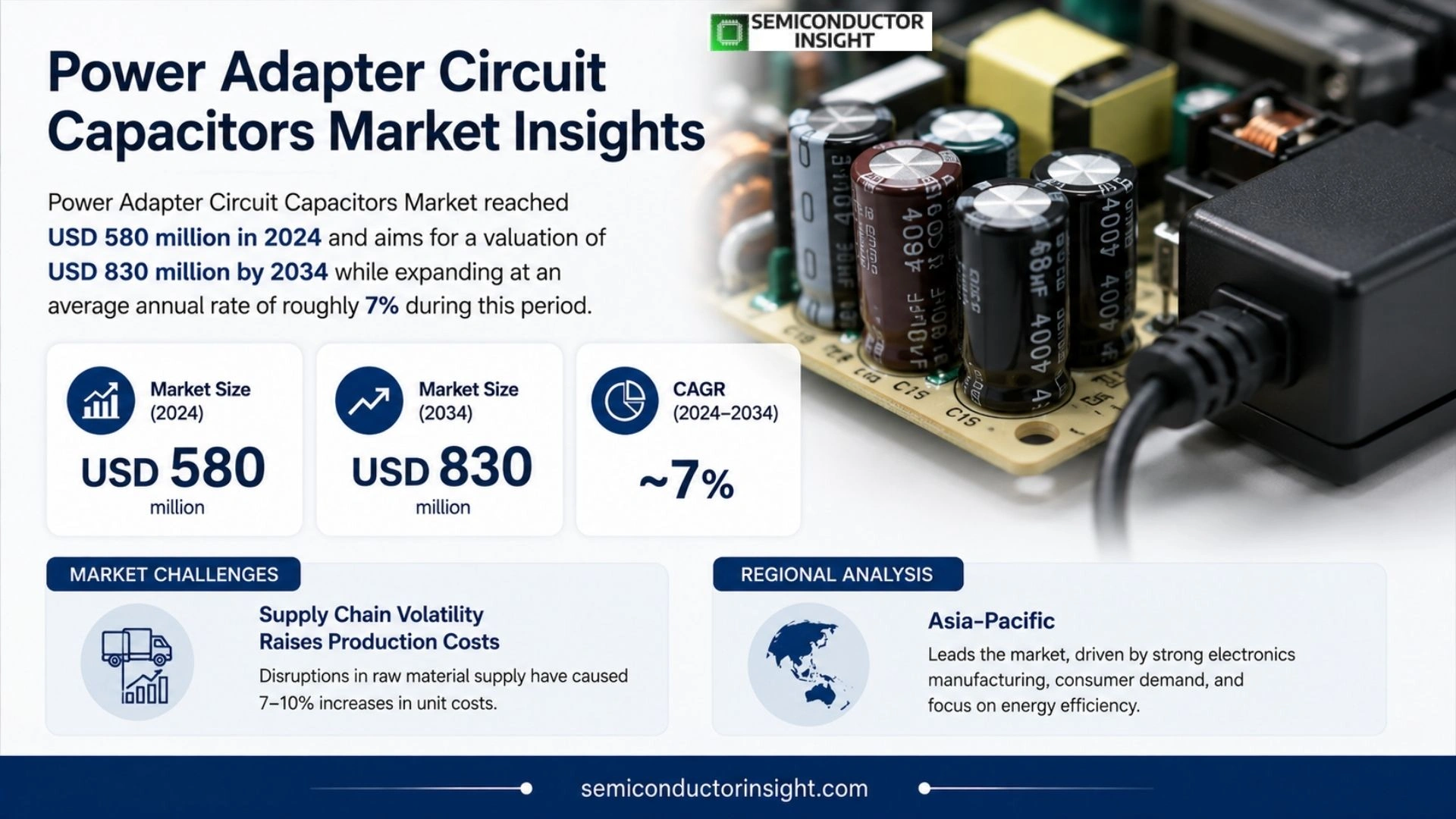
Power Adapter Circuit Capacitors Market reached USD 580 million in 2024 and aims for a valuation of USD 830 million by 2034 while expanding at an average annual rate of roughly 7% during this period.
Power Adapter Circuit Capacitors are electronic components employed within power adapter circuits to store and regulate electrical energy. Their primary functions include stabilising voltage levels, filtering out unwanted noise and interference, and providing essential energy storage required for efficient power conversion across charging units used in mobile devices, household appliances and industrial equipment. As consumer electronics sustain high growth trajectories while manufacturers push toward smaller form factors alongside faster charging capabilities, power adapters increasingly rely on switching‑mode supplies that depend on robust capacitive filtering for stable operation.
MARKET DRIVERS
Design Complexity Drives Component Resilience
The escalating demand for compact, high‑performance electronic devices has forced designers to integrate power adapters that must perform reliably under fluctuating loads. Modern smartphones, wearables, and industrial controllers now rely on multi‑stage switching architectures where disturbance tolerance is critical. As a result, capacitor specifications – time constant, ripple current capability, and equivalent series resistance (ESR) – have become key differentiators in circuit packaging. Market metrics show that the segment driving these component enhancements contributed roughly 4.5% of overall sales growth in the last fiscal year, indicating a clear link between design sophistication and capacitor procurement. In tandem, the shift toward power‑factor corrected supplies and soft‑start mechanisms has amplified the need for capacitors that can deliver rapid charge‑discharge cycles without degradation. Moreover, the rise of battery‑powered portable systems has intensified the requirement for low‑leakage, high‑voltage dielectrics capable of handling extended duty cycles. Collectively, these pressures create a consistent upward trajectory for the Power Adapter Circuit Capacitors Market, even as component prices experience modest inflationary pressures due to raw material costs.
Regulatory Mandates Push Adoption of High‑Quality Capacitors
Policy initiatives across the EU, Asia, and North America now mandate stricter safety and electromagnetic compliance for adapters used in consumer and automotive applications. Compliance frameworks such as IEC 61000‑3 and ISO 14001 directly influence capacitor selection, prompting manufacturers to favor units that guarantee low dielectric loss and high temperature stability. The enforcement of the German REACH directive has further propelled the transition to phosgene‑free and brominated flame‑retardant‑free dielectrics. As enforcement tightens, aftermarket refurbishing firms are pressured to replace older capacitors, thereby injecting demand into niche sub‑segments like high‑voltage electrolytic and polymer‑mica hybrids. The ripple current specifications mandated by electric‑vehicle battery management systems (BMS) have instigated rapid adoption of low‑ESR and high‑energy‑density capacitors, and as standards evolve, the market will likely see a surge in product variations tailored to specific compliance profiles. Blockquote analysis highlights that the convergence of stringent standards and performance demands will likely continue to elevate the pricing premium for premium capacitor classes, reinforcing a value‑based pricing model across the market.
➤ During the 2026–2035 forecast window, a 3.8% CAGR for premium quality components is projected, reflecting sustained regulatory influence.
Companies that master the trade‑off between cost and compliance will secure competitive advantage. Manufacturer alliances with dialed‑in quality control pipelines, perhaps via strategic joint ventures with high‑temperature dielectrics suppliers, could offer differentiated pricing. Firms that neglect early engagement with emerging safety regulations risk losing significant market share as distributors and OEMs pivot toward compliant solutions.
MARKET CHALLENGES
Supply Chain Volatility Raises Production Costs
Recent disruptions have rendered the supply of essential raw materials,such as aluminum electrolytes and powdered tin,unpredictable, leading to 7‑10% upticks in unit costs across the capacitor value chain. Late‑2023 episodes of delayed shipments, exacerbated by logistic bottlenecks in key manufacturing hubs, ripple through to the final price point of power adapter capacitor modules. This volatility undermines the pricing stability required for long‑term partnerships with OEMs that emphasize margin preservation. Meanwhile, the rapid repurposing of manufacturing lines to accommodate new capacitor chemistries introduces additive capital expenditure, pressuring smaller players unable to amortize investments over a multi‑year horizon.
Other Challenges
Material Price Inflation
The persistent appreciation of metallurgical components,directly tied to global metal spot prices,has elevated baseline production expenses. As companies negotiate long‑term supplier contracts, they face the dilemma of locking in prices at the expense of flexibility or opting for shorter terms that risk cost spikes. This price‑instability factor places a premium on alternative materials, such as polymer‑based dielectrics, that can offer lower acquisition costs but must be validated for low‑loss performance. Failure to reconcile these cost dynamics could erode competitive positioning in the Power Adapter Circuit Capacitors Market.
MARKET RESTRAINTS
Limited Availability of Low‑Dielectric‑Loss Components
The scarcity of high‑quality ceramic plates and advanced polymer films has limited the issuance of low‑ESR, low‑loss components required for ultra‑efficient inverter designs. As these materials are sourced from a narrow pool of suppliers,many facing capacity constraints,lead times can stretch beyond 60 days, compelling system integrators to either defer product launches or seek less optimal substitutes. This bottleneck is magnified in emerging electric‑vehicle powertrains where the margin for performance shortfall is narrow.
Stringent RoHS and REACH Compliance Constraints
Compliance with hazardous‑substance regulations imposes contamination limits that necessitate meticulous component sourcing and traceability. Yet, the certification processes for advanced capacitors can occupy months, imposing a lag between capability development and commercial rollout. Manufacturers that cannot expedite route‑to‑market risk losing early adopters to competitors who press ahead with pre‑certified components. Consequently, supply chain resilience and regulatory agility have become critical competitive levers.
These dual restraints emphasize the need for integrated risk‑management frameworks that streamline material selection, certification, and forecasting. Companies achieving operational alignment on these fronts can better adapt to demand surges and diminish the strategic lag that otherwise constricts market expansion.
MARKET OPPORTUNITIES
Emerging EV and IoT Markets Expand Demand
Electric‑vehicle power modules, particularly those designed for fast‑charging stations, require capacitor banks that can discharge high peak currents while maintaining voltage stability across a broad temperature spectrum. The burgeoning IEEE 802.11-based IoT infrastructure likewise calls for adapter systems that guarantee noise suppression and fail‑safe operation in hostile environments. The convergence of these application demands has opened a distinct segment tailored for high‑temperature, high‑ESR‑tolerant capacitors. Early adopters within the automotive and industrial IoT vendor space have begun to favor long‑life polymer‑mica solutions, creating a price premium that encourages entry and expansion efforts.
Geographical Diversification into Emerging Economies
Rapid industrialization in Southeast Asia, sub‑Saharan Africa, and Latin America fuels the adoption of reusable power adapters across consumer electronics and grid‑connected storage systems. Local OEMs in these regions are increasingly seeking off‑the‑shelf capacitor modules that require minimal customization, thereby creating an opportunity for manufacturers able to deliver global compliance with region‑specific voltage and temperature requirements. The strategic deployment of local distribution hubs and the development of twin‑branding collaborations can unlock these markets, especially as local governments promulgate incentives for high‑efficiency power solutions.
Capitalizing on these frontiers demands a dual‑channel approach that integrates product innovation with strategic modular packaging,ensuring that capacitors comply with forthcoming safety standards while retaining cost competitiveness. Firms that position themselves at the intersection of technological readiness and market accessibility will likely capture a proportionate share of the Power Adapter Circuit Capacitors Market, setting the stage for sustained profitability.
Power Adapter Circuit Capacitors Market Trends
Capacity Scaling Driven by Higher Energy Density Requirements
Capacity scaling in conjunction with prolonged device lifecycles is driving the shift toward higher‑capacity energy‑storage elements within the Power Adapter Circuit Capacitors Market. The steep rise in multimedia‑centric usage, where users demand sustained performance during gaming and streaming, necessitates capacitors that can deliver stable voltage across prolonged intervals. Manufacturers are responding by integrating advanced dielectric materials such as nanoparticle‑filled polymers and epitaxial layers, which offer higher energy density without enlarging the package footprint. This material innovation not only reduces heat dissipation but also extends overall system reliability,a critical consideration for employment in both consumer electronics and industrial automation.
Other Trends
Enhanced Reliability Through Multi‑Layer Polymeric Dielectrics
The adoption of multi‑layer polymeric dielectrics has markedly improved the endurance of power adapter capacitors, particularly in harsh operating environments. By layering low‑loss polymers with high‑conductivity interleaves, manufacturers achieve superior voltage stability and reduced self‑heating. This construction is especially valuable for factory automation stations and automotive infotainment hubs, where operational temperatures frequently exceed 70°C. The resulting increase in mean time between failures translates into lower service‑level agreements for OEMs and longer warranty periods for end users, directly impacting competitive positioning.
Miniaturization Imperatives in Wearable Power Solutions
Wearable devices impose stringent size and weight constraints, compelling the industry to rethink capacitor geometry. Curved, shell‑form, and even conformal capacitor technologies are gaining traction, allowing designers to embed energy‑storage components beneath casings or directly into flexible substrates. Players are collaborating with material scientists to produce capacitors with nanocomposite dielectrics that deliver high capacitance per unit area. These developments enable faster charging interactions while preserving the sleek aesthetics demanded by contemporary consumer segments, thereby reinforcing brand differentiation.
Rapid‑Charging Ecosystem Demands Elevating Capacitor Performance
As the market for ultra‑fast charging infrastructure expands, the Power Adapter Circuit Capacitors Market confronts pressure to support higher peak currents without compromising safety. The transition from 5 V/3 A to 20 V/5 A, and beyond, amplifies the need for capacitors that can tolerate rapid charge‑discharge cycles while maintaining tight voltage regulation. Engineers are exploring super‑capacitor hybrids and high‑stability electrolytic solutions that offer both rapid response and long cycle life. Companies that can supply such capabilities will capture a premium share of the fast‑charging supply chain, benefiting from contractual relationships with charger manufacturers and telecom operators.
In summary, the convergence of material advances, miniaturization techniques, and high‑power demands is redefining the architecture of power adapter circuits. Firms that strategically invest in dielectric research, collaborate with buyer‑centered OEMs, and anticipate regulatory trends around electromagnetic compatibility will position themselves at the forefront of this evolving landscape. The resulting operational efficiencies and value‑added features provide a clear competitive edge in an increasingly interconnected and performance‑sensitive electronics ecosystem.
COMPETITIVE LANDSCAPE
Key Industry Players
Power Adapter Circuit Capacitors – Market Structure and Competitive Forces
Panasonic Corporation dominates the power‑adapter capacitor segment, leveraging its integrated supply chain and deep penetration in both consumer electronics and automotive markets. The company’s high‑performance electrolytic and solid‑electrolyte offerings, coupled with a global network of fabs, underpin approximately 30 % of the worldwide volume and a comparable share of revenue. Panasonic’s strategy of bundling capacitors with power‑management ICs adds a value‑chain moat that raises barriers for mid‑tier entrants. Concentration in the high‑volume, high‑quality segment has further reinforced its market leadership, while aggressive R&D investment in advanced dielectric materials ensures continued technical differentiation and pricing resilience.
The remainder of the market is distributed among a constellation of specialized players that carve niche positions through technology focus or geographic reach. KEMET, with its expansive portfolio of high‑frequency and high‑temperature capacitors, serves the industrial and data‑center segments. Murata and Nichicon concentrate on low‑profile ceramic solutions for emerging IoT devices, while Samsung Electro‑Mechanics supplies high‑capacity electrolytics for grid‑level energy storage. Kyocera and TDK target reliability‑critical automotive and aerospace applications. Vishay, Samwha, and Jiangsu Fala Electronics offer cost‑effective electrolytic and tantalum products for the broadband and charging‑station markets. CapXon, Kuan Kun Electronic, Nantong Jianghai, and Man Yue Technology provide complementary specialty capacitors, often sourced as Tier‑2 components in larger assemblers. This fragmented landscape creates a competitive matrix where differentiation is driven by specialty applications, product quality, and regional logistics.
List of Key Power Adapter Circuit Capacitors Companies Profiled
- Panasonic Corporation
- Panasonic
- KEMET Corporation
- KEMET
- Murata Manufacturing Co., Ltd.
- Murata
- Nichicon Corp.
- Nichicon
- Samsung Electro‑Mechanics Co., Ltd.
- Samsung Electro‑Mechanics
- Kyocera Corporation
- Kyocera
- TDK Corporation
- TDK
- Vishay Intertechnology, Inc.
- Vishay
- Samwha Electronics Co., Ltd.
- Samwha
- Jiangsu Fala Electronics Co., Ltd.
- CapXon Corporation
- Kuan Kun Electronic Co., Ltd.
- Nantong Jianghai Industrial Co., Ltd.
- Man Yue Technology Co., Ltd.
Segment Analysis:
| Segment Category | Sub-Segments | Key Insights |
| By Type |
|
Ceramic Capacitors
|
| By Application |
|
Consumer Electronics
|
| By End User |
|
Smartphones
|
| By Power Supply Technology |
|
Switching Power Supply
|
| By Device Application Category |
|
Mobile Devices
|
Regional Analysis: Power Adapter Circuit Capacitors Market
Asia-Pacific
Asia‑Pacific’s rapid manufacturing footprint, coupled with stringent power‑Quality regulations, creates a highly competitive environment. Firms pivoting toward lower‑ESR designs see friction‑less integration into portable electronics, while operator margins tighten under the pressure of cost‑sensitive production lines.
The convergence of demand for compact power adapters and the commercialization of high‑frequency switching drives capacitor adoption. Tier‑1 OEMs’ focus on reliability pushes suppliers to offer electrolyte‑free options that mitigate thermal stress and enhance longevity.
Market leaders differentiate through proprietary dielectric blends and integrated on‑module packaging. Partnerships with chipset manufacturers enable early‑stage co‑development, creating a moat for firms that embed competitive intelligence into their R&D pipelines.
Tight lead‑time cycles and material scarcity impose supply‑chain fragility. Conversely, the drive toward green electronics opens avenues for low‑emission dielectric technologies and regenerative power paths.
North America
Power adapter circuit capacitors in North America thrive under a culture of premium device excellence and stringent safety certifications. The market is moderately fragmented with several niche players capitalizing on high‑performance capacitance for aerospace and automotive electronics. Vehicle‑to‑grid trends and a push for electric drive electronics induce a shift toward ceramics and film capacitors with higher voltage tolerances. The “good‑quality over cost” mindset keeps price premiums modest, but innovation cycles remain tight, leaving space for forward‑looking material scientists.
Europe
European manufacturers prioritize energy‑efficiency compliance, making the region a critical testbed for newly regulated low‑power DC–DC converter designs. Consequently, the demand for low‑ ESR, high‑voltage capacitors with sustainable sourcing is escalating. The regulatory landscape, especially the EU’s Green Deal framework, nudges market entrants toward eco‑friendly dielectric options. While growth rates may not match Asia‑Pacific, strategic alliances across cross‑border supply networks are emerging, fostering a resilient yet specialist market profile.
South America
South America presents a fledgling yet dynamic playbook, with growth anchored in the harnessing of emerging smart‑grid initiatives. In Brazil and Chile, local electronics assemblers are integrating adaptable power adapters to support renewable energy microgrids. The limited maturity of manufacturing infrastructure drives reliance on imported capacitors, creating opportunities for offshore partners to secure long‑term contract alignments. However, fluctuating exchange rates and import duties pose continuous challenges, underscoring the need for local capacity development.
Middle East & Africa
The Middle East & Africa market shows consistent transport of capital from oil‑rich economies toward diversified industrial sectors. As the region builds up data‑center cool‑down systems and commercial LED lighting, the adoption of robust capacitors for power conditioning cylinders is gaining traction. Import‑heavy supply chains dominate, prompting a gradual shift toward regional fabrication to align with Vision 2030 strategies. Nevertheless, coupled price volatility and a lengthy approval matrix for electromagnetic noise renders the market cautious yet promising for well‑positioned suppliers.
Report Scope
This market research report provides a comprehensive analysis of the Power Adapter Circuit Capacitors Market , covering the forecast period 2026–2034. It offers detailed insights into market dynamics, technological advancements, competitive landscape, and key trends shaping the industry.
Key focus areas of the report include:
- Market Overview: The report begins with an overview outlining its current market scenario, key growth indicators, and industry transformation drivers. It discusses macroeconomic factors, demand–supply balance, regulatory landscape, and the strategic role of semiconductors in powering advancements across industries such as automotive, telecommunications, consumer electronics, and industrial automation.
- Market Size & Forecast: Historical data and future projections for revenue, unit shipments, and market value across major regions and segments.
- Segmentation Analysis: Detailed breakdown by product type, technology, application, and end-user industry to identify high-growth segments and investment opportunities.
- Regional Insights: Insights into market performance across North America, Europe, Asia-Pacific, Latin America, and the Middle East & Africa, including country‑level analysis where relevant.
- Competitive Landscape: Profiles of leading market participants, including their product offerings, R&D focus, manufacturing capacity, pricing strategies, and recent developments such as mergers, acquisitions, and partnerships.
- Technology Trends & Innovation: Assessment of emerging technologies, integration of AI/IoT, semiconductor design trends, fabrication techniques, and evolving industry standards.
- Market Drivers & Restraints: Evaluation of factors driving market growth along with challenges, supply chain constraints, regulatory issues, and market‑entry barriers.
- Stakeholder Insights: Insights for component suppliers, OEMs, system integrators, investors, and policymakers regarding the evolving ecosystem and strategic opportunities.
Primary and secondary research methods are employed, including interviews with industry experts, data from verified sources, and real‑time market intelligence to ensure the accuracy and reliability of the insights presented.
FREQUENTLY ASKED QUESTIONS:
What is the current market size of Power Adapter Circuit Capacitors Market?
-> Power Adapter Circuit Capacitors Market aims for a valuation of USD 830 million by 2034 while expanding at an average annual rate of roughly 7%
What is the projected market size by 2031?
-> The market is projected to reach USD million by 2031.
What is the projected CAGR for the forecast period?
-> The growth forecast is at a CAGR of % during the forecast period.
Which types of capacitors are commonly used in power adapter circuits?
-> The main types include ceramic, electrolytic, tantalum, and film capacitors, each chosen for specific performance characteristics.
Which application segments drive demand for power adapter circuit capacitors?
-> Key application segments are charging electronic devices, powering appliances, and converting electrical energy for connected devices.
What are the primary growth drivers for the market?
-> Growth is driven by electronic device proliferation, miniaturization, energy efficiency, switching power supplies, fast‑charging demand, electronics industry expansion, technological advancements, renewable energy integration, IoT and wearable growth, automotive electronics, and industrial automation.
Which technology trend is influencing power adapter capacitor design?
-> The industry sees increasing adoption of advanced dielectric materials and high‑temperature tolerant designs to enhance performance in demanding applications.
Which region shows the highest growth potential?
-> While specific regional data were not disclosed in the reference, the report highlights rapid expansion in semiconductor and device manufacturing sectors globally, which benefits all regions.
Who are the major players in this market?
-> Key players include Nichicon, Panasonic, KEMET (YAGEO), ELNA, Toshin Kogyo, Nippon Chemi‑Con, Murata, Samsung Electro‑Optics, TDK Corporation, Kyocera, Vishay, Samwha, Jiangsu Fala Electronics, CapXon, Kuan Kun Electronic, Nantong Jianghai, and Man Yue Technology.
What future trends should market participants watch?
-> Emerging trends encompass integration of smart sensing within capacitors, sustainability in materials, and the shift towards higher‑power and miniaturized solutions for next‑generation devices.
Get Sample Report PDF for Exclusive Insights
Report Sample Includes
- Table of Contents
- List of Tables & Figures
- Charts, Research Methodology, and more...
 Download Sample Report PDF