PN Junction Diode Market Insights
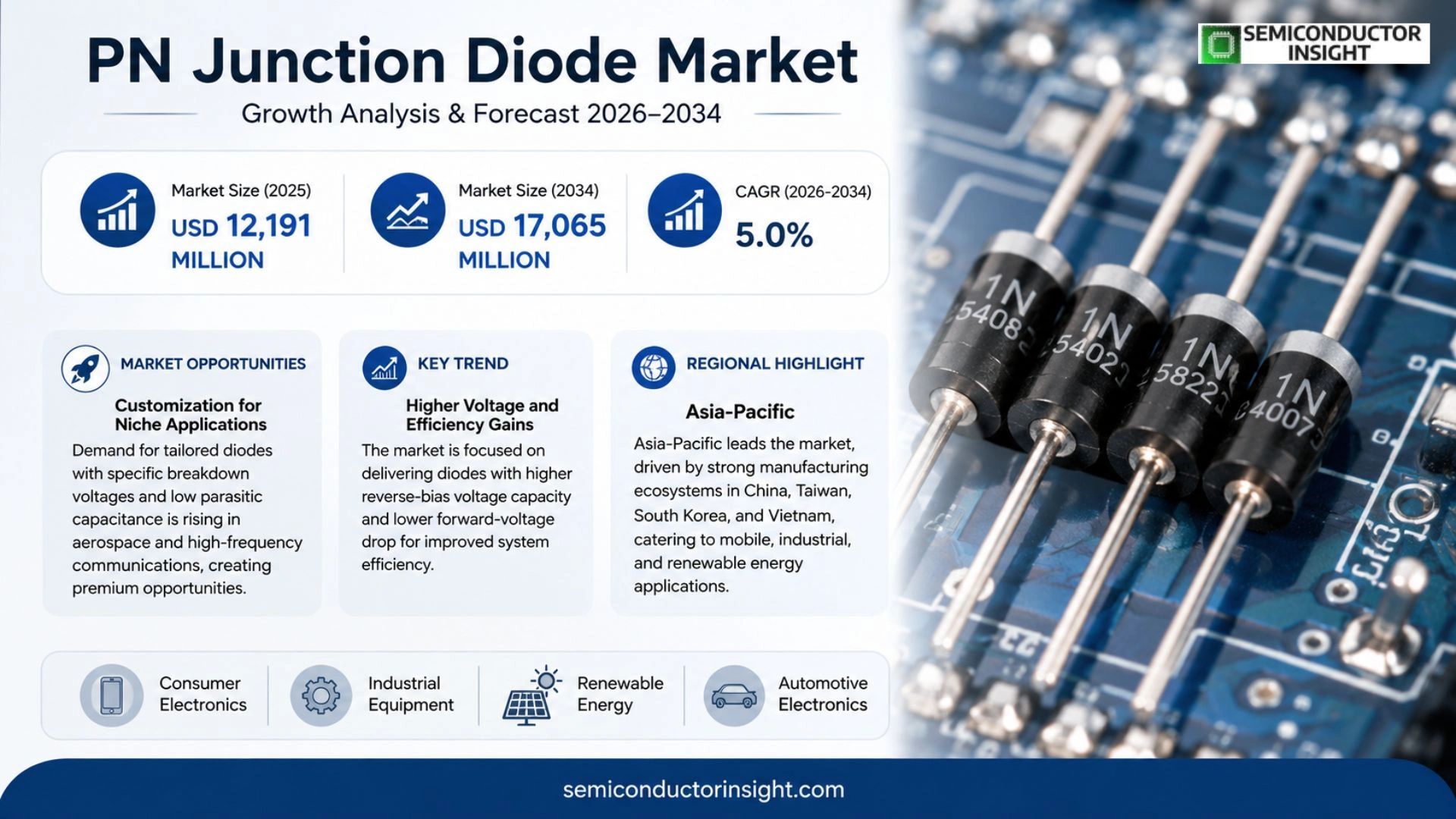
PN Junction Diode market size was valued at USD 12,191 million in 2025. Forecasts indicate the market will reach USD 17,065 million by 2034, reflecting a CAGR of 5.0% over the period.
A PN junction diode is a basic discrete semiconductor component created by diffusion, epitaxy or ion implantation of P‑type and N‑type materials to form a junction that is then packaged with electrodes. Its defining trait is unidirectional conductivity: forward bias yields low resistance and high current flow, while reverse bias presents high resistance and minimal leakage until breakdown occurs at a critical voltage. This property enables rectification, switching, voltage regulation, detection, limiting and protection functions within electronic circuits.
Demand grows as consumer electronics, power adapters, automotive systems and renewable‑energy converters require inexpensive yet reliable diodes. Production estimates point to roughly 267 billion units in 2025 at an average price of USD 0.05 per unit; however, intense price competition compresses margins except for higher‑specification variants serving automotive and power‑electronics applications.
MARKET DRIVERS
Rising Demand in Power Conversion Systems
PN Junction Diode market is gaining traction as manufacturers of renewable‑energy inverters and electric‑vehicle chargers require robust rectification solutions. Recent production data show a 7 % year‑over‑year increase in diode shipments for photovoltaic converters, reflecting the sector’s shift toward higher efficiency architectures. This surge is not merely volume‑driven; engineers are favoring silicon‑based PN junctions for their low forward voltage drop, which translates into measurable energy savings at scale.
Advancements in Semiconductor Materials
Material science breakthroughs,particularly in silicon‑carbide (SiC) and gallium‑nitride (GaN) integration,are reshaping diode performance envelopes. Companies that embed SiC substrates into traditional PN structures report a 15 % improvement in thermal tolerance, enabling devices to operate at higher currents without compromising reliability. Such technical leverage reduces system‑level cooling costs, encouraging OEMs to specify more demanding diode grades.
➤ Industry insiders note that design cycles are shortening as simulation tools incorporate real‑time PN junction parameters, accelerating time‑to‑market for new applications.
Beyond hardware, regulatory frameworks that enforce stricter power‑factor correction and emissions limits are nudging end‑users toward more efficient rectification topologies. Consequently, distributors are reporting tighter inventory turns for high‑efficiency PN junction diodes, indicating that market participants are aligning supply chains with the evolving compliance landscape.
MARKET CHALLENGES
Supply‑Chain Volatility for High‑Purity Silicon
While demand accelerates, the availability of ultra‑high‑purity silicon wafers has become a bottleneck. Recent outages at two major polysilicon plants caused a 12 % dip in overall diode output during Q2 2024, prompting manufacturers to ration allocation among key customers. This scarcity forces design teams to revisit part‑selection strategies, sometimes opting for older, less efficient diode families to meet production schedules.
Other Challenges
Cost Sensitivity in Tier‑1 Automotive
Automotive OEMs are negotiating tighter component budgets as electric‑vehicle platforms scale. Even marginal price hikes in PN junction diodes can erode margin targets, pushing suppliers to explore volume‑based pricing models or alternative packaging technologies that lower per‑unit cost.
MARKET RESTRAINTS
Stringent Reliability Standards
Certification regimes such as IEC 60747 impose rigorous testing sequences that extend time‑to‑certify for new diode designs. Companies that attempt rapid product introductions often encounter multiple iteration cycles, inflating R&D spend and delaying commercial rollout. The cumulative effect is a cautious adoption curve for innovative PN junction technologies.
Furthermore, end‑of‑life management directives are compelling manufacturers to embed traceability features within each diode batch. Implementing such tracking mechanisms adds complexity to inventory systems and can deter smaller players from entering the market.
Lastly, the emergence of alternative rectification solutions,especially those based on wide‑bandgap materials,creates a competitive pressure that limits the willingness of certain segments to upgrade existing PN junction inventories.
MARKET OPPORTUNITIES
Customization for Niche Applications
Specialized sectors such as aerospace and high‑frequency communications are seeking diodes with tailored breakdown voltages and reduced parasitic capacitance. Engineers in these fields are willing to pay a premium for custom‑tuned PN junctions, opening a lucrative avenue for contract manufacturers that can deliver low‑volume, high‑specification parts.
Another promising frontier lies in the integration of PN junction diodes with embedded sensors for predictive maintenance. By coupling temperature monitoring directly onto the diode package, system integrators can preemptively flag degradation, extending equipment lifespan and creating a value‑added service layer.
Finally, emerging markets in Southeast Asia are expanding their electronics assembly capacity, and local governments are offering incentives for domestic semiconductor production. Early entry into these regions could secure a foothold for firms looking to diversify supply chains while capitalizing on cost‑effective labor pools.
PN Junction Diode Market Trends
Higher Voltage and Efficiency Gains
PN Junction Diode market is increasingly defined by a push toward devices that sustain higher reverse‑bias voltages while shedding forward‑voltage loss. Suppliers are adopting refined epitaxial processes and tighter doping controls to meet the stricter voltage‑rating specs demanded by power‑supply converters and emerging electric‑vehicle architectures. Because a lower forward drop translates directly into reduced conduction losses, manufacturers that can guarantee sub‑0.6 V drops at 10 A and above gain a competitive edge in high‑density power modules. This technical trajectory is fueled by the proliferation of renewable‑energy inverters and the need for compact, efficient chargers across consumer and industrial segments.
Other Trends
Automotive‑Grade Reliability Pressures
Reliability thresholds in automotive electronics have tightened as OEMs embed diodes in safety‑critical circuits such as battery‑management systems and drive‑train inverters. PN Junction Diode market responds with tighter screening, extended temperature ratings, and packaging formats that survive harsh vibration environments. Margins on automotive‑grade parts sit at the upper end of the 10‑25 % range, reflecting the premium placed on long‑life performance and traceability. Companies that align their supply chain with automotive‑qualified silicon wafers and certify their testing labs gain privileged access to this higher‑margin niche.
Cost Competition and Commoditization
While advanced specifications command price premiums, the bulk of PN Junction Diode market remains a volume‑driven commodity segment. Production volumes reached roughly 267 billion units in 2025 at an average selling price of US$0.05, underscoring the razor‑thin economics that dominate standard‑spec devices. Price erosion is accelerated by the entry of new fabs leveraging mature silicon processes, forcing legacy players to either pursue cost‑cutting initiatives or differentiate through specialty packaging such as power‑package and die‑level integration. The strategic implication for most suppliers is a dual‑track approach: protect the high‑value automotive and power‑electronics lanes while optimizing yield and fab utilization for the high‑volume, low‑margin core.
COMPETITIVE LANDSCAPE
Key Industry Players
PN Junction Diode Market Competitive Overview
Infineon Technologies dominates the high‑volume segment of PN Junction Diode market, leveraging its deep silicon‑process expertise and extensive automotive‑grade product portfolio. The company’s ability to integrate diode fabrication with power‑module assembly grants it pricing leverage and a resilient supply chain, allowing it to capture a sizable share of both consumer‑electronics and power‑conversion orders. STMicroelectronics and onsemi follow closely, each differentiating through aggressive node migration and a focus on low‑forward‑voltage drops that appeal to energy‑efficient designs. This tier of manufacturers anchors the market structure, setting price baselines and driving incremental performance improvements that ripple through downstream OEMs.
Beyond the top tier, a collection of niche players sustains diversification across material systems and form factors. ROHM and Vishay, for instance, have carved out specialty segments in high‑frequency and high‑voltage diodes, offering SiC and GaN‑based devices that meet emerging automotive and renewable‑energy standards. Smaller firms such as Nexperia, Littelfuse, and Mitsubishi Electric concentrate on compact SMD packages for consumer gadgets, where volume and cost efficiency dominate. Meanwhile, regional manufacturers like Taiwan Semiconductor and Panjit provide cost‑effective alternatives for emerging markets, reinforcing competitive pressure that keeps overall margins modest.
List of Key PN Junction Diode Companies Profiled
- Infineon Technologies
- STMicroelectronics
- onsemi
- Vishay
- ROHM Semiconductor
- Nexperia
- Littelfuse
- Mitsubishi Electric
- Taiwan Semiconductor
- PanJit
- Microchip Technology
- Navitas Semiconductor
- Alpha and Omega Semiconductor
- Semikron Danfoss
- Shindengen
Segment Analysis:
| Segment Category | Sub-Segments | Key Insights |
| By Type |
|
Silicon
|
| By Application |
|
Power Supply and Energy Conversion
|
| By End User |
|
Industrial Control
|
| By Material |
|
Silicon Carbide (SiC)
|
| By Packaging |
|
SMD/SMT
|
Regional Analysis: PN Junction Diode Market
Asia‑Pacific
High‑volume fabs in Guangdong and Gyeonggi capitalize on automated wafer handling, which lowers per‑unit cost while preserving tight tolerance levels essential for diode performance.
Regional automakers are integrating power‑train control modules that rely on robust PN junction diodes, prompting tier‑1 suppliers to embed these components early in vehicle architecture.
Smartphone and wear‑able manufacturers demand diodes with low forward voltage drop, driving local design houses to iterate quickly on material composition and junction depth.
Diversified sourcing of silicon wafers across the region cushions against geopolitical shocks, ensuring steady component flow to downstream assemblers.
North America
The United States maintains a strong foothold in high‑performance PN junction diode design, driven by aerospace and defense programs that demand ultra‑reliable rectifiers. While domestic fabs are fewer, research institutions collaborate closely with niche manufacturers to produce diodes suited for high‑frequency radar and satellite communications. The market narrative here is less about volume and more about specialized performance metrics, prompting OEMs to source premium devices even at a premium price. Canada’s growing renewable‑energy sector adds modest demand for diodes in inverter stacks, complementing the broader North American outlook focused on technology leadership rather than sheer output.
Europe
European manufacturers lean on precision engineering traditions, integrating PN junction diodes into automotive safety systems and industrial automation. Germany’s automotive clusters, for instance, embed diodes within advanced driver‑assistance modules, where failure tolerance is non‑negotiable. Simultaneously, the EU’s sustainability agenda encourages the adoption of efficient power‑conversion topologies, indirectly boosting demand for low‑loss diodes in grid‑balancing equipment. Although the region lacks the manufacturing scale of Asia, its emphasis on quality standards and regulatory compliance creates a niche market that values reliability over cost advantage.
South America
Brazil and Mexico emerge as modest growth pockets, largely driven by expanding consumer‑electronics assembly plants that source components from nearby Asian hubs. Local companies are beginning to assemble end‑products that embed PN junction diodes, prompting modest investments in test and burn‑in facilities to meet regional certification requirements. The market is still in an early stage, but the presence of multinational OEMs hints at a gradual shift toward localized component integration as supply‑chain diversification becomes a strategic priority.
Middle East & Africa
In the Middle East, the boom in solar‑farm projects fuels demand for power‑electronics modules where diodes serve as critical protection elements. Companies in the United Arab Emirates are partnering with Asian suppliers to secure steady diode supplies for inverter manufacturing. Africa, meanwhile, sees limited but growing usage in telecommunications infrastructure upgrades, where reliable rectification is essential for base‑station power stability. The regional narrative centers on infrastructure development, and while volumes remain modest, the strategic importance of diodes in emerging energy and communication networks is gaining recognition.
Report Scope
This market research report provides a comprehensive analysis of the PN Junction Diode Market , covering the forecast period 2026–2034. It offers detailed insights into market dynamics, technological advancements, competitive landscape, and key trends shaping the industry.
Key focus areas of the report include:
- Market Overview: The report begins with an overview outlining its current market scenario, key growth indicators, and industry transformation drivers. It discusses macroeconomic factors, demand–supply balance, regulatory landscape, and the strategic role of semiconductors in powering advancements across industries such as automotive, telecommunications, consumer electronics, and industrial automation.
- Market Size & Forecast: Historical data and future projections for revenue, unit shipments, and market value across major regions and segments.
- Segmentation Analysis: Detailed breakdown by product type, technology, application, and end-user industry to identify high-growth segments and investment opportunities.
- Regional Insights: Insights into market performance across North America, Europe, Asia-Pacific, Latin America, and the Middle East & Africa, including country-level analysis where relevant.
- Competitive Landscape: Profiles of leading market participants, including their product offerings, R&D focus, manufacturing capacity, pricing strategies, and recent developments such as mergers, acquisitions, and partnerships.
- Technology Trends & Innovation: Assessment of emerging technologies, integration of AI/IoT, semiconductor design trends, fabrication techniques, and evolving industry standards.
- Market Drivers & Restraints: Evaluation of factors driving market growth along with challenges, supply chain constraints, regulatory issues, and market-entry barriers.
- Stakeholder Insights: Insights for component suppliers, OEMs, system integrators, investors, and policymakers regarding the evolving ecosystem and strategic opportunities.
Primary and secondary research methods are employed, including interviews with industry experts, data from verified sources, and real-time market intelligence to ensure the accuracy and reliability of the insights presented.
FREQUENTLY ASKED QUESTIONS:
What is the current market size of PN Junction Diode Market?
-> PN Junction Diode market will reach USD 17,065 million by 2034, reflecting a CAGR of 5.0% over the period.
Which key companies operate in PN Junction Diode Market?
-> Key players include Infineon, STMicroelectronics, onsemi, Vishay, Nexperia, ROHM, Toshiba Electronic Devices & Storage, Diodes Inc., Littelfuse, Microchip, Mitsubishi Electric, Hitachi Energy, Fuji Electric, Semikron Danfoss, Navitas Semiconductor, Alpha and Omega Semiconductor, Semtech, Bourns, Central Semiconductor, Taiwan Semiconductor, Panjit, Comchip, Micro Commercial Components, Shindengen, Sanken, KEC, Yangjie, JSCJ, JieJie Microelectronics, CR Micro, Silan, BYD Semiconductor, among others.
What are the key growth drivers?
-> Key growth drivers include continuous growth in electronic devices, rising efficiency requirements in power systems, expansion of automotive electronics and new energy industries, and long‑term demand for cost‑effective mature components.
Which region dominates the market?
-> Asia is the dominant region, driven by strong demand in consumer electronics, automotive, and power electronics, while also showing the fastest growth.
What are the emerging trends?
-> Emerging trends include higher voltage ratings, improved efficiency, lower forward voltage drop, higher switching frequency, miniaturization, and stronger emphasis on reliability for automotive‑grade and power electronics applications.

Get Sample Report PDF for Exclusive Insights
Report Sample Includes
- Table of Contents
- List of Tables & Figures
- Charts, Research Methodology, and more...
 Download Sample Report PDF