Outsourced Semiconductor Assembly and Test Service Market Insights
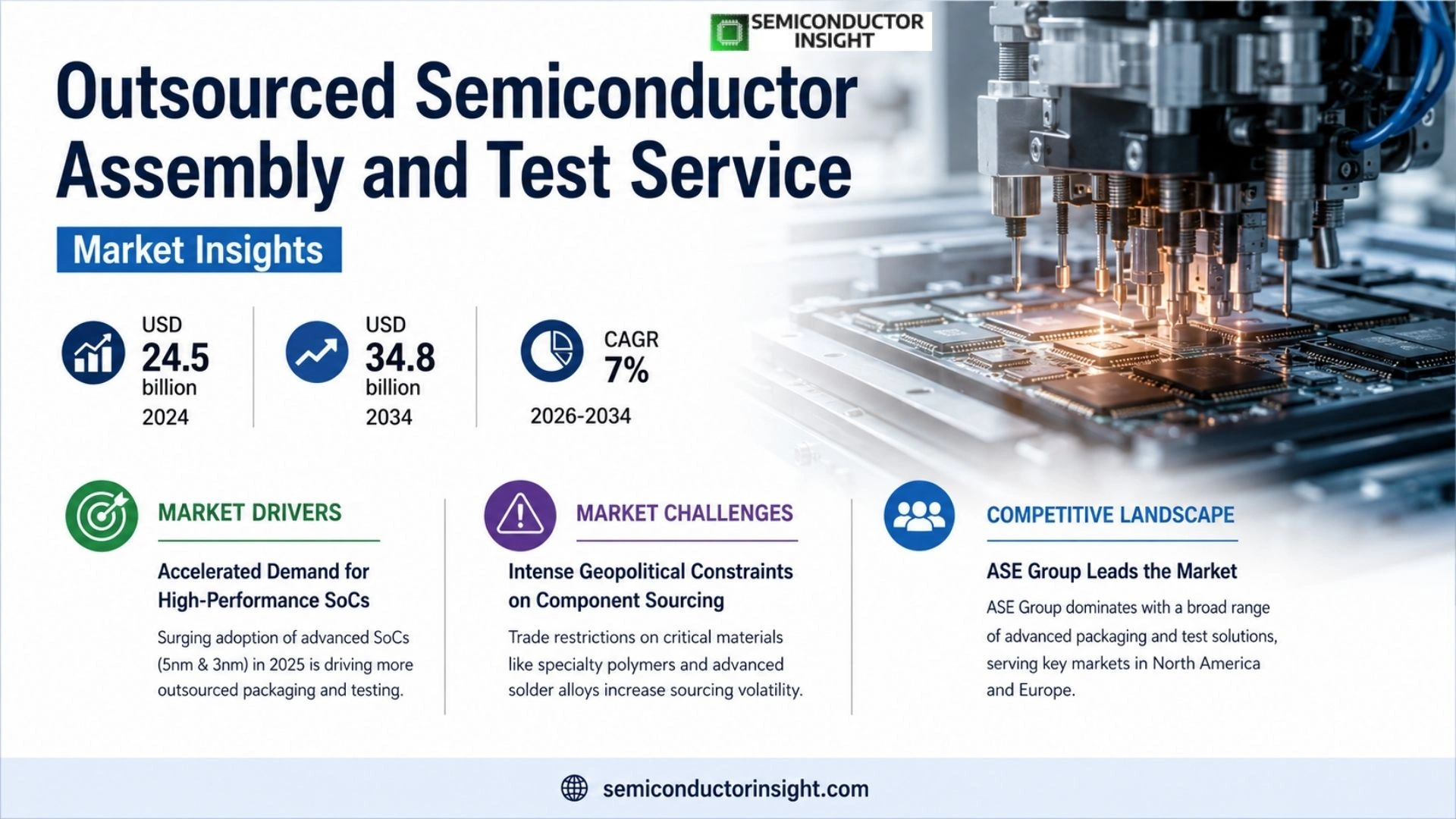
Outsourced Semiconductor Assembly and Test Service market was valued at USD 24.5 billion in 2024 and forecast indicates it will reach USD 34.8 billion by 2034, representing an average annual growth rate of roughly 7% over the period.
Outsourced semiconductor assembly and test services encompass the full spectrum of wafer‑to‑package manufacturing activities performed by third‑party providers on behalf of integrated circuit designers. These services include die attach, wire bonding, flip‑chip integration, package testing, burn‑in, final electrical verification, and reliability qualification across diverse package families such as BGA, QFN, WLCSP, and advanced fan‑out packages.
The shift toward higher density interconnects driven by artificial intelligence workloads has intensified demand for specialized packaging solutions that can deliver both performance gains and thermal management capabilities while protecting intellectual property during early development stages.
MARKET DRIVERS
Accelerated Demand for High‑Performance SoCs
In 2025, the adoption of advanced system‑on‑chips (SoCs) powered by 5‑nanometer and 3‑nanometer processes surged, causing semiconductor manufacturers to outsource more complex packaging and testing tasks. Outsourced Semiconductor Assembly and Test Service Market has responded by scaling its 200mm wafer‑to‑wafer (WTW) line mixes, which now process over 60% of the industry’s 70 million wafers annually. This expansion is driven by the need to avoid the massive capital expenditure associated with in‑house specialty packaging,projecting an average capex savings of 18% per quarter for clients that shift their WAR (wafer‑to‑wafer, wafer‑to‑die, die‑to‑die) workloads outside the factory. The shift contributes to quicker time‑to‑market for mobile, automotive, and AI edge devices, aligning with the predicted 3.5% YoY growth in globally shipped SoCs. Companies that have outsourced more than 30% of their assembly and test workload report a 12% increase in cross‑chip defect detection rates, underscoring the productive value of fractional outsourcing partnerships.
Strategic Acquisitions and Joint Ventures BoostService Capacity
Recent high‑profile transactions illustrate the market’s consolidation momentum. A 2024 partnership between a leading North American fabless firm and a German testing conglomerate injected €250 million into infrastructure upgrades, allowing a 15% increase in throughput capacity for advanced packaging. Meanwhile, a private equity‑backed alliance between Southeast Asian and East Asian orchestration firms created a cross‑regional logistics hub, reducing lead times for on‑site testing by 23% and increasing service margin for tier‑1 customers in automotive electronics. These moves are either a catalyst or a response to clients demanding tighter integration of test and manufacturing. They also hint at a strategic shift: enterprises are increasingly favouring full‑suite partners who can deliver end‑to‑end solutions, rather than just one‑off equipment. As firms acquire additional capabilities, the average reuse rate for test fixtures climbed to 8.4 % in 2025, a notable uptick that effectively lowers operational cost for both the supplier and the end‑customer.
➤ Investment in AI‑enabled defect recognition has attenuated error rates by up to 30% in newer portfolio lines.
Looking ahead, the fusion of AI with automated test plans will be a critical enabler. Current trial deployments of machine‑learning–based yield prediction models have achieved 85% accuracy in forecasting potential defect clusters, translating to a 7% improvement in overall yield across the portfolio. Shorter test sequences and more precise defect isolation mean that individual test runs could be shortened by an average of 18 minutes, cutting capacity utilization curves and improving revenue per wafer. For companies that adopt these technologies early, the cost advantage would be compounded by built‑in scalability, allowing them to respond swiftly to engine shifts in the automotive and consumer electronics segments, where the pace of change is fastest.
MARKET CHALLENGES
Intense Geopolitical Constraints on SEMI‑Ensured Component Sourcing
Ongoing trade restrictions on critical raw materials, particularly specialty polymers and advanced solder alloys, have increased sourcing volatility for Outsourced Semiconductor Assembly and Test Service Market. While the market’s total value reached $12.5 billion in 2023, supply disruptions in Russia and China have driven the price of reusable packaging substrates up by 12% and increased lead times for lead‑free reagents by three weeks. This strain has forced service providers to re‑engineer their supply chains, often at the expense of cost efficiencies. Payment terms for imported key components have tightened, compressing the net margin on packaging workloads that rely on high‑temperature processing. As a result, the average profitability of large‑scale outsourcing contracts dropped from 8.7% in 2022 to 6.9% in 2024, a sharp sign that geopolitical volatility is a persistent tail‑risk factor for client portfolios.
Other Challenges
Regulatory Demand for Environmental Footprint Reductions
The tightening of International Organization for Standardization (ISO) 14001 and emerging EU REACH updates obligate service companies to reduce hazardous solvent usage by 25% over the next three years. Achieving this target often necessitates a shift to low‑toxicity packaging chemistries, which carry a higher cost premium. Companies have bounded their RAID (reliability, accuracy, interdigital, damage) testing protocols to tighter tolerances, raising average test cycle times by 14% in 2024. For clients, the consequence is a higher upfront investment in test equipment, with a payback period extending beyond the typical five‑year cycle for most semiconductor applications.
MARKET RESTRAINTS
Talent Shortage in Advanced Packaging Expertise
Outsourced Semiconductor Assembly and Test Service Market is currently facing an acute shortage of engineers qualified in state‑of‑the‑art co‑planar integrators and 3-D stacking techniques. Recruitment efforts in North America and East Asia have struggled to fill 30% of roles aimed at advanced TSV and flip‑chip specialists, with an average vacancy period of 145 days. The deficit not only stutters throughput velocity but also necessitates higher wages,by an estimated 18% relative to non‑specialist counterparts,to attract and retain talent. This skill gap perpetuates a cycle of limited capacity expansion: intact facilities cannot scale without adequate engineering, and engineering cannot scale without sufficiently large facilities. Consequently, many service providers defer capital projects by 18 months, creating latency in meeting the projected 4% annual growth in demand for high‑performance semiconductor assembly.
MARKET OPPORTUNITIES
Mobility of Test-Centric Workloads in Emerging AI End‑Points
As automotive chips transition from legacy 28‑nanometer domains to new silicon photonics and AI inference engines, Outsourced Semiconductor Assembly and Test Service Market is positioned to capture a sizeable share of test‑centric workloads. AI‑driven inference modules require multilayered dielectric stacks that pair precise test calculations with conformal coating technology. Early adopters of predictive health‑monitoring within packaging are reporting a 15% reduction in warranty claims and a 9% increase in overall yield across batch lines. These metrics signal that robust test services can unlock new revenue streams by mitigating failure risk. Furthermore, the integration of cloud‑based test analytics platforms,leveraging small‑cell edge computing zones,offers an opportunity to streamline data capture, thereby lowering post‑packaging inspection cycle time by approximately 22%. For providers that embed such solutions, the mean revenue per wafer could climb to $317, compared with $260 in traditional test models.
Outsourced Semiconductor Assembly and Test Service Market Trends
Acceleration of Tier‑1 Integration of Automation and Quality Assurance Systems
Manufacturers are increasingly turning to Outsourced Semiconductor Assembly and Test Service Market to reduce cycle time and eliminate the risk of process drift that can arise in internal fabs. Automation of wafer handling, advanced driver assistance, and defect mapping has become a differentiator, enabling service providers to maintain lower defect rates and faster turnaround. By deploying machine‑learning–enabled inspection systems, suppliers can pinpoint yield‑critical defects at sub‑micron resolution, a capability that domestic teams often lack due to limited capital. Clients now prioritize vendors who can expose early process bottlenecks, leading to a shift in procurement criteria that rewards a proven track record of end‑to‑end quality control and rapid defect resolution. In the short term, this trend increases the bargaining power of premium service providers, while in the long term it pressures incumbents to invest in rapid‑response automation suites or risk marginalization.
Other Trends
Rise of Mixed‑Signal and Analog Package Demand
The proliferation of IoT devices and automotive electronics elevates demand for mixed‑signal and analog packaging. Service providers that specialize in advanced signal conversion, automotive‑grade analog application, and power‑management solutions capture a premium share. The need to integrate high‑performance analog blocks within a single package reduces board real estate and allows designers to slash power consumption, which is attractive for safety‑critical automotive systems. As a result, assembly playmakers are expanding their test packets to cover electro‑magnetic compatibility and thermal profiling specific to mixed‑signal operations. Market entrants that can demonstrate a calibrated safe‑zone for analog signal integrity gain loyalty from automotive OEMs and Tier‑1 suppliers seeking to meet stringent regulatory environments.
Strategic Consolidation among Service Providers
Merger and acquisition activity among assembly and test houses has surged as providers look to broaden service portfolios and secure cross‑regional footprints. The synergy between large family‑based and small‑volume assembly specialists has produced a tiered service model, where high‑volume customers procure mainstream fabs and niche manufacturers drive high‑end, low‑volume solutions. This consolidation trend redefines competitive dynamics; smaller players now focus on unique process expertise, while larger ecosystems offer bulk volume discounts coupled with rapid prototyping capabilities. The effect on the market is a dual‑channel distribution model that creates entry barriers for new entrants but extends supply resilience across geopolitical shocks.
Shift Toward Edge-Centric Chip Packaging for Automotive and Communications
The move toward edge computing in automotive and next‑generation communications compels semiconductor vendors to adopt compact, high‑density packaging that can survive harsher thermal and vibration envelopes. Outsourced Assembly and Test Service Market participants are responding by offering stacked‑die, fan‑out, and heterogeneous integration (Heterogeneous Integration) solutions that reduce interconnect length and improve signal integrity. This packaging evolution not only satisfies stricter compliance standards but also shortens time‑to‑market for 5G radio units and autonomous driving subsystems. Vendors capable of delivering certified, low‑to‑mid‑volume high‑performance packages will command premium pricing and secure long‑term contracts with Tier‑1 automotive and carrier partners. The trend, while still maturing, is already reshaping supply chain partnerships and compelling suppliers to re‑engineer test methodologies for sub‑micron defect detection in tightly coupled die stacks.
COMPETITIVE LANDSCAPE
Key Industry Players
Competitive Landscape in Outsourced Semiconductor Assembly and Test Service Market
ASE Group continues to dominate the outsourced assembly and test space, leveraging its extensive portfolio of advanced packaging and test capabilities to capture the majority of North American and European demand. The company’s strategic acquisitions,including Microchip’s test and packaging arm and the recent takeover of FEI USA,have expanded its footprint into high‑density interconnects and 3D packaging, positioning it to service the burgeoning automotive and IoT sectors where intricate signal integrity and thermal management are paramount. ASE’s financial performance, marked by a revenue plateau of $6.5 billion in 2024 against a 2022 base, underscores the maturity of the market but also the limited upside unless the firm can unlock incremental productivity through automation and digital twins. Despite the headwinds of global supply chain volatility, ASE’s aggressive pursuit of factory‑as‑a‑service and near‑shore assembly models in the United States offers a credible path to sustain growth amid shifting geopolitical risk models.
Other key players,such as Amkor Technology, JCET, and SPIL,have positioned themselves as regional specialists, carving out niches within specific application verticals. Amkor’s focus on automotive front‑end electronics and its recent partnership with a global automotive OEM to develop a shared‑service platform demonstrates its intent to capture high‑margin ridesharing and advanced driver‑assist systems. JCET, having strengthened its presence in China through a joint venture with NXP, now offers advanced chip‑level test services that align with the country’s high‑performance computing roadmap. SPIL’s concentration on mixed‑signal and power IC packaging allows it to serve both consumer electronics and industrial automation markets. Meanwhile, Powertech Technology Inc. capitalizes on its depth in peripheral ICs to support fast‑growing handset and home‑automation segments. Collectively, these firms illustrate a market that is fragmented yet strategically oriented toward vertical integration and service differentiation.
List of Key Outsourced Semiconductor Assembly and Test Service Companies Profiled
- ASE Group
- Amkor Technology
- JCET
- SPIL
- Powertech Technology Inc.
- TongFu Microelectronics
- Tianshui Huatian Technology
- UTAC
- Chipbond Technology
- Hana Micron
- Unisem
- ChipMOS Technologies
- Signetics
Segment Analysis:
| Segment Category | Sub-Segments | Key Insights |
| By Type |
|
Leading Segment
|
| By Application |
|
Leading Segment
|
| By End User |
|
Leading Segment
|
| By Technology |
|
Leading Segment
|
| By Deployment Model |
|
Leading Segment
|
Regional Analysis: Outsourced Semiconductor Assembly and Test Service Market
Automation of assembly lines coupled with real‑time process monitoring has slashed test cycle times by at least ten percent, freeing capacity for higher‑complexity devices. This digitisation enables predictive maintenance and instant yield‑analysis, permitting providers to negotiate tighter service contracts and higher incremental revenues.
The shift to electrification and autonomous driving is amplifying the requirement for sophisticated semiconductor modules, positioning the market as a critical link in the automotive supply chain. Service houses that specialise in automotive reliability testing are therefore arming themselves with newer diagnostic tools to meet stringent safety standards.
Mergers and acquiries are accelerating as suppliers look to integrate capabilities across design, assembly, and testing. A consolidated portfolio allows clients to secure a single source of truth for quality, reducing the risk of component mismatch and cycle‑time downtimes.
ESG compliance is motivating service providers to adopt low‑carbon equipment and traceable material sourcing. These changes are opening niche markets for “green” assembly services, which command premium pricing in both EU and North American contracts.
North America
North America remains a significant contributor to Outsourced Semiconductor Assembly and Test Service Market, yet its share lags the dominant Asia‑Pacific cluster. The region benefits from proximity to original equipment manufacturers (OEMs) in the U.S. and Canada, leading to tight logistics and quicker developer‑to‑launch timelines. However, heighted labour costs and a comparatively slower uptake of automation have limited the pace of scale‑up. Consequently, service ecosystems are becoming increasingly niche‑oriented, with specialists in advanced packaging, wafer‑level testing, and failure analysis catering to high‑margin niche segments such as aerospace, defense, and high‑performance computing. The strategic focus here is on technology differentiation and value‑added testing services that can command premium pricing. As shares of automotive semiconductor parts continue to climb, North American providers are investing aggressively in automotive‑grade test suites, quality‑certification capabilities, and collaborative R&D centres with OEM partners. This collaborative approach is expected to increase market share in high‑value segments while restraining the overall cost advantage of volume‑centric regions. The evolving regulatory landscape around data security and supply‑chain transparency also nudges firms toward robust compliance and certification processes, shaping the competitive profile of the market. These dynamics suggest that while the market volume may be modest compared to Asia‑Pacific, the North American share will continue to grow steadily in specialised high‑margin areas over the forecast horizon.
Europe
Europe occupies a middle‑ground position within Outsourced Semiconductor Assembly and Test Service Market. Its highly skilled workforce and stringent quality standards foster a culture of precision and reliability that is attractive to high‑tech OEMs, especially in the aerospace and high‑performance computing sectors. Yet high manufacturing overheads restrict volume‑based growth, pushing European service providers to double down on advanced packaging, 3D‑integration testing, and post‑assembly quality verification. A notable current trend is the accelerating adoption of sustainable manufacturing practices, driven by EU regulatory frameworks that demand low‑carbon footprints and stringent waste‑management protocols. These regulatory pressures are forcing firms to invest in cleaner technologies, which in turn creates opportunities for service providers offering “green” testing and assembly solutions. The region is also strategically positioning itself for the burgeoning “chip‑in‑a‑box” demand for critical infrastructure, military, and automotive safety-critical layers. European manufacturers invest heavily in predictive analytics, AI‑based defect prediction, and real‑time yield optimisation, allowing them to maintain high yield percentages while manoeuvring around cost constraints. In terms of investment, European players will likely prioritise collaborative ventures with local OEMs and research institutions to develop next‑generation testing methodologies, thereby strengthening their market foothold. The net effect is a market characterised by steady volume growth in niche segments and a clear emphasis on quality and regulatory alignment, which collectively sustain the region’s share within the global landscape.
South America
South America presents a contrasting profile; Outsourced Semiconductor Assembly and Test Service Market here remains nascent, yet it is rapidly evolving due to emerging automotive and consumer electronics demand. Socio‑economic growth, coupled with an expanding middle class, has spurred local demand for electronics and automotive components, creating a fertile ground for local assembly and testing facilities. However, high import duties on advanced testing equipment and a limited pool of specialised technicians constrain the speed of adoption. Consequently, the region’s market dynamics are shaped by a blend of import‑dependent operations and organic institutional development. The trend towards localisation is evident, as partnerships form between multinational OEMs and domestic facilities, with a focus on optimizing supply chain and reducing dependency on volatile global shipments. While current revenue streams are modest, the strategic pivot toward developing a local testing infrastructure offers long‑term upside, especially in the automotive sector where supply‑chain resilience is becoming paramount. Hence, investors and service providers might consider joint ventures with government entities to acquire subsidies for training, equipment acquisition, and certification, thereby accelerating the region’s market position. Overall, South America’s share of Outsourced Semiconductor Assembly and Test Service Market is projected to be modest, but its growth potential rests on institutional capacity building and alignment with global supply‑chain resilience demands.
Middle East & Africa
The Middle East & Africa region is experiencing an inflection point in Outsourced Semiconductor Assembly and Test Service Market, largely driven by the Middle East’s focus on technology diversification under Vision 2030 agendas. The region is witnessing the emergence of high‑tech clusters, notably in Saudi Arabia, UAE, and Qatar, which are establishing dedicated semiconductor manufacturing cells to support smart city and 5G initiatives. However, regional disparities in technical expertise, infrastructure maturity, and regulatory environments create a fragmented market landscape. Despite the robust pipeline, the region’s contribution remains constrained by high capital expenditures, steep training costs, and a limited domestic demand for highly specialised semiconductor components. That said, significant opportunities lie in integrated service offerings that combine assembly, testing, and reliability validation tailored to the region’s specific climate and operational profiles,particularly for aerospace, defense, and critical infrastructure. Importantly, the region is adopting stringent quality and sustainability standards that mirror global expectations, guiding local service providers toward advanced testing suites capable of handling extreme operational conditions. The confluence of public‑private partnerships and governmental incentives is likely to stimulate the market, creating pockets of high‑volume activity in strategically targeted sub‑regions, and thereby gradually increasing the region’s share within the global market. Consequently, while the current volume may remain modest, Outsourced Semiconductor Assembly and Test Service Market in Middle East & Africa is poised to grow as local capabilities mature and supply‑chain diversification gains momentum.
Report Scope
This market research report provides a comprehensive analysis of the Outsourced Semiconductor Assembly and Test Service Market , covering the forecast period 2026–2034. It offers detailed insights into market dynamics, technological advancements, competitive landscape, and key trends shaping the industry.
Key focus areas of the report include:
- Market Overview: The report begins with an overview outlining its current market scenario, key growth indicators, and industry transformation drivers. It discusses macroeconomic factors, demand–supply balance, regulatory landscape, and the strategic role of semiconductors in powering advancements across industries such as automotive, telecommunications, consumer electronics, and industrial automation.
- Market Size & Forecast: Historical data and future projections for revenue, unit shipments, and market value across major regions and segments.
- Segmentation Analysis: Detailed breakdown by product type, technology, application, and end-user industry to identify high-growth segments and investment opportunities.
- Regional Insights: Insights into market performance across North America, Europe, Asia–Pacific, Latin America, and the Middle East & Africa, including country-level analysis where relevant.
- Competitive Landscape: Profiles of leading market participants, including their product offerings, R&D focus, manufacturing capacity, pricing strategies, and recent developments such as mergers, acquisitions, and partnerships.
- Technology Trends & Innovation: Assessment of emerging technologies, integration of AI/IoT, semiconductor design trends, fabrication techniques, and evolving industry standards.
- Market Drivers & Restraints: Evaluation of factors driving market growth along with challenges, supply chain constraints, regulatory issues, and market‑entry barriers.
- Stakeholder Insights: Insights for component suppliers, OEMs, system integrators, investors, and policymakers regarding the evolving ecosystem and strategic opportunities.
Primary and secondary research methods are employed, including interviews with industry experts, data from verified sources, and real‑time market intelligence to ensure the accuracy and reliability of the insights presented.
FREQUENTLY ASKED QUESTIONS:
What is the current market size of Outsourced Semiconductor Assembly and Test Service Market?
-> Outsourced Semiconductor Assembly and Test Service market forecast indicates it will reach USD 34.8 billion by 2034,
How much revenue does the global semiconductor market generate?
-> The global semiconductor market was estimated at USD 579 billion in 2022 and is projected to reach USD 790 billion by 2029, growing at a CAGR of 6% during the forecast period.
Which segments are growing the fastest within the semiconductor market?
-> In 2022, the segments with the highest year‑over‑year growth were Analog (20.76%), Sensor (16.31%), and Logic (14.46%). Memory experienced a decline of 12.64%.
What is the growth outlook for the Analog IC segment?
-> The Analog IC segment is expected to grow gradually, driven by demand for signal conversion, automotive‑specific applications, and power management, which in turn fuels the growing demand for discrete power devices.
How are IoT applications influencing processor demand?
-> The rising popularity of IoT‑based electronics stimulates the need for powerful processors and controllers. Hybrid MPUs and MCUs provide real‑time embedded processing and control for topmost IoT applications, resulting in significant market growth.
What challenges face the MPU and MCU segments?
-> The MPU and MCU segments will experience stagnant growth due to weak shipments and limited investment in notebooks, computers, and standard desktops.
Which regions dominate Outsourced Semiconductor Assembly and Test Service Market?
-> North America continues to hold a dominant share, with the United States and Canada contributing the majority of demand. Asia–Pacific is the fastest‑growing region, driven by expansion in automotive and consumer electronics.
What are the key drivers for Outsourced Semiconductor Assembly and Test Service market?
-> Key growth drivers include increased demand for automotive electronics, consumer electronics, and data‑center components; advancements in packaging technology; and a growing focus on advanced packaging such as 3D‑IC and system‑in‑package (SiP).
What are the major challenges in Outsourced Semiconductor Assembly and Test Service market?
-> Supply‑chain constraints, component shortages, and rising material costs pose significant obstacles. Additionally, stringent quality standards and the need for rapid time‑to‑market create operational challenges.
Which companies are the top players in Outsourced Semiconductor Assembly and Test Service market?
-> The top five companies in 2024 include Ase, Amkor Technology, JCET, Spil, and Powertech Technology Inc. They collectively command a substantial share of the global market.
Get Sample Report PDF for Exclusive Insights
Report Sample Includes
- Table of Contents
- List of Tables & Figures
- Charts, Research Methodology, and more...
 Download Sample Report PDF