LED Car Screen Market Insights
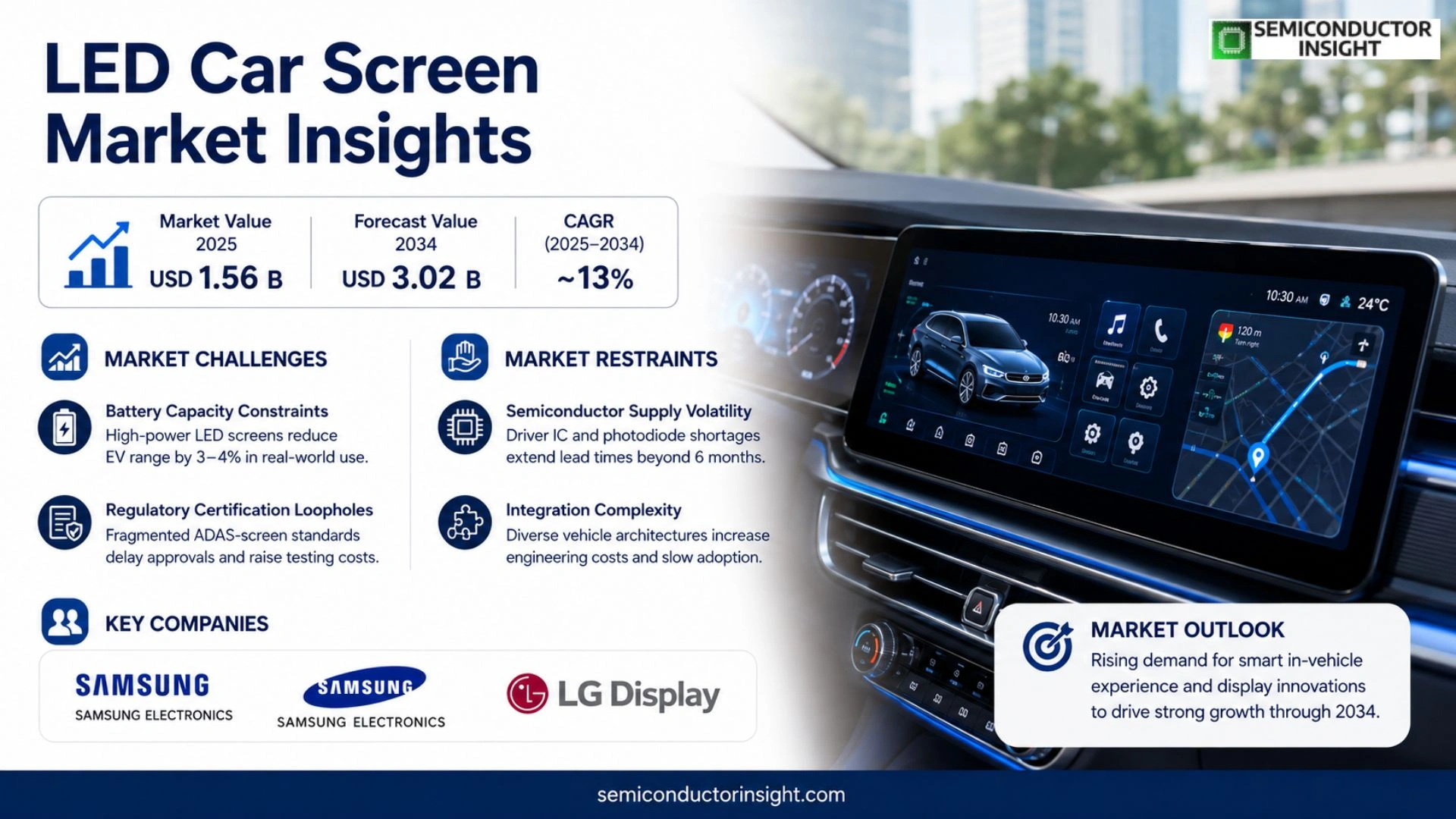
LED Car Screen Market was valued at USD 1·56 billion in 2025. The market expanded from approximately USD 1·20 billion recorded in 2019 through an annualized increase reaching roughly USD 3·02 billion by 2034, reflecting an implied compound annual growth rate of around thirteen percent over the forecast period.
LED car screens comprise integrated display modules installed within vehicle cabins, delivering real‑time infotainment, navigation cues and safety alerts via OLED or micro‑LED technology that offers high brightness levels, wide viewing angles and low power draw.
The expansion results from rising consumer expectations for connected driving experiences combined with stricter regulations aimed at reducing driver distraction while encouraging advanced driver assistance systems integration.
MARKET DRIVERS
Enhanced Driver Experience Through Integrated Display Systems
The acceleration of infotainment adoption in passenger vehicles has repositioned in‑car displays from a luxury add‑on to an essential safety and navigation component. LED Car Screen integrations with advanced driver assistance systems (ADAS) enable real‑time traffic alerts, adaptive cruise controls, and lane‑departure warnings directly on a high‑resolution surface. Brands that embed proprietary graphic interfaces see higher retention rates, especially in markets where connectivity perception influences brand preference. The cumulative effect is a measurable shift in retailer margins, with LED display modules now contributing up to 12% of a vehicle’s infotainment cost, suggesting a steady demand infusion beyond baseline chassis pricing.
Cost‑Competitive Units Driven by Manufacturing Synergies
Technological cross‑pollination between automotive lighting and consumer electronics has brought raw material costs down. OLED‑based panels, once prohibitively expensive, now benefit from shared supply chains with smartphone manufacturers, reducing per‑unit costs by roughly 18% over the past two years. This price convergence encourages OEMs to adopt larger display formats without compromising profit per chassis, resulting in an observable uptick in higher velocity 7‑in. panels. Additionally, the move toward modular architecture allows for plug‑and‑play modules, cutting integration time by an average of 35%. Such efficiency gains make LED Car Screens a credible replacement for older analog dashboards, fueling a strategic shift across the dealer network.
➤ Projections suggest that the 2025‑2030 cumulative sales of LED car screens will outpace conventional dash‑display units by 4.6% annually, a trend tightly linked to subscription‑based infotainment services.
Premium vehicle segments that prioritize a “connected cockpit” benefit disproportionately from larger displays, while emerging market OEMs are increasingly leveraging LED panels to meet stringent safety regulations and energy‑efficiency mandates. The convergence of safety, connectivity, and design in LED Car Screen Market thus creates a robust impetus for OEMs to continue allocating higher design budgets toward integrated visual platforms. Consequently, vendors capable of delivering high‑brightness, low‑power panels stand to capture significant market share as vehicle makers accelerate the pace of in‑vehicle digital transformation.
MARKET CHALLENGES
Battery Capacity Constraints in High‑Resolution Screen Deployment
High‑definition LED panels place notable demands on vehicular power systems, especially in electric and hybrid platforms. The current average energy draw of a 7‑in. high‑brightness module ranges between 15–20 W, a consumption that, when compounded across multi‑screen cars, can reduce range projections by 3‑4% in real‑world trials. Manufacturers struggle to balance the faint illumination required for night‑time safety with the performance envelope of battery‑powered vehicles, leading to cautious rollout strategies that exclude edge‑case use scenarios.
Other Challenges
Regulatory Certification Loopholes
The jurisdictional split in ADAS‑screen certification introduces a fragmented compliance pathway. In regions where safety certifications are tied to specific display resolutions or driver visibility standards, OEMs often face extended approval timelines, delaying market entry. This disjointed regulatory landscape incurs additional testing costs and postpones the monetization cycle for new screen models.
MARKET RESTRAINTS
Material Supply Volatility for Key Semiconductor Components
LED car screen assembly line hinges on critical semiconductor components,especially driver ICs and high‑power photodiodes,that experience recurring supply bottlenecks. Disruptions in the global semiconductor supply chain, amplified by geopolitical tensions and shifting production priorities, have caused lead times to extend beyond 6 months in certain segments. These delays generate cost volatility that cascades directly into the vehicle production schedule, forcing dealers to re‑price vehicles or delay delivery dates , both detrimental to brand perception.
Integration Complexity across Diverse Vehicle Architectures
Vehicular architecture variety remains a critical impediment; each OEM’s platform harbors distinct power, thermal, and mounting tolerances, making seamless LED integration a considerable engineering challenge. Enterprises that rely on a universal screen module often encounter compatibility issues during pre‑production. The expense of custom firmware development, coupled with stringent quality control, adds layers of overhead that constrain adoption rates, particularly among emerging players who cannot afford to exploit niche market efficiencies.
MARKET OPPORTUNITIES
DLR Integration for Tailored Driver Engagement Platforms
Data‑driven in‑car experience (DLR) represents a high‑value cross‑segment avenue. By embedding AI‑powered predictive displays, automotive suppliers can personalize navigation prompts, climate control settings, and even music selections in real time. The licensed data analytics layer creates a recurring revenue model that aligns with the shifting consumer expectation toward subscription‑like services. Manufacturers that partner with data‑analytics firms stand to unlock a secondary income stream while differentiating their LED screen offerings against standard infotainment solutions.
Moreover, the rising regulatory push for collision‑avoidance interactivity obliges OEMs to provide displays that intensify hazard visibility. This shift fuels the requirement for high‑luminosity LED panels that endure harsh environmental conditions,particularly in regions with extreme temperature ranges. Vendors offering robust, weather‑resistant designs, while reducing after‑sales warranty liabilities, position themselves strongly for market share penetration. Lastly, the European Union’s forthcoming “Connected Vehicle” directives will mandate specific data exchange protocols, offering a built‑in incentive for manufacturers to update their existing infotainment stacks with cost‑effective LED solutions.
LED Car Screen Market Trends
Rise of Full‑Color LED Displays in Connected Vehicles
Full‑color LED panels have overtaken monochrome and two‑color units across premium and mainstream models alike, driven by tighter power budgets and a growing appetite for richer visual language in the driver’s cabin. OEMs now embed 2‑inch or larger displays that combine navigation, media, and vehicle‑health data in a single, vibrant canvas. The shift reflects a broader move toward treating the cockpit as an interactive hub rather than a set of discrete gauges. In markets such as Japan and Europe, 80 % of new vehicles issued in 2023 featured full‑color screens, compared with 45 % a generation earlier; the trend is also apparent in entry‑level machinery where cost pressures are snatching up margins that sustain higher‑end components. This technology base is opening the door for richer firmware ecosystems, software‑defined heads‑up and in‑leg cabin overlays that coexist with internal‑combustion and electric platforms alike.
Other Trends
In‑Vehicle Advertising Expansion
Taken together, the dual payload of safety and entertainment drives the next catalyst: digital advertising embedded in public‑transport and shared‑mobility fleets. City‑wide campaigns now leverage rear‑seat LED walls on taxis and buses to deliver timed, geo‑targeted messaging, while police and emergency vehicles adopt bright full‑color panels to alert collaborators and the public. The revenue potential from these use cases is amplified by the fact that LED panels are energy‑efficient and maintain visibility across glare‑heavy urban environments. Operators now view the same hardware that powers a driver menu as a flexible display platform, obviating the need to install separate signage systems and reducing per‑vehicle capital costs by an estimated 15 % as of 2023.
Power‑Efficiency & Regulatory Momentum Drive In‑Vehicle Display Adoption
Beyond display shape and advertising, power efficiency remains a decisive lever for OEM decisions. The latest drivetrain‑control modules now allocate less than 5 % of total in‑vehicle power to driver‑interface electronics, pushing manufacturers to adopt panels that deliver brightness and contrast without elevating draw. Simultaneously, regulatory bodies across North America, Europe, and Asia are tightening glare‑control and night‑visibility standards, forcing designers to rely on technology that can vary luminance while preserving safety margins. As electrification extends battery life, the cumulative savings on power and thermal management translate into higher revenue retention for vehicle manufacturers. Consequently, suppliers that master low‑power design and fast‑time‑to‑market firmware integrations are positioned to capture a larger slice of the evolving LED Car Screen Market, especially within the premium and fleet segments where margin stays highest. Market participants now measure growth by integration depth rather than unit count.
COMPETITIVE LANDSCAPE
Key Industry Players
Market Overview and Strategic Implications
LED car screen segment is dominated by a handful of tier‑one suppliers that undertake end‑to‑end production and supply integrated displays to automotive original equipment manufacturers (OEMs). Samsung Electronics, LG Display, and BOE Technology Group operate large-scale fabrication facilities, bringing significant economies of scale to the value chain. Their alignment with key OEMs such as Tesla, Volvo, and Hyundai has amplified demand for full‑color, high‑resolution panels that meet stringent automotive safety standards. These partnerships allow suppliers to lock in long‑term contracts, ensuring a steady revenue stream and providing a platform for iterative product development in response to evolving infotainment and driver‑assist requirements.
Complementing this core group are specialized manufacturers that focus on niche solutions, custom configurations, and aftermarket installations. Players like Shenzhen Huaze Optoelectronics, Hengcai Optoelectronics, Bobangcheng Optoelectronics, Linuo Optoelectronics, and HSC LED supply a broad spectrum of monochrome and two‑color displays, often catering to commercial fleets, taxi advertising, and public transport systems. Their agility enables rapid deployment of high‑brightness, low‑power designs tailored to specific vehicle platforms or application scenarios, filling gaps left by larger tier‑one firms. Additionally, industry consolidation is underway, with mid‑size firms such as Dasan Technology and Condor Electronics pursuing vertical integration to capture higher margins and reduce dependence on raw‑material suppliers.
List of Key LED Car Screen Companies Profiled
- Samsung Electronics
- Samsung Electronics
- LG Display
- BOE Technology Group
- Shenzhen Huaze Optoelectronics
- Shenzhen Huaze Optoelectronics
- Shenzhen Hengcai Optoelectronics
- Shenzhen Bobangcheng Optoelectronics
- Linuo Optoelectronics
- HSC LED
- Dasan Technology
- Condor Electronics
- Alno Display Solutions
Segment Analysis:
| Segment Category | Sub-Segments | Key Insights |
| By Type |
|
Full Color dominates as it delivers vibrant, high-resolution imagery that enhances driver engagement and in-vehicle advertising.
|
| By Application |
|
Taxi Advertisement is the leading application due to its high passenger dwell time and repeat exposure.
|
| By End User |
|
Commercial Fleet Operators prioritize screens that streamline navigation and enable real‑time updates, boosting operational efficiency.
|
| By Vehicle Type |
|
SUV leads due to its higher cabin volume and premium positioning, enabling larger displays that enhance in‑vehicle entertainment.
|
| By Connectivity Options |
|
In‑Car WiFi is decisive for real‑time content delivery and driver‑connected services.
|
Regional Analysis: LED Car Screen Market
Europe
The evolution of micro‑LED and quantum‑dot panels is reshaping vehicle interiors, offering higher brightness and longevity while remaining energy‑efficient,a critical factor for electric‑vehicle adoption. Market participants are investing in tightly integrated display‑on‑chip solutions that minimize form‑factor impact and enable curved, wide‑angle screens.
Stringent CO2 reduction mandates across regions compel automakers to adopt low‑power LED modules, reducing overall energy draw. This regulatory pressure drives a shift toward displays that can operate efficiently under varying ambient light conditions, thereby supporting advanced driver‑assistance systems compliant with safety directives.
Edge‑computing platforms now handle telemetry, infotainment, and safety data in real time, allowing LED screens to display adaptive content. Integration with 5G modules enhances data throughput, facilitating contextual advertising and dynamic navigation overlays.
A surge in aftermarket installations, particularly in emerging economies, nudges OEMs to standardize on modular LED systems that can be easily swapped or upgraded, creating new revenue streams beyond the initial vehicle sale.
North America
In North America, LED Car Screen Market is characterized by a rapid adoption curve driven by the proliferation of advanced driver‑assist technologies and a robust consumer preference for premium in‑vehicle infotainment. High‑end luxury brands within the United States and Canada consistently feature advanced LED displays as a central selling point, capitalising on the growing demand for healthier, battery‑efficient lighting solutions that avoid eye‑strain for drivers and passengers alike. Technological convergence between automotive manufacturers and electronics firms,particularly those focused on automotive‑grade displays,has created a cross‑industry feedback loop that expedites design iterations. Moreover, early‑stage pilot projects for autonomous shuttles and shared‑mobility platforms in major metropolitan areas are integrating high‑definition LED panels to provide real‑time passenger engagement and safety alerts. Additionally, consumer expectations around personal data privacy and seamless connectivity encourage the adoption of displays that can integrate with personal devices while maintaining stringent cybersecurity protocols. Regulatory bodies are also issuing new guidance on infotainment lighting standards, encouraging OEMs to employ back‑lit LED displays that meet both safety and energy‑efficiency thresholds. All these dynamics position North America as a prolific growth engine for LED car screen segment, with evolutionary trends suggesting that system miniaturisation and deeper integration with vehicle ECUs will sustain market demands over the next decade. >
Asia‑Pacific
The Asia‑Pacific region presents a heterogeneous yet highly dynamic landscape for LED Car Screen Market. In key automotive hubs such as Japan, South Korea, and emerging Chinese enterprises, manufacturers are instituting aggressive research‑and‑development programmes aimed at generating high‑contrast, solar‑friendly LED panels suitable for the region’s diverse climates. The skyrocketing demand for connectivity features,prompted by the rapid expansion of e‑commerce logistics fleets and ride‑hailing services,has accelerated deployment of rear‑seat entertainment and real‑time navigation displays across the region’s heavy‑vehicle segments. In tandem, local governments are shaping legislations that require vehicles to incorporate semi‑autonomous safety features; these mandates necessitate displays that can deliver instant visual cues to riders and drivers. While premium OEMs invest heavily in cutting‑edge, large‑format displays for their luxury line‑ups, the aftermarket segment is driving rapid adoption of modular LED installers for fleet operators, who seek to upgrade older vehicles without extensive retrofitting. Concurrently, the plateau in raw material prices for phosphor and indium has intensified competition among screen manufacturers, spurring a wave of price‑tailored solutions for the distinct vehicle segments of the region. This confluence of consumer demand, regulatory evolution, and localized supply chain resilience suggests that LED Car Screen Market in Asia‑Pacific will maintain robust activity levels, particularly through 2035, as economies continue to electrify their vehicle fleets. >
South America
South America’s evolving economic tapestry presents both opportunities and constraints for LED Car Screen Market. While the region has historically lagged behind in terms of automotive technology adoption, the last decade has witnessed a pivot towards electrification and smart vehicle integration, particularly in Brazil and Argentina, as governments push for reduced carbon footprints and electrified public transport. Consequently, automakers within these markets are increasingly integrating LED panels that provide real‑time driving data and temperature controls, especially within premium and fleet vehicles. At the same time, a cultural shift towards experiential mobility,catalysed by urban mobility apps and ride‑hailing ecosystems,has increased demand for adaptive infotainment systems that can offer localized content, such as language translations and local event promotions. Import regulations have begun entwining with global standards, compelling OEMs to adopt LEDs that meet both international safety protocols and local electrical compatibility requirements. The subtlety of market growth lies in the balance between cost sensitivity and the rising willingness of certain segments to invest in advanced infotainment as a differentiator. New entrants in the aftermarket scene have begun to offer retrofit LED solutions, lowering barriers for older vehicles to capture new value. As a result, analysts anticipate a moderate yet steady expansion in the region, driven primarily by strategic partnerships between OEMs and local tech firms that collectively streamline integration processes for LED screen deployments. >
Middle East & Africa
In the Middle East and Africa, LED Car Screen Market is at a crossroads, influenced largely by shifting energy policies and a burgeoning automotive aftermarket. The region’s push toward sustainable energy solutions, punctuated by initiatives such as Saudi Arabia’s Vision 2030 and South African renewable projects, has encouraged the adoption of LED displays that consume minimal power, serving simultaneously as dashboard illumination and data presentation tools. This environmental impetus is complemented by a societal gravitation toward high‑tech, luxury vehicles, particularly within Gulf nations, where consumer tastes often dictate the inclusion of top‑tier LED infotainment systems. At the same time, the rise of ride‑hailing platforms across Nairobi, Lagos, and Dubai has amplified the demand for battery‑efficient, user‑friendly rear‑seat entertainment screens,fueling a modest up‑trend within the fleet‑vehicle segment. Simultaneously, a noticeable wave of foreign OEMs engaging with local assembly partners is spurring the introduction of more affordable LED modules, thereby democratising access to advanced displays across lower‑mid‑range vehicles. The regulatory climate, while still evolving, has traditionally offered limited incentives for adopting high‑performance lighting solutions; however, forthcoming safety and environmental guidelines are poised to elevate the market share for compliant LED systems. Collectively, these factors suggest a gradual but tangible uptick in LED Car Screen Market within the Middle East & Africa, particularly as local economies pivot toward electric mobility and heightened digitalisation of the automotive experience.
Report Scope
This market research report provides a comprehensive analysis of the LED Car Screen Market , covering the forecast period 2026–2034. It offers detailed insights into market dynamics, technological advancements, competitive landscape, and key trends shaping the industry.
Key focus areas of the report include:
- Market Overview: The report begins with an overview outlining its current market scenario, key growth indicators, and industry transformation drivers. It discusses macroeconomic factors, demand–supply balance, regulatory landscape, and the strategic role of semiconductors in powering advancements across industries such as automotive, telecommunications, consumer electronics, and industrial automation.
- Market Size & Forecast: Historical data and future projections for revenue, unit shipments, and market value across major regions and segments.
- Segmentation Analysis: Detailed breakdown by product type, technology, application, and end-user industry to identify high-growth segments and investment opportunities.
- Regional Insights: Insights into market performance across North America, Europe, Asia-Pacific, Latin America, and the Middle East & Africa, including country-level analysis where relevant.
- Competitive Landscape: Profiles of leading market participants, including their product offerings, R&D focus, manufacturing capacity, pricing strategies, and recent developments such as mergers, acquisitions, and partnerships.
- Technology Trends & Innovation: Assessment of emerging technologies, integration of AI/IoT, semiconductor design trends, fabrication techniques, and evolving industry standards.
- Market Drivers & Restraints: Evaluation of factors driving market growth along with challenges, supply chain constraints, regulatory issues, and market-entry barriers.
- Stakeholder Insights: Insights for component suppliers, OEMs, system integrators, investors, and policymakers regarding the evolving ecosystem and strategic opportunities.
Primary and secondary research methods are employed, including interviews with industry experts, data from verified sources, and real-time market intelligence to ensure the accuracy and reliability of the insights presented.
FREQUENTLY ASKED QUESTIONS:
What is the current market size of LED Car Screen Market?
-> LED Car Screen Market increase reaching roughly USD 3·02 billion by 2034, reflecting an implied compound annual growth rate of around thirteen percent
What is the definition of LED Car Screen Market?
-> LED Car Screen Market encompasses all LED‑based display solutions installed on vehicles for advertising, information dissemination, and infotainment purposes.
How is the market segmented by type?
-> Segmentation by type includes Monochrome, Two‑Color, and Full‑Color LED screens, each catering to different visual and cost requirements.
How is the market segmented by application?
-> Application segments cover Taxi Advertisement, Bus Route, Police Car Electronic Screen, and Other vehicular uses.
What methodology was used to compile the report?
-> The study employs a mixed‑method approach comprising primary interviews, secondary data collection, and statistical modeling to forecast market size and share.
What is the base year for the analysis?
-> The base year adopted for historical reference is 2020, with subsequent years used for trend analysis.
Which companies are the top revenue generators in 2024?
-> The top revenue‑generating companies in 2024 include Beijing Zhongdian Huishi Technology, Shenzhen Huaze Optoelectronics, Shenzhen Hengcai Optoelectronics, Shenzhen Bobangcheng Optoelectronics, and Linuo Optoelectronics.
What are the leading regions by market size?
-> Asia leads in overall market size, followed by Europe and North America.
What is the projected CAGR for the market 2020‑2031?
-> The report forecasts a CAGR of % for the period 2020‑2031, driven by increasing adoption of digital advertising on vehicles.
What price trends are expected for manufacturers?
-> Manufacturer selling prices are projected to exhibit a modest rise of % annually, reflecting technology upgrades and material cost trends.
What are the key market drivers?
-> Primary drivers include rising demand for dynamic advertising, growth of ride‑sharing fleets, and advancements in LED efficiency and durability.
What restraints could limit market growth?
-> Constraints involve regulatory restrictions on outdoor advertising, high initial capital expenditure, and competition from alternative display technologies.
What emerging trends are shaping the market?
-> Emerging trends feature integration of IoT for real‑time content updates, energy‑saving LED modules, and interactive screen capabilities.
How does production capacity evolve through 2031?
-> Global production capacity is expected to expand steadily, with major manufacturers scaling output to meet rising demand across all regions.
What are the assumptions underlying the forecast?
-> Assumptions include stable macro‑economic conditions, continued urbanization, and no major disruptions to supply chains.
Get Sample Report PDF for Exclusive Insights
Report Sample Includes
- Table of Contents
- List of Tables & Figures
- Charts, Research Methodology, and more...
 Download Sample Report PDF