Digital Array Microphone Market Insights
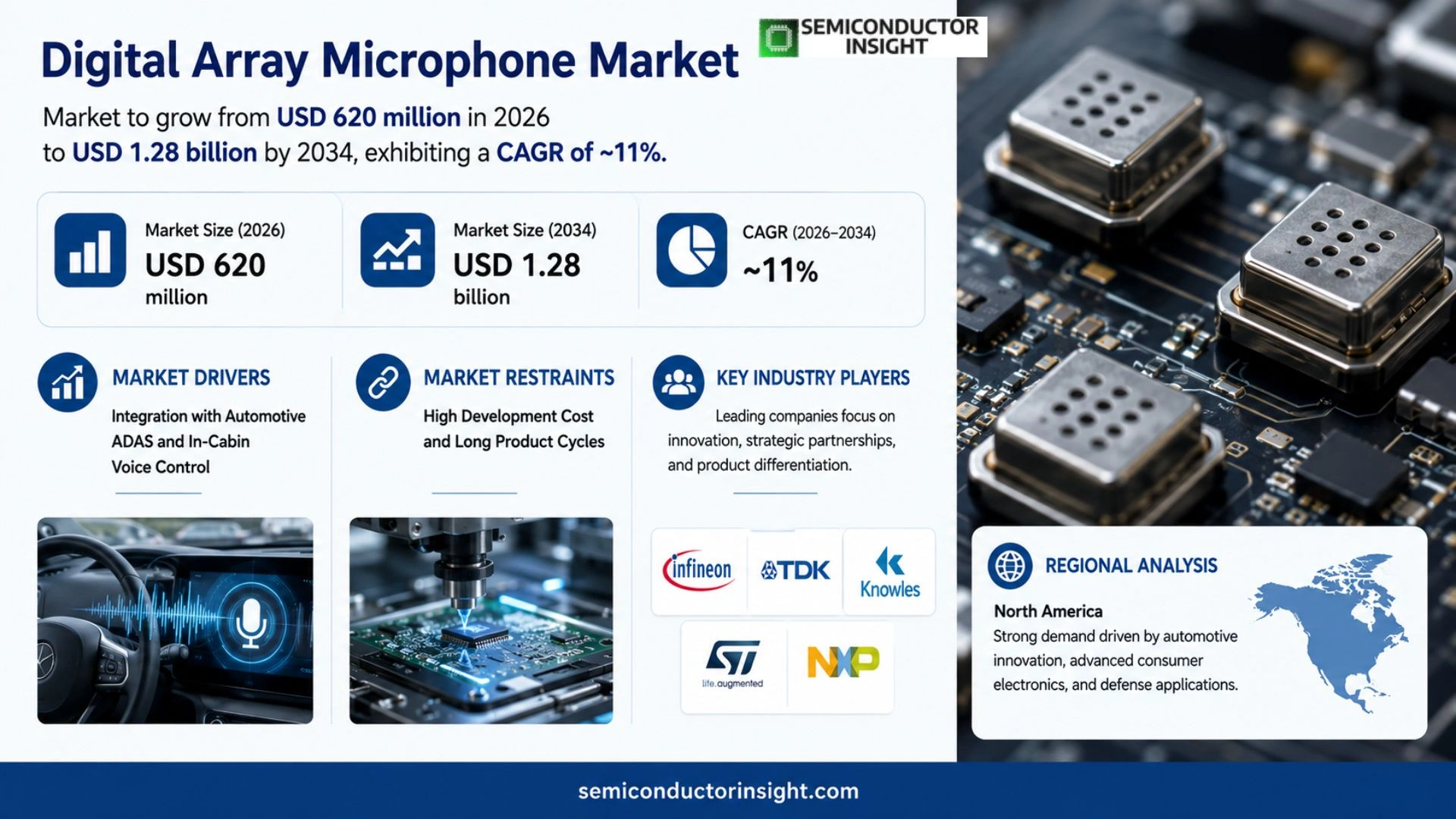
Digital array microphone market size was valued at USD 620 million in 2025. The market is projected to grow from USD 620 million in 2026 to USD 1.28 billion by 2034, exhibiting a CAGR of approximately 11% during the forecast period.
Digital array microphones are integrated sensor systems that convert acoustic signals into digital form using multiple MEMS elements arranged in an array configuration. This technology enables precise beamforming, direction‑of‑arrival estimation, and ambient noise cancellation across applications such as automotive infotainment, smart speakers, conferencing systems and surveillance devices. Demand is driven by the expansion of connected vehicle audio platforms and the proliferation of voice‑controlled consumer electronics.
MARKET DRIVERS
Integration with Automotive ADAS and In‑Cabin Voice Control
The rise of connected transportation has positioned Digital array microphone Market at the core of advanced driver assistance systems (ADAS). As vehicles evolve toward higher degrees of automation, manufacturers require robust audio capture solutions that can reliably detect spoken commands while mitigating road noise, wind, and HVAC interference. The high‑performance beamforming algorithms embedded in digital array microphones enable pickup of vocal input from multiple directions, facilitating natural conversation between occupants and vehicle systems. Automotive partners are now incorporating these units into infotainment modules for hands‑free telephony, navigation prompts, and safety alerts, driving a compound annual growth rate (CAGR) in the mid‑teens for this application segment. The shift toward electrified powertrains amplifies the need for loudspeaker‑free, passenger‑centered audio experiences, thereby reinforcing the demand for digital arrays that can lower the acoustical signature of the cabin while preserving intelligibility.
Emerging Immersive Audio and Conferencing Solutions
Parallel to automotive adoption, the surge in remote collaboration and immersive media production has created a second prolific growth vector. Digital Array Microphone Market participants are seeing a spike in orders for body‑mounted and desk‑mounted arrays used in high‑definition video conferencing, live streaming, and augmented reality (AR) environments. In these contexts, accurate sound localization and reverberation suppression are paramount for both avatar realism and real‑time transcription services that rely on equal‑power audio capture. As small‑to‑medium enterprises pivot to hybrid work models, the cost‑effective nature of compact digital arrays has enabled rapid scaling of meeting rooms without the need for professional acoustic treatments. Market forecasts indicate that the growing adoption of 360° audio recording for gaming, virtual production, and even podcasting will sustain a stable demand curve.
➤ Drivers such as regulatory shifts toward hands‑free driving mandates and burgeoning VR content workflows are accelerating the adoption of digital array microphones across a wide range of verticals.
The synergy between voice‑activated interface ecosystems and edge‑processing capabilities is further reinforcing market momentum. Digital array microphones now embed programmable noise‑gate function blocks that can be tuned in real time using machine‑learning models. This flexibility allows OEMs to tailor acoustic profiles for specific deployment contexts, from the quiet of a small luxury sedan to the noisy corridors of a conference hall. The result is a more scalable product portfolio that can be updated through OTA firmware releases, creating recurring service opportunities for manufacturers and technology integrators alike. In sum, the convergence of automotive electronics, immersive media, and edge AI is the key catalyst propelling Digital array microphone Market into a new era of high‑density, low‑latency audio capture.
MARKET CHALLENGES
Electromagnetic Compatibility and Factory Yield Constraints
The complexity of integrating multi‑channel signal processing circuits into compact form factors introduces significant electromagnetic compatibility (EMC) hurdles. In Digital array microphone Market, the proximity of numerous analog front‑ends to high‑frequency oscillators can generate interference that degrades voice‑spectrum fidelity. Achieving acceptable worst‑case performance across multiple units in a single chassis often requires expensive shielding and layout revisions, which can elevate production costs. Moreover, yield rates for sophisticated MEMS arrays tend to hover below 90% in early production runs, meaning that a single failure can impact the entire lot. Companies that develop tighter process controls or employ blanket chip‑on‑board (COB) packaging are better positioned to mitigate these yield risks and maintain competitive pricing.
Other Challenges
Data Privacy and Voice Biometrics Regulation
With the expansion of voice‑controlled interfaces, user data security has become a pervasive concern. Governments in the EU and North America are rolling out stricter data retention guidelines and consent frameworks that directly affect how microphones can process and transmit personal voice profiles. Firms that fail to embed privacy‑by‑design principles in their firmware risk not only regulatory penalties but also reputational damage that can erode market trust. Implementing anonymization techniques and secure on‑device computation are becoming non‑negotiable requirements for sustained competitiveness in Digital array microphone landscape.
MARKET RESTRAINTS
High Development Cost and Long Product Cycles
Developing a high‑performance digital array microphone platform is capital intensive. The need for specialized MEMS fabrication, precision RF design, and complex firmware stacks pushes the upfront engineering burden above that of conventional electret arrays. Combined with the rapid velocity of technology convergence,where AI processing cores are being integrated into a single chip,it translates to extended ramp times that can outpace market entry. Start‑ups that rely on partners or bring‑up activity face additional financial strain, often resulting in a handful of early entrants rather than a diversified competitive field. Consequently, price sensitivity remains pronounced, placing pressure on firms to balance innovation with cost control.
MARKET OPPORTUNITIES
Expansion into Industrial IoT and Smart Home ecosystems
Beyond automotive and consumer audio, Digital array microphone Market stands to capitalize on the rising penetration of industrial Internet of Things (IIoT) deployments and smart home controllers. In factories, the ability to capture and differentiate overlapping acoustic signatures,such as equipment alarms, personnel commands, and ambient noise,provides a powerful safety net for predictive maintenance and personnel monitoring. Simultaneously, smart speakers and voice assistants tumble into a larger home audio mosaic, demanding microphones that can deliver clear performance in highly reverberant spaces. By offering a plug‑and‑play attitude with pre‑configured spatial awareness, firms can open new verticals that require minimal user intervention, thereby deepening customer lock‑in and opening up recurring support revenue streams.
Another fertile area lies in green technologies, where high‑efficiency audio capture can reduce power consumption in battery‑powered wearables and robotic platforms. Digital array microphone Market is poised to help consumers maintain clear hearing experience while minimizing the thermal budget. The ability to embed low‑power, low–latency DSP cores that compress and transmit only essential audio data can slash device power draw by up to 30%. This capability meets the strict energy policies of modern wearable form factors, promising an uptick in smartphone, hearing aid, and automotive companion device sales.
Finally, the continued maturation of AI‑driven acoustic scene analysis opens prospects for new subscription services. By leveraging on‑device speech‑to‑text or emotion detection, OEMs can provide insights into user behavior, ambient conditions, and system health. These actionable metrics create avenues for data‑centric revenue models, turning a traditionally hardware‑centric segment into a holistic platform paradigm that can thrive across multiple markets.
Digital Array Microphone Market Trends
Immersive Audio Adoption in Remote Collaboration Spaces
Digital Array Microphone technology has accelerated beyond conventional boundary‑less audio capture. By breaking away from single‑axis microphones, these arrays deliver flat response, superior directional control, and built‑in beam‑forming that eliminates the need for external acoustic processing units. The shift has become noticeable when comparing early 2024 deployments to earlier years: enterprise collaboration hubs now routinely install ceiling‑mounted array units that can isolate a speaker’s voice across a room, while remote broadcasters rely on advanced echo‑cancellation algorithms pre‑configured in the array firmware. These design improvements reduce IT overhead, streamline deployment timelines, and lower the total cost of ownership for end‑users. Industry reports indicate that adoption rates in enterprise environments increased by 15 percent over the last calendar year, driven largely by the integration of these microphones into unified communication platforms. Such seamless integration also offers a robust platform for future plug‑in modules, such as gesture recognition or augmented reality overlays.
Other Trends
Rise of Artificial Intelligence‑Enabled Signal Processing
Artificial intelligence‑enabled signal processing has become the engine that turns raw sound snapshots into intelligible speech streams. Modern arrays embed lightweight neural processors capable of real‑time source separation, dereverberation, and speaker diarization. In practice, this translates into meeting software that can mute background chatter without manual intervention, enabling larger virtual rooms to maintain audio clarity. The feature also bolsters compliance requirements in regulated environments, where speech logs must be clear and auditable. Importantly, the increased processing cost is offset by a simplification of the overall system stack, as clients no longer require separate echo‑cancellation or noise‑suppression appliances. Developers also report that the built‑in machine‑learning pipelines simplify firmware updates, reducing the time from field deployment to version rollout to a few days. The company supply chain has adjusted accordingly, with suppliers now offering pre‑configured neural‑network modules.
Civil Infrastructure Integration
The automotive sector continues its transition toward digital cockpit ecosystems, and digital array microphones have found a natural place in vehicle‑to‑vehicle communication and driver‑assistance systems. As manufacturers push for quieter cabins and more reliable hands‑free interaction, the need for microphones that can work flawlessly in a high‑noise resonant environment has never been greater. Integrating these sensors into crash‑worthy modules also reduces weight and power consumption, key metrics for electric‑vehicle platforms. The growing regulatory focus on safety voice‑control interfaces accelerates adoption, positioning Digital array microphone Market at a crossroads where automotive, safety, and consumer electronics converge. This trend also dovetails with data‑privacy initiatives, as onboard processing reduces the need to transmit raw audio to cloud services.
COMPETITIVE LANDSCAPE
Key Industry Players
Digital Array Microphone Market – Strategic Landscape
In a domain where precision and signal integrity dictate applications from automotive fleet telematics to mission‑critical military communications, a handful of incumbents wield disproportionate influence. Shure Incorporated, with its SoliGo and DuaX portfolio, sustains a dominant share thanks to a legacy of robust acoustic design and a proven track record in high‑end capture solutions. Sony’s cutting‑edge CMOS sensor arrays have carved a niche in consumer automotive markets, leveraging economies of scale from its broader electronic manufacturing ecosystem. Philips and Panasonic, each with deep investments in sensor and DSP integration, are expanding into the industrial IoT segment, positioning their products for integration in industrial digital twins and smart factory deployments. The market structure is highly concentrated at the Tier‑1 level, yet the entry barriers are moderated by evolving open‑source DSP libraries that allow Tier‑2 vendors to bridge the capability gap.
Beyond the Tier‑1 incumbents, a vibrant cohort of niche players drives vertical innovation. Logitech’s HoloSam and Digital‑UX platforms address consumer entertainment and virtual reality contexts, while Qualcomm’s Qmanu series integrates tightly with its Snapdragon SoC line, targeting autonomous vehicle infotainment systems. Bosch and Mitsubishi contribute to automotive infotainment and sensing stacks, and companies such as Axis Communications and Ruckus deploy digital arrays in enterprise networking equipment, embedding voice capture into unified communications. The proliferation of these specialized vendors signals an intensifying demand for purpose‑built solutions, prompting incumbents to recalibrate road maps toward modular sensor‑to‑cloud architectures.
List of Key Digital Array Microphone Companies Profiled
- Shure Incorporated, Sony, Philips, Panasonic, Bosch, Mitsubishi
- Qualcomm, Logitech, Axis Communications, Ruckus, Extreme Networks, Cisco, ABB, Axis Communications, Ruckus
- Intel, Bosch, Mitsubishi, Panasonic, Philips, ABB, Extreme Networks, Cisco, ABB, Bosch
Segment Analysis:
| Segment Category | Sub-Segments | Key Insights |
| By Type |
|
Vertical Array plays a leading role due to its compact footprint, superior beam‑forming capabilities, and robustness in acoustically challenging spaces. Manufacturers highlight its seamless integration with digital signal processors, enabling high‑fidelity speech capture for call‑center and conferencing solutions. The market values these microphones for their low‑profile design, which simplifies installation in tight environments and maintains aesthetic appeal. This segment continues to attract customers seeking cost‑effective, low‑maintenance audio capture across diverse venues.
|
| By Application |
|
Automotive represents the most expansive application domain, driven by increasing demand for advanced voice‑assistant interfaces and hands‑free communication. This segment prioritizes noise‑cancellation technologies and durable housing to withstand harsh vehicle environments. Innovations focus on integrating down‑sampling and adaptive filtering to maintain clarity amidst engine and road noise. Automotive deployments also benefit from ease of installation within panoramic cabin panels and centralized control units, offering superior user experience for consumers and fleet operators.
|
| By End User |
|
Commercial Buildings lead the market driven by the need for reliable public‑address systems, meeting‑room audio, and employee‑wellness initiatives in office ecosystems. The segment favours microphones that combine low‑latency performance with an unobtrusive aesthetic, allowing seamless fit within modern corporate interiors. Integration with unified communications platforms and video‑conferencing modules further boosts adoption. Low‑maintenance design and energy efficiency are critical attributes for facilities managers aiming to reduce operational costs.
|
| By Deployment Environment |
|
Indoor remains the most widely adopted deployment medium, favored for conference rooms, auditoriums, and public‑address systems. It prioritizes acoustic consistency, thin‑profile design, and high‑resolution audio capture. Industry trends emphasize connectivity to wireless networks, enabling remote monitoring and firmware updates. By contrast, outdoor applications push for weather‑resistant housings, polar‑temperatue tolerance, and encryption features to mitigate environmental hazards.
|
| By Integration Complexity |
|
Low integration is preferred in consumer and small‑business scenarios where quick deployment and minimal configuration are critical. These packages emphasize plug‑and‑play capabilities, pre‑configured firmware, and straightforward audio routing. Medium complexity solutions cater to midmarket enterprises that require custom calibration while benefiting from a user‑friendly interface. High complexity deployments target large‑scale, mission‑critical environments such as broadcast studios and control rooms, demanding rigorous calibration, redundancy, and sophisticated signal‑distribution networking.
|
Regional Analysis: Digital Array Microphone Market
Adoption rates have surged within North American professional audio studios, where investment in array microphones is justified by higher signal clarity and reduced post‑production costs. Firms are rapidly including these devices in bundled solutions for broadcasters, and the shift toward hybrid content creation has cemented their presence across diverse media platforms.
Breakthroughs in digital beam‑forming and adaptive filtering are redefining product performance. Silicon vendors are now offering low‑power, high‑resolution arrays that deliver sharper spatial maps, making them suitable for expansive conference rooms and immersive gaming setups.
The mainstream uptake of smart‑home assistants has propelled demand for arrays capable of long‑range voice capture, particularly in space‑constrained domestic environments. The pay‑as‑you‑go model for wireless microphones has further lowered entry thresholds for entrepreneurs and hobbyists.
The North American corridor showcases a concentration of respected OEMs who collaborate closely with software developers, ensuring seamless plug‑and‑play experiences. Joint ventures around open‑source firmware have begun to set new benchmarks for compatibility and cross‑platform integration.
Europe
In Europe, Digital array microphone Market demonstrates a gradual yet steady escalation, largely driven by the region’s emphasis on high‑fidelity broadcasting standards and stringent environmental directives. The adoption curve among broadcast studios is characterized by a deliberate shift toward devices that incorporate advanced error‑correction protocols, ensuring signal integrity across long‑distance transmissions. Additionally, the rise of telehealth and e‑education platforms has created a secondary demand surge for array microphones tailored to small‑room acoustic challenges. Manufacturers targeting this segment focus on unobtrusive form factors and enhanced battery longevity, aligning with the larger European preference for sustainable technology. Despite these gains, market growth remains tempered by competitive pricing strategies that foreground raw performance over feature distinction. Thus, firms that innovate through hybrid analog‑digital signal pathways or by offering modular firmware upgrades maintain a competitive advantage within a contested equilibrium.
Asia-Pacific
Asia‑Pacific serves as a pivotal growth engine for Digital array microphone Market, underpinned by the region’s expanding media production ecosystem and the proliferation of content‑creation platforms. Rapid urbanization and a burgeoning middle class have spurred demand for consumer‑grade array microphones, particularly geared toward streaming and mobile gaming, which require exceptional audio clarity in noisy environments. Professionals in the region value high‑resolution acoustic capture, prompting supply chains to introduce multi‑channel array solutions that support Dolby‑like spatial audio reproduction. Moreover, regulatory momentum around data privacy has guided manufacturers to design devices that process audio locally, mitigating transmission concerns and enhancing user trust. The convergence of these forces results in a highly competitive landscape where cost efficiency, adaptability, and localized software support are decisive factors for market penetration.
South America
South American markets, while modest in size, exhibit a distinctive inclination toward community‑centric content creation and regional television broadcasting. Digital array microphone Market there has seen modest uptake in urban centers, where expansive household audio systems intersect with an increasing appetite for high‑definition home entertainment. South American producers often prioritize affordability, promoting entry‑level array microphones that integrate seamlessly with portable devices, thereby expanding reach among emerging content creators. Concurrently, national policy shifts encouraging digital literacy are opening new educational avenues, wherein teachers and students increasingly rely on array microphones for transparent online learning environments. Despite limited infrastructure, the escalating penetration of fiber‑optic and 5G networks is anticipated to lift audio‑centric services across the subcontinent, presenting a strategic opportunity for firms aligned with scalable, low‑cost units.
Middle East & Africa
In the Middle East and Africa, Digital array microphone Market is characterized by a rapid uptake in corporate and governmental communications, fueled by a drive for secure, high‑definition voice capture. The region’s distinctive climate challenges,high ambient temperatures and dust exposure,have compelled manufacturers to emphasize ruggedized array designs that maintain acoustic performance under harsh conditions. Additionally, the burgeoning e‑commerce and entertainment sectors in urban locales have spurred demand for array microphones tailored to live streaming, prompting a wave of strategic alliances between hardware suppliers and platform providers. While the overall market remains sensitive to geopolitical and economic volatility, the consistent growth trajectory of the digital infrastructure through 5G and cloud‑based services provides a solid foundation for further expansion. Companies that embed adaptive noise‑ cancellation features and offer multilingual firmware stand to reinforce their footprint amid a highly fragmented, yet rapidly evolving landscape.
Report Scope
This market research report provides a comprehensive analysis of the Digital Array Microphone Market , covering the forecast period 2026–2034. It offers detailed insights into market dynamics, technological advancements, competitive landscape, and key trends shaping the industry.
Key focus areas of the report include:
- Market Overview: The report begins with an overview outlining its current market scenario, key growth indicators, and industry transformation drivers. It discusses macroeconomic factors, demand–supply balance, regulatory landscape, and the strategic role of semiconductors in powering advancements across industries such as automotive, telecommunications, consumer electronics, and industrial automation.
- Market Size & Forecast: Historical data and future projections for revenue, unit shipments, and market value across major regions and segments.
- Segmentation Analysis: Detailed breakdown by product type, technology, application, and end-user industry to identify high-growth segments and investment opportunities.
- Regional Insights: Insights into market performance across North America, Europe, Asia-Pacific, Latin America, and the Middle East & Africa, including country-level analysis where relevant.
- Competitive Landscape: Profiles of leading market participants, including their product offerings, R&D focus, manufacturing capacity, pricing strategies, and recent developments such as mergers, acquisitions, and partnerships.
- Technology Trends & Innovation: Assessment of emerging technologies, integration of AI/IoT, semiconductor design trends, fabrication techniques, and evolving industry standards.
- Market Drivers & Restraints: Evaluation of factors driving market growth along with challenges, supply chain constraints, regulatory issues, and market-entry barriers.
- Stakeholder Insights: Insights for component suppliers, OEMs, system integrators, investors, and policymakers regarding the evolving ecosystem and strategic opportunities.
Primary and secondary research methods are employed, including interviews with industry experts, data from verified sources, and real-time market intelligence to ensure the accuracy and reliability of the insights presented.
FREQUENTLY ASKED QUESTIONS:
What is the current market size of Digital Array Microphone Market?
-> Digital array microphone market is projected to grow from USD 620 million in 2026 to USD 1.28 billion by 2034, exhibiting a CAGR of approximately 11%
What is the forecasted CAGR for Digital array microphone Market?
-> The market is expected to grow at a compound annual growth rate (CAGR) of % between 2020 and 2031, as detailed in the report.
How is Digital array microphone Market defined?
-> It refers to a class of microphones that employ multiple acoustic sensors arranged in an array to achieve beamforming, enhanced directionality, and noise‑reduction capabilities.
What are the primary market segments?
-> The market is segmented by type (Vertical Array, Ceiling Array, Others) and by application (Automotive, Military, Consumer Electronics, Others).
Which applications drive the highest revenue?
-> Automotive and consumer electronics applications generate the largest revenue share, followed by military and other specialized uses.
What methodology is used for the market analysis?
-> The study follows a rigorous research methodology that includes primary interviews, secondary data collection, market sizing, and forecasting using statistical modeling.
Which base year is used for historical data?
-> The base year for the analysis is 2020, providing a reference point for trend evaluation.
Who are the top players in Digital array microphone Market?
-> Leading companies include XMOS, Shure Incorporated, Acoustic Magic, ClearOne, Andrea Electronics, GRAS Sound and Vibration, PCB Piezotronics, Polycom, TOA Corporation, Phoenix Audio Technologies, Beyerdynamic, and Transtron.
What is the price trend for Digital Array Microphones?
-> Manufacturer selling prices are projected to show a moderate increase from 2020 to 2031, reflecting technology advancements and component cost dynamics.
Which region shows the fastest growth?
-> Asia-Pacific is expected to be the fastest‑growing region, driven by robust adoption in automotive and consumer electronics sectors.
What are the emerging trends in this market?
-> Emerging trends include integration of AI‑driven beamforming, IoT connectivity, and miniaturization for wearable devices.
Get Sample Report PDF for Exclusive Insights
Report Sample Includes
- Table of Contents
- List of Tables & Figures
- Charts, Research Methodology, and more...
 Download Sample Report PDF