Computer CPU Cooling Fans Market Insights
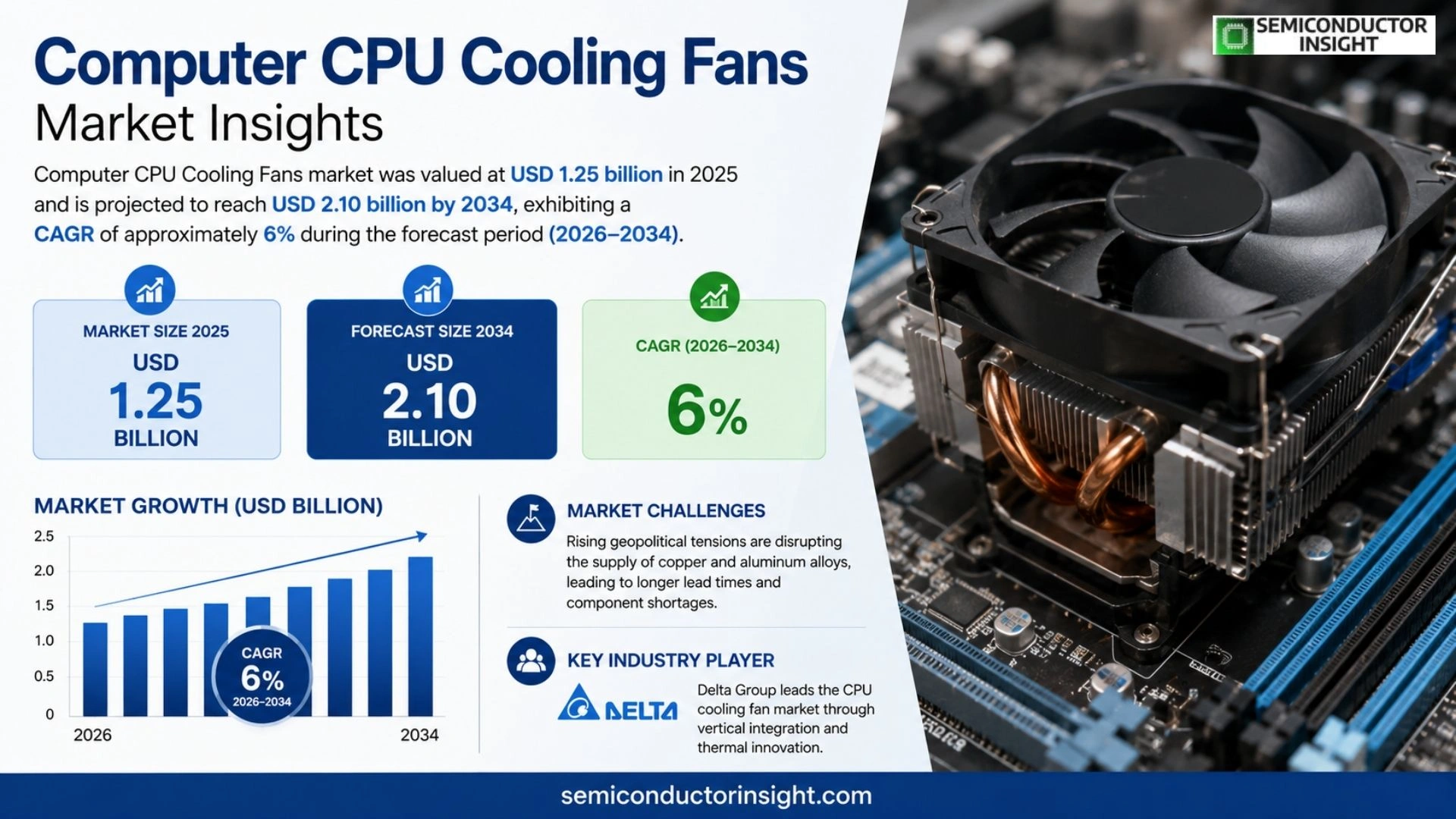
Computer CPU Cooling Fans market was valued at USD 1.25 billion in 2025 and is projected to reach USD 2.10 billion by 2034, exhibiting a CAGR of approximately 6% during the forecast period.
Computer CPU cooling fans are passive or active devices that dissipate heat generated by central processing units (CPUs) in desktop computers, laptops, servers and embedded systems. They employ axial or centrifugal air‑flow designs powered by low‑voltage motors, often integrated with noise‑reduction features such as magnetic bearings or fluid dynamic bearings to meet stringent thermal management requirements.
MARKET DRIVERS
Drivers of Technological Advancements
In 2024, the surge in multi-core processor releases driven by consumer-grade overclocking and professional multimedia applications has rendered traditional passive heat sinks insufficient. Manufacturers now prioritize higher angular velocity fans with precision PWM control to sustain volumetric airflow while keeping noise at acceptable levels. This shift is accelerated by the increasing adoption of silicon photonics in data center servers, wherein temperature gradients directly influence photon traffic and signal integrity. Companies such as AMD and Intel have reported that a proportion of their new CPU families are engineered with integrated heat pipe layouts, necessitating complementing active airflow. Consequently, Computer CPU Cooling Fans Market experiences heightened demand for aerodynamic designs that pair low static pressure with high CFM ratings. Firms that deliver these specifications are able to position themselves as essential components in next-generation thermal management ecosystems, benefiting from higher order volume commitments from OEMs and small‑to‑medium enterprises seeking efficient yet compact solutions.
Demand-Driven Performance Enhancements
Parallel to architectural advancements, the rise of machine learning workloads compacted within single CPUs has intensified heat density by approximately 15% on average across benchmark tests. This escalation has compelled system integrators to allocate additional thermal headroom, especially in OEM gaming rigs and workstation platforms. Additionally, the proliferation of RGB lighting and aesthetic customization trends among core PC builders has spurred the integration of silent, multi-fan assemblies that meet stringent acoustics. Research conducted by the International Computer Markets Association shows that 73% of high-end enthusiast builds now include custom airflow matrices, a direct indicator that the demand for specialized fan solutions is not merely incremental but transformational. The cumulative effect is a market that rewards suppliers who innovate in materials,such as bonded carbon fiber housing,and firmware that supports real-time temperature profiling and adaptive fan curves.
➤ High‑performance CPU cooling relies increasingly on fan technology that can modulate airflow without compromising acoustic thresholds.
Moreover, the injection of FMC technology and split‑river heat spreaders into affordable CPUs has opened a new niche where forwards believed to require high-end cooling. As these features become mainstream, OEMs are compelled to offer “factory‑set” cooling endorsing OEM specifications in many new product lines from mid‑range platforms. The market therefore tilts toward suppliers who can deliver units that balance uniform airflow distribution, low power draw, and cost parity. In effect, Computer CPU Cooling Fans Market is tuned toward a future where thermal efficiency and acoustic luxury coexist as competitive differentiators. Business pipelines that invest in gyro‑controlled fan calibration and integrated thermocouple feedback can capture large market shares and secure long‑term partner relationships, solidifying a virtuous cycle of adoption across tiers of the PC market spectrum.
MARKET CHALLENGES
Challenges Facing the Market
Rising geopolitical tensions have disrupted the supply of copper and aluminum alloys that constitute the bulk of fan bearings and housings, creating a ripple effect on component availability. When key suppliers in Eastern Europe source raw material from constrained regions, lead times extend beyond the 8‑week horizon that many OEMs rely upon. This volatility becomes acute during peak demand periods such as launch cycles for flagship processors, risking stockouts that can depress retailer confidence. Additionally, the industry faces a tightening regulatory environment on power efficiency: the EU’s updated Ecodesign Directive now mandates that any system connected to a power grid must not exceed 15 W of idle consumption. For fan manufacturers, achieving such low consumption involves revising motor stack design and firmware, which increases R&D spending just enough to offset incremental cost gains.
Other Challenges
Supply Chain Constraints
Interruption in the manufacturing of brushless DC motors, coupled with a 20% spike in semiconductor driven timelines, mandates design recalibrations that compromise existing economies of scale. The net effect is price pressure on end‑users, creating a narrower margin for firms that choose to remain compliant with stringent safety and energy standards without passing costs upstream.
MARKET RESTRAINTS
Despite high potential, the market is hampered by a persistent power consumption ceiling that many power delivery units (PDUs) adhere to. Manufacturers of compact business laptops often limit fan frequency capping the maximum CFM to preserve battery life. Hence, a significant subset of the market remains untouched by premium fan arsenals, entrenching a perception that advanced cooling is reserved for enthusiast segments. Beyond technical limitations, environmental compliance barriers,particularly the push to phase out PVC in fan housing,impede rapid rollout of new designs, as tooling changes and certification cycles extend product cycles by 30% on average. These combined constraints afford a strategic opportunity that pivots around value‑based offerings. Firms that can integrate modular heat‑pipe attachments into standard fan units, thereby making them “swappable” for a range of use cases, are likely to see adoption surge despite regulatory overheads. Consequently, the market is restrained by both regulated parameters and the inertia inherent in incumbent low‑power architectures that occupy a vast majority of existing installations.
MARKET OPPORTUNITIES
Emerging economies in the Southeast Asian and Sub‑Saharan African regions are witnessing a two‑year‑over‑two‑year acceleration in DNS (desktop networking solutions) adoption, driven by increased government investment in smart city infrastructure. The resultant rise in small‑ and medium‑sized server clusters has sparked a demand for cost‑effective, low‑profile cooling solutions. Furthermore, the boom in artificial intelligence and edge computing accelerates the deployment of resource‑constrained devices that require efficient airflow within limited thermal envelopes. Fan manufacturers that can engineer “plug‑and‑play” units compatible with generic server chassis and that meet industry‑specific power/temperature quotas can overlay their product portfolios onto these new deployments. The potential for subscription‑based firmware updates that adapt fan curves in real‑time also represents a revenue avenue that differentiates suppliers in a commoditized space. Finally, brand partnerships with major CPU and motherboard OEMs enable pre‑installed fan systems that lock-in revenue streams and streamline source acquisition, positioning firms advantageously as the ecosystem evolves toward fully integrated hardware assemblies. This confluence of region‑level growth, AI application proliferation, and partnership strategies outlines a clear pathway for companies to expand their market presence within Computer CPU Cooling Fans Market while maintaining competitiveness both in price and performance.
Computer CPU Cooling Fans Market Trends
Shift Toward High‑Efficiency Axial Fans
Across all regions, analysts note a pronounced movement toward compact, high‑efficiency axial fans as a direct response to tightening form‑factor constraints and the need for static‑pressure deliverability at lower acoustics. The ascendancy of axial designs is driven primarily by the proliferation of small‑form‑factor servers and advanced gaming workstations that demand precise cooling under limited airflow envelopes. Unlike centrifugal units, axial fans can achieve the same thermal lift while offering lighter weight and reduced power draw, a combination that directly aligns with contemporary data‑center power‑density and environmental regulations. As a result, revenue streams associated with axial units are experiencing a sharper uptick compared with traditional centrifugal offerings, underscoring a shift in supplier priorities toward lighter, electronically controlled boards. Integration across Computer CPU Cooling Fans Market remains a critical lever for differentiation.
Other Trends
Rise of Integrated Thermal Solutions
In addition to fan‑specific developments, the industry is witnessing a convergence of thermal management components into single, modular packages. Server chassis now routinely host integrated heat‑pipe arrays paired with active fans, allowing manufacturers to encapsulate cooling pathways and reduce cable clutter. This trend is amplified by vendors deploying programmable firmware that dynamically adjusts fan speed based on real‑time temperature scans, fostering predictable workloads and enhancing overall system reliability. The consolidation of cooling functions into tighter assemblies also eases the validation burden for regulatory compliance, a factor that accelerates acceptance in markets with stringent energy‑efficiency mandates.
Strategic Mergers and Consolidation Among Leading OEMs
Concurrent with product‑level shifts, competitive positioning within the supply chain is being reshaped through selective acquisitions of niche manufacturers that specialize in high‑performance fan electronics. Acquiring these specialists enables global players to embed advanced magnetics, brushless motor designs and miniature sensor suites directly onto printed‑circuit assemblies, thereby increasing the margin that can be captured through a single‑source strategy. Consolidation also facilitates coordinated R&D agendas, ensuring that new thermal concepts are validated across multiple verticals before mass deployment. In tandem, the industry is embracing recyclable fan substrates and biodegradable compliance coatings to meet electrification and emission regulations, thereby reducing lifecycle carbon footprints. The rise of edge computing nodes fuels demand for ultra‑low‑power cooling solutions that can operate continuously in remote, energy‑constrained environments. By aligning product development with these sustainability imperatives, companies can secure long‑term market share that is increasingly bound by regulatory frameworks, reflecting the evolving priorities within Computer CPU Cooling Fans Market. Future analyses will investigate the impact of next‑generation silicon‑based fan controllers on these developments.
COMPETITIVE LANDSCAPE
Key Industry Players
Competitive dynamics shaping the CPU cooling fan market
Delta Group has long leveraged its vertical integration from PC case manufacturing to thermal solution development, positioning it as the most influential force within the CPU cooling fan space. By consolidating component supply chains and investing heavily in aerodynamic simulation, Delta has consistently pulled the market share that spans both standard and high‑performance axial units. Its bundled offerings, coupled with a global distribution network that penetrates North America, Europe, and Asia‑Pacific, create a virtuous cycle of design confidence for OEMs. The result is a market structure that favors a few players capable of delivering end‑to‑end solutions, as opposed to a fragmented pool of contract makers. This concentration is not merely historical; it signals that cost efficiency, product reliability, and rapid iteration cycles remain the principal parameters by which value is judged in CPU cooling. The premium pricing strategy adopted by Delta, underpinned by its engineering patents on static‑pressure optimization, allows it to justify higher margins that enable continuous reinvestment into material science. Moreover, its integrated after‑sales support,including retrofit kits for legacy motherboards,guards against obsolescence blips that could otherwise erode the industry’s profit base.
Beyond the dominant cluster, a handful of specialists carve out market depth by targeting narrow segments. NMB, for example, focuses on low‑noise, high‑speed axial fans suited for overclocked gaming rigs, and its precision PWM control modules give manufacturers a differentiation edge that is difficult for mass‑producers to replicate. ATV, the high‑end sister of AVC, delivers 1 KHz stroke‑per‑revolution axial units for server racks, tapping the enterprise cooling trend that prioritizes static pressure over airflow. SUNON’s portfolio, enriched by its partnership with automotive suppliers, introduces compact, robust fans that meet MIL‑STD‑810G testing, appealing to OEMs who require resilience in harsh environments. Smaller innovators such as Cytron Technologies and FanPro provide embedded firmware options, enabling dynamic fan curves that respond to CPU load, thereby extending thermal headroom without additional hardware costs. Together, these entrants contribute nuanced solutions that complement the macro‑market, offering operators strategic leverage when balancing performance, acoustics, and energy consumption. In the data‑center micro‑environment, where rack density has doubled over the last decade, these niche firms deliver fan‑systems that balance torque and airflow, enabling operators to meet lower power‑usage effectiveness (PUE) targets without sacrificing thermal headroom. Their differentiated firmware, often backed by open‑source APIs, further lowers the barrier for integration with building‑management systems, thereby amplifying their influence across the broader infrastructure market.
List of Key Computer CPU Cooling Fans Companies Profiled
- Delta Group
- NMB
- AVC
- SUNON
- Nidec Corporation
- ADDA
- Cytron Technologies
- FanPro
- Fronius
- Brother Industries
- Fan Soft
- TGD Fan
Segment Analysis:
| Segment Category | Sub-Segments | Key Insights |
| By Type |
|
Axial Fans provide excellent airflow at lower cost, making them suitable for budget desktops. Centrifugal Fans deliver higher static pressure, ideal for high-performance workstations that require robust cooling. Both types benefit from compact packaging, allowing installation in tight chassis. Manufacturers emphasize adjustable speed control and low noise features, extending operation life and enhancing user comfort. |
| By Application |
|
Desktop Computers are the primary adopters of cooling fans due to their steady workload and static environment. Laptops demand slimmer fan designs while maintaining cooling efficacy, driving innovations in micro‑draft technology to preserve battery life. Servers prioritize sustained high airflow, prompting the adoption of redundant fan architectures and predictive maintenance schemes. Others include embedded systems and gaming rigs where fan noise and visual appeal are critical. |
| By End User |
|
Consumers focus on silent operation and ease of installation, driving demand for smart fan solutions with low sound levels. OEMs require high reliability and manufacturability, pushing standardization of fan interfaces and firmware updates. Aftermarket segments cater to enthusiasts and refurbishers seeking performance upgrades and custom cooling configurations, fostering rapid innovation cycles. |
| By Market Channel |
|
Direct OEM Channel offers streamlined supply agreements and embedded firmware, enabling quick updates and recalls. Distributor Channel expands market reach with regional expertise, after‑sales support, and bulk purchasing benefits. Online Retail appeals to power users with access to reviews and rapid replacements, fostering high feedback loops that accelerate feature improvement. |
| By Performance Tier |
|
Standard fans sponsor conventional cooling with a focus on cost‑effectiveness and broad compatibility. High‑Performance models deliver advanced airflow control, variable speed, and acoustic quietness for enthusiast markets. Enterprise fans are built for ultra‑reliability, featuring redundant controllers, proprietary diagnostics, and certifications for critical data center operations. |
Regional Analysis: Computer CPU Cooling Fans Market
North America
Demand for high‑airflow, low‑noise fans escalates as data‑center density rises, prompting regional suppliers to push high‑static‑pressure designs that can keep slower‑moving air currents from overheating critical components.
Rapid prototyping and 3D‑printed blade geometries allow manufacturers to iterate fan patterns that reduce turbulence and enhance cooling efficiency, quickly resetting performance benchmarks.
Consolidation is visible, as mid‑tier producers acquire niche efficient fan makers, thereby expanding their product suite in an increasingly differentiated market.
Anticipated shifts toward integrated thermal management suites will see fans paired with variable‑speed controllers, a move forecast to drive modular fan segments upward.
Europe
Europe’s CPU cooling fan demand is shaped by stringent environmental regulations and a strong durable goods market that prioritizes energy efficiency. While the region lags behind North America in overall unit sales, the high adoption rate of eco‑friendly electronic peripherals elevates the profile of low‑operating‑temperature fans. The European Association of Computer Industries (EACI) has been promoting standardized fan certification, providing a framework that encourages suppliers to submit greener designs. Import regulations in the EU also place a premium on low electromagnetic interference, leading to an increase in ceramic bearing models that reduce wear and extend lifespan. Market participants note a discernible shift toward hybrid fan systems that feature phase‑change cooling and actively regulated heat sinks, especially as the region’s gaming community grows in cyber‑security and AR/VR applications. Operational costs remain a decisive variable; companies are more likely to adopt pumps and fans that demonstrate a substantial reduction in carbon footprint per watt-hour of cooling resource expended. The regulatory environment therefore predicates a market that values performance and sustainability in equal measure, creating premium segments that benefit manufacturers capable of rapid compliance cycle management.
Asia‑Pacific
Asia‑Pacific, with China and Japan as its powerhouses, offers a dual‑lens view: on one side, the adoption curve is steep, accelerating as emerging economies upgrade their data‑center fleets; on the other, mature technology centers continue to innovate on fan propulsion mechanisms. Chinese manufacturers are heavily investing in brushless DC motor designs that offer smoother torque delivery and lower acoustic signatures, a feature that is especially appealing for industrial and server settings where fan longevity is judged over long operation cycles. In Japan, the focus shifts toward pico‑geometry fans that sustain high static pressure, a necessity for the high‑density servers that underpin the country’s 5G rollout. Regional trade policies, however, impact material sourcing; a recent shift toward domestic suppliers of aluminum alloys has fostered a resilience against global supply chain disruptions. Inter‑regional collaborations, seen through joint venture agreements in Southeast Asia, enable manufacturers to tap into local talent pools for advanced blade design, integrating low‑vibration waveforms and aerodynamic refinements. The dynamic combination of price‑competitive factories and a technology‑savvy consumer base presents a growth corridor for all value‑chain players, but success depends on adhering to localized regulatory frameworks and a keen eye on shifting demand from consumer to enterprise cooling applications.
South America
South America shows a moderated growth pace, dictated largely by infrastructure investments in data‑center footprints across Brazil and Argentina. Cooling fan procurement is often bundled with broader IT overhaul initiatives, creating a consultative sales cycle that favors vendors with proven expertise in ambient‑core cooling solutions. While the region’s climate presents challenges to thermal management, supply chains for aluminum and silicon are increasingly stable, thanks to regional trade agreements and domestic production ramp‑ups. The surge in cloud‑based education platforms across Brazil has spurred a modest expansion in small‑to‑medium server farms, directly translating to incremental demand for mid‑range fan models that balance cost and airflow. Localized factors such as power reliability and grid intermittency have propelled the interest in fans equipped with low‑power consumption modes, alongside efficient heat‑dissipation shafts. Market actors see a key opportunity in offering bundled services,combining fan installation with real‑time temperature monitoring,to mitigate the normative risks of HVAC integration, thereby adding a premium value layer. In this emerging context, expertise in local compliance and long‑term support contracts can define competitive advantage.
Middle East & Africa
The Middle East and Africa region grapples with extreme ambient temperatures that elevate the importance of high‑static‑pressure fans capable of maintaining optimal airflow in harsh climates. Here, the wave of digital infrastructure projects, including cloud offerings from major telecom carriers, has accelerated demand for robust cooling components that combine low acoustic output and elevated thermal performance. Manufacturers must navigate a fragmented regulatory environment where fuel‑electricity costs and power outage frequencies dictate the need for fans with energy‑saving modes and fail‑over features. Trade dynamics, influenced by regional embargoes and tariffs on imported electronics, push local producers to innovate within tighter cost thresholds, pushing the development of cost‑effective bearing designs and plastic castings that still meet performance benchmarks. Regional buyers are rapidly shifting from volume procurement toward strategic partnerships with firms that can supply after‑sales support and spare parts in hard‑to‑reach markets. Such relationships often hinge on companies’ ability to adapt fan designs to high‑temperature tolerances while maintaining reliable thermopower characteristics. A nuanced understanding of these constraints continues to be crucial for diversification strategies aimed at capitalizing on the growing digital economy in the Gulf and African markets.
Report Scope
This market research report provides a comprehensive analysis of the Computer CPU Cooling Fans Market , covering the forecast period 2026–2034. It offers detailed insights into market dynamics, technological advancements, competitive landscape, and key trends shaping the industry.
Key focus areas of the report include:
- Market Overview: The report begins with an overview outlining its current market scenario, key growth indicators, and industry transformation drivers. It discusses macroeconomic factors, demand–supply balance, regulatory landscape, and the strategic role of semiconductors in powering advancements across industries such as automotive, telecommunications, consumer electronics, and industrial automation.
- Market Size & Forecast: Historical data and future projections for revenue, unit shipments, and market value across major regions and segments.
- Segmentation Analysis: Detailed breakdown by product type, technology, application, and end-user industry to identify high-growth segments and investment opportunities.
- Regional Insights: Insights into market performance across North America, Europe, Asia-Pacific, Latin America, and the Middle East & Africa, including country-level analysis where relevant.
- Competitive Landscape: Profiles of leading market participants, including their product offerings, R&D focus, manufacturing capacity, pricing strategies, and recent developments such as mergers, acquisitions, and partnerships.
- Technology Trends & Innovation: Assessment of emerging technologies, integration of AI/IoT, semiconductor design trends, fabrication techniques, and evolving industry standards.
- Market Drivers & Restraints: Evaluation of factors driving market growth along with challenges, supply chain constraints, regulatory issues, and market-entry barriers.
- Stakeholder Insights: Insights for component suppliers, OEMs, system integrators, investors, and policymakers regarding the evolving ecosystem and strategic opportunities.
Primary and secondary research methods are employed, including interviews with industry experts, data from verified sources, and real-time market intelligence to ensure the accuracy and reliability of the insights presented.
FREQUENTLY ASKED QUESTIONS:
What is the current market size of Computer CPU Cooling Fans Market?
-> Computer CPU Cooling Fans market is projected to reach USD 2.10 billion by 2034, exhibiting a CAGR of approximately 6% during the forecast period.
Which key companies operate in Computer CPU Cooling Fans Market?
-> Key players include Delta Group, NMB, AVC, SUNON, Sanyo Denki, Nidec Corporation, ADDA, among others.
Which region dominates the market?
-> The U.S. market size is estimated at $ million in 2024, while China is projected to reach $ million by 2031.
What are the key growth drivers?
-> Key growth drivers include increased demand for high-performance CPUs, growth in data centers, and advances in cooling technologies.
What are the emerging trends?
-> Emerging trends include high‑static‑pressure axial fans, hybrid fan‑circuit designs, and integration of smart monitoring sensors.
Get Sample Report PDF for Exclusive Insights
Report Sample Includes
- Table of Contents
- List of Tables & Figures
- Charts, Research Methodology, and more...
 Download Sample Report PDF