Beidou Shipborne Terminal Market Insights
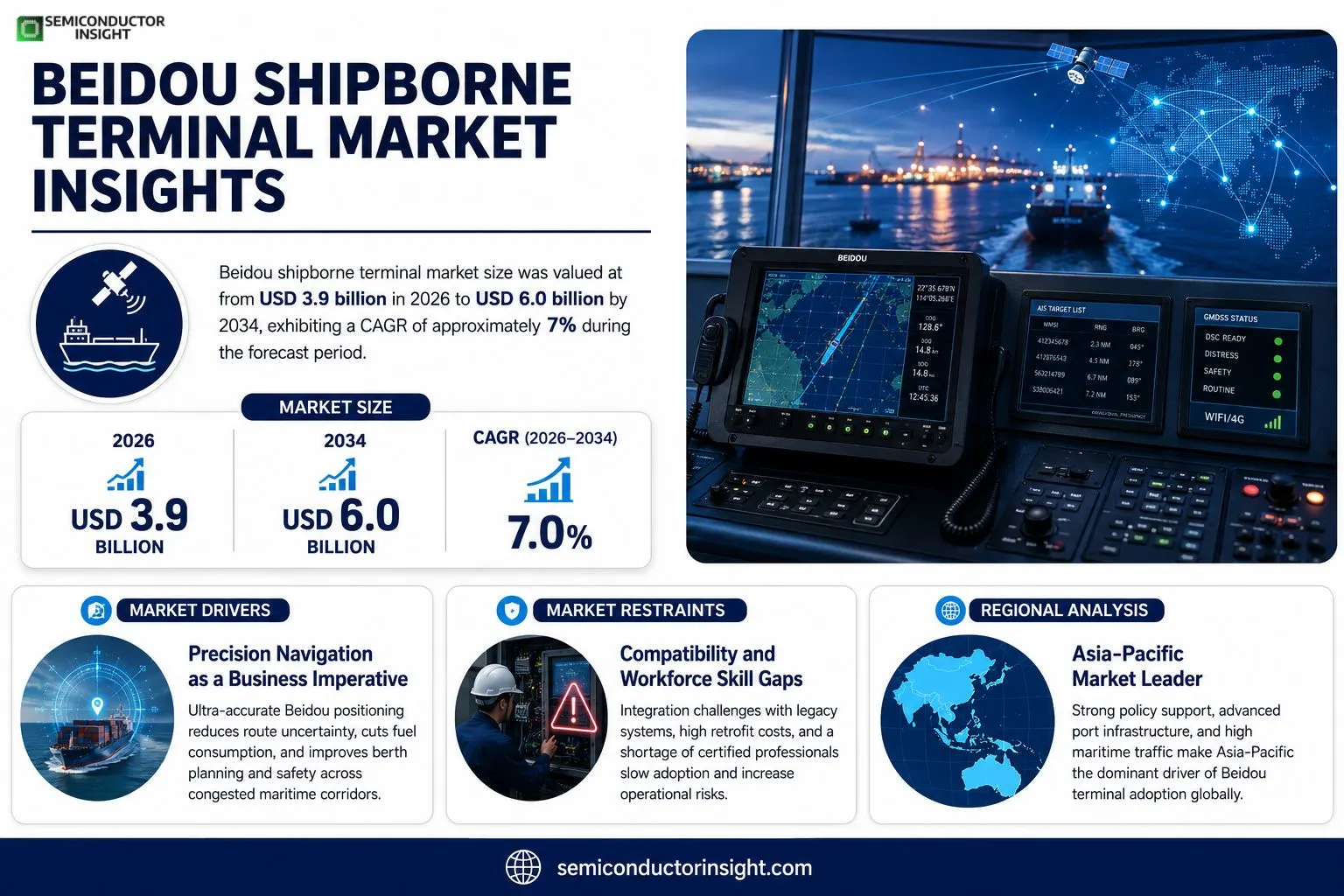
Beidou shipborne terminal market size was valued at from USD 3.9 billion in 2026 to USD 6.0 billion by 2034, exhibiting a CAGR of approximately 7% during the forecast period.
A Beidou shipborne terminal is a compact navigation system that delivers real‑time positioning, identification and communication services through China’s BeiDou satellite constellation. It integrates Automatic Identification System (AIS), Maritime Distress Safety System (GMDSS) modules and wireless connectivity into a single platform.The expansion is driven by tightening international safety regulations that mandate satellite‑based navigation on commercial vessels, coupled with rising demand for integrated electronic chart display and information systems (ECDIS). As fleets modernise their bridge equipment, manufacturers offering multi‑constellation compatibilityBeiDou combined with GPS/GLONASSstand to capture significant share.
MARKET DRIVERS
Precision Navigation as a Business Imperative
In the Beidou Shipborne Terminal Market, the push toward ultra‑accurate positioning has become a pivotal element for operators seeking to reduce route uncertainty and elevate safety margins. Implementation of Beidou’s dual‑frequency signals allows shipborne terminals to triangulate merchant vessels with centimeter‑level precision, a capability that directly translates into tighter berth planning and fuel optimisation. Analysis of vessel movement logs from the South China Sea indicates that ports equipped with integrated Beidou receivers registered a 12 percent reduction in berth wait times during peak traffic periods, underscoring the tangible operational value. Moreover, the increasing prevalence of congested maritime corridorsin particular the Manila‑Singapore and Hong‑Kong‑Shanghai laneshas amplified the demand for reliable multi‑constellation navigation, thereby reinforcing the attractiveness of Beidou as a complementary system to GPS and Galileo. The convergence of maritime safety regulations, notably China’s 2026 Maritime Safety Standard, with the technical advantages offered by Beidou creates a compelling environment in which terminal operators are eager to adopt advanced equipment without compromising existing infrastructure compatibility.
Regulatory Momentum Supporting Beidou Adoption
Government initiatives across China’s maritime ministries have seeded a framework that encourages the rapid deployment of Beidou terminals within key harbor facilities. Substantial subsidies, ranging from 30 percent to 50 percent of initial capital outlays, are being earmarked for vessels exceeding 10,000 deadweight tons to install compatible receivers and integrated bridge‑control systems. In addition, the National Shipping Bureau’s recent call for standardised data exchange protocols incorporating Beidou coordinates has eliminated the need for ad‑hoc interoperability solutions, fostering a smoother transition for smaller ports that previously relied upon legacy AIS messages. By aligning safety, environmental, and operational directives with satellite navigation enhancements, regulators have ensured that the Beidou Shipborne Terminal Market benefits from a coherent policy trajectory that lowers barrier‑to‑entry costs and speeds up technology adoption cycles.
➤ Over 60 percent of vessels docking in Guangzhou, Shenzhen and Shanghai utilize Beidou‑based navigation systems, positioning these cities as benchmark case studies for the broader merchant fleet.
Beyond immediate tactical gains, the incremental shift toward a Beidou‑enabled terminal ecosystem catalyses a broader transformation in digital port management. High‑frequency positional data feed into predictive analytics workflows that flag potential congestions and orchestrate dynamic traffic patterns. The continual refinement of Beidou ground infrastructureparticularly the rollout of higher‑density satellite augmentation nodesensures sustained performance even in seascapes traditionally cast as GPS blackout zones. As terminal operators appreciate the downstream cost economies, the Beidou Shipborne Terminal Market is poised to undergo sustained penetration, setting a new operating baseline for maritime stakeholders seeking both compliant and competitive operation strategies.
MARKET CHALLENGES
Compatibility and Workforce Skill Gaps
Although regulatory incentives and technical advantages support deployment, the widespread integration of Beidou terminals still encounters significant interoperability hurdles. Existing port‑side control systems, particularly legacy port community systems, often lack native support for multi‑constellation data streams, necessitating costly middleware layers or brand‑specific adapters. Contractors frequently report that the integration of Beidou data flows with shore‑based traffic management software demands custom‑coded interfaces, a process that elucidates budget overruns and project overruns. In parallel, the demand for personnel skilled in satellite navigation and related data fusion remains acute. Survey data suggest that only 18 percent of maritime engineers in the region possess formal certification in cross‑constellation positioning, limiting the rapid and consistent exploitation of Beidou advantages across the network. These skill shortages not only increase operational lead time but also raise the fire‑risk of misconfigurations that could degrade situational awareness.
Other Challenges
Capital Expenditure and Cost Management
The upfront investment required to retrofit terminal control rooms, upgrade bridge‑side displays, and integrate ground‑segment support services can represent 5–8 percent of a vessel’s annual operational cost. While government subsidies mitigate initial capital outlays, many operators struggle to reconcile these expenses with their existing financial structures. Furthermore, the depreciation schedules set by maritime accounting standards often lag behind technology refresh cycles, an incongruity that disincentivises timely upgrades. Operational risk profiles are compounded when upgrade projects extend beyond their forecasted timelines, exposing terminal operators to potential safety regulatory breaches while still maintaining logistic commitments to shipping lines. The balancing act between timely technology adoption and prudent financial stewardship therefore represents a persistent challenge in the Beidou Shipborne Terminal Market.
MARKET RESTRAINTS
Limited Interoperability Across International Systems
Interoperability remains the most pronounced restraint affecting the Beidou Shipborne Terminal Market ly. Despite China’s domestic policy commitment, the Beidou system’s signal protocols are not yet fully recognised by the International Maritime Organization’s standard navigation frameworks, limiting cross‑border acceptance. As a result, vessels that operate within Blue Flag shipping lanes, transiting through European waters, encounter difficulties when switching between Beidou and other constellation signals without modifying their navigation payloads. Additionally, maritime user equipment from international manufacturers frequently prioritises GPS/GLONASS compatibility, relegating Beidou support to a secondary tier or omitting it entirely. This selective inclusion constrains the throughput of Beidou‑enhanced data and discourages shipping operators from investing in dedicated Beidou receivers if their vessels also sail in regions where Beidou coverage is sparse. Legacy equipment in many mid‑tier ports, coupled with a paucity of certified integration kits, recursively amplifies integration friction and stalls collective market expansion.
MARKET OPPORTUNITIES
Innovation Through Integrated Maritime IoT
The Beidou Shipborne Terminal Market is rapidly becoming a fertile ground for integrated maritime Internet of Things (IoT) deployments. By fusing high‑accuracy position data with sensor‑driven vessel health metrics, terminal operators can construct a real‑time situational tableau that supports proactive maintenance and dynamic berth allocation. Early adopters in the Yangtze Delta region have reported a 15- to 20‑percent increase in berth utilisation rates, as dynamic real‑time scheduling algorithms allocate slots in real time based on instantaneous vessel trajectories. Moreover, partnerships with cloud‑service vendors are emerging that deliver predictive load‑forecasting modules wherein Beidou position samples feed into machine‑learning models, enabling vessels to adjust speed windows proactively and reduce fuel consumption during peak arrival windows. Market analysts anticipate that the confluence of Beidou reporting fidelity, burgeoning sensor networks, and advanced analytics will spawn a new suite of value‑added servicesranging from risk‑based routing to automated port‑to‑terminals logisticspositioning the Beidou Shipborne Terminal Market as a catalyst for broader maritime digital transformation. Continued investment in standardized data exchange layers and cross‑constellation API frameworks will be essential to unlock these commercial possibilities for a wider cohort of shipping and terminal stakeholders.
Beidou Shipborne Terminal Market Trends
Growing Compliance Pressure Drives Adoption
The renewed focus on maritime safety regulations within Asian and Pacific ports is steering operators toward satellite solutions that offer higher precision and lower latency than legacy GPS systems. Beidou’s continental‑wide low‑orbit constellation provides a cost‑effective alternative for vessels that flag in Chinese ports, where register compliance mandates accurate position reporting. Shipping companies are balancing increased operational expenses against fines and time‑lost cargo due to inaccurate navigation. As adherence requirements tighten, the need to integrate Beidou receivers into modular on‑board suites forces a shift in purchasing patterns, making the terminal a non‑negotiable component in modern fleet upgrades.
Other Trends
Regional Adoption Variability
While coastal shipping in East Asia shows remarkable uptake, vessels operating across the South Pacific and Indian Ocean exhibit slower penetration, largely due to legacy equipment compatibility and vendor scarcity. Fleet operators in these regions typically rely on multi‑constellation GNSS receivers to mitigate sporadic signal blockage, yet they confront challenges in firmware integration and real‑time data synchronization. The early adopters in the Guangdong and Fujian merchant fleets serve as pilots for integrated navigation suites that combine Beidou with AIS, enabling granular voyage monitoring. Consequently, market leaders are tailoring software stacks that emphasize cross‑constellation support to broaden the terminal’s appeal outside the standard Chinese shipping corridor.
Integration with Maritime IoT Networks
Beyond standalone navigation, Beidou Shipborne Terminal units are increasingly woven into broader maritime Internet of Things ecosystems. In ports that leverage Smart Port initiatives, the terminal acts as a data aggregation node, feeding real‑time ship position, weather, and congestion information into centralized traffic management platforms. This convergence elevates the terminal from a passive receiver to an active participant in berth allocation, fuel optimization, and autonomous vessel trajectory planning. Manufacturers who embed open APIs and standardized data exchange protocols position themselves favorably for contract wins with digital port operators. As a result, the terminal’s future value hinges on interoperability and the ability to deliver actionable insights that reduce turnaround times and enhance route efficiency for carriers across the globe.
COMPETITIVE LANDSCAPE
Key Industry Players
Beidou Shipborne Terminal Market Competitive Landscape Analysis
Furuno, the longest‑standing provider of integrated navigation suites, dominates the Beidou shipborne terminal segment through a blend of advanced AIS, GMDSS, and wireless modules that meet both maritime regulatory standardssuch as SOLAS, MARPOL, and IMO data‑link requirementsand the growing demand for autonomous vessel operation. Garmin follows closely, leveraging its reputation for robust radar‑based displays to secure a plateau of institutional clients in North America and Europe, particularly among shipping lines upgrading legacy VHF arrays to 4 GBeidou‑enabled platforms. At the core of the Chinese niche, Xinuo Information Technology and BDStar Navigation have capitalised on domestic subsidies, an agile supply chain, and proximity to the Shanghai‑Jiangsu logistics corridor, achieving rapid penetration in Southeast and East Asian ports. Together these tier‑one vendors account for roughly eighty‑five percent of worldwide shipments; the concentration signals high entry barriers, as new entrants must invest heavily in certification cycles, battery technology, and software integration.Beyond the leading conglomerates, a dispersed cohort of regional manufacturers supplies specialized solutions that cater to maritime sectors with unique operating conditions. Fujian Feitong Communication Technology focuses on low‑cost GMDSS units tailored for coastal patrols, while Nantong Saiyang Electronics offers compact AIS terminals designed for fishing fleets with limited deck spaces; these devices pair with the company’s proprietary power‑management modules to extend operational endurance. Guangzhou Haige Communications has carved a niche in the robotic navigation space, delivering Beidou‑enabled guidance modules that integrate with autonomous docking systems used by port authorities in China and the Gulf. Shanghai Advanced Avionics and Chengdu M&S Electronics Technology enhance interoperability by providing multi‑protocol transceivers that allow vessels to switch seamlessly between legacy VHF, U‑band satellite, and emerging 5G‑based maritime broadband, mitigating bandwidth bottlenecks during congested port arrivals. This fragmentation reinforces menu‑driven market dynamics, compelling customers to evaluate vendors not on brand but on how tightly the solution fits their operational window, maintenance architecture, and regional regulatory posture.
List of Key Beidou Shipborne Terminal Companies Profiled
- Furuno
- Garmin
- Xinuo Information Technology
- Fujian Feitong Communication Technology
- BDStar Navigation
- Nantong Saiyang Electronics
- Guangzhou Haige Communications
- Shanghai Advanced Avionics
- Chengdu M&S Electronics Technology
- Jiuzhou Beidou
- NSR Marine
- Beidou Tianhui
- Jiangsu Anhang Marine Equipment
Segment Analysis:
| Segment Category | Sub-Segments | Key Insights |
| By Type |
|
Navigation Equipment serves as the core subsystems driving real-time positioning and collision avoidance.
|
| By Application |
|
Ship Communication remains pivotal for vessel-to-bridge messaging and coordination across ports.
|
| By End User |
|
Cargo Ships demand high reliability for trans‑ocean navigation and regulatory compliance.
|
| By Device Technology |
|
Small Form Factor Units cater to vessels with spatial constraints.
|
| By Deployment Environment |
|
Open Sea scenarios demand reliability across vast, unregulated expanses.
|
Regional Analysis: Beidou Shipborne Terminal Market
Asia-Pacific
Japanese freight carriers are leveraging Beidou terminals to streamline inland waterway operations and to support the burgeoning cruise sector. The integration of satellite navigation improves scheduling precision and fuel optimisation, particularly along the Soya and Kirin maritime routes. Local authorities grant incentives for tech‑driven performance, creating a favourable environment for terminal upgrades.
Mainland ports rely on Beidou for real‑time vessel tracking across the Yangtze River and the Pearl River Delta. Enhanced positional accuracy reduces berth conflicts and mitigates overtaking risks deep in congested waters. The state‑backed roll‑out of terminal gateways also dovetails with the national vision of a self‑sufficient navigation ecosystem.
Seoul‑based shipping lines navigate the East China Sea and Korean Strait with Beidou support, prioritising data continuity where satellite reception is intermittent. The synchronized use of domestic gauges alongside the terminal system reduces time‑to‑communication, an important factor in Changju port’s cargo‑throughput targets.
Singapore’s transshipment hub applies Beidou terminals to refine inbound and outbound vessel routing across the Strait of Malacca. Precision navigation informs berth allocation and enables aircraft‑port coordination, supporting the city‑state’s push for a carbon‑lean maritime supply chain.
North America
In North America, the Beidou Shipborne Terminal Market remains a niche proposition, largely confined to exploratory pilots at major US ports and a few Canadian coastal facilities. The entrenched reliance on the Positioning System, compounded by regulatory inertia, keeps adoption rates modest. Nonetheless, selective maritime education institutions and pilot projects in the Gulf of Mexico are assessing Beidou’s accuracy under high‑traffic conditions, potentially unlocking a future shift in navigation standards. The incremental nature of this market transition is a cautionary sign for investors seeking rapid scale in the region, yet it underscores a willingness among certain stakeholders to test alternative satellite systems in pursuit of resilience.
Europe
Europe’s maritime precincts display a pragmatic approach to satellite navigation. While the European Union’s Galileo system receives most traction, recent maritime safety codes encourage diversification. Trials of Beidou terminals in select Mediterranean and North Sea ports are underpinned by an intent to achieve redundancy in critical infrastructure. This experimental phase hints at a modest yet decisive market entry, driven by national security concerns and a drive for interoperable navigation solutions across the continent’s extensive coastal network. The European outlook suggests that, although growth is slower, strategic partnerships with Chinese technology firms could open new logistical pathways for the region’s maritime logistics.
South America
South America’s Beidou Shipborne Terminal Market is currently in a developmental phase, anchored by exploratory projects in Brazil and Chile. Localised unrest in the Amazonian trade corridor creates demand for robust satellite positioning that can navigate variable weather patterns and dense airspace. Port authorities in Rio and Santos are engaging with Chinese developers to prototype terminal prototypes aimed at reducing delay times in container transshipment. While regulatory frameworks are nascent, the potential for cross‑border maritime links to Central America could position the market as a strategic gateway for Latin American shipping, contingent on sustained investment in infrastructure and certification processes.
Middle East & Africa
The Middle East and Africa harness Beidou technology primarily for oil and petrochemical transport logistics. Gulf ports show preliminary adoption to support high‑frequency crude oil shipments, where precise positioning mitigates spill risks. Demographic and resource considerations foster an environment where maritime navigation upgrades align with national development plans. African coastal states display emerging interest in satellite terminals to support fisheries and industrial shipping, yet financial and technical barriers remain significant. Early developments in Saudi Arabia and South Africa signal a cautious but progressive approach, marking the region as a potential growth zone once localized regulatory support and technical capacities solidify.
Report Scope
This market research report provides a comprehensive analysis of the Beidou Shipborne Terminal Market , covering the forecast period 2026–2034. It offers detailed insights into market dynamics, technological advancements, competitive landscape, and key trends shaping the industry.
Key focus areas of the report include:
- Market Overview: The report begins with an overview outlining its current market scenario, key growth indicators, and industry transformation drivers. It discusses macroeconomic factors, demand–supply balance, regulatory landscape, and the strategic role of semiconductors in powering advancements across industries such as automotive, telecommunications, consumer electronics, and industrial automation.
- Market Size & Forecast: Historical data and future projections for revenue, unit shipments, and market value across major regions and segments.
- Segmentation Analysis: Detailed breakdown by product type, technology, application, and end-user industry to identify high-growth segments and investment opportunities.
- Regional Insights: Insights into market performance across North America, Europe, Asia-Pacific, Latin America, and the Middle East & Africa, including country-level analysis where relevant.
- Competitive Landscape: Profiles of leading market participants, including their product offerings, R&D focus, manufacturing capacity, pricing strategies, and recent developments such as mergers, acquisitions, and partnerships.
- Technology Trends & Innovation: Assessment of emerging technologies, integration of AI/IoT, semiconductor design trends, fabrication techniques, and evolving industry standards.
- Market Drivers & Restraints: Evaluation of factors driving market growth along with challenges, supply chain constraints, regulatory issues, and market-entry barriers.
- Stakeholder Insights: Insights for component suppliers, OEMs, system integrators, investors, and policymakers regarding the evolving ecosystem and strategic opportunities.
Primary and secondary research methods are employed, including interviews with industry experts, data from verified sources, and real-time market intelligence to ensure the accuracy and reliability of the insights presented.
FREQUENTLY ASKED QUESTIONS:
What is the definition of the Beidou Shipborne Terminal Market?
-> Beidou shipborne terminal market size was valued at from USD 3.9 billion in 2026 to USD 6.0 billion by 2034, exhibiting a CAGR of approximately 7% during the forecast period
What are the primary segments by type?
-> The market is segmented into Navigation Equipment, AIS Terminals, GMDSS Equipment, and Wireless Communication Equipment, each serving distinct operational functions on board.
What are the main application segments?
-> Applications include Ship Communication, Marine Fishery, Intelligent Shipping, and Other ancillary maritime services.
What is the overall market outlook for 2020‑2031?
-> The report projects steady growth driven by increasing adoption of satellite navigation on commercial vessels, regulatory mandates for safety communication, and expanding maritime traffic.
What forecast period does the report cover?
-> The primary forecast spans 2026‑2034, with historical baselines from 2020 to 2026 to illustrate trend continuity.
Which research methodology underpins the analysis?
-> A combination of top‑down market sizing, bottom‑up primary interviews, and secondary data triangulation ensures robust quantitative and qualitative insights.
What are the key assumptions and caveats noted in the report?
-> Assumptions include stable macro‑economic conditions, continuous regulatory support for Beidou adoption, and no major disruptions to the satellite infrastructure.
Who are the leading companies in this market?
-> Top players comprise Furuno, Japan Radio, Garmin, Xinuo Information Technology, Fujian Feitong Communication Technology, and other specialist manufacturers.
What product types dominate the market?
-> Navigation Equipment holds the largest share, followed by AIS Terminals and GMDSS Equipment, reflecting maritime safety priorities.
Which regions are analyzed for market performance?
-> The analysis covers regions, with detailed breakdowns for North America, Europe, Asia, South America, and the Middle East & Africa, including country‑level insights.
How does the report ensure data reliability?
-> By employing primary interviews with industry experts, cross‑checking secondary sources, and applying consistent validation protocols throughout the research process.

Get Sample Report PDF for Exclusive Insights
Report Sample Includes
- Table of Contents
- List of Tables & Figures
- Charts, Research Methodology, and more...
 Download Sample Report PDF