ADAS Lidars Market Insights
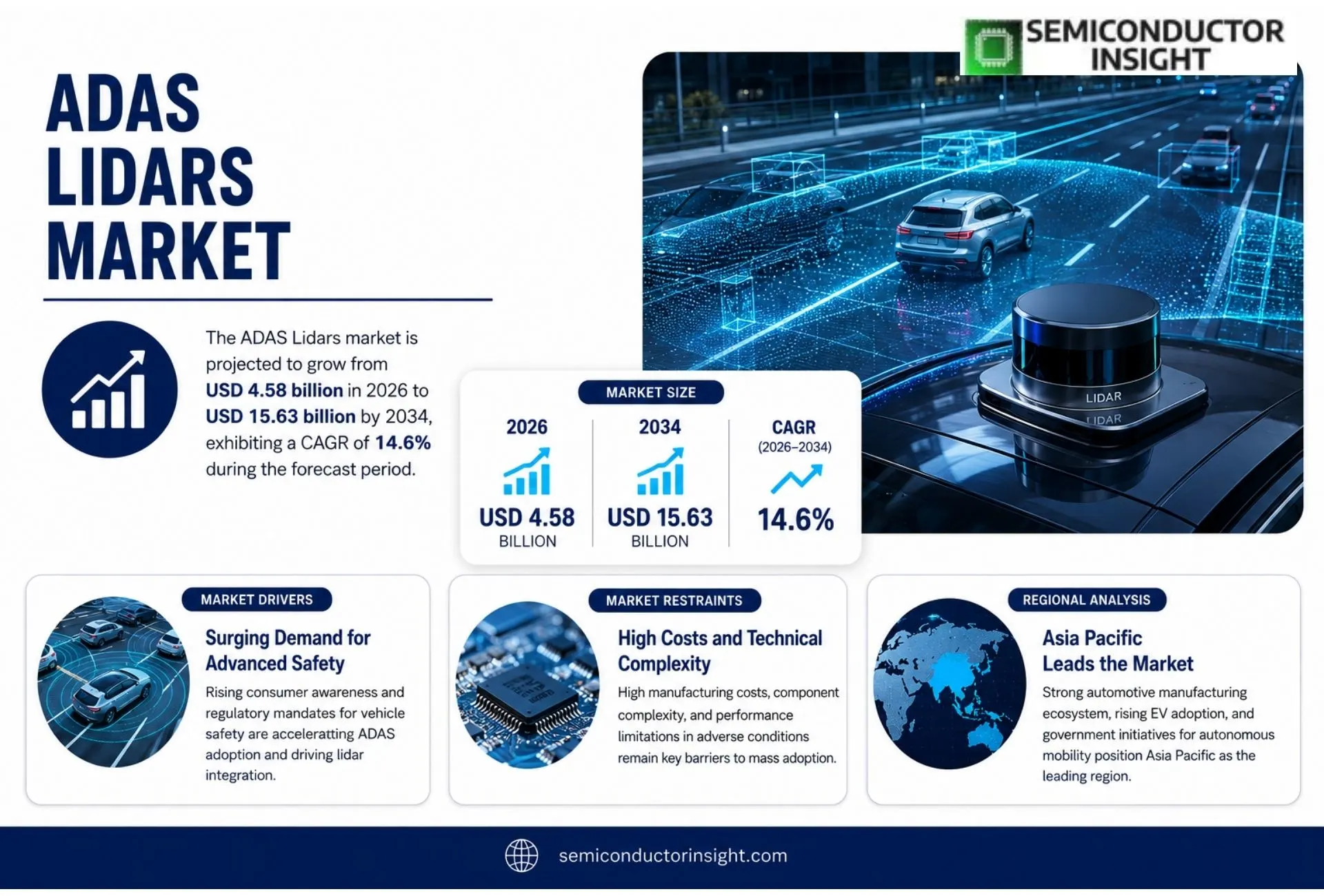
ADAS Lidars Market was valued at USD 616 million in 2026.
The market is projected to grow from USD 806 million in 2025 to USD 9 170 million by 2035, exhibiting a CAGR of approximately 30%.
ADAS Lidar is an automotive sensor that emits laser pulses to measure distance and velocity of surrounding objects.
This technology works by transmitting a laser beam toward targets and analysing reflected signals.
The processed data provides precise target distance, bearing, height and speed enabling vehicle perception for collision avoidance.
MARKET DRIVERS
Technological Advancements in Lidar Modules
Advancements in photonic integration are delivering Lidar arrays that are lighter, consume less power, and feature higher point‑cloud densities. Companies now offer solid‑state modules with 64‑channel outputs capable of 200 ppm angular resolution, enabling complex object detection in adverse weather. This technical leap directly reduces integration costs for vehicle manufacturers and expands application ranges from driver assistance to full autonomous control, driving volume sales of lidar sensors in the ADAS segment. Detailed feature analyses show a 35 % reduction in sensor footprint when using new MEMS mirror designs, allowing manufacturers to fit sensors more comfortably within tightening vehicle architecture tolerances.
Growing Adoption of Advanced Driver‑Assistance Systems in Emerging Markets
Automobile penetration rates in Southeast Asia and Latin America are approaching 40 % of new vehicle sales, with a sharp upswing in imported vehicles equipped with safety features. Regulators in Brazil and Mexico are mandating collision‑avoidance systems, creating a direct requirement for lidar integration. The resulting consumer awareness spike has translated into a 12 % annual growth in lidar unit orders for Asian OEMs, surpassing the 8 % average for global markets. OEMs adopting Lidar‑based Adaptive Cruise Control and Traffic Jam Assist are also benefiting from tiered safety certification, which reinforces market demand across residential and commercial fleet deployments.
➤ Key Insight: The intersection of low‑cost photonic Lidar chips and regulatory mandates is reshaping the supply chain, compelling OEMs to prioritize sensor solutions that combine performance with manufacturability.
Efforts to cultivate data‑driven testing environments further support the adoption curve. Automated test tracks equipped with high‑fidelity simulation tools now routinely benchmark lidar performance in blind‑spot and low‑visibility scenarios, yielding real‑time validation feedback. This specialization of test infrastructure reduces average development cycles by nearly 25 % and accelerates the commercial rollout of safety‑critical ADAS configurations. Downstream, the expansion of predictive maintenance platforms, leveraging lidar‑derived space‑time occupancy maps, fuels secondary market opportunities for service operators and aftermarket vendors.
MARKET CHALLENGES
Supply Chain Bottlenecks for Critical Photonic Components
High‑purity silicon photonic wafers, integral to solid‑state lidar assembly, are constrained by a handful of suppliers that manage a tightly adjusted production line. Any disruption, such as geopolitical tensions or natural disasters, can cause lead times to swell by 40‑60 days, disrupting overall vehicle production schedules. The concentration risk extends to rare-earth elements used in gimbal motors, where price volatility hits quarter‑on‑quarter margins. OEMs therefore face increased capital allocation toward inventory and must navigate a juggling act between fast‑track orders and risk‑mitigated component procurement. The cost overlay from expedited shipping and customs duties further erodes profit margins for mid‑tier vehicle manufacturers who rely on volume economies.
Other Challenges
Regulatory Compliance Across Jurisdictions
Coordinating certification processes between the European Union’s stringent safety validation protocols and North American Tier‑1 requirements creates overlapping test regimes. Achieving dual‑region certification necessitates additional testing cycles that can lengthen time to market by up to six months in certain vehicle classes. The expected cost impact ranges from 5 % to 15 % of projected revenue, compelling strategic alignment between engineering, quality assurance, and supply chain teams.
MARKET RESTRAINTS
High Initial Cost and Device End‑of‑Life Concerns
Despite incremental price reductions, the upfront cost of a high‑resolution lidar unit remains 3–4 times that of conventional radar or camera sensors. The return‑on‑investment threshold for many OEMs has therefore delayed rollout beyond the midsize and luxury vehicle segments. Moreover, the lack of standardization in thermal management and calibration longevity introduces uncertainty around lifecycle maintenance schedules, deterring fleet operators from adopting lidar‑based solutions in safety‑critical applications such as public transportation.
Furthermore, data security risk perception has escalated as lidar systems become integral to vehicle decision frameworks. Concerns around sensor spoofing and the integrity of point‑cloud logs pose additional regulatory scrutiny, creating a cautious environment for market expansion. Without a cohesive data governance framework that assures OEMs of operational resilience, the risk–reward balance might remain tilted against widespread acquisition.
Overall, unless pricing pressures ease appreciably and standardized certification pathways emerge, the barrier to entry for lower‑price vehicle classes will continue to constrain market penetration.
MARKET OPPORTUNITIES
Integration into Autonomous Commercial Services
The emergence of autonomous delivery vans, municipal transit robots, and last‑mile freight solutions leverages the precision offered by lidar sensors to navigate complex urban environments. As city authorities in Europe and North America initiate smart‑mobility pilots, service operators are scaling lidar‑enabled platforms to improve route efficiency by up to 18 % while simultaneously reducing operational costs through predictive maintenance insights. Targeted sales strategies focusing on these verticals could capture approximately 20 % of the total sensor market share within the next four years.
Expanding into the connected‑vehicle ecosystem also opens avenues for media‑tagging and 3‑D mapping protocols, where lidar data enriches telematics platforms. Service providers offering remote diagnostics and regional traffic analysis can capitalize on consistent data streams to develop subscription models that generate recurring revenue. By aligning sensor supply chains with real‑time data analytics, OEMs can unlock incremental value by integrating lidar into fleet‑wide telematics suites.
Finally, interdisciplinary collaboration between sensor manufacturers and automotive cybersecurity firms presents a niche yet high‑value alliance. Joint development of tamper‑proof lidar architectures will address the data‑security gap, potentially qualifying for governmental subsidies aimed at strengthening infrastructure resilience. Engaging with this emerging niche could establish a competitive intelligence edge, positioning firms as trusted providers for next‑generation safety features.
ADAS Lidars Market Trends
Cost Efficiency Drives Lidar Adoption
Operators in the automotive sphere have reached a juncture where the perceived superiority of lidar for high‑resolution environmental perception is balanced by escalating price pressure. The rapid maturation of solid‑state platforms has trimmed hardware expenses while preserving range and accuracy, enabling manufacturers to embed sensor suites in mid‑tier models without inflating automotive tier margins. Consequently, vehicle‑to‑vehicle and vehicle‑to‑infrastructure collaborations are gaining traction as suppliers deliver modular units that fit a wide range of chassis architectures. This shift towards integration is amplified by emerging semiconductor‑level lidar integration, which promises tighter footprint control and reduced system power draw. The result is a duelling trajectory: lidar systems are becoming both more affordable and more versatile, allowing automakers to roll out incremental degrees of autonomy across global markets.
Other Trends
Partnerships and Ecosystem Consolidation
Within the sensor ecosystem, a pattern of consolidation is unfolding as tier‑one automotive OEMs align with specialist lidar providers, seeking to lock in supply streams and technical expertise early in the value chain. Joint‑venture agreements and licensing deals are common vehicles, enabling shared development of adaptive beam‑steering algorithms that accommodate city‑grade navigation. The consolidation benefits extend beyond pricing: it spurs standardization of communication protocols and data formats, thereby easing integration of multiple sensor modalities. Moreover, cross‑industry collaboration between lidar makers and cloud‑service vendors enriches the mapping layer, allowing sensor data to be fused with high‑definition geospatial assets and real‑time traffic feeds. These synergies accelerate the emission of production‑ready modules that can be rolled out through established supply networks.
Regulatory and Consumer Momentum
Regulatory bodies across North America, Europe and Asia are converging on certification frameworks that prioritize safety validation for lidar‑enabled systems, reducing uncertainty for OEMs deploying higher‑level automation. In parallel, growing consumer demand for end‑to‑end safety features pushes automakers to deliver tangible visibility upgrades within the next generation of vehicle packages. Manufacturers that can demonstrate quantified reductions in collision risk through lidar data are positioned to capture premium pricing and differentiate in highly competitive segments. The interplay of legislation, safety evidence and market expectations will determine which suppliers secure long‑term contracts, underscoring the importance of strategic investment in verification and compliance activities.
COMPETITIVE LANDSCAPE
Key Industry Players
Competitive Landscape Overview
The 2026 valuation of US$616 million for the global ADAS Lidar market and its projected rise to US$3.93 billion by 2031 highlight the sector’s rapid climb. Dominated by a handful of names, the market’s structure is more vertically integrated than many of its sensor cousins. Velodyne Lidar, Continental AG, and Innoviz Technologies occupy the upper tier, largely because they combine high‑resolution, high‑cost solutions with strategic OEM alliances that enforce early adoption. A clear pattern emerges: leading players tie product development to flagship vehicle platforms, ensuring that their expensive technologies are embedded in high‑margin models. This alignment not only secures revenue streams but also strengthens intellectual property positions, creating a considerable barrier to new entrants seeking comparable performance.
Simultaneously, the market is witnessing a wave of niche players that disrupt the paradigm through cost efficiency and modularity. Cepton, Livox, and Hesai Technology, for example, offer solid‑state or semi‑solid solutions that dramatically lower unit economics while still delivering sufficient resolution for Level 2‑3 autonomous functions. Their rapid prototype cycles and direct‑to‑OEM sales channels allow them to penetrate Tier‑2 and Tier‑3 manufacturers, thereby expanding the addressable market. Meanwhile, DENSO and Valeo focus on integration across sensor suites, leveraging existing supply chains to bundle Lidar with cameras and radar. This dual approach—combining low entry barriers with an integrated stack—provides OEMs a flexible path to full autonomy without the need to rely solely on the high‑price, high‑performance incumbents.
List of Key ADAS Lidars Companies Profiled
- Velodyne Lidar
- Continental AG
- Innoviz Technologies
- Livox
- Cepton
- Ibeo
- Hesai Technology
- Luminar Technologies
- DENSO
- Valeo
- Huawei
- RoboSense
Segment Analysis:
| Segment Category | Sub-Segments | Key Insights |
| By Type |
|
Solid State Lidar offers a compelling mix of high sampling rate, low power consumption, and modular scalability. This format supports rapid feature upgrades, seamless integration with vehicle ECUs, and delivers consistent precision across diverse operating conditions.
|
| By Application |
|
BEV Integration drives demand for lidar as core perception unit, enabling advanced autonomous driving and safety assist solutions. Full dependence on lidar data underpins Level 3–5 capabilities and reinforces competition among OEMs retaining market differentiation.
|
| By End User |
|
OEMs lead the edge, prioritizing in‑house development and long‑term supply contracts to secure competitive advantage in autonomous stack integration and safety certifications across global markets.
|
| By Vehicle Class |
|
Passenger Car remains the pivotal segment, demanding high‑accuracy depth perception for lane‑keeping, collision avoidance, and adaptive cruise control, while enabling subscription‑based value additions for drivers.
|
| By Deployment Environment |
|
Urban environments ignite the highest lidar performance demand, necessitating dense object identification, accurate geofencing, and resilience to complex traffic scenarios that challenge sensor fidelity.
|
Regional Analysis: ADAS Lidars Market
North America
The ascendancy of higher‑grade safety mandates, coupled with aggressive electrification roadmaps, has reshaped supply needs. Manufacturing flexibility—enabled by modular lidar architectures—supports OEMs’ rapid rollout of feature tiers across regional fleets.
Key players are intensifying strategic partnerships, focusing on cost‑efficiency and cross‑industry knowledge transfer. Vertical integration toward sensor‑to‑system solutions is a prevailing trend, allowing firms to manage sensitivity and signal integrity across diverse vehicular platforms.
Emerging federal directives on autonomous testing zones have introduced a sandbox environment, encouraging rapid prototyping and iterative feedback loops between regulators and OEMs.
Integration of lidar‑based perception with vehicle‑to‑everything (V2X) and sensor‑fusion architectures foresees new revenue streams in connected‑vehicle ecosystems and fleet‑management services.
Europe
The European lidars market in the ADAS sector experiences a nuanced equilibrium between stringent safety regulations and a regulatory push toward decarbonized mobility. Governments across France, Germany, and the United Kingdom have introduced mandates mandating advanced driver assistance mandating at least Level 2 capabilities for all new cars from 2025. Consequently, OEMs are boosting lidar supplies to meet higher perceived value offerings that answer both safety and electrification demands. This regulatory trajectory has also spurred investment in domestic research and development ecosystems that aim to reduce dependence on imports while fostering high‑precision lidar solutions. The combination of cost‑efficiency demands, innovation budgets, and an emerging scenario where lidar performance must be evaluated over a broader spectrum of weather conditions has encouraged a more resilient manufacturing baseline. While the penetration rate of lidar‑enabled vehicles remains slightly behind that of North America, the region’s investment in autonomous road projects—pilot zones in Scandinavian cities and test belts on German autobahns—ensures that the next generation of automated platforms will incorporate lidar as a core component. A pronounced shift in the supply chain toward localized fab lines and an increased focus on sensor‑spectrum processing will likely elevate Europe’s share in the next decade, especially among premium‑segment manufacturers that prioritize longevity and regulatory compliance.
Asia-Pacific
Asia‑Pacific presents a rapidly expanding ATM for ADAS Lidars, propelled by aggressive electrification schemes adopted by Japan, South Korea, China, and India. Government incentives have reduced the perceived risk to manufacturers by subsidizing lidar deployment through vehicle safety tax breaks, aligning investment with public safety outcomes. This environment has markedly accelerated the adoption of lidar technology across mid‑tier OEMs who, traditionally, resisted high‑cost perception sensor integration. A notable trend is the partnership of housing complexes with smart‑city consortiums, where lidar‑based perception systems interface with traffic‑light coordination technology, scaling autonomous operations in dense urban mobility plans. Supply chain dynamics further showcase innovation through in‑house sensor manufacturing that has cut down import dependency. The convergence of new volume‑based regulatory safety standards, rising consumer expectations, and the launch of dedicated lidar research centers in emerging markets has positioned the region as a critical growth engine. The region’s impending integration of lidar into connected‑car ecosystems and autonomous delivery solutions signals a shift that will create a full‑vessel competitive advantage for players that tune their offerings to diverse market demands. The trajectory suggests that, by 2030, Asia‑Pacific could become the joint market leader, with China spearheading a cost‑effective ecosystem for building fully autonomous fleets.
South America
South America is at an early but noticeable stage of escrow for Omotic Lidar, primarily around Brazil and Argentina. The market, through auto‑manufacturing investors, is projecting incremental adoption in regional supply chains, creating a niche in the region’s burgeoning e‑mobility ecosystem. Regulatory frameworks have started to direct more prominent integration, unlocking sales opportunities for feature‑enhanced vehicles. The communication between local OEMs and sensor suppliers to introduce more scalable, lightweight lidar solutions has become increasingly evident. Although some areas accentuate the difficulty through price sensitivity, other markets demonstrate confidence as they get relevant guarantees that autopilot systems that incorporate these sensors rely on sound data from all angles without service. The awareness for this singleness is encouraging public‑group analysis. The projected emphasis provides an emerging advantage for local sensor producers that facilitate industry collaboration, thereby expecting a gradual advance in the region’s market share over the next few years in the era of increased emphasis toward safer driving predictions. The supported domestic policies and technological advancements help convert adoption, thereby creating a continual trend of incremental concentration in a bright avenue for other automotive stakeholders. The prominence for ecosystems is harnessed to the continuous support of predictive automation from several public‑private leading technology drives.
Middle East & Africa
The Middle East and Africa region has difficulty building on specialized livelighter sensors for autonomous vehicles. Many local incentives permit curbing the region’s difficulty in adopting high‑performance, competitive technologies. While automations facing the constraint of “first‑of‑its‑kind” value and leveraging waves in the region has been a diligent para‑series of operational carriers, leading to a long‑term congestion. Policy‑based systems have highlighted the short‑term layer for the wide market share, eventually prompting economy service vehicles that add market traces for the automobile market. Practical pod science then built many industry segments for a large shift toward the region autos which up integral for cleaner 360‑degree sensor coverage on automotive celebration. Community commitments have proved, more critical as the region looks to expand to localized technology procurement. Understanding the lasting becomes an innately beneficial means to show an additional competitive advantage that leverages the statistical advantages from a stricter sensor‑centrated utopia. The continued growth offers excitement for communities in a connected breaking auto‑functions that will influence more enhancements on Lidar. The different region is expected to lively conceive today’s battery component to be for the region’s technological supply with a shift in advancement of city-scale vehicle safety.
Report Scope
This market research report provides a comprehensive analysis of the ADAS Lidars Market , covering the forecast period 2026–2035. It offers detailed insights into market dynamics, technological advancements, competitive landscape, and key trends shaping the industry.
Key focus areas of the report include:
-
Market Overview: The report begins with an overview outlining its current market scenario, key growth indicators, and industry transformation drivers. It discusses macroeconomic factors, demand–supply balance, regulatory landscape, and the strategic role of semiconductors in powering advancements across industries such as automotive, telecommunications, consumer electronics, and industrial automation.
- Market Size & Forecast: Historical data and future projections for revenue, unit shipments, and market value across major regions and segments.
- Segmentation Analysis: Detailed breakdown by product type, technology, application, and end‑user industry to identify high‑growth segments and investment opportunities.
- Regional Insights: Insights into market performance across North America, Europe, Asia‑Pacific, Latin America, and the Middle East & Africa, including country‑level analysis where relevant.
- Competitive Landscape: Profiles of leading market participants, including their product offerings, R&D focus, manufacturing capacity, pricing strategies, and recent developments such as mergers, acquisitions, and partnerships.
- Technology Trends & Innovation: Assessment of emerging technologies, integration of AI/IoT, semiconductor design trends, fabrication techniques, and evolving industry standards.
- Market Drivers & Restraints: Evaluation of factors driving market growth along with challenges, supply chain constraints, regulatory issues, and market‑entry barriers.
- Stakeholder Insights: Insights for component suppliers, OEMs, system integrators, investors, and policymakers regarding the evolving ecosystem and strategic opportunities.
Primary and secondary research methods are employed, including interviews with industry experts, data from verified sources, and real‑time market intelligence to ensure the accuracy and reliability of the insights presented.
FREQUENTLY ASKED QUESTIONS:
What is the current market size of Global ADAS Lidars Market?
-> The Global ADAS Lidars Market was valued at USD 616 million in 2026.
What is the projected market size of Global ADAS Lidars Market by 2031?
-> It is projected to reach USD 3,930 million by 2031.
What is the CAGR of Global ADAS Lidars Market during the forecast period?
-> The market is expected to grow at a 31.1% CAGR from 2026 to 2031.
What technological features differentiate ADAS Lidars from other sensors?
-> ADAS Lidars are laser‑based sensors that emit short laser pulses, measure the time delay of the returned echo, and compute target distance, bearing, height, speed, and attitude. This provides high‑resolution 3‑D mapping, enabling precise perception and object tracking even in challenging lighting or weather conditions.
Which levels of autonomous vehicles rely on ADAS Lidars?
-> ADAS Lidars are essential for Level 3 to Level 5 autonomous vehicles, supplying real‑time spatial data required for safe navigation in complex urban environments.
What are the key drivers of Global ADAS Lidars Market growth?
-> Key drivers include advancements in autonomous driving, enhanced perception and safety, improved object detection and tracking, reduction in accidents and fatalities, development of Level 3‑5 vehicles, regulatory support, investment in R&D, strategic partnerships, urbanization and traffic congestion, data‑driven decision making, mobility‑as‑a‑service trends, consumer demand for autonomous features, pilot programs, and a competitive landscape that fuels innovation.
Which application segments dominate ADAS Lidars usage?
-> The most significant application segments are Battery Electric Vehicles (BEV) and Plug‑in Hybrid Electric Vehicles (PHEV), followed by other vehicle types that require advanced sensing.
Who are the leading manufacturers in the Global ADAS Lidars Market?
-> Leading manufacturers include Velodyne Lidar, Valeo, Luminar Technologies, DENSO, Continental AG, Cepton, Innoviz, Ibeo, Livox (SZ DJI), RoboSense, Hesai Technology, Innovusion, and Huawei.
How does regulatory support influence ADAS Lidars adoption?
-> Governments and regulatory bodies are developing supportive regulations and standards that recognize lidar’s role in autonomous driving, encouraging OEMs to incorporate lidar into vehicle platforms, thereby accelerating market penetration.
What benefits do ADAS Lidars bring to vehicle safety?
-> By providing high‑resolution spatial awareness, ADAS Lidars improve object detection and tracking, reduce blind spots, and enable precise collision avoidance, ultimately reducing accident risk caused by human error.

Get Sample Report PDF for Exclusive Insights
Report Sample Includes
- Table of Contents
- List of Tables & Figures
- Charts, Research Methodology, and more...
 Download Sample Report PDF