Zigbee 3.0 / PRO Stack Chip Market Insights
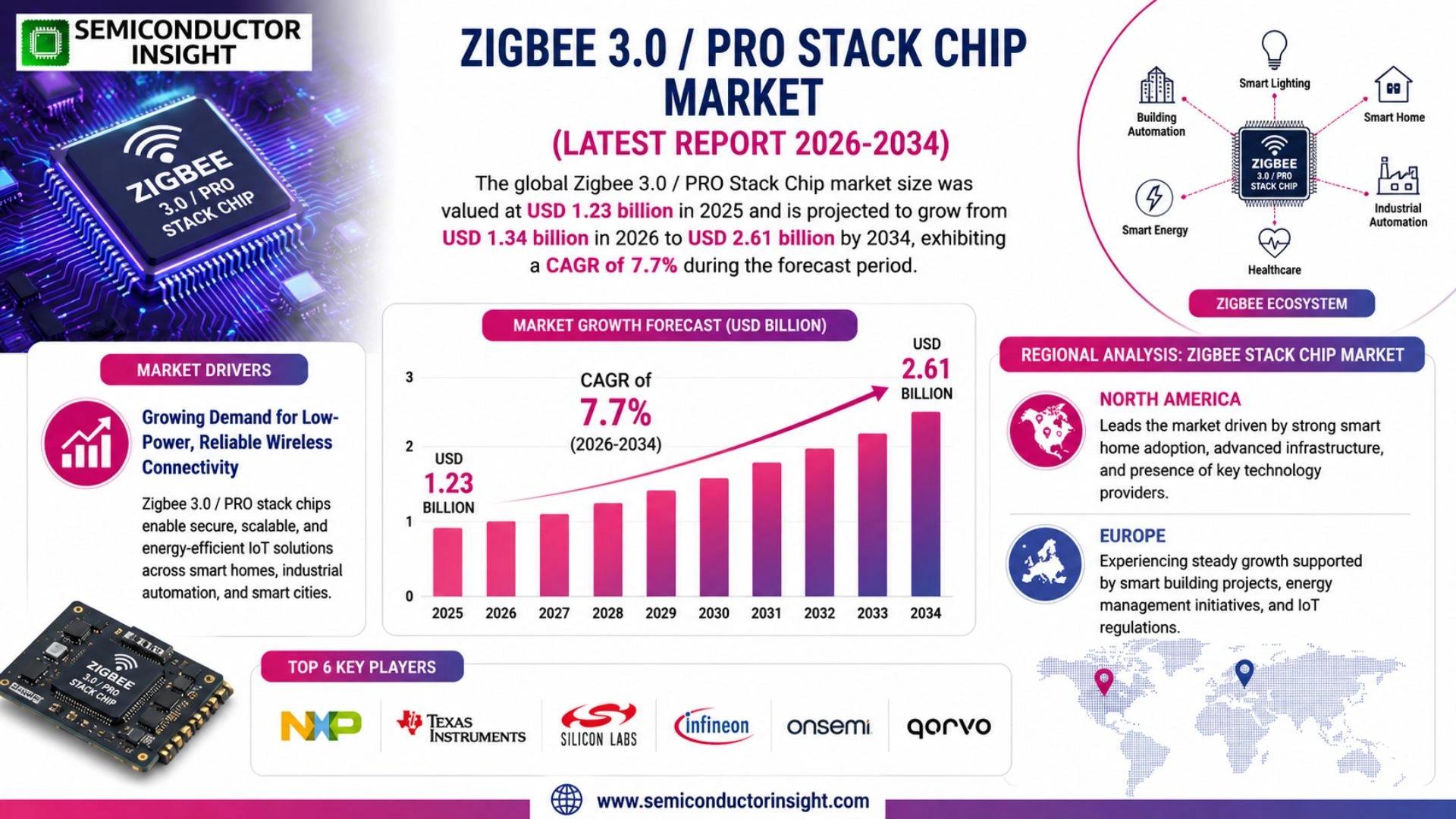
Zigbee 3.0 / PRO Stack Chip Market size was valued at USD 1.23 billion in 2025. The market is projected to grow from USD 1.34 billion in 2026 to USD 2.61 billion by 2034, exhibiting a CAGR of 7.7% during the forecast period.
Zigbee 3.0 / PRO Stack chips are specialized semiconductor components that implement the IEEE 802.15.4-based Zigbee wireless communication protocol, enabling low-power, low-data-rate mesh networking across a wide range of connected devices. These chips integrate the full Zigbee PRO stack, supporting interoperability across smart home, industrial automation, and building management applications. The product landscape encompasses system-on-chip (SoC) solutions, standalone baseband processors, and multi-protocol variants that combine Zigbee with Bluetooth Low Energy or Thread, offered by leading semiconductor manufacturers including Silicon Laboratories, NXP Semiconductors, Texas Instruments, Qorvo, and Nordic Semiconductor.
The market is experiencing steady growth driven by accelerating smart home device adoption, expanding industrial IoT deployments, and the widespread integration of Zigbee-certified devices within the Matter interoperability standard ecosystem. Furthermore, the growing need for energy-efficient, reliable mesh networking in commercial building automation and healthcare monitoring environments continues to fuel demand for Zigbee 3.0 / PRO Stack chips globally.
MARKET DRIVERS
Rapid Expansion of Smart Home and IoT Ecosystems Fueling Zigbee 3.0 Stack Chip Adoption
The global proliferation of connected devices across residential and commercial environments has emerged as one of the most significant catalysts for Zigbee 3.0 / PRO Stack Chip Market. As consumers and enterprises increasingly adopt smart lighting, HVAC automation, security systems, and energy management platforms, the demand for reliable, low-power mesh networking solutions has intensified. Zigbee 3.0, built on the IEEE 802.15.4 standard, offers a unified application layer that resolves interoperability fragmentation present in earlier protocol versions, making it a preferred wireless communication standard for device manufacturers developing multi-vendor smart home ecosystems.
Energy Efficiency Requirements Accelerating PRO Stack Chip Integration Across Industrial IoT
Industrial automation and smart building deployments are placing growing emphasis on ultra-low power consumption without compromising network range or reliability. The Zigbee PRO Stack Chip architecture is specifically engineered to support extended battery life across sensor nodes, making it highly suitable for large-scale Industrial IoT deployments involving thousands of endpoints. The chip’s support for mesh network topologies with self-healing capabilities further enhances its value proposition in mission-critical environments such as factory floors, logistics warehouses, and smart grid infrastructure, driving steady procurement by system integrators and OEMs worldwide.
➤ The alignment of Zigbee 3.0 / PRO Stack Chip technology with the Matter smart home standard,which uses Zigbee as a foundational Thread and connectivity reference,has significantly broadened its addressable market, encouraging semiconductor vendors to accelerate next-generation chip development cycles.
Government-backed energy efficiency mandates and smart city initiatives across North America, Europe, and Asia-Pacific are further reinforcing the growth trajectory of Zigbee 3.0 / PRO Stack Chip Market. Public infrastructure programs focused on intelligent street lighting, smart metering, and building energy management systems are creating sustained, long-term procurement pipelines for Zigbee-enabled semiconductor solutions. The technology’s proven track record in large-scale deployments adds to its institutional credibility among procurement decision-makers operating under strict regulatory compliance frameworks.
MARKET CHALLENGES
Intensifying Competition from Alternative Low-Power Wireless Protocols Challenging Zigbee 3.0 Market Positioning
Zigbee 3.0 / PRO Stack Chip Market faces meaningful competitive pressure from alternative wireless communication standards, including Z-Wave, Bluetooth Low Energy (BLE), Wi-Fi HaLow, and Thread. As silicon vendors expand their multi-protocol chip offerings, end-product manufacturers increasingly have the flexibility to select protocol stacks based on cost, ecosystem compatibility, and regional regulatory requirements. This competitive dynamic is compressing average selling prices for Zigbee stack chips and compelling vendors to differentiate through integrated security features, enhanced range, and simplified development toolchains rather than protocol performance alone.
Other Challenges
Interoperability and Certification Complexity
Despite Zigbee 3.0’s consolidated application layer, achieving seamless interoperability across diverse device categories from multiple manufacturers remains a technical and commercial challenge. The certification process administered by the Connectivity Standards Alliance (CSA) requires significant investment in testing and compliance validation, which can extend product development timelines and increase costs,particularly for smaller device manufacturers and startups entering Zigbee 3.0 / PRO Stack Chip Market for the first time.
Network Scalability Constraints in Dense Deployments
While Zigbee PRO Stack supports robust mesh networking, very high-density deployments involving thousands of concurrent nodes can introduce latency and network management complexity. In environments such as large commercial buildings or smart manufacturing facilities, engineers must carefully architect network topologies to maintain throughput and reliability, adding design burden compared to some competing protocols that natively support higher node densities with lower configuration overhead.
MARKET RESTRAINTS
Supply Chain Vulnerabilities and Semiconductor Sourcing Constraints Limiting Market Scalability
The broader semiconductor supply chain disruptions experienced in recent years continue to exert residual pressure on Zigbee 3.0 / PRO Stack Chip Market. Specialized RF and mixed-signal chip fabrication relies on mature process nodes, and capacity constraints at key foundries can create lead time extensions that disrupt product launch schedules for device manufacturers. For vendors operating in cost-sensitive consumer electronics segments, these sourcing uncertainties complicate inventory planning and can erode gross margins when procurement is required from spot markets at premium pricing.
Fragmented Regional Regulatory Environments Creating Market Entry Barriers
Regulatory heterogeneity across key geographic markets presents a structural restraint for manufacturers developing Zigbee 3.0 / PRO Stack Chip-based products intended for global distribution. Variations in RF spectrum allocation, transmission power limits, and mandatory certification requirements across the United States, European Union, Japan, and emerging Asian markets necessitate multiple hardware configurations or costly regulatory approvals per region. This complexity disproportionately affects mid-sized device manufacturers that lack the regulatory affairs infrastructure of large multinational electronics companies, effectively slowing market penetration rates in high-growth regions.
The relatively higher bill-of-materials cost associated with Zigbee PRO Stack Chip integration compared to simpler, proprietary RF solutions can also act as a restraint in price-sensitive application segments. In markets such as low-cost consumer appliances or entry-level smart plugs, where wireless connectivity is valued but budget constraints are severe, manufacturers may opt for lower-cost proprietary alternatives, limiting the addressable market for standards-based Zigbee silicon despite its technical superiority in mesh networking and security capabilities.
MARKET OPPORTUNITIES
Matter Protocol Adoption Creating Transformative Growth Opportunities for Zigbee 3.0 / PRO Stack Chip Vendors
The widespread industry adoption of the Matter smart home interoperability standard represents a compelling growth catalyst for Zigbee 3.0 / PRO Stack Chip Market. Matter leverages Thread,a protocol that shares its IEEE 802.15.4 physical and MAC layer foundation with Zigbee,as its primary mesh transport for low-power devices. This architectural relationship positions Zigbee chip vendors with strong RF and stack expertise to develop dual-stack or multi-protocol silicon solutions that serve both legacy Zigbee deployments and emerging Matter-over-Thread product lines, effectively expanding their serviceable market without entirely replacing existing technology investments.
Smart Healthcare and Asset Tracking Verticals Emerging as High-Value Application Segments
Healthcare facility management and medical asset tracking are emerging as high-priority verticals for Zigbee 3.0 / PRO Stack Chip adoption. Hospitals and clinical environments require reliable, low-interference wireless connectivity for patient monitoring equipment, infusion pump tracking, and environmental sensing systems. Zigbee’s proven electromagnetic compatibility profile and mesh resilience make it technically well-suited for these demanding environments. As healthcare providers globally accelerate digital infrastructure investment, semiconductor vendors with Zigbee-certified chip platforms have a significant opportunity to address a segment that commands premium pricing and values technical certification over commodity cost competition.
The accelerating rollout of smart city infrastructure projects across Asia-Pacific, the Middle East, and Latin America presents an additional long-cycle opportunity for Zigbee 3.0 / PRO Stack Chip Market. Municipalities investing in connected street lighting, environmental monitoring networks, and automated utility metering are evaluating mesh wireless protocols with proven field reliability at scale. Zigbee’s decade-long deployment history in AMI (Advanced Metering Infrastructure) and smart grid programs provides a credibility advantage that positions certified chip vendors favorably in government and utility procurement processes, where demonstrated interoperability and security compliance are non-negotiable evaluation criteria.
Trends
Rising Smart Home Adoption Accelerating Demand for Zigbee 3.0 / PRO Stack Chips
Zigbee 3.0 / PRO Stack Chip Market is witnessing sustained momentum as smart home ecosystems continue to expand globally. Zigbee 3.0 / PRO Stack chips, built on the IEEE 802.15.4 standard, have become foundational components in connected lighting, smart thermostats, door locks, and energy management systems. The convergence of consumer demand for seamless home automation and the industry push toward standardized interoperability protocols has positioned these chips at the center of next-generation IoT device design. Leading semiconductor manufacturers such as Silicon Laboratories, NXP Semiconductors, Texas Instruments, Qorvo, and Nordic Semiconductor continue to invest in refining their Zigbee PRO stack chip portfolios to address the growing variety of smart home applications.
Other Trends
Integration with the Matter Interoperability Standard
One of the most significant developments shaping Zigbee 3.0 / PRO Stack Chip Market is the widespread integration of Zigbee-certified devices within the Matter interoperability standard ecosystem. Matter, backed by major industry alliances, enables cross-platform device communication, and Zigbee PRO serves as a key underlying transport layer within Thread-based Matter deployments. This alignment has broadened the addressable market for Zigbee 3.0 / PRO Stack chips, encouraging semiconductor vendors to develop multi-protocol system-on-chip solutions that combine Zigbee with Bluetooth Low Energy and Thread for greater design flexibility.
Expansion in Industrial IoT and Building Automation
Beyond residential applications, Zigbee 3.0 / PRO Stack Chip Market is benefiting from accelerating deployments in industrial IoT environments and commercial building management systems. Zigbee PRO’s mesh networking architecture offers reliable, low-power communication across large facility footprints, making it well-suited for HVAC control, occupancy sensing, and asset tracking. The healthcare sector is also emerging as a notable end-use segment, where Zigbee-enabled monitoring devices require the dependable, low-latency connectivity that the PRO stack protocol delivers.
Multi-Protocol SoC Solutions Driving Next Phase of Market Evolution
The transition toward multi-protocol system-on-chip architectures represents a defining trend for Zigbee 3.0 / PRO Stack Chip Market. Device manufacturers increasingly require chips that can support Zigbee alongside complementary wireless standards, reducing bill-of-materials complexity and enabling firmware-configurable connectivity. This shift is prompting leading suppliers to introduce highly integrated SoC platforms that preserve full Zigbee 3.0 PRO stack compliance while expanding support for adjacent protocols, ensuring long-term design relevance as the broader IoT connectivity landscape continues to evolve.
COMPETITIVE LANDSCAPE
Key Industry Players
Zigbee 3.0 / PRO Stack Chip Market: Competitive Dynamics and Leading Semiconductor Manufacturers Shaping the Global Landscape
Global Zigbee 3.0 / PRO Stack Chip Market is characterized by a concentrated yet competitive semiconductor landscape, with Silicon Laboratories firmly positioned as a dominant player through its EFR32 Mighty Gecko series , widely recognized for its robust Zigbee PRO stack integration, multi-protocol capabilities combining Zigbee with Bluetooth Low Energy and Thread, and broad adoption across smart home, building automation, and industrial IoT applications. NXP Semiconductors and Texas Instruments also command significant market presence, offering mature, well-supported SoC platforms such as NXP’s JN series and TI’s CC2652 family, which are deeply embedded within Zigbee-certified product ecosystems and continue to benefit from the expanding Matter interoperability standard. These tier-one players collectively leverage decades of semiconductor expertise, extensive reference design ecosystems, and strong relationships with ODMs and system integrators to maintain competitive advantages across price-sensitive and performance-driven segments alike.
Beyond the leading players, Zigbee 3.0 / PRO Stack Chip Market features several strategically significant niche and regional competitors. Qorvo, through its GP5xx series acquired from GreenPeak Technologies, maintains a focused presence in smart home metering and residential automation. Nordic Semiconductor has increasingly extended its multi-protocol nRF52 and nRF5340 platforms to support Zigbee PRO alongside Thread and Bluetooth LE, attracting wearable and compact IoT device manufacturers. Telink Semiconductor has emerged as a cost-competitive alternative particularly within the Asia-Pacific supply chain, while MediaTek and Microchip Technology round out the competitive field with dedicated offerings targeting smart energy, commercial building management, and healthcare monitoring verticals. Collectively, these players are driving innovation in low-power mesh networking, interoperability certification, and integration density, reinforcing sustained market growth projected at a CAGR of 7.7% through 2034.
List of Key Zigbee 3.0 / PRO Stack Chip Companies Profiled
- Silicon Laboratories Inc.
- NXP Semiconductors N.V.
- Texas Instruments Incorporated
- Qorvo Inc.
- Nordic Semiconductor ASA
- Telink Semiconductor Co., Ltd.
- MediaTek Inc.
- Microchip Technology Inc.
- Espressif Systems
- STMicroelectronics N.V.
- Renesas Electronics Corporation
- Infineon Technologies AG
- Ember Corporation (acquired by Silicon Laboratories)
- Telegesis Ltd.
- IOTEK Inc.
Segment Analysis:
| Segment Category | Sub-Segments | Key Insights |
| By Type |
|
System-on-Chip (SoC) Solutions represent the dominant chip type withZigbee 3.0 / PRO Stack Chip Market, owing to their highly integrated architecture that consolidates the RF transceiver, microcontroller core, memory, and the full Zigbee PRO stack into a single compact die.
|
| By Application |
|
Smart Home Automation stands as the leading application segment driving consumption of Zigbee 3.0 / PRO Stack chips, underpinned by accelerating consumer adoption of connected lighting, smart locks, thermostats, occupancy sensors, and home security systems.
|
| By End User |
|
Consumer Electronics Manufacturers constitute the dominant end-user cohort Zigbee 3.0 / PRO Stack Chip Market, as leading brands across smart lighting, home security, and connected appliance categories continue to embed Zigbee chipsets into high-volume product lines targeting mainstream residential consumers.
|
| By Protocol Compatibility |
|
Zigbee PRO Stack chips maintain the leading position within this segmentation dimension, as the PRO variant delivers enhanced mesh network scalability, superior security architecture, and more robust support for large-node-count deployments compared to the baseline Zigbee 3.0 specification alone.
|
| By Power Configuration |
|
Ultra-Low Power Battery-Operated Configurations represent the most strategically important power segment, as the defining value proposition of Zigbee 3.0 / PRO Stack chips for end-device applications is their ability to sustain multi-year operational lifetimes on compact coin-cell or AA batteries without compromising network responsiveness.
|
Regional Analysis: Zigbee 3.0 / PRO Stack Chip Market
Asia-Pacific
Asia-Pacific’s consumer electronics ecosystem is deeply intertwined with Zigbee 3.0 / PRO Stack Chip adoption. Manufacturers across China and South Korea are embedding these chips into smart speakers, lighting controllers, and connected appliances at scale, capitalizing on a vast middle-class consumer base eager for affordable, interoperable smart home solutions aligned with global Matter protocol compatibility.
National programs across China, India, Japan, and Singapore are mandating intelligent building standards and connected infrastructure deployment, creating sustained institutional demand for Zigbee 3.0 / PRO Stack Chip-enabled solutions. These policy-driven frameworks accelerate the integration of low-power mesh networking technologies into public infrastructure, commercial buildings, and municipal energy management systems across the region.
The region hosts an unparalleled concentration of chip fabrication facilities and fabless design houses actively developing next-generation Zigbee 3.0 / PRO Stack Chip architectures. Taiwan’s TSMC and similar foundries enable rapid iteration of advanced node chips optimized for ultra-low power Zigbee mesh applications, giving Asia-Pacific-based vendors a significant time-to-market advantage over competitors in other geographies.
Beyond consumer applications, Asia-Pacific’s industrial sector is rapidly adopting Zigbee 3.0 / PRO Stack Chip technology for factory automation, predictive maintenance, and energy monitoring systems. Countries like Japan and South Korea, with mature industrial bases, are spearheading the deployment of Zigbee-enabled sensor networks in manufacturing facilities, driving a parallel commercial and industrial growth trajectory distinct from purely residential demand.
North America
North America represents a highly mature and innovation-driven market for Zigbee 3.0 / PRO Stack Chip Market, characterized by strong enterprise adoption, well-developed smart home penetration, and a thriving ecosystem of platform developers and system integrators. The United States is the primary engine of regional demand, with leading technology companies continuously investing in Zigbee-compatible ecosystems tied to voice-assistant platforms, energy management solutions, and commercial building automation. The region’s advanced regulatory environment, including energy efficiency mandates and smart grid development programs, creates structural tailwinds for Zigbee 3.0 / PRO Stack Chip adoption across residential and commercial segments alike. Canada contributes through its growing smart building sector, particularly in urban centers pursuing net-zero energy targets. North America also benefits from a strong venture capital environment that continues to fund Zigbee-focused IoT startups, ensuring a continuous pipeline of application innovation that sustains long-term chip demand through the 2026–2034 forecast horizon.
Europe
Europe occupies a strategically significant position in Global Zigbee 3.0 / PRO Stack Chip Market, shaped by the region’s rigorous energy efficiency regulations and its ambitious digital infrastructure agenda. The European Union’s directive-driven approach to building energy performance and smart grid modernization has created a compelling regulatory catalyst for Zigbee 3.0 / PRO Stack Chip deployment across both new construction and retrofit applications. Germany, the Netherlands, and Scandinavia are particularly advanced markets, where building automation standards and industrial IoT programs have normalized Zigbee mesh networking as a preferred low-power connectivity protocol. The region’s strong emphasis on interoperability standards and data privacy compliance aligns naturally with Zigbee 3.0’s open-standard architecture. Additionally, Europe’s automotive and industrial automation sectors are beginning to explore Zigbee PRO Stack Chip integration for specialized applications, further diversifying the regional demand base beyond traditional home automation use cases.
South America
South America presents an emerging growth frontier for Zigbee 3.0 / PRO Stack Chip Market, with adoption currently concentrated in Brazil, Chile, and Colombia , economies that are actively investing in smart city infrastructure and digital transformation programs. While the region lags behind North America and Europe in overall smart home penetration, rising urbanization rates and improving broadband connectivity are gradually establishing the foundational conditions necessary for broader Zigbee ecosystem growth. Brazil’s utility sector, in particular, is exploring Zigbee-enabled advanced metering infrastructure as part of national grid modernization efforts, which could serve as a meaningful near-term demand driver. Cost sensitivity remains a key market dynamic across South America, encouraging the adoption of competitively priced Zigbee 3.0 / PRO Stack Chip solutions. Regional system integrators are increasingly partnering with global chip vendors to localize deployment capabilities and address the specific infrastructure requirements of Latin American smart building projects.
Middle East & Africa
The Middle East & Africa region is at an early but promising stage of engagement with Zigbee 3.0 / PRO Stack Chip Market, underpinned by ambitious smart city development projects and a growing commitment to sustainable building practices. Gulf Cooperation Council nations , particularly the UAE and Saudi Arabia , are channeling substantial investment into intelligent building infrastructure as part of broader economic diversification strategies, creating pockets of sophisticated Zigbee adoption in commercial and hospitality sectors. Africa’s market remains nascent overall, though South Africa and select North African economies are beginning to integrate Zigbee-enabled energy monitoring solutions to address power reliability challenges. The region’s unique operational environments, including extreme temperatures and variable grid reliability, place a premium on the robustness and low-power characteristics inherent in Zigbee 3.0 / PRO Stack Chip designs. As smart infrastructure investment accelerates across the Middle East, the region is anticipated to emerge as an increasingly active participant in the global Zigbee market through the latter half of the 2026–2034 forecast period.
Report Scope
This market research report provides a comprehensive analysis of the Zigbee 3.0 / PRO Stack Chip Market , covering the forecast period 2026–2034. It offers detailed insights into market dynamics, technological advancements, competitive landscape, and key trends shaping the industry.
Key focus areas of the report include:
- Market Overview: The report begins with an overview outlining its current market scenario, key growth indicators, and industry transformation drivers. It discusses macroeconomic factors, demand–supply balance, regulatory landscape, and the strategic role of semiconductors in powering advancements across industries such as automotive, telecommunications, consumer electronics, and industrial automation.
- Market Size & Forecast: Historical data and future projections for revenue, unit shipments, and market value across major regions and segments.
- Segmentation Analysis: Detailed breakdown by product type, technology, application, and end-user industry to identify high-growth segments and investment opportunities.
- Regional Insights: Insights into market performance across North America, Europe, Asia-Pacific, Latin America, and the Middle East & Africa, including country-level analysis where relevant.
- Competitive Landscape: Profiles of leading market participants, including their product offerings, R&D focus, manufacturing capacity, pricing strategies, and recent developments such as mergers, acquisitions, and partnerships.
- Technology Trends & Innovation: Assessment of emerging technologies, integration of AI/IoT, semiconductor design trends, fabrication techniques, and evolving industry standards.
- Market Drivers & Restraints: Evaluation of factors driving market growth along with challenges, supply chain constraints, regulatory issues, and market-entry barriers.
- Stakeholder Insights: Insights for component suppliers, OEMs, system integrators, investors, and policymakers regarding the evolving ecosystem and strategic opportunities.
Primary and secondary research methods are employed, including interviews with industry experts, data from verified sources, and real-time market intelligence to ensure the accuracy and reliability of the insights presented.
FREQUENTLY ASKED QUESTIONS:
What is the current market size of Zigbee 3.0 / PRO Stack Chip Market?
-> Zigbee 3.0 / PRO Stack Chip Market was valued at USD 1.23 billion in 2025 and is expected to reach USD 2.61 billion by 2034, growing at a CAGR of 7.7% during the forecast period from 2026 to 2034.
Which key companies operate Zigbee 3.0 / PRO Stack Chip Market?
-> Key players include Silicon Laboratories, NXP Semiconductors, Texas Instruments, Qorvo, and Nordic Semiconductor, among others.
What are the key growth drivers?
-> Key growth drivers include accelerating smart home device adoption, expanding industrial IoT deployments, and widespread integration of Zigbee-certified devices within the Matter interoperability standard ecosystem. Additionally, the growing need for energy-efficient, reliable mesh networking in commercial building automation and healthcare monitoring environments continues to fuel demand.
Which region dominates the market?
-> Asia-Pacific is the fastest-growing region, driven by rapid smart home adoption and industrial IoT expansion, while North America and Europe remain significant markets owing to advanced building automation and connected device ecosystems.
What are the emerging trends?
-> Emerging trends include multi-protocol chip variants combining Zigbee with Bluetooth Low Energy or Thread, integration within the Matter interoperability standard, and growing adoption of system-on-chip (SoC) solutions supporting low-power mesh networking across smart home, industrial automation, and building management applications.

Get Sample Report PDF for Exclusive Insights
Report Sample Includes
- Table of Contents
- List of Tables & Figures
- Charts, Research Methodology, and more...