X-ray Flat Panel Detector (TFT) Gate Driver Market Insights
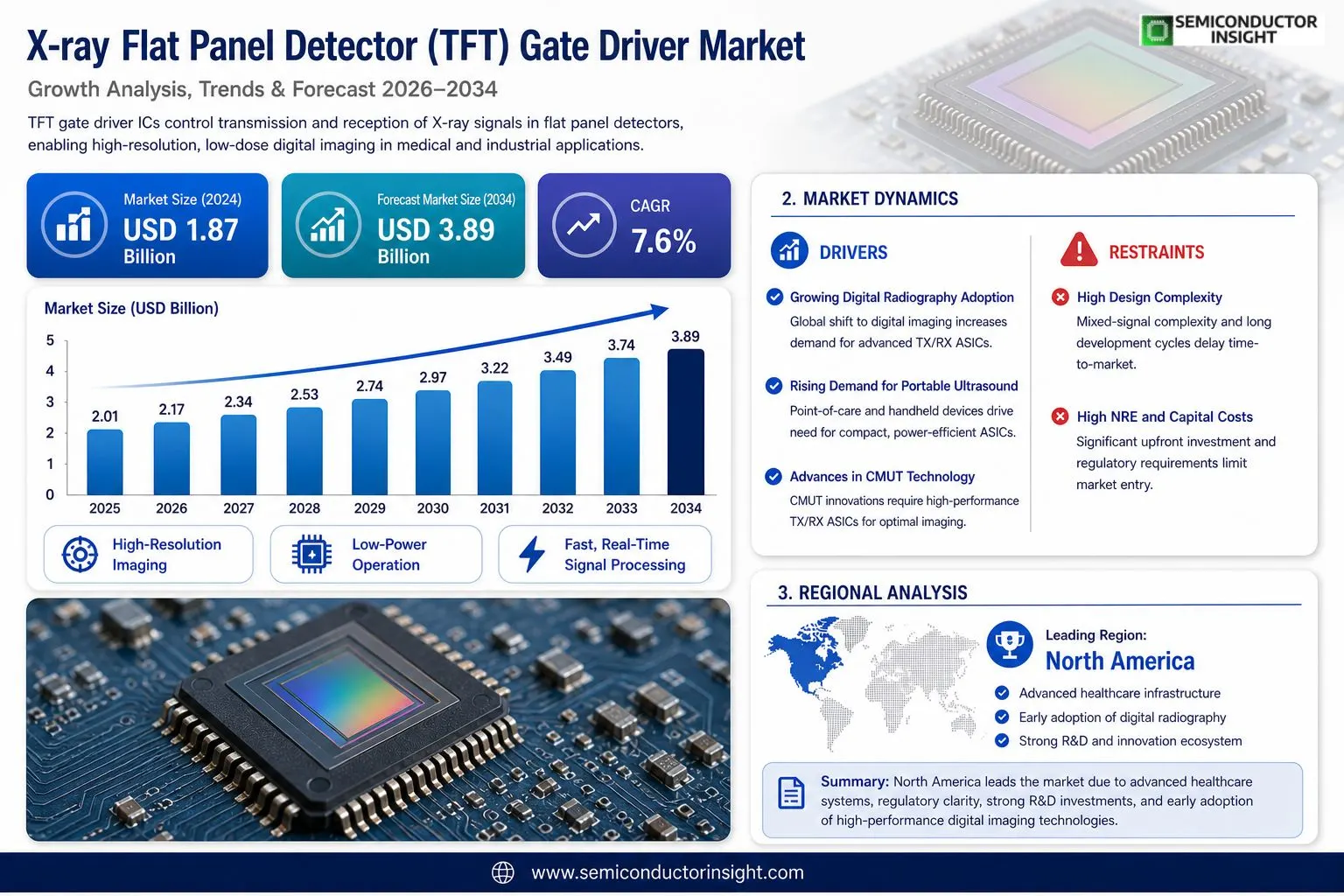
Global X-ray Flat Panel Detector (TFT) Gate Driver Market size was valued at USD 1.87 billion in 2024. The market is projected to grow from USD 2.01 billion in 2025 to USD 3.89 billion by 2034, exhibiting a CAGR of 7.6% during the forecast period.
X-ray flat panel detectors equipped with thin-film transistor (TFT) gate drivers are advanced digital imaging components that replace conventional film-based and image intensifier systems in medical, dental, and industrial radiography. The TFT gate driver is a critical integrated circuit that sequentially activates the pixel rows within the flat panel detector array, enabling precise charge readout and high-resolution image acquisition. These detectors are broadly categorized by their conversion method , direct conversion and indirect conversion , and find application across static and dynamic (fluoroscopic) imaging systems.
The market is witnessing robust momentum driven by the accelerating global transition from analog to digital radiography, increasing investments in healthcare infrastructure, and growing demand for high-sensitivity, low-dose imaging solutions. Furthermore, rising incidences of chronic diseases requiring frequent diagnostic imaging, combined with expanding industrial non-destructive testing applications, are reinforcing adoption. Key industry participants such as Varex Imaging Corporation, Konica Minolta, Canon Medical Systems, Fujifilm Holdings, and Vieworks Co., Ltd. continue to advance TFT gate driver architectures to support larger active areas, faster readout rates, and improved signal-to-noise performance across their flat panel detector portfolios.
MARKET DRIVERS
Rising Demand for High-Resolution Digital Imaging in Medical Diagnostics
X-ray Flat Panel Detector (TFT) Gate Driver Market is experiencing significant growth momentum driven by the accelerating transition from conventional analog X-ray systems to advanced digital radiography platforms across hospitals, diagnostic imaging centers, and specialty clinics worldwide. TFT-based flat panel detectors have become the preferred imaging modality due to their superior image quality, reduced radiation dose requirements, and faster image acquisition speeds. The gate driver integrated circuit, a critical component within the TFT array architecture, directly governs pixel row switching and charge readout operations, making its performance central to overall detector efficiency. As healthcare providers invest in upgrading legacy imaging infrastructure, demand for high-performance gate driver solutions capable of supporting large-area TFT panels continues to expand.
Expansion of Portable and Mobile X-ray Systems Driving Gate Driver Innovation
The proliferation of portable and wireless flat panel detectors for point-of-care and emergency imaging applications has emerged as a strong market driver for X-ray Flat Panel Detector (TFT) Gate Driver Market. Mobile X-ray units deployed in intensive care units, field hospitals, and remote diagnostic settings require compact, power-efficient gate driver ICs that can maintain high switching accuracy under varying operational conditions. Semiconductor manufacturers are responding with low-voltage, multi-channel gate driver architectures that minimize power consumption while sustaining precise TFT gate line control across panel sizes ranging from small veterinary detectors to large-format chest imaging panels. This trend toward miniaturization and power optimization is reshaping the competitive landscape of gate driver component suppliers.
➤ The increasing adoption of digital flat panel detectors in interventional radiology and fluoroscopy procedures is generating demand for gate drivers capable of supporting high frame-rate readout modes, a technical requirement that is pushing the boundaries of conventional TFT gate driver design and opening new avenues for advanced IC development.
Government initiatives and public health investments aimed at improving diagnostic infrastructure, particularly across emerging economies in Asia-Pacific, Latin America, and Africa, are further amplifying procurement of digital X-ray systems equipped with TFT flat panel detectors. National health programs prioritizing early disease detection and tuberculosis screening have directly contributed to sustained volume growth in flat panel detector deployments, creating a corresponding uptick in demand for associated gate driver components across the supply chain of X-ray Flat Panel Detector (TFT) Gate Driver Market.
MARKET CHALLENGES
Technical Complexity in Designing High-Speed, Low-Noise Gate Drivers for Large-Area TFT Panels
One of the foremost challenges confronting X-ray Flat Panel Detector (TFT) Gate Driver Market is the engineering complexity involved in developing gate driver ICs that can reliably address thousands of gate lines across large-area amorphous silicon or low-temperature polysilicon TFT arrays without introducing timing jitter, crosstalk, or thermal instability. As detector panel resolutions increase to support subspecialty imaging requirements in mammography, orthopedic, and cardiac applications, gate driver circuits must operate at tighter timing tolerances while managing higher channel counts. Achieving consistent gate pulse waveforms across all addressed rows , particularly in panels exceeding 43 cm × 43 cm in active area , demands sophisticated circuit design, process technology optimization, and rigorous electromagnetic compatibility management, all of which elevate development costs and extend product qualification timelines.
Other Challenges
Supply Chain Concentration and Semiconductor Sourcing Vulnerabilities
The gate driver IC supply chain for X-ray flat panel detectors remains concentrated among a relatively limited number of specialized semiconductor foundries capable of fabricating the advanced mixed-signal process nodes required for these components. This concentration exposes flat panel detector OEMs to procurement risks associated with foundry capacity constraints, geopolitical trade restrictions, and raw material availability, all of which can disrupt production schedules and inflate component costs. X-ray Flat Panel Detector (TFT) Gate Driver Market participants are actively evaluating dual-sourcing strategies and regional supply diversification to mitigate these vulnerabilities.
Regulatory and Certification Barriers Across Key Markets
Gate driver components integrated within medical-grade X-ray flat panel detectors are subject to stringent regulatory scrutiny as part of the broader detector system approval process under frameworks such as the U.S. FDA 510(k) pathway, EU MDR, and equivalent national medical device regulations in Japan, China, and South Korea. Any design modification to a gate driver IC that affects detector performance characteristics may necessitate re-validation testing and regulatory re-submission, creating a disincentive for frequent component refreshes and slowing the pace at which improved gate driver generations can be commercialized within X-ray Flat Panel Detector (TFT) Gate Driver Market.
MARKET RESTRAINTS
High Capital Requirements and Long Product Development Cycles Limiting New Entrants
A significant structural restraint in X-ray Flat Panel Detector (TFT) Gate Driver Market is the substantial capital investment required to develop, qualify, and bring to market a gate driver IC that meets the stringent electrical, reliability, and longevity specifications demanded by medical imaging OEMs. Prospective entrants must invest in advanced EDA toolsets, tape-out costs at specialized foundries, extensive characterization and reliability testing, and the lengthy customer qualification processes that typically span 18 to 36 months before commercial volume shipments can commence. These barriers effectively limit meaningful competition to established semiconductor companies with deep domain expertise in display driver and imaging sensor IC design, constraining market dynamism and sustaining pricing power among incumbent suppliers.
Price Sensitivity Among Flat Panel Detector Manufacturers Compressing Margins
Intense price competition among flat panel detector manufacturers, particularly in the mid-range and value-tier segments of the market, creates persistent downward pressure on the bill-of-materials cost targets allocated to gate driver components. As detector OEMs seek to compete on price in cost-sensitive procurement environments, they pass cost reduction mandates down to their component suppliers, including gate driver IC vendors. This dynamic restrains the ability of gate driver manufacturers to recover R&D investments through premium pricing, particularly in applications where the performance differentiation of next-generation gate driver architectures is not readily apparent to end-user procurement committees evaluating detector systems in X-ray Flat Panel Detector (TFT) Gate Driver Market.
Technological Transition Risks Associated with Emerging Detector Architectures
The gradual emergence of alternative flat panel detector technologies , including IGZO-based TFT backplanes and direct conversion detector architectures utilizing photon-counting readout circuits , presents a medium-term restraint on the conventional amorphous silicon TFT gate driver segment of X-ray Flat Panel Detector (TFT) Gate Driver Market. While amorphous silicon TFT panels remain the dominant platform for cost-effective digital X-ray imaging, ongoing research investments in next-generation detector architectures may progressively shift design activity and component procurement toward alternative readout and switching IC approaches, requiring existing gate driver suppliers to adapt their technology roadmaps accordingly to sustain market relevance.
MARKET OPPORTUNITIES
Growing Adoption of AI-Integrated Digital Radiography Systems Creating Premium Gate Driver Demand
The integration of artificial intelligence-based image processing and computer-aided detection algorithms into modern digital radiography platforms is creating an opportunity for X-ray Flat Panel Detector (TFT) Gate Driver Market, as AI-driven workflows increasingly require high frame-rate, low-noise image data streams that are only achievable with advanced gate driver ICs capable of supporting rapid multi-line addressing and dual-gate scanning modes. Detector manufacturers developing AI-ready platforms are willing to specify higher-performance gate driver components to ensure that image data quality meets the input requirements of AI diagnostic engines, creating a premium market segment with more favorable pricing dynamics for technically differentiated gate driver suppliers.
Expansion of Veterinary and Industrial NDT Applications Broadening the Addressable Market
Beyond medical imaging, X-ray Flat Panel Detector (TFT) Gate Driver Market stands to benefit from expanding adoption of flat panel detector technology in veterinary radiography and industrial non-destructive testing applications, including aerospace component inspection, electronics manufacturing quality control, and security screening systems. These application segments have distinct detector size and performance requirements compared to medical imaging, creating opportunities for gate driver IC suppliers to develop application-optimized variants that address the specific gate line counts, operating voltage ranges, and environmental durability requirements of non-medical flat panel detector deployments.
Infrastructure Development in Emerging Markets Accelerating Digital X-ray Penetration
Rapid healthcare infrastructure expansion across high-growth economies in Southeast Asia, South Asia, the Middle East, and Sub-Saharan Africa is creating a substantial incremental demand opportunity for digital X-ray flat panel detector systems and, by extension, for the gate driver components that enable their operation. As governments and private hospital networks in these regions equip new diagnostic facilities with digital radiography equipment, the volume of flat panel detectors deployed is expected to grow considerably, providing a sustained long-term demand tailwind for X-ray Flat Panel Detector (TFT) Gate Driver Market and incentivizing gate driver suppliers to establish regional distribution and technical support capabilities to serve these expanding customer bases effectively.
X-ray Flat Panel Detector (TFT) Gate Driver Market Trends
Accelerating Transition from Analog to Digital Radiography
One of the most defining trends shaping X-ray Flat Panel Detector (TFT) Gate Driver Market is the accelerating global shift from analog and film-based imaging systems to advanced digital radiography platforms. Healthcare facilities across developed and emerging economies are progressively replacing conventional image intensifier systems with flat panel detectors that integrate TFT gate driver circuits, enabling precise sequential pixel row activation and high-resolution image acquisition. This transition is being reinforced by regulatory emphasis on improved diagnostic accuracy, reduced radiation exposure, and streamlined clinical workflows. The demand for low-dose, high-sensitivity imaging solutions is compelling hospitals and diagnostic centers to invest in next-generation digital detector infrastructure, directly fueling demand across X-ray Flat Panel Detector (TFT) Gate Driver Market.
Other Trends
Rising Demand Across Medical and Industrial Applications
X-ray Flat Panel Detector (TFT) Gate Driver Market is experiencing broadened adoption beyond traditional medical radiography. Dental imaging, orthopedic diagnostics, and dynamic fluoroscopic procedures are increasingly relying on TFT-based flat panel detectors for their superior signal-to-noise performance and faster readout rates. Concurrently, industrial non-destructive testing applications , including aerospace component inspection, pipeline integrity assessment, and electronics quality control , are emerging as significant growth verticals. The versatility of direct and indirect conversion detector architectures is enabling manufacturers to address both static and dynamic imaging requirements across these diverse end-use sectors.
Advancements in TFT Gate Driver Architecture
Leading industry participants such as Varex Imaging Corporation, Konica Minolta, Canon Medical Systems, Fujifilm Holdings, and Vieworks Co., Ltd. are actively advancing TFT gate driver designs to support larger active detector areas, higher frame rates, and enhanced charge readout precision. Innovations in integrated circuit miniaturization and low-noise amplification are enabling next-generation flat panel detectors to deliver improved spatial resolution and dynamic range, particularly for fluoroscopic and real-time imaging applications. These architectural enhancements are positioning TFT gate driver technology as a cornerstone of premium digital detector development.
Healthcare Infrastructure Investment Driving Market Expansion
Growing public and private investments in healthcare infrastructure, particularly across Asia-Pacific and Latin American markets, are creating sustained procurement opportunities for X-ray Flat Panel Detector (TFT) Gate Driver solutions. The rising incidence of chronic diseases requiring frequent diagnostic imaging , including cardiovascular conditions, orthopedic disorders, and oncological screenings , is driving demand for reliable, high-throughput radiographic systems. As healthcare systems modernize their imaging departments, TFT gate driver-integrated flat panel detectors are increasingly specified as the preferred replacement for legacy radiographic equipment, reinforcing the long-term growth trajectory of this market.
COMPETITIVE LANDSCAPE
Key Industry Players
X-ray Flat Panel Detector (TFT) Gate Driver Market: Competitive Dynamics and Leading Manufacturer Strategies
Global X-ray Flat Panel Detector (TFT) Gate Driver market is characterized by a moderately consolidated competitive structure, with a handful of technologically advanced companies commanding significant market share. Varex Imaging Corporation stands out as one of the foremost players, offering a comprehensive portfolio of flat panel detectors with proprietary TFT gate driver architectures designed for high-resolution medical and industrial imaging applications. Canon Medical Systems and Fujifilm Holdings similarly leverage extensive R&D capabilities and established distribution networks to maintain competitive positioning, continuously advancing their TFT gate driver designs to support faster readout rates, reduced image lag, and improved signal-to-noise ratios. The market’s competitive intensity is further shaped by the accelerating global transition from analog to digital radiography, prompting both established corporations and emerging technology firms to invest heavily in next-generation gate driver integrated circuits capable of supporting larger active imaging areas and dynamic fluoroscopic applications.
Beyond the dominant players, a number of niche and regionally significant manufacturers are making notable inroads in X-ray Flat Panel Detector (TFT) Gate Driver Market. Konica Minolta and Vieworks Co., Ltd. have carved out strong positions in specialized segments, particularly in high-sensitivity and low-dose imaging solutions catering to both medical diagnostics and industrial non-destructive testing. Companies such as Rayence, iRay Technology, and Teledyne DALSA are increasingly investing in proprietary TFT gate driver technologies to differentiate their flat panel detector offerings in terms of pixel pitch, frame rate, and dynamic range. Meanwhile, firms like Shimadzu Corporation, Carestream Health, and Analogic Corporation continue to expand their presence through strategic partnerships and product innovation, particularly targeting emerging markets where healthcare infrastructure investments are accelerating demand for advanced digital radiography systems.
List of Key X-ray Flat Panel Detector (TFT) Gate Driver Companies Profiled
- Varex Imaging Corporation
- Fujifilm Holdings Corporation
- Canon Medical Systems Corporation
- Konica Minolta, Inc.
- Vieworks Co., Ltd.
- Rayence Co., Ltd.
- iRay Technology Company Limited
- Teledyne DALSA Inc.
- Shimadzu Corporation
- Carestream Health, Inc.
- Analogic Corporation
- Detection Technology Plc
- Drtech Corporation
- Trixell S.A.S.
- Perkin Elmer, Inc.
Segment Analysis:
| Segment Category | Sub-Segments | Key Insights |
| By Type |
|
Indirect Conversion FPDs currently represent the leading segment within the X-ray Flat Panel Detector TFT Gate Driver market, owing to their widespread commercial maturity and broad clinical acceptance across diverse imaging environments.
|
| By Application |
|
Static Radiography remains the dominant application segment, underpinned by its foundational role in routine diagnostic workflows across hospitals, clinics, and outpatient imaging centers globally.
|
| By End User |
|
Hospitals and Diagnostic Imaging Centers constitute the leading end-user segment, as these institutions collectively represent the highest concentration of X-ray flat panel detector deployments across a diverse spectrum of clinical procedures.
|
| By Imaging Mode |
|
Fixed / Stationary Detectors lead this segment due to their entrenched presence within established radiology suites and fluoroscopy rooms, where system integration complexity and image quality demands favor dedicated, high-specification TFT gate driver configurations.
|
| By Technology Integration |
|
Digital / Mixed-Signal TFT Gate Drivers represent the leading and most strategically significant technology integration segment, reflecting the industry-wide shift toward programmable, software-configurable readout architectures that offer superior adaptability across varied imaging modalities and detector panel sizes.
|
Regional Analysis: X-ray Flat Panel Detector (TFT) Gate Driver Market
North America
The North American X-ray Flat Panel Detector (TFT) Gate Driver Market benefits from a clearly defined regulatory framework. FDA oversight ensures that gate driver components embedded in TFT-based detectors meet rigorous performance and safety benchmarks. This compliance-driven culture encourages manufacturers to invest in premium-grade, clinically validated gate driver architectures, elevating overall product quality and market reliability across the region.
North America hosts a concentration of semiconductor research institutions and medtech innovation hubs actively advancing TFT gate driver design. Collaborative efforts between universities, national laboratories, and private enterprises are accelerating developments in low-power, high-resolution gate driver circuits, enabling next-generation X-ray flat panel detector systems that deliver superior image clarity with reduced radiation exposure for patients.
The rapid digitalization of healthcare services across the United States and Canada is a significant catalyst for X-ray Flat Panel Detector (TFT) Gate Driver Market. Hospitals and outpatient imaging centers are increasingly transitioning to fully digital radiographic platforms, where high-performance TFT gate drivers play a critical role in ensuring consistent, artifact-free image acquisition essential for accurate clinical diagnosis.
Beyond medical imaging, North America’s X-ray Flat Panel Detector (TFT) Gate Driver Market is expanding into industrial non-destructive testing and airport security screening. Defense agencies and industrial quality-control sectors are deploying advanced flat panel detector systems requiring robust, high-speed gate driver solutions capable of operating reliably in demanding environmental conditions, broadening the market’s revenue base significantly.
Europe
Europe represents a mature yet continuously evolving landscape for X-ray Flat Panel Detector (TFT) Gate Driver Market. Countries such as Germany, France, the United Kingdom, and the Netherlands maintain sophisticated healthcare ecosystems that prioritize cutting-edge diagnostic imaging technology. The European Union’s medical device regulatory framework, particularly the MDR, establishes high benchmarks for detector component quality, indirectly encouraging the adoption of advanced TFT gate driver solutions. European manufacturers are increasingly focused on energy-efficient gate driver designs that align with the region’s broader sustainability agenda. Moreover, collaborative research initiatives funded through EU programs are fostering cross-border innovation in detector electronics. The aging demographic across Western Europe is intensifying demand for oncology and orthopedic imaging, further propelling market growth. Eastern European nations are gradually upgrading their healthcare infrastructure, presenting additional expansion opportunities for X-ray flat panel detector technology and its underlying TFT gate driver components throughout the 2026–2034 forecast window.
Asia-Pacific
Asia-Pacific is recognized as the fastest-growing region in Global X-ray Flat Panel Detector (TFT) Gate Driver Market, propelled by rapid healthcare infrastructure development, expanding medical device manufacturing capacity, and growing patient populations across China, India, Japan, and South Korea. China’s domestic semiconductor industry is increasingly capable of producing TFT gate driver components, reducing import dependence while lowering production costs for flat panel detector manufacturers. Japan’s precision engineering heritage continues to yield high-quality detector components, while South Korea’s advanced display and semiconductor ecosystem provides strong technological synergies with the TFT gate driver segment. India’s government-led healthcare expansion programs are accelerating hospital-level adoption of digital X-ray systems. The increasing prevalence of chronic diseases and the expansion of diagnostic imaging networks across emerging ASEAN economies further underscore Asia-Pacific’s accelerating prominence in X-ray Flat Panel Detector (TFT) Gate Driver Market.
South America
South America presents a developing yet promising market for X-ray Flat Panel Detector (TFT) Gate Driver technology, with Brazil and Mexico leading regional adoption. Public and private sector investments in healthcare modernization are gradually replacing outdated radiographic equipment with digital flat panel detector systems, creating new demand for reliable TFT gate driver components. Government health programs targeting improved diagnostic access in underserved communities are acting as meaningful demand drivers. However, economic volatility, currency fluctuations, and fragmented regulatory environments across individual countries pose challenges for international suppliers seeking consistent market penetration. Local distribution partnerships and flexible pricing strategies are increasingly important for vendors targeting the South American X-ray Flat Panel Detector (TFT) Gate Driver Market. Despite near-term constraints, long-term population growth and rising chronic disease burdens are expected to sustain steady market development through the 2026–2034 period.
Middle East & Africa
The Middle East & Africa region occupies an emerging position within Global X-ray Flat Panel Detector (TFT) Gate Driver Market, characterized by wide variation in healthcare infrastructure maturity across sub-regions. Gulf Cooperation Council nations, particularly Saudi Arabia and the UAE, are investing substantially in world-class healthcare facilities equipped with state-of-the-art digital imaging platforms, creating meaningful demand for high-performance TFT gate driver solutions. Government-backed vision programs in these countries emphasize medical technology modernization as a national priority. In contrast, Sub-Saharan Africa continues to face infrastructure, funding, and supply chain limitations that temper near-term adoption. Nevertheless, international aid programs and NGO-driven healthcare initiatives are gradually introducing digital radiography systems into underserved markets. Over the 2026–2034 forecast period, the Middle East & Africa is expected to register incremental but meaningful growth in X-ray Flat Panel Detector (TFT) Gate Driver Market as regional healthcare standards progressively elevate.
Report Scope
This market research report provides a comprehensive analysis of the X-ray Flat Panel Detector (TFT) Gate Driver Market , covering the forecast period 2026–2034. It offers detailed insights into market dynamics, technological advancements, competitive landscape, and key trends shaping the industry.
Key focus areas of the report include:
- Market Overview: The report begins with an overview outlining its current market scenario, key growth indicators, and industry transformation drivers. It discusses macroeconomic factors, demand–supply balance, regulatory landscape, and the strategic role of semiconductors in powering advancements across industries such as automotive, telecommunications, consumer electronics, and industrial automation.
- Market Size & Forecast: Historical data and future projections for revenue, unit shipments, and market value across major regions and segments.
- Segmentation Analysis: Detailed breakdown by product type, technology, application, and end-user industry to identify high-growth segments and investment opportunities.
- Regional Insights: Insights into market performance across North America, Europe, Asia-Pacific, Latin America, and the Middle East & Africa, including country-level analysis where relevant.
- Competitive Landscape: Profiles of leading market participants, including their product offerings, R&D focus, manufacturing capacity, pricing strategies, and recent developments such as mergers, acquisitions, and partnerships.
- Technology Trends & Innovation: Assessment of emerging technologies, integration of AI/IoT, semiconductor design trends, fabrication techniques, and evolving industry standards.
- Market Drivers & Restraints: Evaluation of factors driving market growth along with challenges, supply chain constraints, regulatory issues, and market-entry barriers.
- Stakeholder Insights: Insights for component suppliers, OEMs, system integrators, investors, and policymakers regarding the evolving ecosystem and strategic opportunities.
Primary and secondary research methods are employed, including interviews with industry experts, data from verified sources, and real-time market intelligence to ensure the accuracy and reliability of the insights presented.
FREQUENTLY ASKED QUESTIONS:
What is the current market size of X-ray Flat Panel Detector (TFT) Gate Driver Market?
-> Global X-ray Flat Panel Detector (TFT) Gate Driver Market size was valued at USD 1.87 billion in 2024. The market is projected to grow from USD 2.01 billion in 2025 to USD 3.89 billion by 2034, exhibiting a CAGR of 7.6% during the forecast period.
Which key companies operate in X-ray Flat Panel Detector (TFT) Gate Driver Market?
-> Key players include Varex Imaging Corporation, Konica Minolta, Canon Medical Systems, Fujifilm Holdings, and Vieworks Co., Ltd., among others.
What are the key growth drivers?
-> Key growth drivers include the accelerating global transition from analog to digital radiography, increasing investments in healthcare infrastructure, growing demand for high-sensitivity, low-dose imaging solutions, rising incidences of chronic diseases requiring frequent diagnostic imaging, and expanding industrial non-destructive testing applications.
Which region dominates the market?
-> Asia-Pacific is the fastest-growing region, driven by rapid healthcare infrastructure expansion, while North America and Europe remain dominant markets due to advanced medical imaging adoption and strong industrial radiography demand.
What are the emerging trends?
-> Emerging trends include advancements in TFT gate driver architectures supporting larger active areas and faster readout rates, integration of direct and indirect conversion technologies, growing adoption of dynamic (fluoroscopic) imaging systems, and continued innovation in improved signal-to-noise performance across flat panel detector portfolios.

Get Sample Report PDF for Exclusive Insights
Report Sample Includes
- Table of Contents
- List of Tables & Figures
- Charts, Research Methodology, and more...
 Download Sample Report PDF