Wireless Vibration Sensors Market Insights
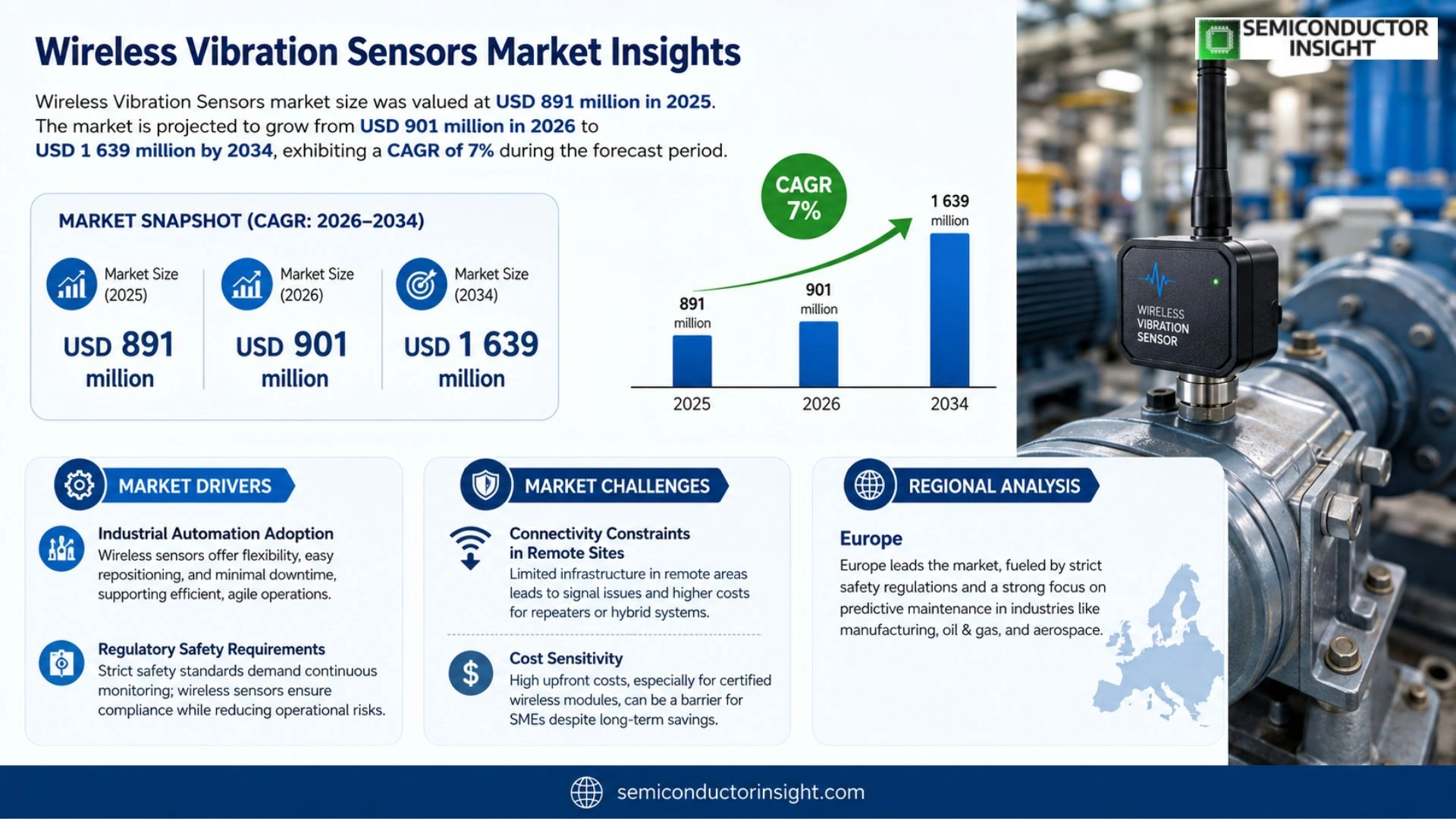
Global Wireless Vibration Sensors market size was valued at USD 891 million in 2025. The market is projected to grow from USD 901 million in 2026 to USD 1 639 million by 2034, exhibiting a CAGR of 7 % during the forecast period.
Wireless Vibration Sensors are compact transducers that convert mechanical oscillations into electrical signals for real‑time condition monitoring across industrial assets. By leveraging short‑range protocols such as Bluetooth 5.0 mesh or low‑power wide‑area networks, these sensors replace traditional wired accelerometers while delivering comparable accuracy.
The sector benefits from expanding automation, stricter predictive‑maintenance mandates, and falling costs of wireless modules. Moreover, advances in low‑energy chipsets enable dense sensor deployments on rotating equipment without frequent battery changes. Leading suppliers,including Baker Hughes, TE Connectivity, ABB and Emerson,are broadening portfolios with integrated edge analytics, positioning them to capture growing demand across manufacturing, energy and transportation.
MARKET DRIVERS
Industrial Automation Adoption
Manufacturers are replacing wired monitoring rigs with wireless vibration sensors to keep production lines running without the downtime associated with cable installation. The flexibility of a wireless network allows engineers to reposition sensors as equipment layouts evolve, which shortens change‑over cycles and supports just‑in‑time manufacturing strategies.
Regulatory Safety Requirements
Safety standards in sectors such as oil & gas, rail, and aerospace now mandate continuous condition monitoring to detect early signs of mechanical failure. Wireless vibration sensors satisfy those mandates while eliminating the trip hazards that traditional wired rigs can create in confined workspaces.
➤ The convergence of tighter safety rules and the need for operational agility is reshaping procurement policies, prompting firms to allocate a larger share of CAPEX to wireless monitoring solutions.
Beyond compliance, the data granularity delivered by modern sensors fuels predictive‑maintenance algorithms, enabling plant managers to shift from reactive repairs to scheduled interventions that preserve asset integrity.
MARKET CHALLENGES
Connectivity Constraints in Remote Sites
Facilities located in offshore platforms or isolated mining camps often lack robust wireless infrastructure. The resulting signal attenuation forces users to invest in repeaters or hybrid wired‑wireless setups, which erodes the cost advantage that pure wireless systems promise.
Other Challenges
Cost Sensitivity
While the total cost of ownership improves over the sensor lifecycle, the upfront expense of certified wireless modules,especially those rated for explosive atmospheres,remains a barrier for small‑to‑mid‑size enterprises.
MARKET RESTRAINTS
High Initial Investment
Deploying a comprehensive wireless vibration monitoring solution often requires simultaneous upgrades to power‑over‑Ethernet or battery‑management systems. Companies hesitant to commit capital before seeing measurable ROI may postpone projects, slowing market penetration.
MARKET OPPORTUNITIES
Integration with Edge AI
Embedding lightweight analytics directly on the sensor node allows real‑time anomaly detection without routing raw data to a central server. This capability reduces bandwidth demands, shortens alert latency, and opens new revenue streams for vendors offering subscription‑based insight platforms.
Wireless Vibration Sensors Market Trends
Expansion of Mesh‑Enabled Bluetooth Networks
The advent of Bluetooth 5.0 mesh has altered the architecture of industrial monitoring. By allowing thousands of nodes to communicate without a central hub, manufacturers can carpet large facilities with sensors that report vibration data in real time. This topology eliminates long cable runs, reduces installation labor, and lowers total cost of ownership. As enterprises shift from periodic manual checks to continuous condition monitoring, the reliability of mesh routing algorithms becomes a decisive factor in selecting a supplier. Companies that embed self‑healing mesh protocols are seeing faster adoption among OEMs that need to retrofit aging equipment while preserving uptime. Consequently, Wireless Vibration Sensors Market is seeing a noticeable migration from point‑to‑point solutions toward fully meshed deployments that support predictive maintenance strategies across entire production lines.
Other Trends
LPWAN Adoption for Remote Assets
Low‑Power Wide‑Area Network (LPWAN) standards such as LoRaWAN and NB‑IoT are gaining traction in sectors where assets are dispersed over vast distances,oil fields, wind farms, and railway corridors. The intrinsic advantage of LPWAN lies in its ability to transmit small packets of vibration data over several kilometers while consuming minimal power, extending battery life beyond five years. This capability addresses a long‑standing barrier for wireless vibration monitoring: frequent battery replacement in hard‑to‑reach locations. Vendors that bundle LPWAN radios with ruggedized accelerometers are attracting operators seeking a single‑sensor solution that combines long‑range connectivity with high‑resolution vibration capture. The result is a broader competitive landscape, where traditional wireless providers must either integrate LPWAN modules or risk losing market share to emerging specialists focused on remote‑asset monitoring.
Shift Toward Integrated Edge Analytics
Beyond connectivity, the market is gravitating toward sensors that perform on‑device signal processing. Edge analytics enable immediate extraction of frequency spectra, trend indicators, and anomaly scores before data reaches a central server. This reduces bandwidth consumption and accelerates alarm generation, which is critical in high‑speed manufacturing environments where a millisecond delay can translate into costly downtime. Manufacturers are therefore favoring solutions that embed machine‑learning models capable of distinguishing between normal operational vibrations and early signs of bearing wear or imbalance. The strategic implication is clear: sensor suppliers that provide turnkey edge‑intelligence platforms position themselves as partners in digital transformation, rather than merely component vendors, thereby commanding higher margins and deeper integration into customers’ maintenance workflows.
COMPETITIVE LANDSCAPE
Key Industry Players
Competitive Dynamics in the Global Wireless Vibration Sensors Market
The market is anchored by a handful of multinational engineering firms that have leveraged extensive OEM relationships and deep R&D budgets to turn wireless accelerometer platforms into de‑facto standards for condition‑monitoring programs. Companies such as TE Connectivity, ABB and Emerson dominate the high‑value segment, offering integrated sensor‑to‑cloud solutions that combine Bluetooth 5.0 mesh with advanced analytics. Their scale enables bulk pricing, rapid certification across multiple safety regimes, and the ability to ship complete network kits to multinational plants. This concentration forces midsize vendors to specialize,either by focusing on niche protocol stacks such as LPWAN for remote oil‑field deployments or by tailoring hardware to specific industries like automotive assembly lines. The resulting ecosystem is a tiered structure where the top three capture roughly 40 % of global revenue, while the remainder is fragmentally split among a dozen focused suppliers.
Beyond the dominant trio, several innovators have carved out defensible positions by targeting under‑served verticals or by differentiating on sensor fidelity. National Instruments and Fluke attract precision‑testing labs with ultra‑low noise accelerometers and turnkey data‑acquisition software. Firms such as Banner Engineering, ifm, and Yokogawa concentrate on rugged, short‑range Bluetooth modules for factory‑floor predictive maintenance, leveraging strong distribution channels in Europe and North America. Smaller Asian players,Valmet, Shinkawa Electric, Acoem, and Sumyoung Tech,excel in cost‑competitive LPWAN devices tailored to the mining and energy sectors, where long‑range connectivity outweighs raw performance. These niche players often partner with system integrators to embed sensors in turnkey monitoring solutions, thereby generating recurring revenue streams despite modest unit volumes.
List of Key Wireless Vibration Sensors Companies Profiled
- TE Connectivity
- ABB
- Emerson
- Yokogawa
- Banner Engineering
- ifm
- National Instruments
- Fluke
- Valmet
- Shinkawa Electric
- Acoem
- Advantech
- Sumyoung Tech
- SPM Instrument
- Baker Hughes
Segment Analysis:
| Segment Category | Sub-Segments | Key Insights |
| By Type |
|
Short-range Wireless Technology is gaining traction because it enables rapid deployment in dense industrial environments; it leverages Bluetooth 5.0 mesh to create resilient sensor meshes; it supports low‑power operation while delivering high‑resolution vibration data. |
| By Application |
|
Manufacturing drives adoption through continuous condition monitoring of rotating equipment; wireless sensors replace wired networks, reducing installation complexity; they enable predictive maintenance strategies that improve asset uptime. |
| By End User |
|
OEMs embed wireless vibration sensors directly into new machinery, creating built‑in health monitoring capabilities; this integration simplifies retrofitting and accelerates time‑to‑value for end users; it also fosters ecosystem partnerships around data analytics platforms. |
| By Connectivity |
|
Bluetooth Mesh emerges as the leading connectivity choice because it supports self‑forming networks, offers robust interference tolerance, and aligns with industrial IoT standards; it enables large‑scale deployments without extensive gateway infrastructure. |
| By Deployment Scale |
|
Large Enterprise Networks are favored by corporations seeking holistic asset health visibility; they benefit from centralized data aggregation, advanced analytics integration, and streamlined maintenance workflows across multiple plants. |
Regional Analysis: Wireless Vibration Sensors Market
Europe
The EU’s updated Machinery Directive requires continuous condition monitoring for high‑risk equipment, prompting manufacturers to opt for wireless vibration solutions that can be retrofitted without extensive rewiring. This regulatory pressure creates a steady pipeline of upgrade projects across the continent.
Energy‑intensive industries such as petrochemical and steel are prioritizing wireless sensors to capture real‑time data from rotating machinery, enabling early fault detection and avoiding costly unplanned outages.
Cities like Munich and Eindhoven host incubators that fuse sensor hardware with AI analytics, accelerating the development of self‑calibrating vibration modules that demand less human intervention.
A robust network of component suppliers in Eastern Europe ensures short lead times, while logistics hubs in Rotterdam streamline distribution to the broader EU market.
North America
North America remains a formidable player, yet its market dynamics differ from Europe’s compliance‑driven approach. Here, the primary catalyst is the relentless push for operational efficiency within the oil‑and‑gas and aerospace sectors. Companies are leveraging Wireless Vibration Sensors Market to integrate condition‑based maintenance into existing digital twins, thereby extracting greater value from existing asset portfolios. The region’s venture capital ecosystem also fuels start‑ups that focus on low‑power, mesh‑networked sensors, creating a competitive pressure that accelerates product cycles. While regulatory forces are less prescriptive than in Europe, industry standards such as API 684 subtly steer firms toward wireless solutions as best practice for high‑value equipment. The net effect is a market that balances rapid technology turnover with a strong emphasis on cost‑avoidance strategies.
Asia‑Pacific
The Asia‑Pacific landscape is characterized by a rapid shift from labor‑intensive practices to automation, especially in China, India, and South Korea. Manufacturers are increasingly viewing Wireless Vibration Sensors Market as an enabler for scaling smart‑factory initiatives across sprawling industrial parks. Government incentives for Industry 4.0 adoption, coupled with rising awareness of equipment reliability, drive early‑stage adoption even among mid‑size enterprises. Local suppliers are beginning to localize cell‑phone‑grade wireless modules, reducing dependence on imported components and fostering a more resilient supply chain. This convergence of policy support and cost‑effective hardware is reshaping the region’s competitive posture, turning previously price‑sensitive buyers into technology‑savvy adopters.
South America
In South America, the market narrative is anchored in the need to extend the lifespan of aging infrastructure in the mining and agribusiness sectors. Operators acknowledge that wireless vibration monitoring offers a pragmatic path to retrofit legacy equipment without extensive downtime. Brazil and Chile, in particular, have witnessed a modest but steady influx of sensor deployments as part of larger digital‑transformation roadmaps financed by multinational equipment manufacturers. While the overall market size remains modest, the strategic value placed on reducing unplanned shutdowns is prompting a gradual reallocation of capital toward wireless monitoring solutions.
Middle East & Africa
The Middle East & Africa region presents a unique blend of high‑value projects and infrastructure constraints. In the Gulf Cooperation Council, large‑scale petrochemical complexes are integrating wireless vibration sensors to meet stringent uptime agreements with global partners. Meanwhile, emerging economies in Africa view the technology as a lever to offset skill shortages, enabling remote monitoring teams to oversee dispersed assets from centralized control rooms. Despite challenges such as intermittent power supply, the willingness of multinational OEMs to provide turnkey solutions is seeding a nascent market that is expected to expand as local utilities modernize their asset management frameworks.
Report Scope
This market research report provides a comprehensive analysis of the Wireless Vibration Sensors Market , covering the forecast period 2026–2034. It offers detailed insights into market dynamics, technological advancements, competitive landscape, and key trends shaping the industry.
Key focus areas of the report include:
- Market Overview: The report begins with an overview outlining its current market scenario, key growth indicators, and industry transformation drivers. It discusses macroeconomic factors, demand–supply balance, regulatory landscape, and the strategic role of semiconductors in powering advancements across industries such as automotive, telecommunications, consumer electronics, and industrial automation.
- Market Size & Forecast: Historical data and future projections for revenue, unit shipments, and market value across major regions and segments.
- Segmentation Analysis: Detailed breakdown by product type, technology, application, and end-user industry to identify high-growth segments and investment opportunities.
- Regional Insights: Insights into market performance across North America, Europe, Asia-Pacific, Latin America, and the Middle East & Africa, including country-level analysis where relevant.
- Competitive Landscape: Profiles of leading market participants, including their product offerings, R&D focus, manufacturing capacity, pricing strategies, and recent developments such as mergers, acquisitions, and partnerships.
- Technology Trends & Innovation: Assessment of emerging technologies, integration of AI/IoT, semiconductor design trends, fabrication techniques, and evolving industry standards.
- Market Drivers & Restraints: Evaluation of factors driving market growth along with challenges, supply chain constraints, regulatory issues, and market-entry barriers.
- Stakeholder Insights: Insights for component suppliers, OEMs, system integrators, investors, and policymakers regarding the evolving ecosystem and strategic opportunities.
Primary and secondary research methods are employed, including interviews with industry experts, data from verified sources, and real-time market intelligence to ensure the accuracy and reliability of the insights presented.
FREQUENTLY ASKED QUESTIONS:
What is the current market size of Wireless Vibration Sensors Market?
-> Wireless Vibration Sensors market is projected to grow from USD 901 million in 2026 to USD 1 639 million by 2034, exhibiting a CAGR of 7 %
Which key companies operate in Wireless Vibration Sensors Market?
-> Key players include Baker Hughes, TE Connectivity, Valmet, Shinkawa Electric, ABB, Emerson, Yokogawa, Erbessd Instruments, Banner Engineering, Ifm, SPM Instrument, NI, Acoem, Advantech, Fluke, Sumyoung Tech, among others.
What are the key growth drivers?
-> Key growth drivers include online condition monitoring, adoption of advanced wireless protocols such as Bluetooth 5.0 mesh, increasing demand for wireless replacement of wired solutions, and rapid advancements in vibration signal detection technology.
Which region dominates the market?
-> Asia-Pacific shows strong adoption driven by manufacturing and industrial automation, while North America and Europe also hold substantial market share.
What are the emerging trends?
-> Emerging trends include integration of IoT and AI for predictive maintenance, deployment of mesh network architectures for large‑scale sensor deployments, and the development of ultra‑low‑power LPWAN solutions for remote monitoring.

Get Sample Report PDF for Exclusive Insights
Report Sample Includes
- Table of Contents
- List of Tables & Figures
- Charts, Research Methodology, and more...
 Download Sample Report PDF