Wireless Power Receiver/Transmitter IC Market Insights
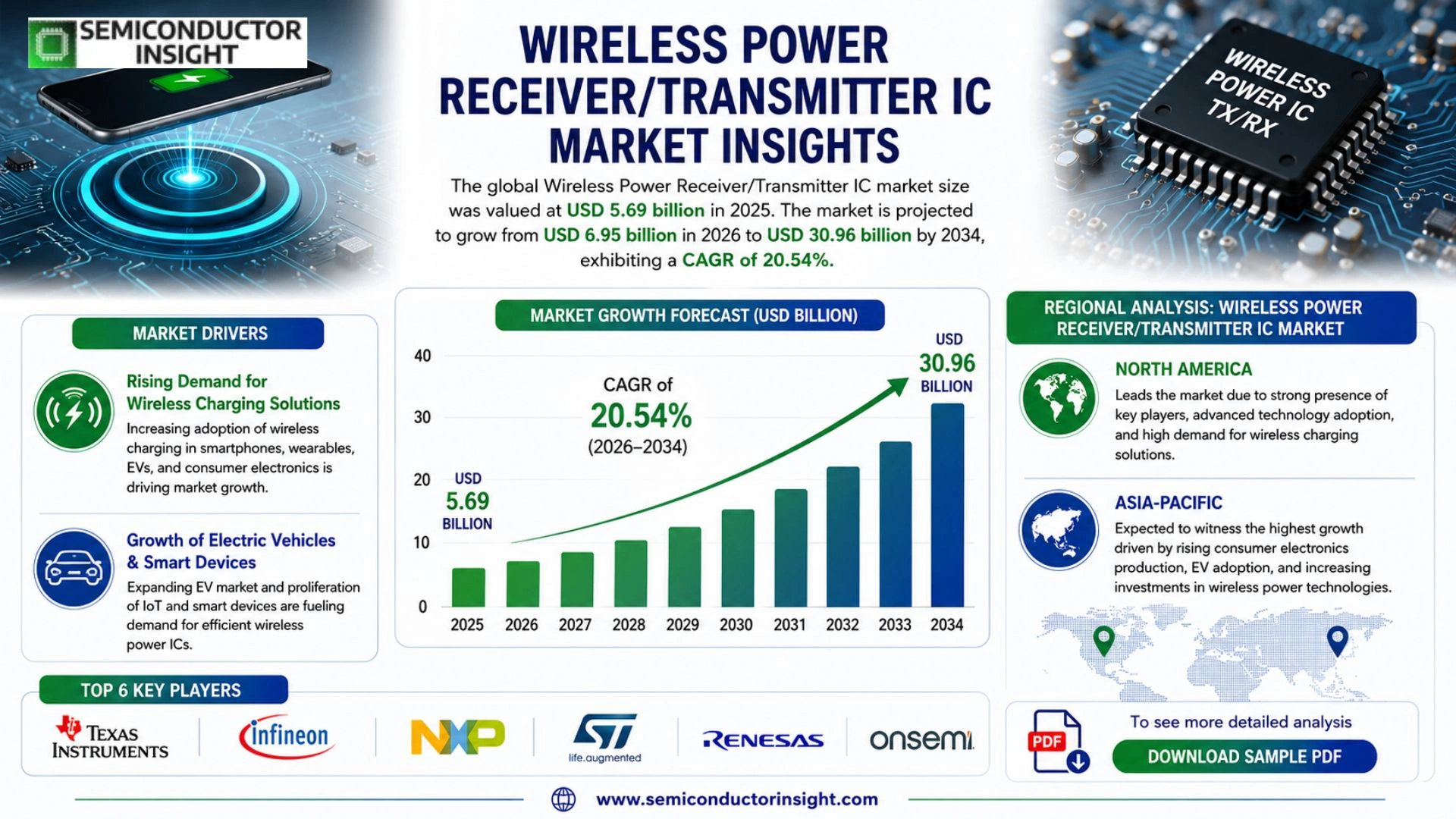
Wireless Power Receiver/Transmitter IC Market size was valued at USD 5.69 billion in 2025. The market is projected to grow from USD 6.95 billion in 2026 to USD 30.96 billion by 2034, exhibiting a CAGR of 20.54% during the forecast period.
Wireless power receiver and transmitter ICs are specialized semiconductor components designed to enable efficient wireless energy transfer between a power source and electronic devices. These integrated circuits manage the conversion, regulation, and control of electromagnetic fields to deliver power without physical connectors, supporting standards such as Qi and various proprietary protocols. Key functions include power amplification in transmitters, rectification and voltage regulation in receivers, foreign object detection, and communication for safe and optimized charging.
The market is experiencing rapid growth due to several factors, including the widespread adoption of consumer electronics, rising demand for convenient cable-free charging solutions, and increasing integration of wireless power technology in electric vehicles and industrial applications. Additionally, advancements in charging efficiency and the expansion of compatible device ecosystems are contributing to market expansion. Initiatives by key players in the market are also expected to fuel the market growth. For instance, leading companies continue to innovate in high-power and multi-device solutions to meet evolving industry needs. Qualcomm Technologies, Inc., Texas Instruments Incorporated, NXP Semiconductors, Infineon Technologies AG, and STMicroelectronics are some of the key players that operate in the market with a wide range of portfolios.
MARKET DRIVERS
Rising Demand in Consumer Electronics
Wireless Power Receiver/Transmitter IC Market is propelled by the widespread adoption of wireless charging in smartphones, wearables, and smart home devices. As manufacturers integrate Qi-compatible solutions, receiver ICs continue to dominate due to their critical role in efficient energy conversion for end-user devices. Growing consumer preference for cable-free convenience drives steady demand for advanced ICs that support faster charging speeds and multi-device compatibility.
Expansion in Automotive and EV Applications
Electric vehicle manufacturers are increasingly incorporating wireless power systems for both in-cabin device charging and dynamic EV charging infrastructure. Transmitter ICs play a vital role in enabling higher power transfer levels required for automotive environments. This trend is supported by industry standards like Qi2 and SAE J2954, which facilitate broader interoperability and accelerate integration across vehicle platforms.
➤ Advancements in semiconductor technologies, including GaN-based designs, enhance efficiency and thermal performance of both receiver and transmitter ICs, supporting higher power applications across multiple sectors.
The proliferation of IoT devices and industrial automation further boosts the market, with wireless power ICs enabling reliable, contactless operation in harsh or hard-to-reach environments while reducing maintenance needs associated with traditional connectors.
MARKET CHALLENGES
Efficiency and Thermal Management Issues
Despite technological progress, achieving high end-to-end efficiency in wireless power transfer remains difficult, particularly as power levels increase. Heat generation in both receiver and transmitter ICs can limit performance and reliability in compact consumer devices and high-power automotive applications.
Other Challenges
Standard Fragmentation
Multiple competing wireless power standards and proprietary solutions create compatibility concerns for manufacturers and consumers, slowing widespread ecosystem adoption.
Integration Complexity
Incorporating receiver/transmitter ICs into space-constrained designs while maintaining electromagnetic compatibility and safety certifications adds significant engineering hurdles for device OEMs.
MARKET RESTRAINTS
High Development and Certification Costs
Wireless Power Receiver/Transmitter IC Market faces restraint from elevated costs associated with R&D, testing, and regulatory certification for electromagnetic safety and efficiency standards. Smaller manufacturers often struggle with these upfront investments, limiting innovation pace and market entry.
Limited Range and Alignment Sensitivity
Current inductive technologies require precise alignment between transmitter and receiver coils, restricting practical charging distances and user convenience. This physical limitation hampers broader adoption in dynamic environments and contributes to slower growth compared to wired alternatives in certain applications.
MARKET OPPORTUNITIES
Emerging Applications in Medical and Industrial Sectors
Significant growth potential exists in medical devices and industrial robotics, where wireless power receiver/transmitter ICs enable hygienic, maintenance-free operation. Advancements in long-range and multi-device charging technologies are expected to open new revenue streams as these sectors prioritize reliability and safety.
Advancements in High-Power and Smart Charging Solutions
Ongoing development of intelligent power management ICs that support adaptive charging, higher wattage, and integration with IoT ecosystems presents substantial opportunities. As 5G infrastructure and smart cities expand, demand for efficient wireless power components is projected to rise steadily through the coming decade.
Trends
Rising Demand for Cable-Free Charging Solutions
Wireless Power Receiver/Transmitter IC Market is witnessing substantial momentum driven by the increasing preference for convenient, connector-free power delivery across various electronic devices. These specialized semiconductor components enable efficient wireless energy transfer by managing electromagnetic fields, power conversion, and device communication. Wireless power receiver and transmitter ICs support established standards such as Qi along with proprietary protocols, incorporating critical features including power amplification in transmitters, rectification, voltage regulation in receivers, and foreign object detection for safe operation.
Other Trends
Expansion Across Consumer Electronics Ecosystems
Growing integration of wireless power technology in smartphones, wearables, and smart home devices continues to propel Wireless Power Receiver/Transmitter IC Market forward. Manufacturers are focusing on enhancing charging efficiency and compatibility to support broader device ecosystems, allowing seamless multi-device charging experiences that align with modern consumer expectations for simplicity and reliability.
Adoption in Electric Vehicles and Industrial Applications
Wireless power receiver and transmitter ICs are finding increased utilization in electric vehicle charging systems and industrial automation equipment. This trend reflects the need for robust, contactless power solutions in environments where traditional connectors may be impractical or prone to wear, contributing to improved operational efficiency and safety in these sectors.
Technological Innovations by Leading Semiconductor Companies
Key industry participants including Qualcomm Technologies, Inc., Texas Instruments Incorporated, NXP Semiconductors, Infineon Technologies AG, and STMicroelectronics are actively developing advanced high-power and multi-device wireless power solutions. Their ongoing initiatives emphasize improvements in energy transfer efficiency, communication protocols, and overall system integration to address evolving requirements across consumer, automotive, and industrial segments. These developments are strengthening the foundation for wider commercialization of wireless power technologies Wireless Power Receiver/Transmitter IC Market.
COMPETITIVE LANDSCAPE
Key Industry Players
Consolidated Leadership with Strong Innovation in Wireless Power IC Solutions
Wireless Power Receiver/Transmitter IC Market features a competitive landscape dominated by established semiconductor leaders with broad portfolios in power management and wireless charging technologies. Qualcomm Technologies, Inc. and Texas Instruments Incorporated stand out as frontrunners, leveraging extensive R&D capabilities and strategic partnerships to deliver high-efficiency solutions compliant with Qi standards and proprietary protocols. The market structure is moderately consolidated at the top tier, with these players commanding significant share through vertical integration and ecosystem support for consumer electronics, automotive, and industrial applications.
Other significant players, including NXP Semiconductors, Infineon Technologies AG, and STMicroelectronics, maintain strong positions by focusing on specialized high-power and multi-device transmitter/receiver ICs. Emerging competition from companies like Renesas Electronics and Analog Devices adds dynamism, particularly in automotive-grade and high-efficiency segments. Continuous advancements in foreign object detection, communication protocols, and charging efficiency drive ongoing market differentiation among participants.
List of Key Wireless Power Receiver/Transmitter IC Companies Profiled
- Qualcomm Technologies, Inc.
- Texas Instruments Incorporated
- NXP Semiconductors
- Infineon Technologies AG
- STMicroelectronics
- Broadcom Inc.
- Renesas Electronics Corporation
- ROHM Co., Ltd.
- Analog Devices, Inc.
- Semtech Corporation
- onsemi (ON Semiconductor)
- MediaTek Inc.
- Murata Manufacturing Co., Ltd.
- IDT (Renesas)
Segment Analysis:
| Segment Category | Sub-Segments | Key Insights |
| By Type |
|
Transmitter ICs lead the segment due to their critical role in power amplification and efficient electromagnetic field generation. These ICs incorporate advanced foreign object detection and multi-coil support capabilities that enhance overall system reliability. Manufacturers prioritize innovations in transmitter designs to support simultaneous charging of multiple devices while maintaining thermal efficiency. The integration of communication protocols within transmitter ICs enables seamless device authentication and adaptive power delivery, making them indispensable for next-generation wireless charging ecosystems. |
| By Application |
|
Consumer Electronics remains the dominant application area as wireless power ICs enable cable-free experiences in smartphones, wearables, and smart home devices. This segment benefits from continuous demand for sleek, user-friendly designs that eliminate traditional connectors. Integration with various device ecosystems drives ongoing enhancements in charging speed and safety features. The proliferation of compatible accessories further strengthens adoption, positioning consumer electronics as the primary driver of technological advancements in wireless power solutions. |
| By End User |
|
Consumer Electronics Manufacturers represent the leading end user group, leveraging wireless power ICs to differentiate products through convenient charging experiences. These manufacturers focus on compact integration and high compatibility across device portfolios. Collaboration with semiconductor suppliers ensures optimized performance tailored to specific product requirements. The emphasis on user convenience and premium features accelerates the incorporation of advanced receiver and transmitter solutions in new product generations. |
| By Technology Standard |
|
Qi-Compliant Solutions dominate due to their widespread interoperability and established ecosystem support across multiple device categories. These solutions facilitate broad market acceptance by ensuring devices from different brands can utilize common charging infrastructure. Continuous refinements improve efficiency and power transfer distances while maintaining backward compatibility. Industry alignment around this standard encourages ecosystem development, including furniture-integrated chargers and public charging spots. |
| By Power Level |
|
Low Power Applications lead the segment by perfectly aligning with the requirements of portable consumer devices and wearables. These solutions emphasize compact form factors, minimal heat generation, and energy efficiency that extend battery life. Design flexibility allows seamless embedding into slim devices without compromising aesthetics or performance. Ongoing advancements focus on improving transfer efficiency in constrained spaces while supporting fast charging protocols demanded by modern users. |
Regional Analysis: Wireless Power Receiver/Transmitter IC Market
Asia-Pacific
Asia-Pacific benefits from vertically integrated semiconductor and electronics clusters that enable rapid prototyping and mass production of wireless power ICs. This ecosystem supports quick iteration cycles for receiver and transmitter designs, allowing manufacturers to address evolving requirements for higher efficiency and thermal management in consumer and industrial devices.
The region leads in patent filings and R&D investments targeting resonant and inductive wireless power technologies. Collaborative efforts between academia and industry drive breakthroughs in multi-device charging capabilities and long-range power transmission suitable for smart homes and factories.
Widespread consumer enthusiasm for convenient charging solutions in mobile and wearable segments, alongside expanding electric vehicle infrastructure, creates sustained demand for sophisticated Wireless Power Receiver/Transmitter ICs across diverse applications.
Leading semiconductor companies form alliances with global brands to co-develop application-specific ICs, ensuring compatibility with multiple wireless standards and positioning the region as the primary hub for technology commercialization.
North America
North America maintains a strong position Wireless Power Receiver/Transmitter IC Market through its focus on high-value innovation and premium applications. The United States leads in developing cutting-edge solutions for medical devices, aerospace, and industrial automation where reliability and safety are paramount. Companies emphasize advanced power management features and integration with IoT ecosystems. Robust venture capital funding supports startups exploring novel materials and architectures for efficient wireless energy transfer. Consumer demand for luxury electronics and smart home devices further stimulates adoption, while regulatory frameworks encourage the use of energy-efficient technologies across sectors.
Europe
Europe exhibits steady growth Wireless Power Receiver/Transmitter IC Market, characterized by stringent environmental regulations and emphasis on sustainable technologies. Countries such as Germany, the Netherlands, and France drive demand through automotive electrification initiatives and industrial digital transformation. The region prioritizes IC designs that comply with strict electromagnetic compatibility and energy efficiency standards. Collaborative research projects between universities and manufacturers advance safe wireless charging for public infrastructure and consumer products. Growing awareness of cable reduction benefits in workplace and retail environments supports broader market penetration.
South America
South America is emerging as a promising market for Wireless Power Receiver/Transmitter ICs, with Brazil and Mexico showing increasing interest in consumer electronics and telecommunications infrastructure modernization. Local manufacturers are gradually incorporating wireless power solutions to enhance product appeal in urban markets. Government initiatives aimed at attracting foreign investment in technology sectors create opportunities for technology transfer and localized production. While adoption lags behind more mature regions, rising disposable incomes and digital transformation efforts are expected to accelerate integration of receiver and transmitter ICs in mobile accessories and smart devices.
Middle East & Africa
The Middle East and Africa region demonstrates growing potential Wireless Power Receiver/Transmitter IC Market, particularly in the Gulf countries investing heavily in smart city projects and diversified economies. Initiatives in Saudi Arabia and the UAE focus on advanced infrastructure that incorporates wireless power solutions for public spaces and transportation hubs. Africa’s expanding mobile connectivity creates demand for convenient charging options in consumer devices. Although the market remains nascent, strategic partnerships with global technology providers are introducing innovative IC applications tailored to challenging environmental conditions and off-grid scenarios.
Report Scope
This market research report provides a comprehensive analysis of the Wireless Power Receiver/Transmitter IC Market , covering the forecast period 2026–2034. It offers detailed insights into market dynamics, technological advancements, competitive landscape, and key trends shaping the industry.
Key focus areas of the report include:
- Market Overview: The report begins with an overview outlining its current market scenario, key growth indicators, and industry transformation drivers. It discusses macroeconomic factors, demand–supply balance, regulatory landscape, and the strategic role of semiconductors in powering advancements across industries such as automotive, telecommunications, consumer electronics, and industrial automation.
- Market Size & Forecast: Historical data and future projections for revenue, unit shipments, and market value across major regions and segments.
- Segmentation Analysis: Detailed breakdown by product type, technology, application, and end-user industry to identify high-growth segments and investment opportunities.
- Regional Insights: Insights into market performance across North America, Europe, Asia-Pacific, Latin America, and the Middle East & Africa, including country-level analysis where relevant.
- Competitive Landscape: Profiles of leading market participants, including their product offerings, R&D focus, manufacturing capacity, pricing strategies, and recent developments such as mergers, acquisitions, and partnerships.
- Technology Trends & Innovation: Assessment of emerging technologies, integration of AI/IoT, semiconductor design trends, fabrication techniques, and evolving industry standards.
- Market Drivers & Restraints: Evaluation of factors driving market growth along with challenges, supply chain constraints, regulatory issues, and market-entry barriers.
- Stakeholder Insights: Insights for component suppliers, OEMs, system integrators, investors, and policymakers regarding the evolving ecosystem and strategic opportunities.
Primary and secondary research methods are employed, including interviews with industry experts, data from verified sources, and real-time market intelligence to ensure the accuracy and reliability of the insights presented.
FREQUENTLY ASKED QUESTIONS:
What is the current market size of Wireless Power Receiver/Transmitter IC Market?
-> Wireless Power Receiver/Transmitter IC Market was valued at USD 5.69 billion in 2025 and is expected to reach USD 30.96 billion by 2034.
Which key companies operate Wireless Power Receiver/Transmitter IC Market?
-> Key players include Qualcomm Technologies, Inc., Texas Instruments Incorporated, NXP Semiconductors, Infineon Technologies AG, and STMicroelectronics, among others.
What are the key growth drivers?
-> Key growth drivers include widespread adoption of consumer electronics, rising demand for convenient cable-free charging solutions, and increasing integration of wireless power technology in electric vehicles and industrial applications.
Which region dominates the market?
-> Asia-Pacific is the fastest-growing region, while North America remains a dominant market.
What are the emerging trends?
-> Emerging trends include advancements in charging efficiency, high-power and multi-device solutions, and expansion of compatible device ecosystems.

Get Sample Report PDF for Exclusive Insights
Report Sample Includes
- Table of Contents
- List of Tables & Figures
- Charts, Research Methodology, and more...
 Download Sample Report PDF