Wi-Fi 7 (802.11be) Router & Gateway SoC Market Insights
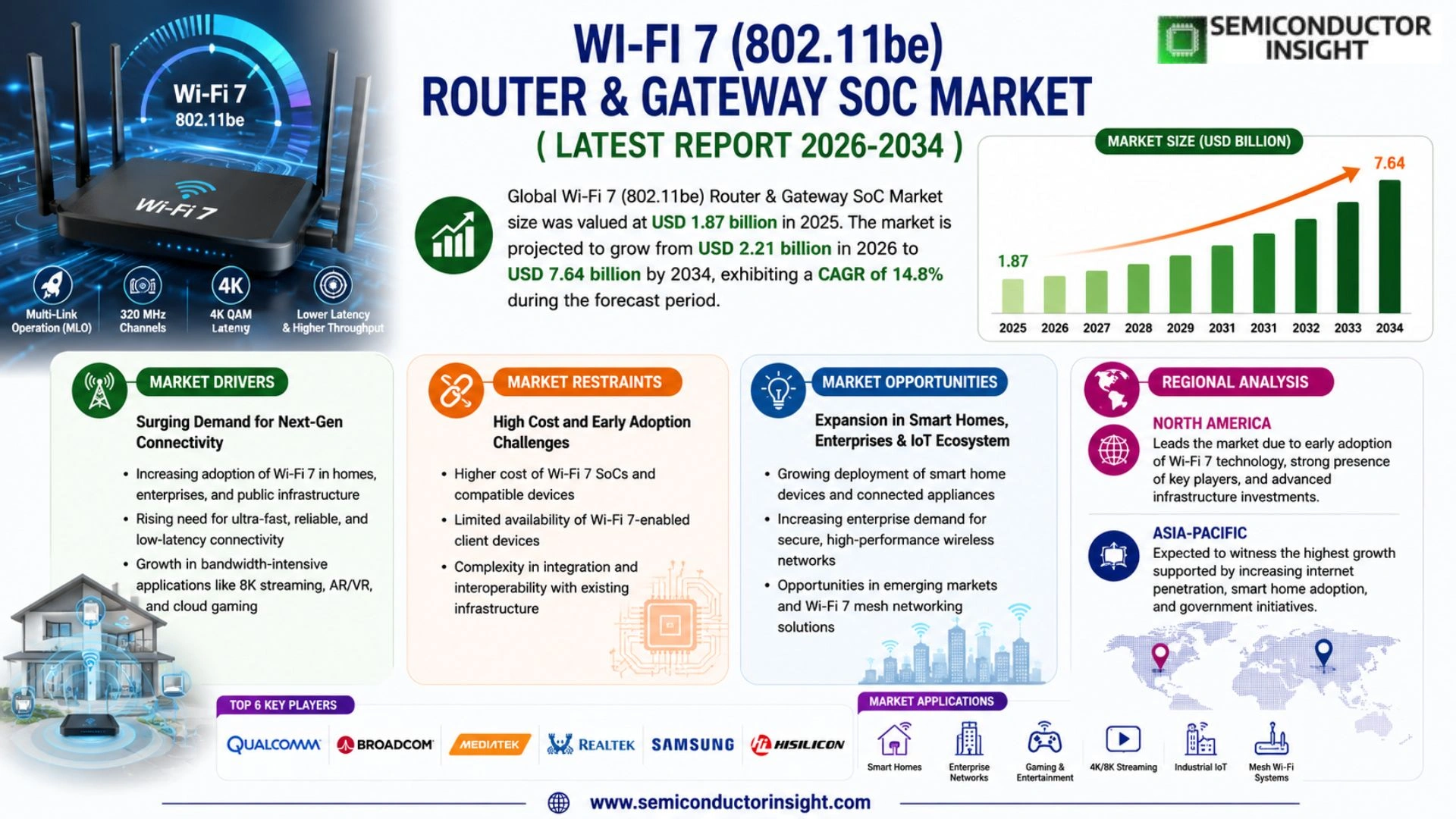
Wi-Fi 7 (802.11be) Router & Gateway SoC Market size was valued at USD 1.87 billion in 2025. The market is projected to grow from USD 2.21 billion in 2026 to USD 7.64 billion by 2034, exhibiting a CAGR of 14.8% during the forecast period.
Wi-Fi 7 Router and Gateway System-on-Chip (SoC) solutions are highly integrated semiconductor devices purpose-built to power next-generation wireless networking equipment compliant with the IEEE 802.11be standard. These SoCs consolidate multi-link operation (MLO) capabilities, support for the 6 GHz frequency band, 320 MHz channel bandwidth, and advanced 4096-QAM modulation into a single chip architecture, enabling routers and gateways to deliver theoretical throughput exceeding 46 Gbps. Key product categories within this space include residential gateway SoCs, enterprise-grade router chipsets, and mesh networking processors.
The market is experiencing robust expansion driven by several converging factors, including the rapid proliferation of bandwidth-intensive applications such as 8K video streaming, cloud gaming, and augmented reality, all of which demand the ultra-low latency and high throughput that Wi-Fi 7 uniquely delivers. Furthermore, the accelerating deployment of smart home ecosystems and the growing number of connected devices per household are compelling both consumers and service providers to upgrade their networking infrastructure. Key industry players are actively advancing this momentum , for instance, Qualcomm Technologies launched its Networking Pro Series Gen 3 platform, while MediaTek introduced the Filogic 880 SoC specifically optimized for Wi-Fi 7 routers and gateways. Broadcom Inc., Intel Corporation, and MaxLinear are among the other prominent players operating in this market with competitive and diversified SoC portfolios.
MARKET DRIVERS
Surging Demand for Ultra-High-Speed Connectivity Accelerating Wi-Fi 7 SoC Adoption
Wi-Fi 7 (802.11be) Router & Gateway SoC Market is experiencing robust momentum driven by the accelerating global demand for higher throughput and lower latency wireless connectivity. Operating across 2.4 GHz, 5 GHz, and 6 GHz frequency bands simultaneously, Wi-Fi 7 delivers theoretical peak data rates exceeding 46 Gbps , a significant leap over Wi-Fi 6E. This technical advancement is compelling semiconductor vendors and router OEMs to accelerate SoC development roadmaps, as enterprises, service providers, and consumers increasingly require networks capable of supporting bandwidth-intensive applications such as 8K video streaming, cloud gaming, and augmented reality experiences without performance degradation.
Multi-Link Operation (MLO) as a Core Technology Differentiator in SoC Design
One of the most transformative innovations embedded within the Wi-Fi 7 (802.11be) specification is Multi-Link Operation (MLO), which enables devices to simultaneously transmit and receive data across multiple frequency bands. This capability dramatically reduces latency and improves reliability, making it particularly valuable for real-time applications including video conferencing, industrial automation, and connected healthcare. SoC designers are integrating advanced MLO logic directly into chipsets, driving a new wave of product differentiation. Leading semiconductor companies have already launched purpose-built Wi-Fi 7 SoC platforms targeting the router and residential gateway segment, with commercial deployments gaining traction across North America, Europe, and Asia-Pacific.
➤ Wi-Fi 7 chipsets incorporating 320 MHz channel bandwidth and 4096-QAM modulation represent a generational shift in router and gateway SoC architecture, enabling silicon vendors to command premium positioning in both the consumer and carrier-grade segments of the market.
The proliferation of smart home ecosystems, enterprise wireless infrastructure upgrades, and broadband service provider gateway refresh cycles is further reinforcing demand withWi-Fi 7 (802.11be) Router & Gateway SoC Market. As internet service providers deploy next-generation residential gateways to complement fiber and DOCSIS 3.1/4.0 deployments, the need for high-performance, energy-efficient SoC platforms has become a strategic procurement priority. This sustained investment cycle across both consumer and commercial segments is expected to underpin strong compound growth in Wi-Fi 7 SoC shipments through the latter half of this decade.
MARKET CHALLENGES
High SoC Development Costs and Design Complexity Presenting Barriers for Emerging Vendors
Despite the strong growth outlook, Wi-Fi 7 (802.11be) Router & Gateway SoC Market faces meaningful challenges rooted in the technical and financial complexity of next-generation chipset development. Designing a fully compliant Wi-Fi 7 SoC requires advanced process nodes, sophisticated RF front-end integration, and rigorous multi-band coexistence management , all of which substantially increase non-recurring engineering (NRE) costs and extend time-to-market timelines. Smaller and mid-tier semiconductor vendors may find it increasingly difficult to compete with established players who possess mature IP portfolios, deep customer relationships, and the financial resources to absorb multi-year development cycles. This dynamic risks consolidating the competitive landscape around a limited number of dominant SoC suppliers.
Other Challenges
Interoperability and Ecosystem Fragmentation
Wi-Fi 7 (802.11be) Router & Gateway SoC Market must contend with interoperability challenges as device certification programs mature. Ensuring seamless compatibility between Wi-Fi 7 routers, gateways, and client devices from diverse manufacturers requires rigorous testing and ongoing standards alignment. Fragmented firmware implementations and varying interpretations of the 802.11be specification among SoC vendors can result in inconsistent user experiences, potentially slowing enterprise adoption and complicating service provider deployment strategies.
Regulatory Spectrum Availability for the 6 GHz Band
The full performance potential of Wi-Fi 7 SoC platforms, particularly capabilities leveraging the 320 MHz channel bandwidth in the 6 GHz band, is contingent on regulatory spectrum allocations that vary significantly by geography. In several key markets across Asia and parts of Europe, 6 GHz spectrum access remains restricted or pending regulatory approval. This geographic inconsistency introduces design complexity for global SoC platforms and may limit the addressable market for premium Wi-Fi 7 router and gateway solutions in regions where spectrum availability constrains feature activation.
MARKET RESTRAINTS
Slow Pace of Client Device Ecosystem Maturity Limiting Near-Term SoC Market Expansion
A primary restraint on Wi-Fi 7 (802.11be) Router & Gateway SoC Market is the relatively nascent state of the Wi-Fi 7 client device ecosystem. While router and gateway SoC platforms have progressed rapidly toward commercial readiness, the installed base of Wi-Fi 7-compatible smartphones, laptops, and IoT endpoints remains limited in the near term. End users and enterprises evaluating infrastructure upgrades may defer investments in Wi-Fi 7 routers and gateways until a broader range of compatible client devices is commercially available, thereby moderating the pace of SoC adoption in the short-to-medium term. This ecosystem dependency creates a chicken-and-egg dynamic that can suppress early-stage demand even when the underlying SoC technology is mature and commercially viable.
Coexistence of Wi-Fi 6 and Wi-Fi 6E Infrastructure Dampening Upgrade Urgency
The substantial global installed base of Wi-Fi 6 and Wi-Fi 6E routers and gateways represents a structural restraint for Wi-Fi 7 (802.11be) Router & Gateway SoC Market. Many enterprise and residential deployments of Wi-Fi 6/6E equipment are relatively recent, with hardware lifecycles that do not yet warrant replacement. Service providers managing large-scale gateway fleets operate on multi-year refresh cycles governed by capital expenditure constraints and subscriber contract durations, further moderating the speed at which Wi-Fi 7 SoC-based platforms can achieve volume penetration. Until clear performance differentiation translates into measurable service revenue uplift or operational cost advantages, upgrade urgency across key customer segments may remain subdued.
Power consumption management also presents a restraint on SoC design scalability withWi-Fi 7 (802.11be) Router & Gateway SoC Market. The simultaneous operation across three frequency bands, combined with higher modulation schemes and wider channel bandwidths, places elevated demands on thermal dissipation and power budgets , particularly for compact residential gateway form factors where passive cooling and power supply constraints are design-limiting factors. Addressing these thermal and power challenges without compromising performance or increasing bill-of-materials costs remains an ongoing engineering constraint for SoC vendors targeting the mass-market router and gateway segment.
MARKET OPPORTUNITIES
Carrier and ISP Gateway Deployments Creating High-Volume SoC Procurement Opportunities
Wi-Fi 7 (802.11be) Router & Gateway SoC Market stands to benefit substantially from the planned large-scale gateway refresh programs being executed by broadband service providers globally. As ISPs transition their residential and SMB subscriber bases to fiber-to-the-home (FTTH) and advanced hybrid fiber-coaxial (HFC) architectures, integrated Wi-Fi 7 gateway platforms featuring purpose-built SoCs represent a natural upgrade path. These high-volume procurement programs, often involving tens of millions of units across multi-year deployment horizons, offer SoC vendors an opportunity to secure anchor customer relationships and achieve the manufacturing scale economics necessary to drive down per-unit costs and expand addressable market reach across mid-tier and value-segment gateway platforms.
Enterprise and Industrial Wireless Infrastructure Refresh as a Premium SoC Growth Vector
Enterprise network infrastructure modernization represents a high-value growth opportunity withWi-Fi 7 (802.11be) Router & Gateway SoC Market. Organizations across sectors including healthcare, manufacturing, logistics, and financial services are evaluating Wi-Fi 7 deployments to support latency-sensitive applications, high-density device environments, and deterministic wireless performance requirements that earlier Wi-Fi generations could not consistently deliver. The ability of Wi-Fi 7 SoC platforms to support features such as restricted target wake time (R-TWT) and enhanced multi-user MIMO makes them particularly well-suited for enterprise access points and managed gateway solutions where quality-of-service guarantees are operationally critical.
Integration of AI-Driven Network Management Capabilities into Wi-Fi 7 SoC Platforms
An emerging and strategically significant opportunity for Wi-Fi 7 (802.11be) Router & Gateway SoC Market lies in the convergence of artificial intelligence and machine learning capabilities with next-generation wireless silicon. SoC vendors are increasingly embedding AI inference engines and intelligent radio resource management logic directly into Wi-Fi 7 chipsets, enabling routers and gateways to dynamically optimize channel selection, traffic prioritization, and interference mitigation without cloud dependency. This on-device intelligence layer adds meaningful differentiation value for OEM partners and service providers seeking to improve subscriber quality-of-experience metrics while reducing network operations overhead , positioning AI-integrated Wi-Fi 7 SoC platforms as a premium product category with strong long-term margin potential.
Trends
Accelerating Adoption of Multi-Link Operation (MLO) Technology
One of the most defining trends shaping Wi-Fi 7 (802.11be) Router & Gateway SoC Market is the widespread integration of Multi-Link Operation (MLO) technology into next-generation chipsets. MLO enables simultaneous data transmission across the 2.4 GHz, 5 GHz, and 6 GHz frequency bands, dramatically improving throughput reliability and reducing latency. As bandwidth-intensive applications such as 8K video streaming, cloud gaming, and augmented reality continue to gain mainstream traction, semiconductor vendors are prioritizing MLO-capable SoC architectures to meet evolving consumer and enterprise demands. Leading chipmakers including Qualcomm Technologies, MediaTek, and Broadcom have already introduced advanced SoC platforms specifically engineered around MLO frameworks to address these performance requirements.
Other Trends
Expansion into the 6 GHz Frequency Band
Regulatory approvals for unlicensed 6 GHz spectrum across multiple regions are accelerating the development of Wi-Fi 7 Router and Gateway SoC solutions designed to harness 320 MHz channel bandwidth and 4096-QAM modulation. This expanded spectrum availability is enabling SoC designers to deliver theoretical throughput exceeding 46 Gbps, a capability that is increasingly critical as the number of connected devices per household continues to rise. Vendors such as MediaTek, with its Filogic 880 SoC, and Qualcomm, with its Networking Pro Series Gen 3 platform, are at the forefront of commercializing 6 GHz-optimized chipsets for residential and enterprise gateway applications.
Growing Demand from Smart Home and Mesh Networking Deployments
The rapid proliferation of smart home ecosystems is generating significant momentum for Wi-Fi 7 (802.11be) Router & Gateway SoC Market. As households deploy an increasing array of connected devices , from smart displays and IoT sensors to home security systems , the need for low-latency, high-capacity mesh networking processors has intensified. SoC manufacturers are responding by developing highly integrated chipsets that consolidate mesh coordination, traffic management, and security functions into single-chip architectures, reducing both system cost and power consumption for OEM router and gateway manufacturers.
Competitive Innovation Among Semiconductor Vendors
The competitive landscape of the Wi-Fi 7 Router & Gateway SoC Market is characterized by rapid product innovation and strategic portfolio diversification. Companies such as Broadcom Inc., Intel Corporation, and MaxLinear are actively expanding their Wi-Fi 7 SoC offerings to capture a growing share of both residential gateway and enterprise router segments. This intensifying competition is driving faster product development cycles, broader feature integration, and more aggressive pricing strategies, ultimately benefiting network equipment manufacturers and end-users seeking cost-effective, high-performance Wi-Fi 7 solutions.
COMPETITIVE LANDSCAPE
Key Industry Players
Wi-Fi 7 (802.11be) Router & Gateway SoC Market: A Highly Concentrated Yet Rapidly Evolving Competitive Arena Dominated by Established Semiconductor Giants
The global Wi-Fi 7 (802.11be) Router & Gateway SoC market is characterized by a moderately consolidated competitive landscape, with a handful of leading semiconductor companies commanding significant market share through advanced R&D capabilities, robust intellectual property portfolios, and deep-rooted partnerships with OEM router and gateway manufacturers. Qualcomm Technologies stands at the forefront with its Networking Pro Series Gen 3 platform, which delivers full IEEE 802.11be compliance including Multi-Link Operation (MLO), 320 MHz channel bandwidth, and 4096-QAM modulation support, making it a preferred silicon choice for premium residential and enterprise Wi-Fi 7 deployments. MediaTek has emerged as a formidable challenger with its Filogic 880 SoC, which is purpose-engineered for Wi-Fi 7 routers and gateways and has gained rapid design-win traction across leading networking OEMs globally. Broadcom Inc. leverages its long-standing dominance in networking silicon with its BCM6765 and related Wi-Fi 7 chipsets, targeting both carrier-grade gateway and enterprise router segments. Intel Corporation and MaxLinear further diversify the competitive field, offering differentiated SoC platforms optimized for gateway and CPE (Customer Premises Equipment) applications requiring integrated DSL or DOCSIS connectivity alongside Wi-Fi 7 radio capabilities.
Beyond the top-tier players, a growing cohort of specialized and regional semiconductor vendors is intensifying competition within niche segments of the Wi-Fi 7 SoC market. Realtek Semiconductor continues to capture cost-sensitive residential and SMB router markets through competitively priced Wi-Fi 7 chipset offerings, while Marvell Technology targets high-performance enterprise and service provider gateway applications with its OCTEON and Prestera-class SoC platforms. Cypress Semiconductor (Infineon Technologies) and Celeno Communications (Renesas Electronics) are also actively investing in Wi-Fi 7 silicon development to address emerging smart home, IoT gateway, and mesh networking use cases. Additionally, HiSilicon (Huawei) maintains a significant presence in the Asia-Pacific market through vertically integrated SoC solutions deployed in Huawei’s own networking product lines. The competitive intensity across this landscape is further amplified by strategic collaborations between SoC vendors and ecosystem partners for interoperability certification, driving innovation across residential gateway SoCs, enterprise-grade router chipsets, and mesh networking processors through the forecast period to 2034.
List of Key Wi-Fi 7 (802.11be) Router & Gateway SoC Companies Profiled
- Qualcomm Technologies, Inc.
- MediaTek Inc.
- Broadcom Inc.
- Intel Corporation
- MaxLinear, Inc.
- Realtek Semiconductor Corp.
- Marvell Technology, Inc.
- Infineon Technologies AG (Cypress Semiconductor)
- Renesas Electronics Corporation (Celeno Communications)
- HiSilicon Technologies Co., Ltd. (Huawei)
- Microchip Technology Inc.
- NXP Semiconductors N.V.
- Lantiq (Intel Germany)
Segment Analysis:
| Segment Category | Sub-Segments | Key Insights |
| By Type |
|
Residential Gateway SoCs represent the leading segment within the Wi-Fi 7 Router & Gateway SoC market, driven by the rapid evolution of consumer networking demands.
|
| By Application |
|
Smart Home & Consumer Networking stands out as the dominant application segment propelling demand for Wi-Fi 7 Router & Gateway SoCs across global markets.
|
| By End User |
|
Telecommunications Service Providers emerge as the most strategically influential end user segment in the Wi-Fi 7 Router & Gateway SoC market, given their role in deploying large-scale networking infrastructure.
|
| By Frequency Band |
|
Tri-Band SoCs supporting the 2.4 GHz, 5 GHz, and 6 GHz frequency bands represent the leading and most rapidly adopted configuration within the Wi-Fi 7 SoC landscape.
|
| By Integration Level |
|
Fully Integrated SoCs consolidating all critical networking functions into a single chip architecture are emerging as the preferred design paradigm among router and gateway original equipment manufacturers (OEMs).
|
Regional Analysis: Wi-Fi 7 (802.11be) Router & Gateway SoC Market
North America
North America’s enterprise sector is among the earliest adopters of Wi-Fi 7 (802.11be) Router & Gateway SoC technology. Large-scale corporate campuses, healthcare facilities, and financial institutions are prioritizing low-latency, high-throughput wireless infrastructure. The region’s readiness to upgrade existing Wi-Fi 6 and 6E environments positions it as a primary volume driver for advanced SoC deployments in commercial settings through the forecast horizon.
The concentration of world-class semiconductor design houses, fabless chipmakers, and wireless IP specialists in North America provides a significant competitive edge Wi-Fi 7 (802.11be) Router & Gateway SoC Market. Silicon Valley and broader U.S. tech corridors host firms that are directly shaping 802.11be chipset roadmaps, enabling faster product commercialization and deeper vertical integration across router and gateway platforms.
Proactive spectrum management by the FCC and favorable unlicensed band policies in the United States are creating a supportive regulatory environment for Wi-Fi 7 deployments. Expanded access to the 6 GHz band, which is central to 802.11be performance, enables router and gateway SoC manufacturers to develop products that fully leverage multi-link operation and wider channel bandwidths across the North American market.
Rising consumer expectations for seamless 8K streaming, cloud gaming, and connected home automation are accelerating residential demand for Wi-Fi 7 (802.11be) routers and gateways. Major broadband service providers across the United States and Canada are beginning to incorporate Wi-Fi 7 gateway SoCs into their CPE portfolios, signaling a near-term inflection point in mass-market adoption and creating sustained long-term demand through 2034.
Europe
Europe represents a strategically significant region Wi-Fi 7 (802.11be) Router & Gateway SoC Market, characterized by strong regulatory coherence, progressive digital infrastructure mandates, and growing enterprise modernization initiatives. The European Union’s Digital Decade policy framework is catalyzing investments in next-generation connectivity, creating fertile ground for Wi-Fi 7 router and gateway SoC adoption across member states. Countries such as Germany, the Netherlands, Sweden, and France are at the forefront of deploying advanced wireless infrastructure in enterprise, public sector, and residential environments. European telecommunications operators are actively evaluating 802.11be-compatible gateway chipsets as part of their broadband evolution strategies. Additionally, the region’s strong emphasis on data privacy and localized network sovereignty is encouraging the development of Wi-Fi 7 SoC solutions tailored to European compliance standards. While Europe may lag North America in early commercialization timelines, its structured policy environment and mature ICT ecosystem position it for rapid and widespread Wi-Fi 7 (802.11be) market penetration across the forecast period.
Asia-Pacific
Asia-Pacific is emerging as a high-velocity growth region within the global Wi-Fi 7 (802.11be) Router & Gateway SoC Market, fueled by massive broadband subscriber bases, accelerating smart city deployments, and the regional dominance of electronics manufacturing. China, Japan, South Korea, and Taiwan are central to both the supply and demand dynamics of the 802.11be SoC ecosystem. Chinese chipmakers are investing aggressively in domestically developed Wi-Fi 7 SoC architectures to reduce reliance on foreign semiconductor suppliers, while Taiwanese ODMs and contract manufacturers are scaling production capacity for global OEM clients. South Korea’s advanced consumer electronics culture and Japan’s enterprise digitization wave are generating robust domestic demand for Wi-Fi 7 routers and gateways. Southeast Asian markets, including India, are transitioning rapidly from legacy wireless standards, presenting significant volume opportunities. The combination of manufacturing scale, engineering talent, and expanding middle-class connectivity demand makes Asia-Pacific a pivotal long-term driver of Wi-Fi 7 (802.11be) Router & Gateway SoC Market through 2034.
South America
South America occupies a developing yet progressively important position Wi-Fi 7 (802.11be) Router & Gateway SoC Market. Brazil leads regional adoption momentum, supported by ongoing broadband infrastructure expansion programs and growing urban demand for high-performance home and enterprise wireless connectivity. Colombia, Chile, and Argentina are also demonstrating increasing interest in next-generation networking technologies as their digital economies mature. While the region faces challenges related to economic volatility and infrastructure gaps in rural areas, urban centers are witnessing rising deployments of advanced wireless gateways. Local telecom operators are partnering with global SoC vendors to integrate Wi-Fi 7-capable equipment into their CPE roadmaps. As regional governments continue to invest in connectivity as an economic enabler, South America is expected to represent a gradually expanding share of the global Wi-Fi 7 (802.11be) Router & Gateway SoC Market over the 2026–2034 period, particularly in the residential gateway segment.
Middle East & Africa
The Middle East & Africa region presents a nuanced landscape for Wi-Fi 7 (802.11be) Router & Gateway SoC Market, with marked contrasts between high-income Gulf Cooperation Council nations and broader emerging markets across sub-Saharan Africa. GCC countries, particularly the UAE, Saudi Arabia, and Qatar, are advancing ambitious smart city and digital transformation agendas , such as Saudi Vision 2030 , that are driving early-stage adoption of cutting-edge wireless infrastructure including Wi-Fi 7 router and gateway SoC solutions. These markets benefit from high consumer spending capacity and government-backed ICT investment programs. In contrast, large portions of Africa are still prioritizing foundational connectivity, making Wi-Fi 7 adoption a longer-term prospect tied to infrastructure maturation. As regional telecom markets evolve and affordable Wi-Fi 7 SoC platforms become available, the Middle East & Africa region is anticipated to transition from a nascent to a moderately active participant in the global Wi-Fi 7 (802.11be) Router & Gateway SoC Market throughout the forecast period.
Report Scope
This market research report provides a comprehensive analysis of the Wi-Fi 7 (802.11be) Router & Gateway SoC Market , covering the forecast period 2026–2034. It offers detailed insights into market dynamics, technological advancements, competitive landscape, and key trends shaping the industry.
Key focus areas of the report include:
- Market Overview: The report begins with an overview outlining its current market scenario, key growth indicators, and industry transformation drivers. It discusses macroeconomic factors, demand–supply balance, regulatory landscape, and the strategic role of semiconductors in powering advancements across industries such as automotive, telecommunications, consumer electronics, and industrial automation.
- Market Size & Forecast: Historical data and future projections for revenue, unit shipments, and market value across major regions and segments.
- Segmentation Analysis: Detailed breakdown by product type, technology, application, and end-user industry to identify high-growth segments and investment opportunities.
- Regional Insights: Insights into market performance across North America, Europe, Asia-Pacific, Latin America, and the Middle East & Africa, including country-level analysis where relevant.
- Competitive Landscape: Profiles of leading market participants, including their product offerings, R&D focus, manufacturing capacity, pricing strategies, and recent developments such as mergers, acquisitions, and partnerships.
- Technology Trends & Innovation: Assessment of emerging technologies, integration of AI/IoT, semiconductor design trends, fabrication techniques, and evolving industry standards.
- Market Drivers & Restraints: Evaluation of factors driving market growth along with challenges, supply chain constraints, regulatory issues, and market-entry barriers.
- Stakeholder Insights: Insights for component suppliers, OEMs, system integrators, investors, and policymakers regarding the evolving ecosystem and strategic opportunities.
Primary and secondary research methods are employed, including interviews with industry experts, data from verified sources, and real-time market intelligence to ensure the accuracy and reliability of the insights presented.
FREQUENTLY ASKED QUESTIONS:
What is the current market size of Wi-Fi 7 (802.11be) Router & Gateway SoC Market?
-> Global Wi-Fi 7 (802.11be) Router & Gateway SoC Market size was valued at USD 1.87 billion in 2025. The market is projected to grow from USD 2.21 billion in 2026 to USD 7.64 billion by 2034, exhibiting a CAGR of 14.8% during the forecast period.
Which key companies operate Wi-Fi 7 (802.11be) Router & Gateway SoC Market?
-> Key players include Qualcomm Technologies, MediaTek, Broadcom Inc., Intel Corporation, and MaxLinear, among others.
What are the key growth drivers?
-> Key growth drivers include rapid proliferation of bandwidth-intensive applications such as 8K video streaming, cloud gaming, and augmented reality, as well as the accelerating deployment of smart home ecosystems and the growing number of connected devices per household, compelling consumers and service providers to upgrade their networking infrastructure.
Which region dominates the market?
-> Asia-Pacific is the fastest-growing region, driven by large-scale consumer electronics adoption and expanding broadband infrastructure, while North America remains a significant market due to early Wi-Fi 7 technology adoption and strong enterprise demand.
What are the emerging trends?
-> Emerging trends include multi-link operation (MLO) capabilities, support for the 6 GHz frequency band, 320 MHz channel bandwidth, and advanced 4096-QAM modulation, enabling routers and gateways to deliver theoretical throughput exceeding 46 Gbps, along with the rise of mesh networking processors and enterprise-grade router chipsets compliant with the IEEE 802.11be standard.

Get Sample Report PDF for Exclusive Insights
Report Sample Includes
- Table of Contents
- List of Tables & Figures
- Charts, Research Methodology, and more...
 Download Sample Report PDF