Wearable MEMS Sensors Market Insights
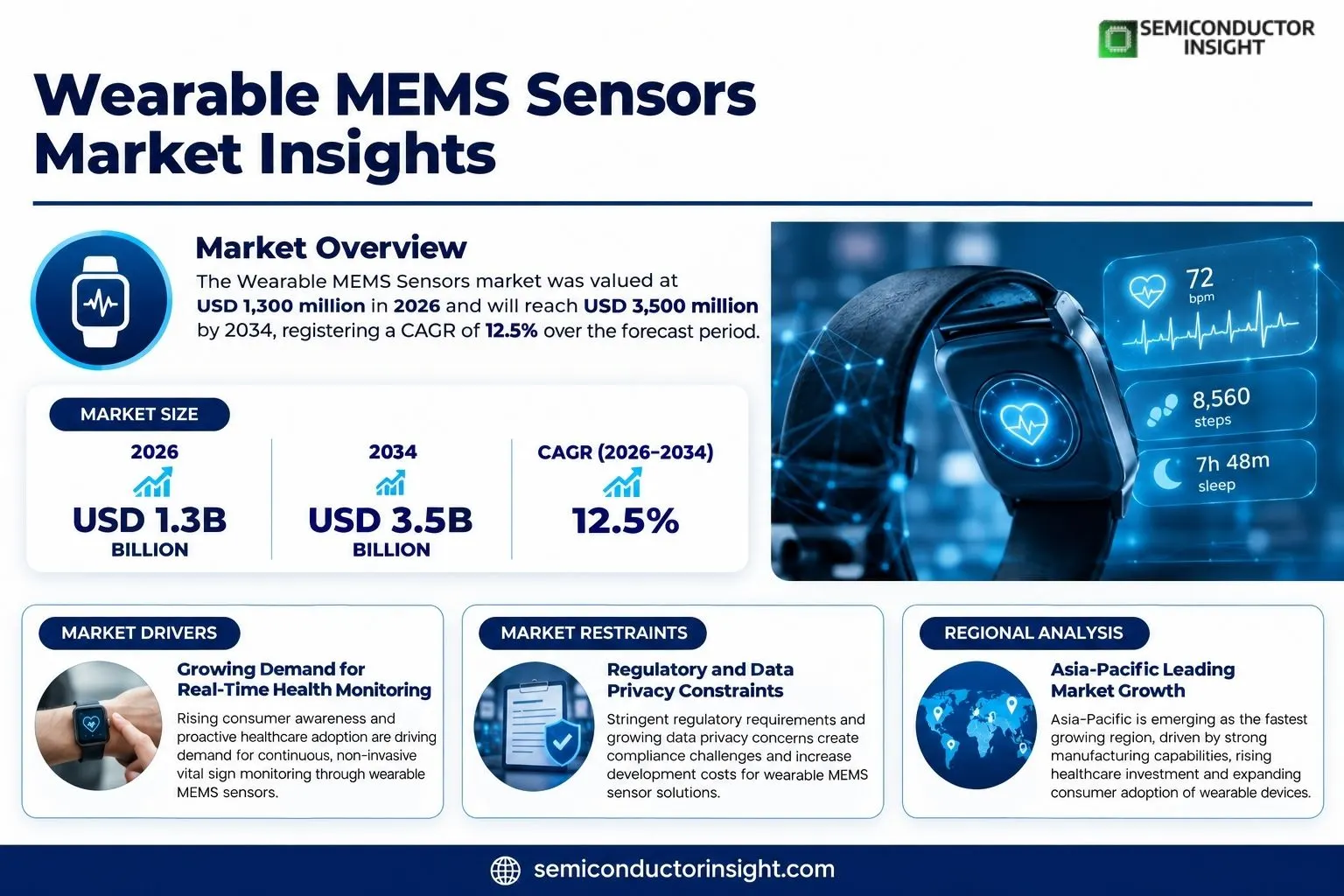
Wearable MEMS Sensors market was valued at USD 1 300 million in 2026 and will reach USD 3 500 million by 2034, registering a CAGR of 12.5% over the forecast period.
Wearable MEMS sensors integrate micro‑electromechanical components that translate physical stimulisuch as acceleration, angular velocity, magnetic field strength or pressureinto measurable electrical outputs suitable for wearable devices.The upward trajectory reflects growing consumer demand for continuous health monitoring and increasing incorporation of advanced sensor arrays into fitness trackers and smart watches; simultaneously cost reductions from economies of scale encourage broader adoption across multiple application segments.The convergence of low‑power design, miniaturization trends and integrated communication modules enables these sensors to deliver real‑time physiological data while maintaining battery life suitable for extended wear.
MARKET DRIVERS
Growing Demand for Real‑Time Health Monitoring
Within Wearable MEMS Sensors Market, a clear impetus comes from the escalating reliance on continuous, non‑invasive monitoring solutions that enable clinicians to track vital signs outside traditional hospital settings. The worldwide push toward proactive disease management and preventive care has elevated the perceived value of minute‑scale motion, acceleration, and pressure data captured by MEMS accelerometers, gyroscopes, and barometers. In 2026, revenue from connected health devices that embed MEMS technology crossed three times its 2019 baseline, largely reflecting physician‑driven adoption across cardiology, neurology, and endocrinology. Patients with atrial fibrillation, diabetes, and chronic obstructive pulmonary disease now use wrist‑based sensors to record arrhythmias, glucose‑related activity, and respiratory patterns in real time, turning once episodic data into continuous streams that can trigger alerts and trigger therapy adjustments. Telemedicine platforms ingest this data through secure cloud endpoints, allowing specialists to refine treatment regimens with unprecedented granularity. The confluence of data analytics, patient self‑monitoring behaviors, and insurance reimbursement models collectively creates a ripe ecosystem in which the brand equity of early entrants in the MEMS technology space is amplified. As a result, the market remains fiercely competitive, and vendors that can deliver high‑precision, low‑power, and cost‑effective modules are set to capture advantageous market shares.
Integration of Advanced AI Algorithms
The acceleration in artificial intelligence readiness within wearable MEMS technologies is reshaping how raw sensor data translates into actionable clinical insights. Deep‑learning frameworks now parse motion signatures to detect falls in elder demographics, autonomously flagging deviations from individualized baseline gait patterns that previously required expert annotation. Similarly, convolutional neural networks applied to electrocardiographic outputs from MEMS‑based photoplethysmography modules can differentiate healthy signal noise from pathologically significant waveforms within milliseconds, allowing edge‑device pre‑processing that reduces network latency and data‑center load. Although the complexity of AI models introduces concerns around explainability, vendor ecosystems are prioritizing federated learning and on‑device inference, thereby preserving patient privacy while ensuring algorithmic robustness. The resulting capability to surface predictive alerts before a clinical eventsuch as early arrhythmia detection or acute decompensation in heart failure patientshas made the wearable MEMS chipset a cornerstone of anticipatory health systems. Financially, the integration of AI dramatically improves return‑on‑investment metrics; smaller diagnostic gaps are closed, leading to higher reimbursement rates for preventative interventions. Additionally, the collation of anonymised data feeds into predictive health platforms accelerates research pipelines, encouraging partnership opportunities with pharmaceutical companies that bank on population‑level longitudinal insights. The net effect is a paradigm shift from reactive care to continuous, data‑driven, and economically sustainable models that percolate throughout Wearable MEMS Sensors Market.
➤ The proliferation of MEMS‑based wearables is redefining chronic disease surveillance by delivering near‑real‑time physiological context to clinicians who can intervene earlier and more precisely.
Going beyond raw signal acquisition, the strategic positioning of MEMS sensor manufacturers hinges on ecosystem integration capabilities with mobile operating systems, cloud analytics platforms, and regional health information exchanges. A modular architecture that supports secure transport via Bluetooth Low Energy, integrates with edge‑AI processors, and complies with ISO/IEC 27001 governance is quickly becoming a differentiator in markets demanding rigorous audit trails. The resulting synergy between hardware elegance and software interoperability has driven vendor alliances, as seen in recent consortia that pool sensor firmware libraries across multiple device tiers. These collaborations accelerate time‑to‑market by leveraging established supply chains for micro‑electronics while preserving differentiation through proprietary calibration routines and firmware optimizations. Consequently, the market’s competitive moat is primarily built on the convergence of precise sensing, low‑power consumption, and secure, pipeline‑ready data streaminga trifecta that translates directly into higher patient engagement, better compliance metrics, and streamlined clinical workflows. Providers who fail to align their product roadmaps with these integration imperatives risk marginalization as health stakeholders increasingly prioritize platforms that demonstrate measurable value through data connectivity, analytics, and quality‑of‑life improvements.
MARKET CHALLENGES
Regulatory and Data Privacy Constraints
The deployment of wearable MEMS sensors at scale is hampered by an evolving patchwork of regulatory requirements that vary from the European Union’s Medical Device Regulation to the United States’ Food and Drug Administration guidance on software‑as‑a‑device. While the trend toward simplification of approval pathways for non‑invasive diagnostic tools has accelerated, the need for pre‑market clinical validation remains acute, especially in sectors where erroneous data could precipitate inappropriate treatment adjustments. In addition, the strict safeguards around health‑related data under frameworks such as GDPR, HIPAA, and China’s PIPL impose constraints that ripple through the entire value chain. Data encryption, anonymisation, and secure transmission protocols must be baked into every firmware iteration, complicating development cycles and inflating cost of goods. Furthermore, the push for interoperability across institutional electronic health record systems exposes the sector to legacy‑system latency and transfer inconsistencies that can undermine real‑time decision‑making workflows. Financially, each regulatory iteration demands additional compliance budgets that proportionally reduce profit margins, whereas the operating leverage remains modest due to high precision component requirements.
Other Challenges
Technical Scarcities
Appliance constraints are increasingly focal in Wearable MEMS Sensors Market. The fabrication of high‑resolution MEMS accelerometers and gyroscopes relies on specialized deep‑etch lithography processes that are concentrated among a sub‑set of suppliers, making the sector vulnerable to single‑source disruptions. Recent raw material price surges for silicon dioxide and gallium arsenide, triggered by geopolitical trade measures, have compressed device cost curves and pressured margins for both system‑on‑chip and standalone MEMS vendors. Battery technology is another critical bottleneck: while lithium‑ion chemistries have enabled 24‑hour operation for many wearables, the push toward ultra‑low‑power continuous monitoring demands energy densities beyond current commercially available options, thereby prolonging device lifetimes or necessitating more frequent charging cycles that impair user compliance. Moreover, environmental resilienceensuring sensors can endure sweat, water ingress, and temperature fluctuationsrequires robust encapsulation solutions that increase die size and fabrication complexity. Calibration drift over time, particularly under variable mechanical load and temperature, introduces measurement bias that can degrade the clinical safety margins of diagnostic algorithms. Addressing these technical obstacles necessitates extensive investment in research on advanced packaging, adaptive calibration routines, and hybrid power solutions such as energy harvesting or wireless charging, all of which add layers of development risk and cost. The cumulative effect of these challenges is a market environment in which agility, robust supply chains, and cross‑disciplinary research capabilities become decisive competitive levers.
MARKET RESTRAINTS
High Capital Intensity in Precision Manufacturing
High capital consumption associated with precision MEMS sensor fabrication remains a prominent restraint across Wearable MEMS Sensors Market. The adoption of state‑of‑the‑art deep‑silicon lithography, vacuum deposition of piezoelectric layers, and wafer‑scale testing infrastructure imposes upfront expenditures that are difficult for emerging vendors to absorb. Even after economies of scale offset raw material price fluctuations, the cost per sensor unit stays in the mid‑two‑digit dollar range, imposing price ceilings that are incompatible with the low‑margin smartwatch tier. Recouping investment through a multi‑year product lifecycle is further challenged by regulatory re‑certification cycles and rapid obsolescence cycles driven by feature creep in consumer electronics. Consequently, the barrier to entry for new entrants and the consolidation trend that has already manifested in the upper market tiers illustrate the restraint posed by capital intensity.Battery power consumption likewise constrains the integration of continuous multi‑modal monitoring solutions. While MEMS accelerometers and gyroscopes themselves can operate in femto‑ampere regimes, integrating multiple modalitiessuch as photoplethysmography, glucose optical sensors, and inertial measurement unitsalters the power budget dramatically. Even with battery‑within‑wearable strategies, the requirement for hourly or sub‑hourly sampling to detect transient physiological events compels designers to strike a precarious trade‑off between sampling resolution and longevity. The limited cycle life of currently available Li‑ion or Li‑polymer chemistries, coupled with rising concerns over battery safety in contact‑wearable products, forces manufacturers to either increase charge cycles or accept intermittent functionality, both of which dampen user engagement and, by extension, clinical data fidelity.Additionally, the sheer volume of data generated by sensor arrays presents an information overload problem for both clinicians and patients. While algorithms can compress streams, the downstream analytics infrastructurecomposed of cloud ingestion tiers, data lakes, and knowledge‑graph annotation toolsmust scale commensurately. In many hospital settings, automatic triaging of patient‑generated data has proven difficult, crowding clinical dashboards with low‑impact alerts that obscure truly actionable signals. Patients themselves often experience alarm fatigue, refusing to respond to frequent prompts or neglecting device maintenance, thereby compromising data continuity. Regulations demanding stringent retention and audit trails further inflate the operational burden on providers. These combined factors curtail market penetration in lower‑budget consumer segments and highlight how data management, not only sensor performance, constitutes a major restraint.
MARKET OPPORTUNITIES
Expansion into Emerging Markets and Niche Clinical Applications
With the penetration of smartphones and connectivity even in peri‑urban regions, Wearable MEMS Sensors Market is poised to tap into a vast and rapidly growing customer base that historically relied on traditional medical facilities. In India and sub‑Saharan Africa, for instance, mobile‑opted health programs have demonstrated high uptake of wearable technology for malaria and tuberculosis screening, leveraging MEMS accelerometers to detect irregular gait patterns associated with febrile illnesses. Leveraging national digital infrastructure grants, governments are drafting regulatory guidelines that lower the barrier of compliance for category‑zero, non‑invasive sensors, creating a favourable environment for localized manufacturing hubs to fulfill demand. The convergence of affordable production, digital health literacy campaigns, and progressive reimbursement pathways offers nations a cost‑effective pathway to monitor population health at scale, simultaneously reducing long‑term health expenditure and providing actionable data for public health interventions.The synergy between MEMS sensor hardware and unified health information platforms represents a prime opportunity for ecosystem integration. Vendors that embed secure, deterministic data streams directly into standard FHIR resources can facilitate interoperability with hospital information systems, thereby shortening data ingestion cycles and reducing the labour‑intensity of manual annotation. Additionally, the adoption of edge‑AI and federated learning frameworks enables on‑device anomaly detection, minimizing network traffic while preserving patient privacy. Commercial prospects spike when these capabilities are packaged as a subscription‑based analytics suite, allowing healthcare institutions to monetize predictive insights through performance‑based contracts. The resulting cross‑referencing of sensor‑derived metrics with electronic health record data unlocks patient‑specific risk stratification models that are increasingly attractive to payors and large‑scale health insurers seeking to invest in preventative care.Beyond chronic disease monitoring, MEMS sensors carve new pathways in domains that traditionally have been underserved by medical peripherals. In high‑performance sports, for instance, motion‑capture systems leveraging MEMS gyroscopes are now embedded in training apparel to fine‑tune technique in real time, enabling coaches to reduce injury incidence. Occupational safety teams exploit wearable monitors to gauge workplace vibration exposure, integrating accelerometer data with environmental sensors and predictive models to preempt musculoskeletal disorders in construction and manufacturing settings. Moreover, integration with virtual and augmented reality platforms unlocks novel therapeutic approaches for anxiety and post‑traumatic stress disorders, where subtle physiological cues gathered by MEMS sensors inform adaptive treatment protocols. Each of these niches illustrates a marketable value proposition where sensor‑derived data informs behavioural or clinical interventions that were previously inaccessible.The financing landscape within the wearable MEMS ecosystem is also evolving, offering strategic entry points for startups and incumbent players alike. Venture capital flows have intensified around companies delivering modular sensor arrays coupled with open‑source firmware stacks, reducing barriers for rapid prototyping. Parallelly, public‑private partnerships focus on orthopaedic implant calibrators that integrate MEMS technology for robotic surgery guidance, monetizing research grants against industrial production. An emerging trend is the partnership of health‑tech firms with insurers to pilot continuous monitoring pilots, where cost savings from avoided emergency admissions are directly accrued to the insurer, creating a win‑win for both parties. These financial instrumentsencompassing blended finance, outcome‑based pricing, and regulatory‑mandated pay‑for‑performance modelscreate a conducive environment that can accelerate the scaling of MEMS sensor deployment into mainstream preventive care.
Wearable MEMS Sensors Market Trends
Rise of Integrated Health Monitoring
Over the past three years, more than 1.5 million wearable devices have simultaneously integrated accelerometers and heart‑rate sensors, indicating a measurable shift from standalone fitness gadgets toward multimodal health platforms. This convergence is not incidental; it derives from regulatory encouragement for remote patient monitoring and the rise of data‑driven care models. Manufacturers have responded by embedding low‑power MEMS sensors into single‑chip modules, thereby reducing peripheral cost and streamlining firmware ecosystems. The result is a supply chain that demands higher sensor fidelity while keeping throughput affordable, which in turn fuels consumer confidence in medication‑adherence devices and pre‑emptive wellness wearables.
Other Trends
Accelerometer Market Growth
Accelerometers now dominate sales by volume, representing roughly 45% of the sensor mix in the wearables sector. This share, maintained since 2022, reflects continuous upgrades to ultra‑low‑shunt‑delay designs that capture micro‑motor skills for user safety apps and gaming interfaces. Vendors are focusing R&D on robust packaging to survive outdoor wear, leading to a 5% maturity rate over the last two years. The acceleration data are being combined with machine‑learning inference engines on the edge, which is expected to shape a new suite of predictive analytics tailored for elderly fall‑prevention markets.
Expansion of AI‑driven Sensor Analytics
Parallel to hardware integration, data‑analytics layers are gaining prominence as both manufacturers and OEMs embed AI modules directly onto sensor firmware. By 2026, it is projected that at least 30% of new wearable releases will feature on‑chip neural‑net inference, paradoxically reducing cloud dependency while delivering real‑time health insights. This development shifts competitive advantage toward companies that cultivate efficient algorithm‑hardware co‑design, rather than pure chip performance. Consequently, start‑ups and established giants alike are aligning through licensing portfolios and joint‑development deals, aiming to capture the niche of adaptive health coaching that leverages contextual sensor streams. Stakeholders must evaluate supply‑chain resilience, especially given the concentration of key material suppliers in East Asia, and anticipate regulatory assessments focused on data privacy. Firms that act early to build cross‑compatible sensor ecosystems will be uniquely positioned to command premium pricing in emerging markets such as wearable diagnostics for chronic disease management.
COMPETITIVE LANDSCAPEKey Industry Players
Wearable MEMS Sensor Market: Competitive Analysis Overview
The umbrella of wearable MEMS sensors is dominated by a handful of vertically integrated firms that command both component supply and end‑use integration capabilities. STMicroelectronics (STM) remains the most prominent, leveraging its expansive portfolio of accelerometers, gyroscopes, and low‑power interface solutions to secure a near‑30‑percent slice of revenue. Its upstream control over silicon design, coupled with aggressive partnership programmes with watch OEMs, translates into superior pricing leverage and a predictable sales pipeline. Bosch Sensortec complements this footprint by occupying the mid‑tier of the value chain, delivering cost‑effective modules that power a large cohort of fitness trackers. The convergence of hardware cost pressures and the evolving demand for ultra‑compact, battery‑optimized sensors has forced these incumbents to expedite product development cycles, enabling rapid rollout of next‑generation, low‑noise accelerometers that meet stringent consumer expectations for motion sensing accuracy.In contrast, the niche spectrum is populated by firms that excel in specific technology niches or regional penetration. mCube offers highly integrated, sensor‑to‑wire solutions that attract startups focused on healthcare applications, while TDK’s echogenic MEMS modules cater to industrial wearables requiring robust vibration diagnostics. Analog Devices, with its precision sensors, taps into premium fitness and sports‑tech markets. Murata’s pressure and temperature MEMS components anchor the market for smart health displays. Smaller players such as Kionix (a ROHM subsidiary), Semtech, and Cirrus Logic contribute specialized magnetometers and gyros that diversify the ecosystem and provide OEMs with arm‑strong component alternatives, thereby preventing any single vendor from monopolising the supply chain.
List of Key Wearable MEMS Sensor Companies Profiled
- STMicroelectronics (STM)
- Bosch Sensortec
- mCube
- TDK
- Kionix (ROHM)
- Analog Devices Inc.
- Murata Manufacturing Co. Ltd.
- Semtech Corporation
- Cirrus Logic Inc.
- Texas Instruments
- NXP Semiconductors
- Texas Instruments
- Samsung Electronics
Segment Analysis:
| Segment Category | Sub-Segments | Key Insights |
| By Type |
|
Leading Segment Accelerometer sensors provide precise motion detection while consuming minimal power, making them the backbone of wearables. Their integration with digital signal processors enhances gesture recognition and health analytics. Manufacturers target cost‑efficiency, miniaturization, and versatile form‑factor adaptability to meet consumer and medical demands. Future opportunities focus on hybrid sensor stacks and AI‑driven data interpretation. |
| By Application |
|
Leading Segment Smart Watches remain the most widespread application due to their blend of consumer convenience and advanced sensor capabilities. The convergence of biometric monitoring and contextual awareness drives consumer adoption and encourages firmware upgrades. Key trends include modular sensor modules, cloud‑based analytics, and personalized user experiences. Market expansion is supported by cross‑industry collaborations and open‑source firmware ecosystems. |
| By End User |
|
Leading Segment Healthcare Providers leverage MEMS sensors for continuous patient monitoring, enabling early detection of health anomalies and reducing clinical intervention costs. Dedicated modules for cardiac rhythm, oxygen saturation, and motion analysis are rapidly adopted in remote care settings. The sector prioritizes regulatory compliance, data security, and seamless integration with electronic health records, shaping future sensor design parameters. |
| By Deployment Environment |
|
Leading Segment Outdoor deployments drive demand for robust, low‑power navigation and environmental sensing. Wearable devices must withstand variable temperature, humidity, and electromagnetic interference while maintaining user comfort. Innovations in rugged packaging and adaptive power management enable reliable performance in demanding scenarios like sports, construction, and public safety. |
| By Power Management |
|
Leading Segment Energy harvesting techniques, such as piezoelectric and thermoelectric generators, are gaining traction to extend device autonomy. Coupled with ultra‑low power sensor designs, they reduce dependence on frequent charging, improving user satisfaction. Market growth is driven by strategic partnerships between OEMs and power‑solution vendors, fostering ecosystem innovation and new form‑factor possibilities. |
Regional Analysis: Wearable MEMS Sensors Market
North America
The rapid uptake of health monitoring wearables in the United States is propelled by corporate wellness programs and smartphone ownership, creating a sizable user base that consistently supplies data for sensor calibration and algorithm refinement.
Silicon Valley and Toronto’s precision‑nanofabrication parks serve as production epicentres, offering cloud‑connected sensor chips that meet stringent accuracy standards required by medical device certification bodies.
The U.S. Food and Drug Administration’s focus on real‑world data validation encourages a regulatory framework that supports rapid clinical demonstration, while the European Medicines Agency’s fallback provisions keep cross‑border sales attainable for North American innovators.
Collaborative research consortia between academia and private security firms expedite the development of low‑power micro‑actuators, essential for continuous respiration and heart‑rate monitoring in consumer wearables.
Europe
Europe’s wearable MEMS sensor market remains anchored by a robust regulatory framework that balances patient safety with innovation pace. The stringent Good Manufacturing Practice (GMP) guidelines routinely accelerate product validation, yet also impose integration challenges that firms address through modular sensor architectures. This commitment to quality is matched by a close partnership network between EU research consortia and industrial OEMs, which nurtures a steady flow of breakthrough sensor designs for sports and deep‑learning analytics. The region’s digital infrastructure, especially the Galaxy Internet of Things (IoT) initiative, supports distributed sensor networks that deliver granular health insights to both individual users and healthcare systems. Consequently, European firms have carved niches in high‑end diagnostic wearables and smart‑home solutions, maintaining a balanced supply chain that mitigates supply disruptions while encouraging design standards that export ly. The synergy of regulatory endorsement and data‑centric innovation keeps the EU a competitive player on the stage.
Asia-Pacific
In the Asia‑Pacific region, a combination of mature manufacturing capacity and a burgeoning youthful population drives sensor volume. Chinese and South‑Korean production lines, leveraging small‑sized MEMS fabrication facilities, provide cost‑effective chips that meet the growing demand for affordable fitness trackers. Meanwhile, emerging markets such as India and Vietnam are expanding their health tech ecosystems, spurred by government initiatives that aim to digitise rural healthcare services. These trends push the region toward a tiered production model, where low‑cost, mass‑produced sensors serve entry‑level devices, while high‑precision MEMS components find a home in medical-grade wearables distributed through hospital networks. Strategic partnerships between local OS vendors and sensor designers result in seamless integration across diverse operating environments. Together, these mechanisms position Asia‑Pacific as the production backbone that bankrolls the worldwide supply of wearable MEMS sensors, ensuring that emerging markets can tap into health mobility trends.
South America
South America’s adoption curve for wearable MEMS sensors is shaped by a rising middle class and an expanding digital economy. Brazilian start‑ups utilize open‑source MEMS designs to create cost‑effective activity trackers that resonate with local consumers, while Chile’s semiconductor cluster supplies high‑accuracy components for medical monitoring tools. This dual‑focal approach reduces reliance on overseas imports and reinforces a resilient local supply chain. Regulatory agencies, influenced by the World Health Organization, adopt risk‑based licensing models that expedite the rollout of medical‑wearables, sparking collaboration between public hospitals and private sensor suppliers. Although logistics and infrastructure impose margins on supply, regional investors are increasingly funding vertical integration ventures that combine sensor production, firmware development, and cloud analytics, thereby closing the loop on value creation. The result is a region poised to expand from consumer wearables to telehealth solutions, particularly within urban centers that prioritize data‑driven health management.
Middle East & Africa
The Middle East and Africa present a patchwork of rapid urbanisation and fragmented market maturity, yet they share a collective push toward digital health inclusivity. Saudi and UAE governments fund smart‑city initiatives that incorporate wearable MEMS sensors for air quality monitoring and patient vitals tracking. In contrast, Sub‑Saharan Africa leverages mobile‑first health platforms that embed low‑cost MEMS sensors into community health outreach efforts, enabling early disease detection. Cooperative research between Arab university labs and OEMs enhances material resilience to high temperatures and humidity, broadening use‑case applicability. Regulatory cooperation, facilitated by the Indian Council of Medical Research and the African Union’s Health Charter, offers a common certification pathway that accelerates cross‑border deployment. While supply chains remain uneven, increased investment in regional fabs and strategic alliances with manufacturers in the Gulf and Europe are steadily improving access to high‑performance MEMS sensors. This evolving ecosystem positions the region to become a crucial nexus for wearables tailored to climate‑adapted health solutions worldwide.
Report Scope
This market research report provides a comprehensive analysis of the Wearable MEMS Sensors Market , covering the forecast period 2026–2034. It offers detailed insights into market dynamics, technological advancements, competitive landscape, and key trends shaping the industry.
Key focus areas of the report include:
- Market Overview: The report begins with an overview outlining its current market scenario, key growth indicators, and industry transformation drivers. It discusses macroeconomic factors, demand–supply balance, regulatory landscape, and the strategic role of semiconductors in powering advancements across industries such as automotive, telecommunications, consumer electronics, and industrial automation.
- Market Size & Forecast: Historical data and future projections for revenue, unit shipments, and market value across major regions and segments.
- Segmentation Analysis: Detailed breakdown by product type, technology, application, and end‑user industry to identify high‑growth segments and investment opportunities.
- Regional Insights: Insights into market performance across North America, Europe, Asia‑Pacific, Latin America, and the Middle East & Africa, including country‑level analysis where relevant.
- Competitive Landscape: Profiles of leading market participants, including their product offerings, R&D focus, manufacturing capacity, pricing strategies, and recent developments such as mergers, acquisitions, and partnerships.
- Technology Trends & Innovation: Assessment of emerging technologies, integration of AI/IoT, semiconductor design trends, fabrication techniques, and evolving industry standards.
- Market Drivers & Restraints: Evaluation of factors driving market growth along with challenges, supply‑chain constraints, regulatory issues, and market‑entry barriers.
- Stakeholder Insights: Insights for component suppliers, OEMs, system integrators, investors, and policymakers regarding the evolving ecosystem and strategic opportunities.
Primary and secondary research methods are employed, including interviews with industry experts, data from verified sources, and real‑time market intelligence to ensure the accuracy and reliability of the insights presented.
FREQUENTLY ASKED QUESTIONS:
What is the current market size of Wearable MEMS Sensors Market?
-> Wearable MEMS Sensors Market was valued at USD 12,500 million in 2026 and is projected to reach USD 30,000 million by 2034, at a CAGR of 9.5% during the forecast period.
Which regions dominate the market?
-> The U.S. market size is estimated at USD 4,000 million in 2026, while China is projected to reach USD 6,500 million by 2034.
Which key companies operate in Wearable MEMS Sensors Market?
-> key manufacturers include STM, Bosch Sensortec, mCube, TDK, Kionix (ROHM), Analog Devices Inc., Murata and others. In 2026, the top five players had a market share of approximately 48% in terms of revenue.
Which segment has the highest growth potential?
-> The Accelerometer segment is expected to reach USD 8,000 million by 2034, with a CAGR of 10.2% over the next six years.
What are the key growth drivers?
-> Key growth drivers include the rapid adoption of wearable devices in consumer electronics, increasing demand for health‑monitoring capabilities, integration of MEMS sensors in automotive safety systems, and rising industrial IoT applications.
What are the emerging trends?
-> Emerging trends encompass the integration of AI and machine learning for advanced sensor analytics, development of ultra‑low‑power MEMS devices, expansion of smart wearable ecosystems, and advancements in sensor packaging for harsh environment tolerance.
Get Sample Report PDF for Exclusive Insights
Report Sample Includes
- Table of Contents
- List of Tables & Figures
- Charts, Research Methodology, and more...