Wear Leveling & Garbage Collection Algorithm License Market Insights
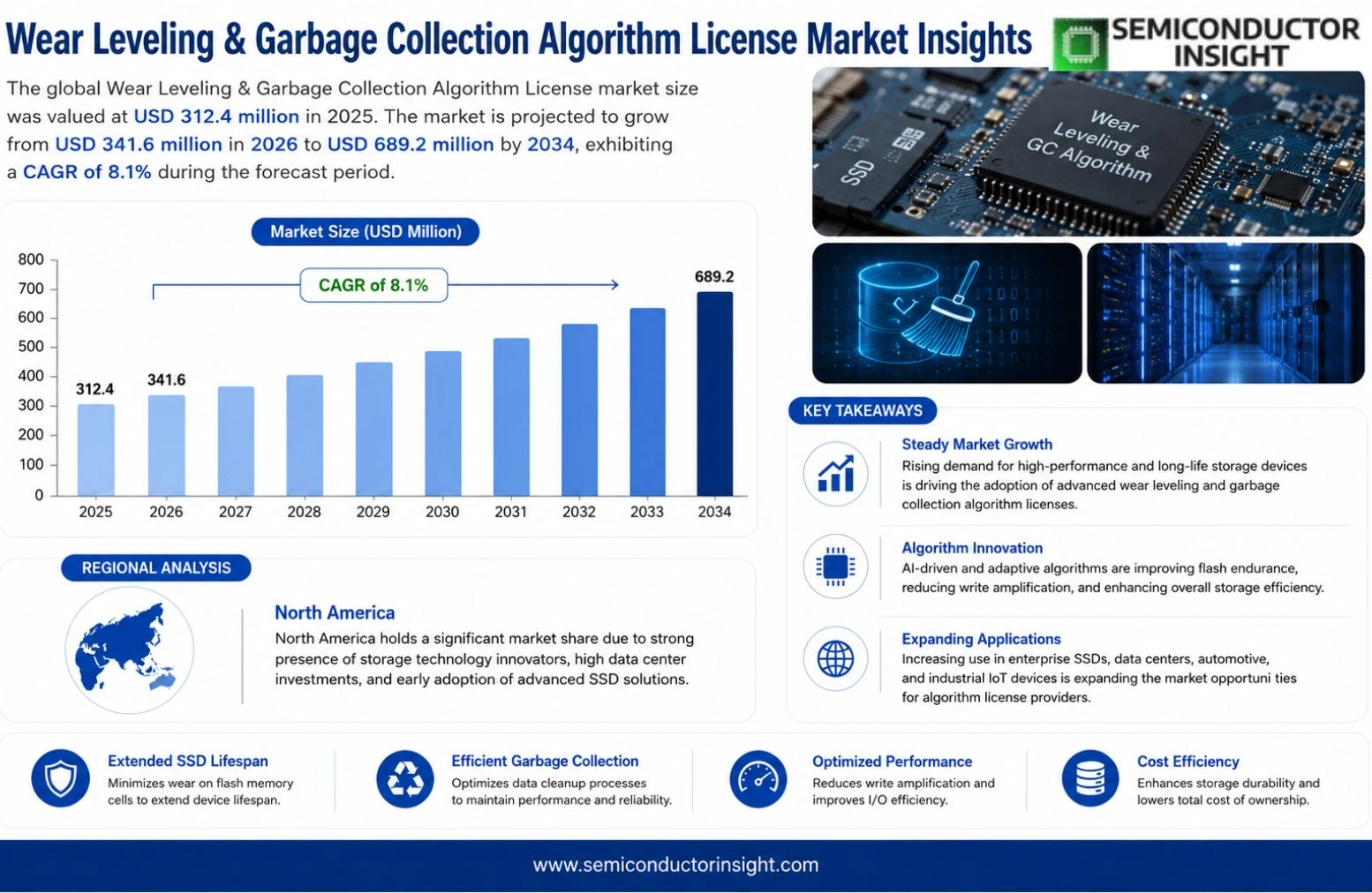
Global Wear Leveling & Garbage Collection Algorithm License Market size was valued at USD 312.4 million in 2025. The market is projected to grow from USD 341.6 million in 2026 to USD 689.2 million by 2034, exhibiting a CAGR of 8.1% during the forecast period.
Wear leveling and garbage collection algorithms are fundamental firmware-level technologies embedded within NAND flash memory controllers, designed to extend the operational lifespan and maintain the performance integrity of solid-state storage devices. These algorithms work by distributing write and erase cycles evenly across all memory blocks , preventing premature cell degradation , while garbage collection routines reclaim invalidated data blocks to ensure consistent write throughput. The licensing of such intellectual property spans dynamic wear leveling, static wear leveling, and adaptive hybrid approaches, catering to applications across SSDs, eMMC, UFS, and industrial-grade embedded storage.
The market is witnessing strong momentum driven by the surging global adoption of NAND flash-based storage across consumer electronics, automotive systems, and enterprise data centers. Furthermore, the rapid proliferation of edge computing and IoT devices , which demand highly reliable, long-endurance flash storage , is amplifying the need for sophisticated algorithm licensing. Key players such as Arm Holdings, Cadence Design Systems, and Synopsys are actively expanding their flash controller IP portfolios to address these evolving demands, making Wear Leveling & Garbage Collection Algorithm License Market one of the more strategically significant segments within the broader semiconductor IP licensing landscape.
MARKET DRIVERS
Explosive Growth in NAND Flash and SSD Adoption Fueling Demand for Wear Leveling & Garbage Collection Algorithm Licenses
The rapid proliferation of NAND flash-based storage solutions across enterprise, consumer, and industrial segments continues to serve as a primary growth engine for Wear Leveling & Garbage Collection Algorithm License Market. As solid-state drives (SSDs) increasingly displace traditional hard disk drives in data centers, edge computing infrastructure, and personal computing devices, the embedded firmware intelligence that governs memory cell longevity has become a critical differentiator. Original equipment manufacturers (OEMs) and storage controller vendors are increasingly licensing proprietary wear leveling and garbage collection algorithms rather than developing them in-house, driven by the complexity of optimizing these functions across diverse NAND geometries including TLC, QLC, and emerging PLC flash technologies.
Surge in Data Center Buildouts and Hyperscale Infrastructure Investment Accelerating Algorithm License Uptake
Global investments in hyperscale data centers and cloud infrastructure are creating sustained demand for high-endurance, high-performance storage solutions, directly benefiting Wear Leveling & Garbage Collection Algorithm License Market. Hyperscale operators require storage subsystems that can sustain intensive read-write workloads over extended operational lifespans without performance degradation. Licensing advanced wear leveling algorithms , including dynamic, static, and hybrid variants , along with sophisticated garbage collection logic enables storage controller manufacturers to offer validated, performance-optimized firmware stacks to data center customers with reduced time-to-market. This dynamic has intensified competition among algorithm IP holders and increased the commercial value attributed to proven, silicon-validated firmware licensing packages.
➤ The convergence of AI-driven workloads, real-time analytics, and high-frequency transactional data processing is placing unprecedented write amplification pressures on NAND flash media, making advanced wear leveling and garbage collection algorithm licensing a strategic necessity rather than an optional firmware enhancement for storage solution providers.
Beyond the data center, the automotive and industrial IoT sectors are emerging as high-value verticals within Wear Leveling & Garbage Collection Algorithm License Market. Automotive-grade storage solutions embedded in advanced driver-assistance systems (ADAS), telematics units, and in-vehicle infotainment platforms demand stringent endurance and reliability guarantees under extreme thermal and operational conditions. Similarly, industrial IoT deployments require storage firmware that can manage write cycles predictably over decade-long operational horizons. These requirements are prompting embedded systems vendors and automotive Tier-1 suppliers to license specialized wear leveling and garbage collection algorithm IP that meets functional safety standards such as ISO 26262 and IEC 61508, further expanding the addressable licensing opportunity.
MARKET CHALLENGES
Increasing Complexity of Multi-Layer Cell NAND Architectures Complicating Algorithm Development and Licensing Validation
One of the most significant technical challenges confronting participants in Wear Leveling & Garbage Collection Algorithm License Market is the accelerating architectural complexity of modern NAND flash memory. The transition from MLC to TLC and QLC NAND has substantially reduced per-cell endurance ratings while increasing the intricacy of error correction and block management requirements. Licensees integrating third-party wear leveling and garbage collection algorithms must undertake extensive co-validation efforts with specific NAND die vendors to ensure algorithm behavior remains within specified write amplification and endurance parameters. This validation burden increases engineering resource requirements and extends the integration timelines for both licensors and licensees, potentially limiting the market’s scalability.
Other Challenges
Fragmented NAND Vendor Ecosystem and Proprietary Interface Variations
Wear Leveling & Garbage Collection Algorithm License Market faces structural fragmentation stemming from the diverse and often proprietary characteristics of NAND flash offerings from leading manufacturers. Differences in block sizes, page structures, multi-plane configurations, and vendor-specific command sets mean that licensed algorithms frequently require substantial customization before they can be deployed across multiple NAND sources. This limits the portability of licensed algorithm packages and increases the total cost of ownership for licensees managing multi-source NAND procurement strategies, creating friction in the commercialization of standardized firmware IP licensing models.
Intellectual Property Disputes and Licensing Fee Sensitivity Among Storage Controller SMEs
Intellectual property litigation risk represents a persistent challenge within Wear Leveling & Garbage Collection Algorithm License Market, particularly as the commercial importance of firmware-level optimization IP has grown alongside SSD market revenues. Smaller storage controller vendors and fabless semiconductor firms with constrained R&D budgets often exhibit significant sensitivity to licensing fee structures, particularly recurring royalty-based models. This dynamic can impede market penetration among mid-tier and emerging controller vendors who may defer licensing engagements or attempt to develop derivative in-house implementations, exposing themselves to potential infringement exposure while simultaneously slowing the adoption of best-in-class garbage collection algorithm technologies across the broader market.
MARKET RESTRAINTS
Open-Source Firmware Initiatives and In-House Algorithm Development Constraining Commercial Licensing Revenue Growth
A meaningful restraint on the commercial expansion of Wear Leveling & Garbage Collection Algorithm License Market is the growing availability of open-source storage firmware frameworks and the strategic preference among large-scale storage solution providers to develop proprietary algorithm stacks internally. Established hyperscale cloud providers and leading SSD manufacturers with mature firmware engineering organizations often choose to invest in building and maintaining their own wear leveling and garbage collection algorithm intellectual property rather than licensing external solutions. This insourcing trend, while not universal, limits the addressable licensing opportunity among the highest-volume storage platform deployments and places downward pressure on licensing fee expectations across the broader market.
Geopolitical Trade Restrictions and Export Control Regulations Impeding Cross-Border Algorithm IP Commercialization
The evolving landscape of semiconductor-related export controls and technology transfer restrictions is introducing a discrete set of regulatory restraints on Wear Leveling & Garbage Collection Algorithm License Market, particularly for cross-border licensing transactions involving advanced storage firmware IP. Restrictions on technology exports to certain jurisdictions, combined with tightening scrutiny of foreign investment in semiconductor intellectual property assets, are compelling both licensors and prospective licensees to navigate increasingly complex compliance frameworks. These regulatory dynamics can extend deal timelines, increase transaction costs, and in some cases preclude commercially viable licensing arrangements, particularly for algorithm IP developed in jurisdictions subject to heightened export control oversight. The cumulative effect of these regulatory pressures represents a structural restraint on the global scalability of Wear Leveling & Garbage Collection Algorithm License Market.
MARKET OPPORTUNITIES
Emergence of Computational Storage and Near-Data Processing Architectures Creating New Algorithm Licensing Frontiers
The evolution toward computational storage devices (CSDs) and near-data processing platforms represents a compelling emerging opportunity for Wear Leveling & Garbage Collection Algorithm License Market. As storage devices increasingly integrate programmable compute elements capable of executing data reduction, analytics, and transformation workloads directly within the storage subsystem, the firmware intelligence governing NAND media management must operate alongside and in coordination with application-layer processing logic. This architectural shift is expanding the functional scope of wear leveling and garbage collection algorithm licensing beyond traditional SSD controller firmware into more comprehensive storage platform IP packages, creating new value-added licensing tiers and service engagement models for algorithm IP holders positioned at the intersection of storage optimization and computational offload.
AI and Machine Learning-Augmented Wear Leveling Algorithm Development Opening Premium Licensing Segments
The integration of machine learning inference capabilities into storage controller firmware is generating a distinct premium licensing opportunity within Wear Leveling & Garbage Collection Algorithm License Market. AI-augmented wear leveling algorithms capable of predictive block retirement, workload-adaptive garbage collection scheduling, and real-time write amplification minimization represent a qualitative advancement over conventional rule-based firmware logic. Algorithm IP developers who can demonstrate quantifiable endurance and performance improvements attributable to ML-based optimization are well-positioned to command premium licensing fees and establish long-term design-win relationships with forward-looking storage controller vendors. As NAND flash densities continue to increase and endurance margins tighten, demand for intelligent, adaptive garbage collection algorithm licensing solutions is expected to grow across enterprise, automotive, and industrial storage market segments.
Expanding Deployment of UFS and eMMC Solutions in Mobile and Embedded Markets Broadening the Addressable Licensing Base
The sustained growth of Universal Flash Storage (UFS) and eMMC-based solutions in smartphone, tablet, wearable, and embedded computing applications is broadening the addressable market for Wear Leveling & Garbage Collection Algorithm License Market beyond traditional SSD-centric segments. Mobile storage controller vendors serving high-volume consumer electronics supply chains require validated, power-optimized firmware IP that can balance aggressive wear leveling performance with stringent battery life constraints and thermal management requirements. This creates a scalable licensing opportunity for algorithm IP providers capable of delivering mobile-optimized wear leveling and garbage collection algorithm packages with demonstrated compatibility across leading NAND die vendors, UFS host interface standards, and the diverse operating environment requirements of global consumer electronics OEMs.
Trends
Rising Adoption of NAND Flash Storage Fueling Demand for Algorithm Licensing
Wear Leveling & Garbage Collection Algorithm License Market is experiencing strong upward momentum, primarily driven by the surging global adoption of NAND flash-based storage solutions across consumer electronics, enterprise data centers, and automotive systems. As solid-state drives and embedded storage devices become increasingly central to modern computing infrastructure, the need for robust firmware-level technologies that extend memory lifespan and maintain performance integrity has grown substantially. Wear leveling algorithms , including dynamic, static, and adaptive hybrid approaches , are now considered essential intellectual property components within NAND flash memory controllers, making their licensing a strategically significant activity across the semiconductor IP ecosystem.
Other Trends
Proliferation of Edge Computing and IoT Devices
The rapid expansion of edge computing deployments and Internet of Things ecosystems is emerging as one of the most influential trends shaping Wear Leveling & Garbage Collection Algorithm License Market. Edge and IoT devices operate in demanding environments that require highly reliable, long-endurance flash storage capable of sustaining frequent read-write cycles over extended operational lifetimes. This requirement directly amplifies demand for sophisticated wear leveling and garbage collection algorithm licenses, particularly for applications embedded in industrial-grade storage formats such as eMMC and UFS. Algorithm licensors are responding by developing solutions tailored to low-power, resource-constrained architectures commonly found across connected device segments.
Expansion of Flash Controller IP Portfolios by Key Market Players
Leading semiconductor IP companies are actively broadening their flash controller intellectual property portfolios to address the evolving demands of Wear Leveling & Garbage Collection Algorithm License Market. Established players such as Arm Holdings, Cadence Design Systems, and Synopsys have been investing in enhanced algorithm IP offerings that cater to diverse storage form factors, including SSDs, eMMC, UFS, and industrial-grade embedded storage. This trend reflects a broader industry recognition that advanced wear leveling and garbage collection algorithms are critical differentiators in flash storage performance, reliability, and product longevity, driving intensified competition among IP licensors.
Shift Toward Adaptive Hybrid Algorithm Licensing Models
A notable trend within Wear Leveling & Garbage Collection Algorithm License Market is the growing preference for adaptive hybrid algorithm licensing over traditional static or dynamic approaches. Adaptive hybrid models combine the strengths of both static and dynamic wear leveling techniques, enabling more intelligent distribution of write and erase cycles based on real-time workload analysis. This approach is gaining traction among flash controller designers targeting high-performance enterprise SSDs and automotive storage applications where consistent write throughput and extended endurance are non-negotiable requirements. As storage workloads grow more complex, adaptive algorithm licensing is expected to represent an increasingly dominant segment within the broader market landscape.
COMPETITIVE LANDSCAPE
Key Industry Players
Wear Leveling & Garbage Collection Algorithm License Market , Competitive Intelligence and Strategic Player Assessment
Wear Leveling & Garbage Collection Algorithm License Market is characterized by the dominant presence of large-scale semiconductor IP licensing firms and flash controller IP specialists. Arm Holdings remains a pivotal force in this space, leveraging its expansive ecosystem of embedded processor and storage controller IP to integrate advanced wear leveling and garbage collection capabilities into licensable firmware solutions. Synopsys and Cadence Design Systems similarly maintain robust flash controller IP portfolios, providing system-on-chip designers with certified algorithm IP blocks tailored for NAND flash applications spanning SSDs, eMMC, UFS, and industrial embedded storage. These incumbents benefit from deep relationships with foundries, OEMs, and fabless semiconductor companies, reinforcing their competitive moats through continuous R&D investment and a broad cross-licensing framework. The market structure is moderately consolidated at the top tier, with a handful of established IP licensors commanding significant revenue share owing to their extensive patent portfolios and proven algorithm performance benchmarks validated across high-endurance, enterprise-grade deployments.
Beyond the tier-one IP giants, the competitive landscape includes several specialized flash storage IP firms and NAND controller developers that license proprietary wear leveling and garbage collection algorithm stacks to storage device manufacturers. Companies such as Silicon Motion Technology, Phison Electronics, and Greenliant Systems have established notable positions by offering vertically integrated controller solutions bundled with licensable firmware algorithm IP, targeting industrial IoT, automotive, and edge computing end markets. Firms like Kioxia, Western Digital, and Micron Technology , while primarily NAND flash manufacturers , also hold substantial algorithm IP that is selectively licensed to third-party controller vendors. Additionally, emerging IP-pure-play companies and university spin-offs are beginning to challenge incumbents with adaptive hybrid wear leveling techniques optimized for 3D NAND architectures, intensifying competition across mid-market and niche licensing segments and contributing to the projected market growth from USD 341.6 million in 2026 to USD 689.2 million by 2034 at a CAGR of 8.1%.
List of Key Wear Leveling & Garbage Collection Algorithm License Companies Profiled
- Arm Holdings
- Synopsys, Inc.
- Cadence Design Systems
- Silicon Motion Technology Corporation
- Phison Electronics Corporation
- Greenliant Systems
- Kioxia Holdings Corporation
- Western Digital Corporation
- Micron Technology, Inc.
- Samsung Semiconductor
- SK Hynix Inc.
- Ramaxel Technology
- Longsys Electronics Co., Ltd.
- YMTC (Yangtze Memory Technologies Co.)
- Macronix International Co., Ltd.
Segment Analysis:
| Segment Category | Sub-Segments | Key Insights |
| By Type |
|
Adaptive Hybrid Wear Leveling Algorithm License represents the leading and most rapidly advancing type segment, driven by its ability to intelligently combine the strengths of both dynamic and static approaches within a single unified firmware framework.
|
| By Application |
|
Solid-State Drives (SSDs) command the leading position within the application-based segmentation of Wear Leveling & Garbage Collection Algorithm License Market, underpinned by the widespread and accelerating deployment of SSDs across enterprise data centers, consumer laptops, and cloud infrastructure.
|
| By End User |
|
Semiconductor IP Vendors & Flash Controller Manufacturers constitute the dominant end-user segment, as these entities serve as the primary and most direct licensees of wear leveling and garbage collection algorithm intellectual property within the global market ecosystem.
|
| By License Model |
|
Royalty-Based License stands as the leading and most widely adopted licensing model within Wear Leveling & Garbage Collection Algorithm License Market, offering IP vendors a sustainable and scalable revenue stream tied directly to the commercial success of licensee products.
|
| By NAND Flash Technology |
|
TLC (Triple-Level Cell) NAND emerges as the leading technology node driving algorithm licensing demand, owing to its dominant position in mainstream consumer and enterprise SSD deployments and its inherently reduced endurance characteristics that necessitate sophisticated wear management solutions.
|
Regional Analysis: Wear Leveling & Garbage Collection Algorithm License Market
North America
North America’s hyperscale data center operators represent a critical demand driver for wear leveling and garbage collection algorithm licenses. As enterprise workloads shift toward high-frequency write-intensive applications, the need for sophisticated storage management algorithms that extend NAND flash lifespan and optimize write amplification has become a strategic priority for operators seeking long-term cost efficiency and infrastructure reliability.
The region hosts a well-established intellectual property licensing framework that enables algorithm developers to effectively commercialize wear leveling and garbage collection innovations. Strong patent enforcement mechanisms, combined with a culture of technology transfer and cross-licensing agreements among semiconductor firms, support a dynamic and commercially active licensing marketplace that continues to expand alongside growing flash memory deployments.
The rapid advancement of autonomous vehicle programs and edge computing deployments across North America is generating substantial new demand for ruggedized, high-endurance flash storage solutions. Wear leveling and garbage collection algorithm licenses are increasingly sought by automotive-grade storage solution providers seeking to meet the stringent reliability and longevity specifications mandated by next-generation vehicle platforms and industrial edge nodes.
Continuous investment in semiconductor research and development within North America ensures a healthy pipeline of next-generation wear leveling and garbage collection algorithmic innovations. University-industry collaboration programs, combined with venture-backed startups focusing on storage firmware optimization, position the region as a sustained source of intellectual property that feeds both domestic and global licensing activity across the forecast horizon.
Europe
Europe represents a strategically significant market for wear leveling and garbage collection algorithm licenses, underpinned by the region’s strong industrial manufacturing base, advanced automotive sector, and growing emphasis on digital sovereignty and data infrastructure resilience. Germany, France, and the Netherlands serve as key hubs where semiconductor design firms and automotive-grade electronics manufacturers actively seek robust flash storage management solutions to meet rigorous functional safety standards. European regulations promoting data protection and sustainability are increasingly influencing procurement decisions, with buyers favoring algorithm solutions that extend NAND flash media longevity and reduce electronic waste. The region’s sophisticated industrial IoT deployments, particularly within smart manufacturing and energy management sectors, further amplify demand for reliable wear leveling and garbage collection algorithm licensing. European firms are also investing in proprietary storage management capabilities to reduce dependence on external technology suppliers, creating new commercial opportunities for algorithm licensors offering flexible and adaptable licensing models tailored to the region’s diverse industrial requirements.
Asia-Pacific
Asia-Pacific is emerging as the fastest-growing region within Wear Leveling & Garbage Collection Algorithm License Market, propelled by the region’s unparalleled concentration of NAND flash manufacturing capacity, a rapidly expanding consumer electronics industry, and accelerating digital transformation across major economies including China, South Korea, Japan, and Taiwan. Leading flash memory producers and controller chip designers based in Asia-Pacific are increasingly pursuing proprietary algorithm licensing arrangements to differentiate their products in an intensely competitive market landscape. The explosive growth of mobile computing, cloud data centers, and 5G infrastructure deployment across the region generates substantial and sustained demand for advanced storage management algorithms capable of maximizing flash endurance under diverse and demanding workload profiles. Government-driven semiconductor self-sufficiency initiatives in China and South Korea are further stimulating domestic investment in storage algorithm development, broadening the regional intellectual property landscape and creating new participants within Wear Leveling & Garbage Collection Algorithm License Market ecosystem.
South America
South America occupies a developing but gradually expanding position in Global Wear Leveling & Garbage Collection Algorithm License Market. Brazil leads regional demand, supported by a growing technology sector, increasing adoption of cloud computing infrastructure, and a rising consumer electronics market that relies on NAND flash storage solutions requiring effective wear management capabilities. While the region currently depends significantly on imported flash storage technologies and associated algorithmic solutions, local system integrators and electronics manufacturers are beginning to engage more actively with international algorithm licensors to enhance product quality and competitiveness. Economic development initiatives promoting digital infrastructure investment across key South American economies are expected to progressively elevate the region’s participation in the wear leveling and garbage collection algorithm licensing ecosystem. Regulatory frameworks encouraging technology localization may further support regional market development as the forecast period advances toward 2034.
Middle East & Africa
The Middle East & Africa region represents an emerging frontier within Wear Leveling & Garbage Collection Algorithm License Market, characterized by accelerating digital infrastructure investment, expanding cloud adoption, and growing government-led smart city and e-governance initiatives. Gulf Cooperation Council nations, particularly the United Arab Emirates and Saudi Arabia, are channeling significant capital into data center construction and technology modernization programs that necessitate high-performance, endurance-optimized flash storage solutions. As telecommunications infrastructure expands across African markets and mobile-first digital economies mature, demand for cost-effective yet reliable flash storage management capabilities is anticipated to strengthen progressively. While the region currently represents a smaller share of global algorithm licensing activity, its trajectory reflects meaningful long-term growth potential as broader technology adoption deepens and local technology procurement standards become increasingly aligned with international flash storage quality benchmarks through the 2026–2034 period.
Report Scope
This market research report provides a comprehensive analysis of the Wear Leveling & Garbage Collection Algorithm License Market , covering the forecast period 2026–2034. It offers detailed insights into market dynamics, technological advancements, competitive landscape, and key trends shaping the industry.
Key focus areas of the report include:
- Market Overview: The report begins with an overview outlining its current market scenario, key growth indicators, and industry transformation drivers. It discusses macroeconomic factors, demand–supply balance, regulatory landscape, and the strategic role of semiconductors in powering advancements across industries such as automotive, telecommunications, consumer electronics, and industrial automation.
- Market Size & Forecast: Historical data and future projections for revenue, unit shipments, and market value across major regions and segments.
- Segmentation Analysis: Detailed breakdown by product type, technology, application, and end-user industry to identify high-growth segments and investment opportunities.
- Regional Insights: Insights into market performance across North America, Europe, Asia-Pacific, Latin America, and the Middle East & Africa, including country-level analysis where relevant.
- Competitive Landscape: Profiles of leading market participants, including their product offerings, R&D focus, manufacturing capacity, pricing strategies, and recent developments such as mergers, acquisitions, and partnerships.
- Technology Trends & Innovation: Assessment of emerging technologies, integration of AI/IoT, semiconductor design trends, fabrication techniques, and evolving industry standards.
- Market Drivers & Restraints: Evaluation of factors driving market growth along with challenges, supply chain constraints, regulatory issues, and market-entry barriers.
- Stakeholder Insights: Insights for component suppliers, OEMs, system integrators, investors, and policymakers regarding the evolving ecosystem and strategic opportunities.
Primary and secondary research methods are employed, including interviews with industry experts, data from verified sources, and real-time market intelligence to ensure the accuracy and reliability of the insights presented.
FREQUENTLY ASKED QUESTIONS:
What is the current market size of Wear Leveling & Garbage Collection Algorithm License Market?
-> Wear Leveling & Garbage Collection Algorithm License Market was valued at USD 312.4 million in 2025 and is expected to reach USD 689.2 million by 2034, growing at a CAGR of 8.1% during the forecast period from 2026 to 2034.
Which key companies operate Wear Leveling & Garbage Collection Algorithm License Market?
-> Key players include Arm Holdings, Cadence Design Systems, and Synopsys, among others, all of which are actively expanding their flash controller IP portfolios to address evolving demands in the semiconductor IP licensing landscape.
What are the key growth drivers?
-> Key growth drivers include surging global adoption of NAND flash-based storage across consumer electronics, automotive systems, and enterprise data centers, as well as the rapid proliferation of edge computing and IoT devices that demand highly reliable, long-endurance flash storage solutions.
Which region dominates the market?
-> Asia-Pacific is the fastest-growing region driven by strong demand in consumer electronics and industrial embedded storage, while North America remains a dominant market supported by enterprise data center expansion and semiconductor IP development.
What are the emerging trends?
-> Emerging trends include adaptive hybrid wear leveling approaches, growth in UFS and eMMC storage licensing, integration of sophisticated garbage collection algorithms in industrial-grade embedded storage, and expanding IP portfolios targeting SSDs and automotive-grade flash memory controllers.

Get Sample Report PDF for Exclusive Insights
Report Sample Includes
- Table of Contents
- List of Tables & Figures
- Charts, Research Methodology, and more...
 Download Sample Report PDF