Water Conductivity Sensor Market Insights
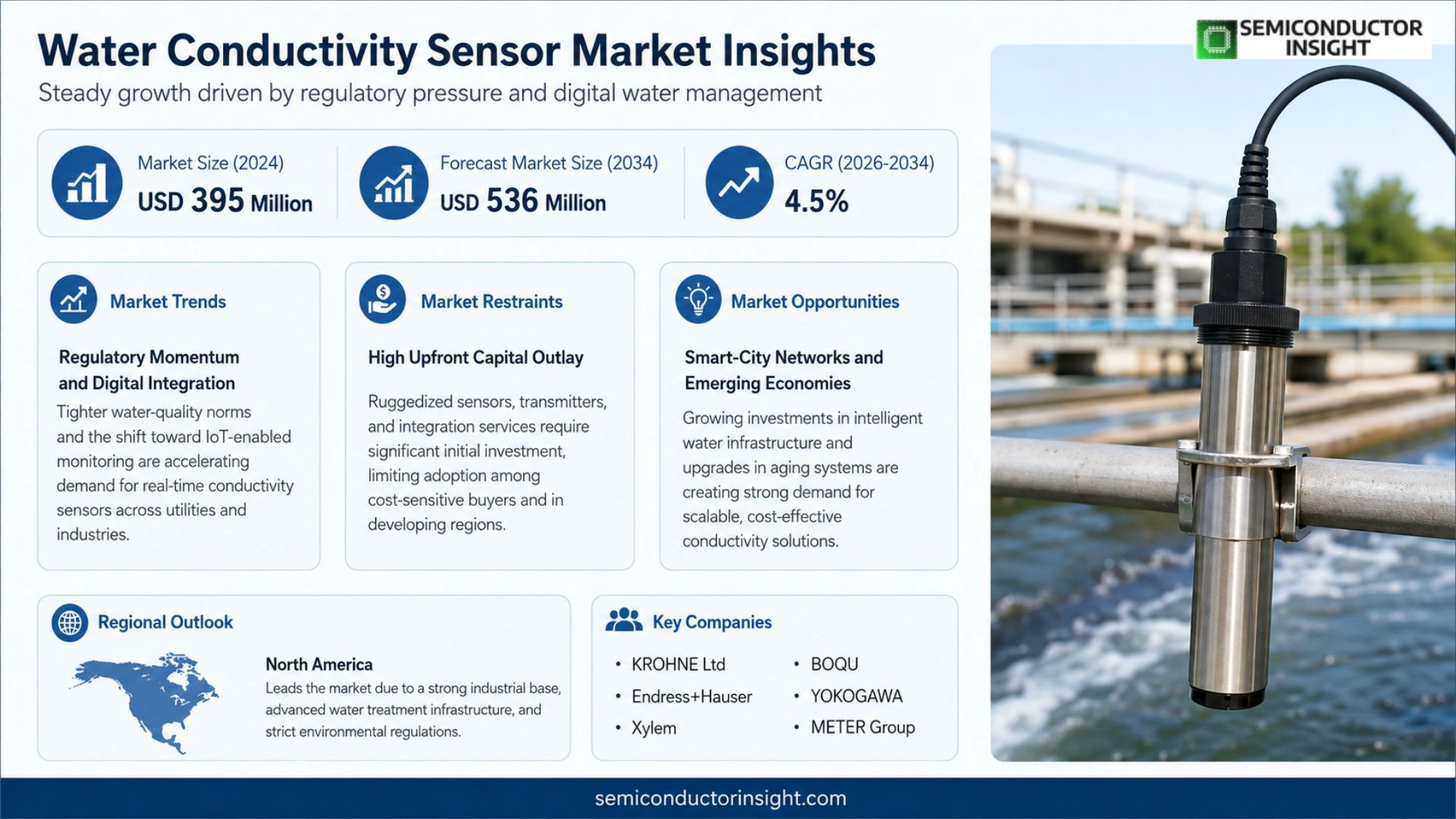
Water Conductivity Sensor market size was valued at USD 395 million in 2024. The market is projected to grow from USD 395 million in 2026 to USD 536 million by 2034, exhibiting a CAGR of 4.5% during the forecast period.
Water conductivity sensors are analytical devices used to quantify how readily an aqueous solution conducts electric current. By measuring ion concentration, these sensors provide a direct indication of water quality; higher ion levels translate into greater conductivity readings.
The market is experiencing rapid growth due to several factors, including stricter governmental regulations on water‑quality monitoring, expanding industrial applications such as pharmaceuticals and power generation, rising awareness of environmental pollution, and continuous technological advancements like smart‑sensor integration with IoT platforms. Key manufacturers such as KROHNE Ltd., YOKOGAWA, Endress‑Hauser, Xylem and HACH are actively launching new product lines and forming strategic partnerships to strengthen their positions.
MARKET DRIVERS
Regulatory pressure for water‑quality compliance
Stricter discharge limits imposed by environmental agencies are compelling municipalities and industrial users to install continuous monitoring solutions. Water Conductivity Sensor Market benefits because conductivity provides a rapid proxy for total dissolved solids, enabling plants to demonstrate compliance in real time rather than relying on intermittent laboratory tests.
Industrial automation and IoT integration
Manufacturers are embedding conductivity probes into SCADA and cloud‑based analytics platforms, turning raw measurements into actionable insights. This convergence reduces manual sampling, lowers labor costs, and creates demand for sensors that can communicate over standardized protocols, thereby expanding Water Conductivity Sensor Market.
➤ “When sensors become data‑rich nodes within a digital twin, the value of real‑time conductivity data multiplies, driving adoption across process industries.”
Moreover, the push toward circular water use in sectors such as food processing and semiconductor fabrication is prompting firms to invest in high‑precision conductivity instruments, further reinforcing market momentum.
MARKET CHALLENGES
Technical complexity and calibration costs
Accurate conductivity measurement demands routine calibration against traceable standards; the associated laboratory effort can strain budgets, especially for small utilities. If calibration cycles are missed, sensor drift erodes data credibility, creating resistance to broader deployment.
Other Challenges
Supply chain volatility
Fluctuations in the availability of specialty alloys and reference solutions have elongated lead times for calibrated probes, pressuring manufacturers to hold higher inventory levels or accept lower margins.
Consequently, end users often postpone upgrades until a clear return on investment can be demonstrated, slowing the overall market uptake.
MARKET RESTRAINTS
High upfront capital outlay
Initial costs for ruggedized, factory‑calibrated sensors,plus required transmitters and integration services,remain a barrier for cash‑constrained entities. While operating expenses may decline over time, the steep capital hurdle discourages early‑stage adopters and limits market penetration in developing regions.
MARKET OPPORTUNITIES
Smart‑city water networks and emerging economies
Urban planners are deploying sensor‑dense water distribution grids to detect leaks and contamination instantly. In parallel, fast‑growing economies are upgrading aging infrastructure, creating a sizable demand pipeline for cost‑effective conductivity solutions that can be scaled across municipal and industrial water systems.
Water Conductivity Sensor Market Trends
Regulatory Momentum and Digital Integration
Water Conductivity Sensor Market recorded a revenue of roughly $395 million in 2024, an indicator that demand for precise ion‑measurement tools is already substantial. Governments across North America, Europe and parts of Asia have tightened water‑quality statutes, compelling utilities and municipalities to install continuous monitoring stations. Because compliance hinges on real‑time ion data, procurement cycles for sensors have accelerated, especially for models that can log and transmit readings without onsite personnel. At the same time, manufacturers have integrated low‑power wireless modules, allowing the devices to slot into broader smart‑water networks. This convergence of stricter oversight and digitized infrastructure creates a feedback loop: more regulated points generate higher data volumes, which in turn justify further investment in connected sensor fleets. As municipalities upgrade legacy analog probes, the market sees a steady influx of retrofit projects that generate recurring revenue for sensor manufacturers. The data collected also supports predictive maintenance programs, turning simple conductivity readings into actionable intelligence for utility operators.
Other Trends
Industrial Process Integration
In sectors such as pharmaceuticals, power generation and food processing, water quality directly influences product integrity and equipment longevity. Companies operating these plants have adopted inductive and electrodeless conductivity sensors to monitor boiler feedwater, cooling circuits and formulation streams. Recent advances that reduce calibration drift have lowered total cost of ownership, making the sensors attractive for continuous‑run facilities. Moreover, the ability to embed sensor outputs into supervisory control systems enables automatic adjustments of dosing pumps, preventing costly shutdowns. The net effect is a measurable lift in operational efficiency and a reduction in waste‑water treatment expenses, factors that management teams now weigh alongside traditional capital budgeting criteria. Beyond immediate process control, the high‑resolution data stream enables advanced analytics such as anomaly detection, which can preempt corrosion events before they impact production. Consequently, capital planners increasingly justify sensor expenditures as risk‑mitigation investments rather than optional upgrades.
Competitive Innovation and Strategic Outlook
The competitive arena remains fragmented, with several established vendors and a handful of niche players racing to embed edge‑computing capabilities into their units. Product road‑maps emphasize modular designs that can be retrofitted to legacy rigs, while partnership agreements with IoT platform providers broaden market reach. For buyers, the shift toward customizable firmware and subscription‑based data services translates into new procurement models that blend hardware acquisition with ongoing analytics fees. Enterprises that align their water‑quality strategy with these emerging service structures are positioned to extract greater value from sensor deployments, while laggards risk falling behind regulatory benchmarks and incurring higher remediation costs. Looking ahead, firms that secure early access to firmware update ecosystems will gain a competitive edge, as regulatory revisions often demand tighter measurement tolerances that older hardware cannot meet.
COMPETITIVE LANDSCAPE
Key Industry Players
Water Conductivity Sensor Market – Competitive Overview
The sensor segment is dominated by a handful of multinationals that leverage deep engineering capabilities and extensive service networks. KROHNE Ltd, Endress+Hauser, and Xylem occupy the top tier, each offering integrated measurement suites that combine conductivity with temperature and dissolved‑oxygen probes. Their market share reflects not only scale but also the ability to embed sensors into automation platforms, which is decisive for utilities and large‑scale industrial users. Competitive pressure among these leaders is manifest in accelerated product road‑maps, frequent firmware upgrades, and strategic alliances with IoT platform providers. As regulatory scrutiny tightens across regions, these firms are also expanding compliance‑focused services, turning sensor sales into recurring revenue streams through data‑analytics contracts.
Beyond the giants, a diverse set of niche specialists sustains a vibrant second tier. Companies such as BOQU, YOKOGAWA, and METER Group focus on high‑precision laboratory instruments, while LTH Electronic and LEVTECH address rugged field deployments in agriculture and aquaculture. Emerging innovators like Aanderaa and Innovative Sensor Technology are pursuing electrodeless designs that promise lower maintenance costs, a feature increasingly valued by small‑scale water‑treatment operators. Regional players – for example, Chemitec in Europe and HYQUEST SOLUTIONS in North America – retain strong relationships with local distributors, enabling them to capture market segments that demand customized calibration services. Collectively, this breadth of participants ensures that end‑users can select solutions aligned with specific performance, cost, and integration requirements.
List of Key Water Conductivity Sensor Companies Profiled
- KROHNE Ltd
- Endress+Hauser
- Xylem
- BOQU
- YOKOGAWA
- METER Group
- LTH Electronic
- LEVTECH
- Aanderaa
- Chemitec
- AHLBORN
- Parker Hannifin
- HYQUEST SOLUTIONS
- HACH
- Eutech Instruments
- Hanna Instruments
- ABB Group
- Thermo Fisher Scientific
- MYRON L Company
- Innovative Sensor Technology
Segment Analysis:
| Segment Category | Sub-Segments | Key Insights |
| By Type |
|
Inductive Sensors – prized for robust performance in harsh industrial environments; – favored where long‑term stability and minimal maintenance are critical; – often selected for high‑temperature or chemically aggressive water streams. Electrodeless Sensors – valued for rapid response and reduced fouling; – preferred in applications demanding high accuracy and low calibration drift; – increasingly integrated with smart diagnostics for predictive maintenance. |
| By Application |
|
Environmental & Regulatory Focus – sensors underpin compliance programs for water bodies, enabling continuous data streams for authorities; – integration with remote telemetry allows real‑time alerts for contamination events; – growing emphasis on ecosystem health drives adoption in estuary and river monitoring. Industrial Process Control – wastewater treatment plants rely on precise conductivity readings to manage discharge standards; – agricultural runoff sensors support nutrient management and protect downstream water quality; – smart sensor networks facilitate automated valve and dosing adjustments. |
| By End User |
|
Regulatory Bodies – prioritize sensors that deliver verified data for compliance audits; – require traceability and standardized calibration procedures; – push for interoperable platforms to unify data across jurisdictions. Treatment Plant Managers – value reliability and low maintenance to keep operations uninterrupted; – seek sensors that integrate with SCADA systems for automated process adjustments; – appreciate intelligent diagnostics that reduce downtime. |
| By Technology Integration |
|
IoT‑Ready Solutions – empower remote monitoring, reducing on‑site visits; – facilitate predictive maintenance through continuous health metrics; – enable seamless integration with enterprise asset management platforms. Cloud Connectivity – supports centralized analytics, trend identification, and regulatory reporting; – enhances collaboration among stakeholders across geography; – drives ecosystem development with third‑party applications and AI‑based water quality models. |
| By Deployment Mode |
|
Fixed Installation – provides continuous, high‑resolution monitoring for critical points; – essential for regulatory stations and large‑scale treatment plants; – benefits from rugged enclosures and long‑term stability. Portable Handheld – offers flexibility for field surveys, rapid assessments, and troubleshooting; – favored by environmental consultants and research teams; – often equipped with user‑friendly interfaces and quick‑swap probes. |
Regional Analysis: Water Conductivity Sensor Market
North America
Heavy‑duty manufacturing sectors,particularly chemicals, petrochemicals, and metal finishing,rely on precise conductivity readings to control reaction chemistry and prevent equipment corrosion, making the sensor a critical control point in process safety.
Federal and state water‑quality statutes stipulate narrow conductivity limits for discharge permits, driving utilities and industrial users toward higher‑accuracy sensors to avoid non‑compliance penalties and protect public trust.
The rollout of cloud‑connected monitoring platforms has nudged OEMs to embed wireless modules in conductivity devices, enabling real‑time analytics and predictive maintenance across distributed water networks.
Venture capital and corporate R&D funds are gravitating toward sensor miniaturization and low‑power designs, anticipating demand from smart‑city water infrastructure projects and remote agricultural deployments.
Europe
European markets exhibit a balanced mix of mature utilities and emerging renewable‑energy water projects, each demanding robust conductivity monitoring to safeguard turbine cooling circuits and desalination plants. The European Union’s Water Framework Directive imposes a uniform set of quality criteria, encouraging cross‑border standardization of sensor specifications. Meanwhile, the rise of decentralized water‑reuse schemes in Germany and the Netherlands is stimulating demand for compact, high‑precision devices that can be integrated into modular treatment units. Industry participants are responding by expanding service contracts that combine sensor supply with calibration and data‑validation services, thereby creating recurring revenue streams beyond the initial hardware sale.
Asia‑Pacific
In Asia‑Pacific, rapid urbanization and intensive agricultural expansion have heightened sensitivity to water‑quality fluctuations, positioning conductivity sensors as a cornerstone of national water‑management strategies. Nations such as China and India are investing heavily in modernizing irrigation networks, where continuous conductivity data informs fertilizer application and salinity mitigation. Additionally, the region’s sizable semiconductor manufacturing base demands ultra‑clean water, prompting factories to adopt inline sensors capable of detecting minute ionic changes. While cost considerations remain paramount, local manufacturers are leveraging economies of scale to offer competitively priced sensors, gradually eroding the market share of premium Western brands.
South America
South American economies are channeling resources into mining and hydroelectric projects, both of which place stringent demands on water‑quality monitoring to protect equipment longevity and environmental compliance. Brazil’s extensive river basin management programs have begun to integrate conductivity sensors into early‑warning systems that detect upstream contamination events. In the agricultural sector, Argentine vineyards are employing sensor data to fine‑tune irrigation schedules, thereby optimizing grape quality while conserving water. Market growth is tempered by currency volatility, yet partnerships between local distributors and global OEMs are facilitating technology transfer and after‑sales support, fostering a modest but steady expansion of the market.
Middle East & Africa
The Middle East & Africa region confronts chronic water scarcity, making real‑time conductivity monitoring indispensable for desalination plants and groundwater remediation initiatives. Gulf Cooperation Council countries have launched national smart‑water programmes that embed advanced sensors within large‑scale reverse‑osmosis facilities, seeking to reduce energy consumption through precise feed‑water quality control. In Africa, pilot projects funded by development banks are introducing low‑cost conductivity probes to rural water‑supply schemes, aiming to safeguard public health. Although market penetration remains uneven, the convergence of governmental incentives and private‑sector innovation is gradually establishing a foothold for Water Conductivity Sensor Market across the region.
Report Scope
This market research report provides a comprehensive analysis of the Water Conductivity Sensor Market , covering the forecast period 2026–2034. It offers detailed insights into market dynamics, technological advancements, competitive landscape, and key trends shaping the industry.
Key focus areas of the report include:
- Market Overview: The report begins with an overview outlining its current market scenario, key growth indicators, and industry transformation drivers. It discusses macroeconomic factors, demand–supply balance, regulatory landscape, and the strategic role of semiconductors in powering advancements across industries such as automotive, telecommunications, consumer electronics, and industrial automation.
- Market Size & Forecast: Historical data and future projections for revenue, unit shipments, and market value across major regions and segments.
- Segmentation Analysis: Detailed breakdown by product type, technology, application, and end-user industry to identify high-growth segments and investment opportunities.
- Regional Insights: Insights into market performance across North America, Europe, Asia-Pacific, Latin America, and the Middle East & Africa, including country-level analysis where relevant.
- Competitive Landscape: Profiles of leading market participants, including their product offerings, R&D focus, manufacturing capacity, pricing strategies, and recent developments such as mergers, acquisitions, and partnerships.
- Technology Trends & Innovation: Assessment of emerging technologies, integration of AI/IoT, semiconductor design trends, fabrication techniques, and evolving industry standards.
- Market Drivers & Restraints: Evaluation of factors driving market growth along with challenges, supply chain constraints, regulatory issues, and market-entry barriers.
- Stakeholder Insights: Insights for component suppliers, OEMs, system integrators, investors, and policymakers regarding the evolving ecosystem and strategic opportunities.
Primary and secondary research methods are employed, including interviews with industry experts, data from verified sources, and real-time market intelligence to ensure the accuracy and reliability of the insights presented.
FREQUENTLY ASKED QUESTIONS:
What is the current market size of Water Conductivity Sensor Market?
-> Water Conductivity Sensor Market is expected to reach USD 536 million by 2036, growing at a CAGR of 4.5% during the forecast period.
Which key companies operate in Water Conductivity Sensor Market?
-> Key players include KROHNE Ltd, BOQU, YOKOGAWA, Endress-Hauser, Xylem, HACH, METER, LTH Electronic, LEVTECH, Aanderaa, Chemitec, AHLBORN, Parker, HYQUEST SOLUTIONS, Eutech Instruments, Hanna Instruments, ABB Group, Thermo Fisher Scientific, MYRON L Company, Innovative Sensor Technology.
What are the key growth drivers?
-> Key growth drivers include increasing regulatory emphasis on water quality monitoring, expanding industrial applications such as pharmaceuticals and power generation, rising awareness of water pollution, technological advancements in sensor accuracy and smart connectivity, and growing adoption of IoT and automation in water management systems.
Which region dominates the market?
-> Asia holds the largest market share, driven by rapid industrialization and stringent water quality regulations, while North America and Europe also represent significant markets.
What are the emerging trends?
-> Emerging trends include smart sensors with wireless connectivity, AI/IoT integration for real‑time monitoring, and advanced data‑logging capabilities that enable predictive water‑quality management.
Get Sample Report PDF for Exclusive Insights
Report Sample Includes
- Table of Contents
- List of Tables & Figures
- Charts, Research Methodology, and more...
 Download Sample Report PDF