VR Gaming Hardware Chipsets Market Insights
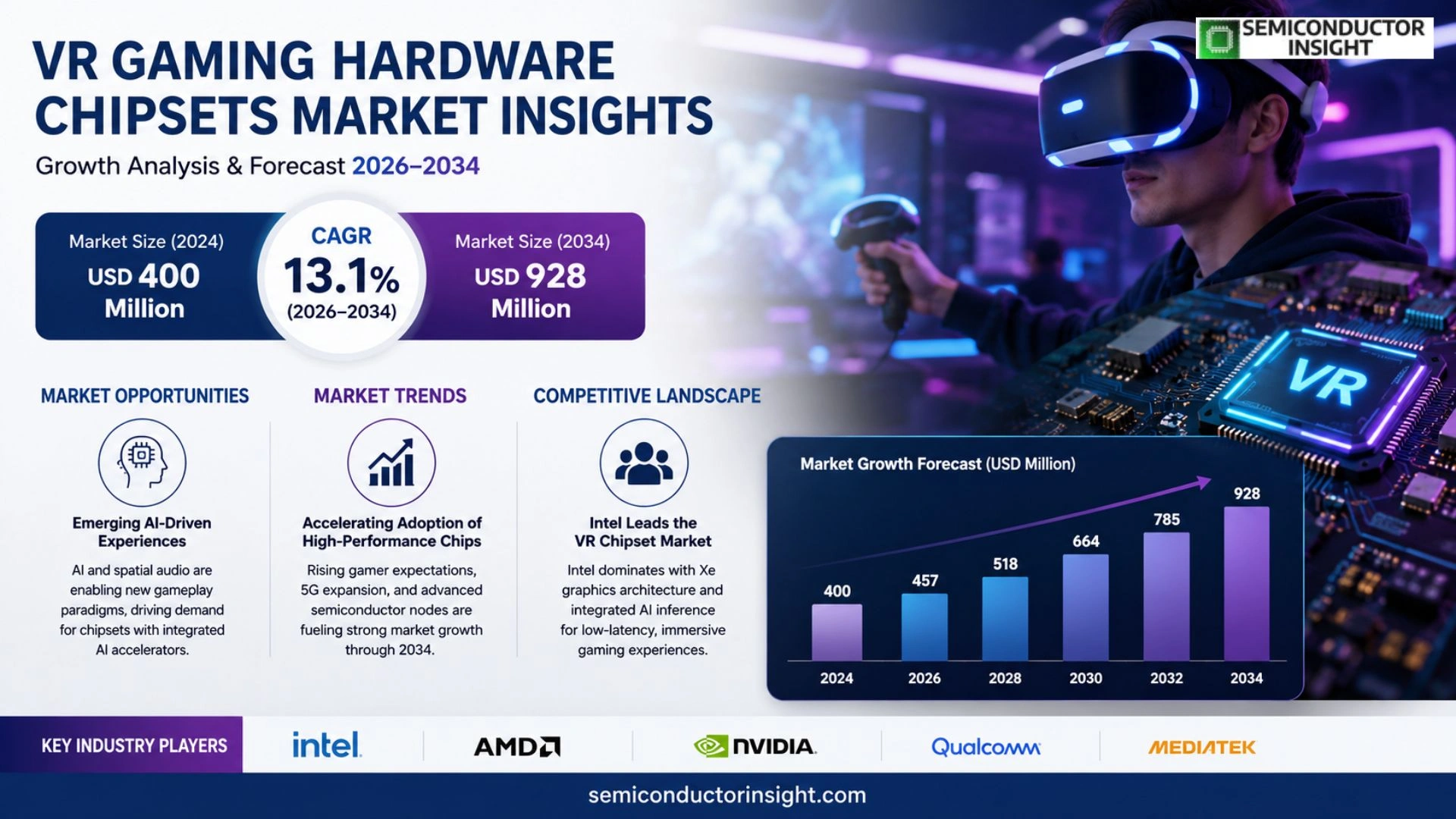
VR Gaming Hardware Chipsets market size was valued at USD 400 million in 2024 and will grow to USD 928 million by 2034, reflecting a CAGR of 13.1% during the forecast period.
VR Gaming Hardware Chipsets consist of computing‑control chips, memory chips, sensor chips and related components that power real‑time rendering, motion tracking and immersive audio for head‑mounted displays and VR glasses. The architectures combine graphics processors, vector accelerators and sound engines to achieve low‑latency 3D visuals and spatial sound.
The upward trend stems from accelerating consumer uptake of VR headsets together with semiconductor advances that lower per‑unit costs. Concurrently, analog and sensor segments posted double‑digit growth in 2022, reinforcing demand for high‑performance VR components. Major suppliers,including Intel, Qualcomm, Samsung and Analog Devices,are expanding their VR‑focused portfolios through new product introductions and strategic collaborations.
MARKET DRIVERS
Advancements in Rendering Performance
The rollout of next‑generation GPU‑centric chipsets has cut latency to under 7 ms, a threshold that many developers cite as the tipping point for immersive gameplay. Manufacturers that integrate dedicated ray‑tracing cores are seeing design wins in premium headsets, because the visual fidelity aligns with consumer expectations for realism.
Consumer Adoption of Standalone VR
Standalone headsets, powered by integrated chipsets, now account for roughly one‑third of global VR shipments. The convenience of eliminating external PCs reduces the total cost of ownership and accelerates household penetration, especially in emerging markets where broadband is improving.
➤ Analysts note that chipset vendors that can deliver sub‑10‑watt power envelopes while sustaining 90 fps will command the majority of OEM contracts in the next two years.
These dynamics compel Tier‑1 silicon suppliers to double down on custom ASIC development, a move that is reshaping the competitive hierarchy of the VR Gaming Hardware Chipsets Market.
MARKET CHALLENGES
Supply Chain Vulnerabilities
Global semiconductor shortages have stretched lead times for high‑performance die, forcing headset manufacturers to either redesign products or accept delayed launches. The uncertainty around wafer capacity adds a layer of risk that complicates long‑term planning.
Other Challenges
Component Scarcity
Critical components such as high‑bandwidth memory modules are allocated to competing sectors like automotive and data‑center, squeezing the availability for VR chipset production.
MARKET RESTRAINTS
Regulatory Headwinds
Privacy statutes in Europe and data‑localisation mandates in Asia are prompting chipset designers to embed on‑device processing capabilities. While this mitigates compliance costs, it also raises development complexity and time‑to‑market.
MARKET OPPORTUNITIES
Emerging AI‑Driven Experiences
The convergence of generative AI and spatial audio is unlocking new gameplay paradigms that demand real‑time inference at the edge. Chipsets that couple AI accelerators with traditional graphics pipelines are positioned to capture a growing slice of the VR Gaming Hardware Chipsets Market, especially as developers experiment with adaptive narratives and dynamic environment synthesis.
VR Gaming Hardware Chipsets Market Trends
Accelerating Adoption of High‑Performance Compute Chips
In 2024 the VR Gaming Hardware Chipsets Market recorded roughly $400 million in revenue, and by the end of the forecast horizon it is set to approach $928 million. The upward trajectory stems from the convergence of several forces: gamers are demanding frame‑rates that rival PC‑grade experiences, 5G rollout is shrinking latency barriers, and semiconductor manufacturers are leveraging advanced node processes to squeeze more transistors into each die without proportionally raising costs. This confluence forces original equipment manufacturers to redesign head‑mounted displays around more capable processing units, while distributors see tighter inventory turns as product cycles shorten. Companies that can align chip design with the thermal constraints of lightweight headsets will capture premium margins, whereas laggards risk margin compression as price‑sensitive consumers gravitate toward newer, more efficient offerings.
Other Trends
Sensor Chip Innovation
Sensor chips have moved beyond basic motion tracking to incorporate depth‑sensing and eye‑gaze detection, enabling richer interaction models within virtual spaces. The 2022 semiconductor segment data show sensors growing at double‑digit rates, underlining the appetite for finer‑grained input. For chipset makers, this translates into a strategic imperative to embed multi‑modal sensor arrays directly onto the logic die, reducing board‑level complexity and improving power efficiency. End‑users benefit from lower latency and more immersive feedback, while developers gain access to a broader data set for refining in‑game mechanics. The net effect is a ripple that pushes ancillary component suppliers,such as lens manufacturers and acoustic module producers,to tighten tolerances and adopt faster qualification cycles.
Shift Toward Integrated Memory‑Logic Solutions
Memory density constraints have prompted a wave of integration where DRAM and logic cores coexist on a single substrate. This approach trims the distance data must travel, slashing power draw,a critical factor for battery‑powered VR headsets. Vendors that successfully merge high‑bandwidth memory with compute logic can offer products that sustain extended sessions without overheating, a key selling point for both consumer and enterprise customers. Suppliers are therefore re‑tooling fabs to accommodate heterogeneous stacking techniques, while OEMs are reshaping product roadmaps to lean on these integrated solutions rather than discrete components. The broader market implication is a gradual reallocation of capital toward platforms that promise tighter silicon footprints and stronger performance per watt, reshaping competitive dynamics across the VR Gaming Hardware Chipsets Market.
COMPETITIVE LANDSCAPE
Key Industry Players
VR Gaming Hardware Chipsets – Competitive Overview
Intel maintains the dominant position in the VR chipset arena largely because its Xe graphics architecture combines high rendering throughput with integrated AI inference blocks that satisfy the latency constraints of immersive experiences. Qualcomm leverages its Snapdragon XR2 platform to deliver a balanced mix of compute, connectivity, and power‑efficiency, which has become the reference solution for many standalone head‑mounted displays. Both firms benefit from deep relationships with leading headset manufacturers, securing design wins that translate into a sizable share of the overall revenue stream. Their roadmaps emphasize tighter integration of sensor fusion and 5G‑enabled streaming, a combination that nudges OEMs toward single‑chip solutions rather than disparate components.
Beyond the two market leaders, a cluster of specialist firms is reshaping niche segments. MediaTek targets cost‑sensitive devices with its Dimensity XR series, while AMD pushes high‑end performance through RDNA‑based compute blocks aimed at premium PC‑tethered rigs. Analog Devices supplies precision inertial measurement units that enhance motion tracking fidelity, and Samsung contributes advanced LPDDR5 memory and logic die that underpin higher frame rates. NXP Semiconductors and Broadcom focus on wireless and power‑management modules that address the fragmented connectivity landscape of next‑generation headsets. STMicroelectronics, Texas Instruments and Sony’s custom SoCs each cater to specific form‑factors, from lightweight glasses to console‑bound systems, creating a diversified ecosystem where differentiation hinges on integration depth and firmware sophistication.
List of Key VR Gaming Hardware Chipsets Companies Profiled
- Intel Corporation
- Qualcomm Inc.
- AMD (Advanced Micro Devices)
- Micron Technology
- Analog Devices, Inc.
- Samsung Electronics
- MediaTek Inc.
- NXP Semiconductors
- Broadcom Inc.
- STMicroelectronics
- Texas Instruments
- Huawei Technologies (HiSilicon)
- Sony Interactive Entertainment
Segment Analysis:
| Segment Category | Sub-Segments | Key Insights |
| By Type |
|
Computing and Control Chips
|
| By Application |
|
VR Headset
|
| By End User |
|
Consumers
|
| By Integration |
|
System‑on‑Chip (SoC) Solutions
|
| By Performance Tier |
|
High‑End Performance
|
Regional Analysis: VR Gaming Hardware Chipsets Market
North America
The region’s chip designers prioritize heterogeneous integration, blending CPU, GPU, and AI accelerators onto single dies to meet the computational intensity of next‑gen VR titles. This approach reduces power draw while preserving frame rates, a vital consideration for untethered headsets targeting premium gamers.
A resilient supply chain, bolstered by domestic fabs and strategic partnerships with overseas foundries, mitigates component shortages. This reliability enables manufacturers to honor aggressive launch schedules without sacrificing quality.
High disposable income and early adoption of immersive entertainment platforms drive consumer willingness to upgrade to newer headsets, prompting OEMs to embed more capable chipsets that deliver richer experiences.
Clear safety guidelines and supportive intellectual‑property frameworks encourage R&D investment, while standards bodies work closely with industry players to harmonize chipset specifications across devices.
Europe
Europe’s VR Gaming Hardware Chipsets Market is shaped by a strong emphasis on sustainability and modular design. Chip manufacturers are increasingly adopting eco‑friendly production methods to align with regional regulations, fostering differentiation based on energy efficiency. Gaming studios across the continent prioritize cross‑platform compatibility, urging chipset producers to support open standards that simplify content deployment. Moreover, a network of research institutions collaborates with industry, accelerating the translation of academic breakthroughs,such as advanced ray‑tracing cores,into commercial products that enhance immersion without inflating cost structures.
Asia‑Pacific
In Asia‑Pacific, rapid urbanization and a burgeoning esports culture create fertile ground for VR hardware adoption. Local chipset firms benefit from cost‑effective manufacturing hubs, allowing them to offer competitive pricing while integrating cutting‑edge features demanded by developers. The region’s consumer base exhibits a high tolerance for early‑stage technology, encouraging OEMs to experiment with novel form factors and haptic feedback solutions. These dynamics stimulate a virtuous cycle: richer content drives hardware upgrades, and upgraded chipsets unlock more sophisticated game mechanics, propelling market depth.
South America
South America experiences a gradual shift from console‑centric gaming toward mobile‑first VR experiences, prompting chipset designers to optimize for power‑constrained environments. Partnerships between regional telecom providers and hardware vendors facilitate bundled offerings that lower entry barriers for consumers. As local developers tailor narratives to culturally resonant themes, chipset requirements gravitate toward latency reduction and stable wireless connectivity, ensuring seamless immersion even in bandwidth‑challenged settings.
Middle East & Africa
The Middle East & Africa region witnesses growing interest in VR for both entertainment and training applications, particularly in hospitality and defense sectors. Chipset providers are adapting to diversified use‑cases by engineering flexible architectures that support both high‑performance gaming and lower‑power educational modules. Investment incentives from sovereign wealth funds encourage joint ventures, fostering technology transfer that enhances local design capabilities. Consequently, the VR Gaming Hardware Chipsets Market in this region is poised to transition from niche deployments to broader consumer acceptance as infrastructure matures.
Report Scope
This market research report provides a comprehensive analysis of the VR Gaming Hardware Chipsets Market , covering the forecast period 2026–2034. It offers detailed insights into market dynamics, technological advancements, competitive landscape, and key trends shaping the industry.
Key focus areas of the report include:
- Market Overview: The report begins with an overview outlining its current market scenario, key growth indicators, and industry transformation drivers. It discusses macroeconomic factors, demand–supply balance, regulatory landscape, and the strategic role of semiconductors in powering advancements across industries such as automotive, telecommunications, consumer electronics, and industrial automation.
- Market Size & Forecast: Historical data and future projections for revenue, unit shipments, and market value across major regions and segments.
- Segmentation Analysis: Detailed breakdown by product type, technology, application, and end-user industry to identify high-growth segments and investment opportunities.
- Regional Insights: Insights into market performance across North America, Europe, Asia-Pacific, Latin America, and the Middle East & Africa, including country-level analysis where relevant.
- Competitive Landscape: Profiles of leading market participants, including their product offerings, R&D focus, manufacturing capacity, pricing strategies, and recent developments such as mergers, acquisitions, and partnerships.
- Technology Trends & Innovation: Assessment of emerging technologies, integration of AI/IoT, semiconductor design trends, fabrication techniques, and evolving industry standards.
- Market Drivers & Restraints: Evaluation of factors driving market growth along with challenges, supply chain constraints, regulatory issues, and market-entry barriers.
- Stakeholder Insights: Insights for component suppliers, OEMs, system integrators, investors, and policymakers regarding the evolving ecosystem and strategic opportunities.
Primary and secondary research methods are employed, including interviews with industry experts, data from verified sources, and real-time market intelligence to ensure the accuracy and reliability of the insights presented.
FREQUENTLY ASKED QUESTIONS:
What is the current market size of VR Gaming Hardware Chipsets Market?
-> VR Gaming Hardware Chipsets Market was valued at USD 400 million in 2024 and is expected to reach USD 928 million by 2034, growing at a CAGR of 13.1% over the forecast period.
Which key companies operate in VR Gaming Hardware Chipsets Market?
-> Key players include Intel, Qualcomm, Micronchip, Analog Devices, Samsung, NXP Semiconductors, Broadcom, among others.
What are the key growth drivers?
-> Key growth drivers include rapid adoption of VR headsets and glasses, increasing demand for high‑performance computing and sensor chips, and the expanding ecosystem of 3D graphics and audio solutions such as GPU, sound cards, vector and compressor accelerators.
Which region dominates the market?
-> Asia‑Pacific remains the largest region by revenue despite a slight decline in 2022, while Europe and the Americas also show strong growth trends.
What are the emerging trends?
-> Emerging trends include integration of AI‑enhanced sensor chips, development of low‑latency 5G‑enabled VR connectivity, and the rise of specialized accelerator cards to support immersive 3D visual and audio experiences.
Get Sample Report PDF for Exclusive Insights
Report Sample Includes
- Table of Contents
- List of Tables & Figures
- Charts, Research Methodology, and more...
 Download Sample Report PDF