Ventilator Pressure & Flow Sensor ASIC Market Insights
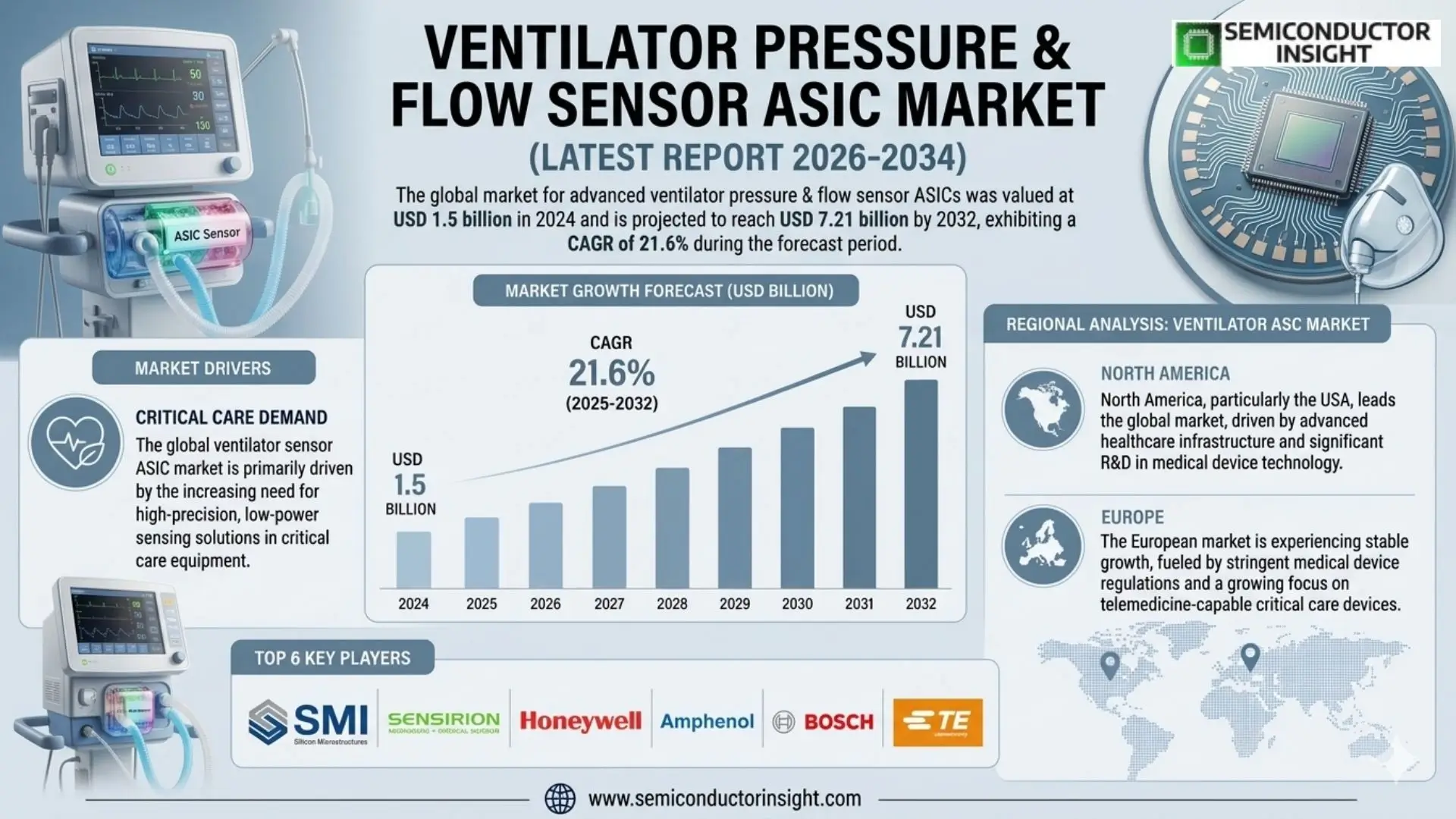
Ventilator Pressure & Flow Sensor ASIC Market size was valued at USD 312.4 million in 2025. The market is projected to grow from USD 334.6 million in 2026 to USD 621.8 million by 2034, exhibiting a CAGR of 7.1% during the forecast period.
Ventilator pressure and flow sensor ASICs (Application-Specific Integrated Circuits) are highly specialized semiconductor devices engineered to precisely measure, condition, and process pressure and airflow signals within mechanical ventilators and respiratory support systems. These integrated circuits combine analog front-end signal conditioning, analog-to-digital conversion, and digital processing functions into a single compact chip, enabling accurate real-time monitoring of airway pressure, tidal volume, and respiratory flow rates. Their design is optimized for the stringent accuracy, low power consumption, and miniaturization demands of critical care and portable ventilation equipment.
The market is witnessing sustained momentum driven by the rising global burden of respiratory diseases, including chronic obstructive pulmonary disease (COPD) and acute respiratory distress syndrome (ARDS), which has significantly amplified demand for advanced ventilatory support technologies. Furthermore, the post-pandemic expansion of intensive care infrastructure across both developed and emerging economies continues to accelerate procurement of next-generation ventilators embedded with high-precision sensor ASICs. Key industry participants such as Sensirion AG, Honeywell International Inc., and Amphenol Advanced Sensors are actively advancing their ASIC-integrated sensor portfolios to address evolving clinical and homecare ventilation requirements.
MARKET DRIVERS
Rising Global Demand for Advanced Mechanical Ventilation Systems
The Ventilator Pressure & Flow Sensor ASIC Market is experiencing robust growth driven by the accelerating global demand for high-performance mechanical ventilation systems across both critical care and homecare settings. Application-specific integrated circuits (ASICs) designed for pressure and flow sensing have become integral to modern ventilator platforms, enabling precise respiratory monitoring with minimal power consumption and reduced signal noise. As healthcare systems worldwide continue to invest in upgrading their respiratory care infrastructure, the need for purpose-built semiconductor solutions tailored to ventilator applications has intensified significantly. Miniaturization of sensor electronics combined with improved accuracy requirements in next-generation ventilators is compelling OEMs to transition from off-the-shelf analog front-end components to custom ASIC architectures.
Post-Pandemic Healthcare Infrastructure Expansion Fueling ASIC Adoption
The COVID-19 pandemic exposed critical gaps in global ventilator supply chains and catalyzed sustained government investment in respiratory care capacity. This structural shift has had a lasting impact on the Ventilator Pressure & Flow Sensor ASIC Market, as medical device manufacturers accelerated development of next-generation ventilators equipped with more sophisticated sensing and control electronics. National stockpiling programs across North America, Europe, and Asia-Pacific have generated long-term procurement pipelines for ventilator manufacturers, translating into consistent demand for proprietary ASIC solutions. Countries including Germany, Japan, South Korea, and the United States have introduced medical device self-sufficiency mandates that further incentivize domestic ventilator production and, by extension, the localized sourcing of critical semiconductor components such as pressure and flow sensor ASICs.
➤ The integration of multi-parameter sensing capabilities within a single Ventilator Pressure & Flow Sensor ASIC die is emerging as a key design paradigm, enabling ventilator manufacturers to reduce board-level component counts, lower system power budgets, and achieve tighter regulatory compliance with IEC 60601-1 and ISO 80601-2-12 standards for medical electrical equipment.
Technological advancements in CMOS process nodes and mixed-signal design methodologies are enabling sensor ASIC developers to deliver higher resolution analog-to-digital conversion, integrated signal conditioning, and digital interface compatibility within a single-chip solution optimized for ventilator pressure and flow measurement. The convergence of IoT-enabled ventilator platforms with cloud-based patient monitoring ecosystems is further driving demand for ASICs that incorporate low-power wireless interface logic alongside core sensing front-ends, broadening the addressable market for Ventilator Pressure & Flow Sensor ASIC vendors beyond traditional intensive care unit applications into home mechanical ventilation and transport ventilator segments.
MARKET CHALLENGES
Stringent Regulatory Approval Processes Creating Extended Time-to-Market Cycles
One of the most significant challenges confronting participants in the Ventilator Pressure & Flow Sensor ASIC Market is the complex and prolonged regulatory approval pathway associated with semiconductor components embedded in life-critical medical devices. ASICs incorporated into ventilator pressure and flow sensing subsystems are subject to rigorous quality management requirements under FDA 21 CFR Part 820, EU MDR 2017/745, and equivalent frameworks in key Asia-Pacific markets. Design validation, verification, and risk management documentation mandated under IEC 62304 for medical device software and ISO 14971 for risk management substantially extend development cycles, often adding 18 to 36 months to product commercialization timelines. Smaller fabless semiconductor firms targeting the ventilator ASIC space frequently encounter resource constraints in navigating these regulatory demands, limiting competitive entry and innovation velocity.
Other Challenges
Semiconductor Supply Chain Vulnerability
The Ventilator Pressure & Flow Sensor ASIC Market remains susceptible to supply chain disruptions affecting specialty foundry capacity for mixed-signal and analog CMOS process nodes. Unlike high-volume consumer semiconductor applications, ventilator ASICs are produced in relatively modest quantities, making it difficult for medical ASIC suppliers to secure priority wafer allocation at leading foundries during periods of capacity constraint. This dynamic was acutely demonstrated during the global semiconductor shortage, during which medical-grade analog process capacity was particularly constrained, causing supply delays for ventilator manufacturers dependent on single-source ASIC providers.
High Non-Recurring Engineering Costs
Custom ASIC development for ventilator pressure and flow sensing applications entails substantial non-recurring engineering (NRE) expenditures associated with mask sets, IP licensing, and extended qualification testing. These upfront investment requirements can represent a significant barrier for mid-tier ventilator OEMs that lack the volume commitments necessary to amortize NRE costs across sufficient unit shipments, often pushing such manufacturers toward general-purpose sensor solutions that may not deliver the performance optimization achievable with purpose-built Ventilator Pressure & Flow Sensor ASIC designs.
MARKET RESTRAINTS
Limited Addressable Volume Relative to High-Volume Consumer Semiconductor Markets
The Ventilator Pressure & Flow Sensor ASIC Market operates within a fundamentally niche volume environment when compared to mainstream semiconductor end markets. Annual global ventilator production volumes, even accounting for post-pandemic capacity expansions, remain orders of magnitude below the shipment scales associated with consumer electronics or automotive semiconductor applications. This volume constraint directly influences the commercial economics of ASIC development investments, as foundry minimum order quantities, packaging tooling costs, and qualification test program expenses must be recovered across a comparatively limited number of device shipments. The resulting per-unit cost structure of ventilator-grade pressure and flow sensor ASICs can make them commercially uncompetitive against general-purpose analog front-end alternatives for cost-sensitive ventilator product tiers, thereby restraining broader ASIC penetration across the full ventilator product spectrum.
Technological Conservatism Among Established Ventilator OEMs
Established ventilator manufacturers with validated product platforms exhibit a well-documented tendency toward design conservatism, preferring to maintain proven sensor and electronics architectures over the life cycle of regulatory-cleared products rather than introducing new ASIC components that would necessitate design change notifications, re-validation activities, and potential re-submission to regulatory authorities. This inherent inertia within medical device development ecosystems can substantially slow the adoption of newly developed Ventilator Pressure & Flow Sensor ASIC solutions, even where those solutions offer demonstrable performance or cost advantages over incumbent designs. The 510(k) substantial equivalence framework and CE marking re-evaluation obligations associated with component-level changes in Class II and Class IIb medical devices create meaningful disincentives for ASIC design refreshes within the product lifecycles of established ventilator platforms.
MARKET OPPORTUNITIES
Expansion of Home Mechanical Ventilation Driving Demand for Low-Power ASIC Solutions
The accelerating global shift toward home-based mechanical ventilation for patients with chronic respiratory conditions, including COPD, neuromuscular disease, and obstructive sleep apnea with respiratory failure, represents a compelling opportunity for Ventilator Pressure & Flow Sensor ASIC developers. Home ventilator platforms impose stringent constraints on power consumption, acoustic noise, and device form factor that are difficult to satisfy using discrete sensor component architectures, creating a strong design-pull toward highly integrated, low-power custom ASIC solutions. Battery-operated and AC-independent home ventilator designs in particular benefit significantly from the power efficiency achievable with purpose-optimized pressure and flow sensor ASICs, as reduced sensing electronics power draw directly translates to extended device operational autonomy ,a critical performance parameter for home and transport ventilation applications.
Emerging Markets Healthcare Modernization Creating New Ventilator ASIC Demand Centers
Rapid healthcare infrastructure development across emerging economies in Southeast Asia, Latin America, the Middle East, and Africa is generating substantial new demand for affordable yet clinically capable ventilation technology, creating a parallel opportunity for cost-optimized Ventilator Pressure & Flow Sensor ASIC solutions tailored to high-volume, price-sensitive market segments. Governments in these regions are actively pursuing domestic medical device manufacturing capability development, supported by regulatory frameworks designed to encourage local production partnerships. ASIC suppliers capable of offering scalable, application-specific sensor solutions with flexible interface architectures and competitive pricing for emerging market ventilator OEMs are well-positioned to capture meaningful share in this rapidly expanding demand geography. The growing number of regional ventilator manufacturing initiatives, supported by multilateral development financing, further reinforces the structural demand outlook for Ventilator Pressure & Flow Sensor ASIC components in these high-growth markets.
AI-Integrated Ventilator Platforms Creating Advanced ASIC Feature Requirements
The increasing incorporation of artificial intelligence and machine learning algorithms into ventilator control and patient-synchrony optimization systems is creating a new tier of performance requirements for pressure and flow sensing subsystems that conventional discrete sensor architectures are poorly equipped to satisfy. AI-driven ventilation management platforms demand higher sampling rates, improved measurement resolution, and deterministic digital data output latency from their sensing front-ends ,characteristics that align closely with the capabilities achievable through purpose-built Ventilator Pressure & Flow Sensor ASIC designs incorporating sigma-delta ADC cores, digital filtering, and standardized digital communication interfaces. This technology convergence trend represents a significant design opportunity for ASIC developers to position next-generation sensor integrated circuits as enabling components for the intelligent ventilator platforms that leading respiratory care OEMs are currently bringing to clinical and commercial development.
Trends
Rising Respiratory Disease Burden Driving Demand for High-Precision Sensor ASICs
The Ventilator Pressure & Flow Sensor ASIC Market is experiencing sustained growth momentum, primarily driven by the escalating global burden of respiratory diseases such as chronic obstructive pulmonary disease (COPD) and acute respiratory distress syndrome (ARDS). As these conditions continue to affect millions of patients worldwide, healthcare providers are increasingly relying on advanced mechanical ventilators embedded with high-precision sensor ASICs capable of delivering accurate real-time monitoring of airway pressure, tidal volume, and respiratory flow rates. The integration of analog front-end signal conditioning, analog-to-digital conversion, and digital processing functions into a single compact chip has positioned these ASICs as indispensable components in modern critical care ventilation systems.
Other Trends
Post-Pandemic Expansion of Intensive Care Infrastructure
The global healthcare response following the COVID-19 pandemic triggered a significant expansion of intensive care unit (ICU) infrastructure across both developed and emerging economies. This infrastructural scale-up has directly accelerated procurement of next-generation ventilators that incorporate Ventilator Pressure & Flow Sensor ASIC technologies. Hospitals and healthcare systems are increasingly prioritizing high-performance ventilatory support solutions to improve patient outcomes in critical care settings, sustaining long-term demand for advanced ASIC-integrated sensor solutions.
Miniaturization and Low Power Consumption as Design Priorities
A notable trend shaping the Ventilator Pressure & Flow Sensor ASIC Market is the growing emphasis on miniaturization and low power consumption in ASIC design. As portable and home-care ventilators gain wider adoption, manufacturers are engineering ASICs that deliver high measurement accuracy within compact, energy-efficient form factors. This design evolution supports the transition of ventilatory care beyond hospital settings into ambulatory and home environments, expanding the addressable market for sensor ASIC developers.
Active Portfolio Advancement by Key Industry Participants
Leading companies in the Ventilator Pressure & Flow Sensor ASIC Market, including Sensirion AG, Honeywell International Inc., and Amphenol Advanced Sensors, are actively advancing their ASIC-integrated sensor portfolios to address evolving clinical and homecare ventilation requirements. These organizations are investing in research and development initiatives aimed at enhancing sensor accuracy, signal conditioning capabilities, and system-level integration. Such competitive activity is fostering continuous innovation within the market, enabling ventilator manufacturers to adopt increasingly sophisticated pressure and flow sensing solutions that meet stringent regulatory and clinical performance standards.
COMPETITIVE LANDSCAPEKey Industry Players
Ventilator Pressure & Flow Sensor ASIC Market: Competitive Dynamics and Leading Manufacturers
Ventilator Pressure & Flow Sensor ASIC Market is characterized by a moderately consolidated competitive landscape, with a handful of technologically advanced semiconductor and sensing solution providers commanding significant market share. Sensirion AG stands out as a preeminent player, renowned for its highly integrated ASIC-based differential pressure and flow sensor solutions tailored for respiratory and critical care ventilation applications. Honeywell International Inc. similarly holds a strong position through its portfolio of medical-grade pressure sensing ASICs, leveraging decades of expertise in signal conditioning and analog front-end design optimized for low-power, high-accuracy ventilator integration. Amphenol Advanced Sensors further reinforces the competitive intensity by offering precision ASIC-embedded flow and pressure transducers designed for both hospital-grade mechanical ventilators and portable homecare respiratory devices. These leading incumbents continuously invest in miniaturization, power efficiency improvements, and regulatory compliance to sustain their competitive advantages across developed and emerging market segments.
Beyond the leading tier, several specialized and mid-tier participants contribute meaningfully to the competitive fabric of the Ventilator Pressure & Flow Sensor ASIC market. Companies such as TE Connectivity, Bosch Sensortec, and First Sensor AG (a TDK Group company) have developed differentiated ASIC-integrated sensor platforms addressing the growing demand for next-generation ventilators in intensive care and homecare settings. NXP Semiconductors and Infineon Technologies bring robust analog mixed-signal ASIC design capabilities to the space, enabling OEM ventilator manufacturers to source highly customized signal processing solutions. Meanwhile, emerging players and contract ASIC design houses such as IXYS (now part of Littelfuse) and Melexis are expanding their medical sensor ASIC competencies to capture incremental growth opportunities arising from post-pandemic ICU infrastructure expansion and the rising global burden of COPD and ARDS. The competitive environment continues to evolve as partnerships between ASIC designers and ventilator OEMs deepen, further blurring boundaries between component suppliers and integrated solution providers.
List of Key Ventilator Pressure & Flow Sensor ASIC Companies Profiled
- Sensirion AG
- Honeywell International Inc.
- Amphenol Advanced Sensors
- TE Connectivity
- Bosch Sensortec GmbH
- First Sensor AG (TDK Group)
- NXP Semiconductors N.V.
- Infineon Technologies AG
- Melexis NV
- Littelfuse, Inc. (IXYS)
- Measurement Specialties (TE Connectivity)
- Omron Corporation
- Merit Sensor Systems
Segment Analysis:
| Segment Category | Sub-Segments | Key Insights |
| By Type |
|
Combination Pressure & Flow Sensor ASICs represent the leading segment in the Ventilator Pressure & Flow Sensor ASIC market, driven by the growing clinical preference for integrated solutions that consolidate multiple sensing functions into a single compact chip.
|
| By Application |
|
Invasive Mechanical Ventilation holds the dominant position among application segments, as it constitutes the most demanding and clinically critical use case for high-precision ventilator pressure and flow sensor ASICs.
|
| By End User |
|
Hospitals & ICUs remain the predominant end-user segment for ventilator pressure and flow sensor ASICs, underpinned by the concentration of critically ill patients requiring sustained and precisely controlled mechanical respiratory support.
|
| By Technology |
|
MEMS-Based Sensor ASICs constitute the leading technology segment, owing to the unique advantages that Micro-Electro-Mechanical Systems fabrication offers in terms of miniaturization, precision, and integration density.
|
| By Portability |
|
Stationary/Intensive Care Ventilator ASICs lead this segment by virtue of the high technical performance benchmarks and stringent regulatory compliance requirements associated with hospital-grade critical care ventilation equipment.
|
Regional Analysis: Ventilator Pressure & Flow Sensor ASIC Market
North America
North America benefits from a clearly defined regulatory landscape governed by the U.S. Food and Drug Administration and Health Canada, which mandates stringent performance benchmarks for medical-grade ASICs. These regulatory guardrails encourage manufacturers to invest in high-precision sensor integration, ensuring that ventilator pressure and flow sensor ASIC products meet clinical-grade accuracy requirements before reaching the market.
The region hosts a dense cluster of semiconductor research institutions and medtech innovation hubs, fostering continuous advancement in low-power, miniaturized ASIC designs. Collaboration between academic medical centers and chip designers is accelerating the development of intelligent sensor solutions that deliver enhanced signal fidelity, critical for next-generation ventilator platforms operating across diverse care settings.
A well-capitalized hospital network and growing prevalence of chronic respiratory conditions create sustained procurement demand for advanced ventilatory solutions. This demand cascades directly into the ventilator pressure and flow sensor ASIC market, as device manufacturers prioritize components that offer superior calibration stability, low noise performance, and compatibility with digital health monitoring ecosystems increasingly deployed in North American ICUs.
North America’s semiconductor supply chain, reinforced by domestic chip manufacturing initiatives and strategic partnerships with foundries, provides a resilient production base. This infrastructure reduces dependency on overseas fabrication for critical medical ASICs and strengthens the region’s capacity to respond swiftly to surges in ventilator component demand, a factor of considerable strategic relevance following global health emergencies.
Europe
Europe represents a highly sophisticated and consistently growing segment of the ventilator pressure and flow sensor ASIC market, anchored by strong public healthcare systems, rigorous medical device directives, and a culture of engineering excellence. Countries such as Germany, the Netherlands, and Switzerland are home to internationally recognized respiratory device manufacturers and precision electronics specialists who actively incorporate high-performance ASICs into their ventilator portfolios. The European Union’s Medical Device Regulation framework has elevated product quality expectations, incentivizing ASIC developers to prioritize long-term reliability, biocompatibility compliance, and traceability throughout the component lifecycle. The region also benefits from a well-integrated cross-border research ecosystem under initiatives such as Horizon Europe, which channels funding into smart medical technologies including advanced sensor integration. As European healthcare systems face mounting pressure to improve outcomes in chronic obstructive pulmonary disease and post-surgical respiratory care, demand for clinically validated ventilator pressure and flow sensor ASICs is expected to grow in a steady and quality-driven manner through the forecast period.
Asia-Pacific
Asia-Pacific is emerging as one of the most dynamic growth frontiers in the ventilator pressure and flow sensor ASIC market, propelled by rapidly expanding healthcare infrastructure, rising disease burden, and aggressive government investment in domestic medical device manufacturing. China, Japan, South Korea, and India collectively represent a heterogeneous but high-potential landscape where both demand-side and supply-side factors are converging favorably. China’s emphasis on semiconductor self-sufficiency, combined with substantial state-backed funding for medical electronics, is creating a pipeline of locally designed ASICs tailored for ventilator applications. Japan and South Korea contribute deep expertise in precision component fabrication, while India’s growing medical device industry is progressively integrating sophisticated sensor technologies. Increasing awareness of respiratory health, driven by urbanization and air quality concerns, further amplifies the regional appetite for advanced ventilatory equipment, making Asia-Pacific a critical battleground for global ASIC suppliers and local innovators alike.
South America
South America occupies a developing but increasingly relevant position within the global ventilator pressure and flow sensor ASIC market. Brazil leads regional activity, supported by a sizeable public health network and a growing private hospital sector that is gradually upgrading its critical care capabilities. The regional market is characterized by a reliance on imported ventilator systems, which in turn drives indirect demand for high-quality ASICs embedded within those platforms. Efforts to strengthen local medical device manufacturing in Brazil and Argentina, supported by national industrial policy frameworks, are beginning to create modest but meaningful opportunities for ASIC component integration at the regional level. Economic volatility and currency fluctuations remain structural challenges that can constrain procurement cycles; however, international partnerships and multilateral health funding programs are helping to sustain investment in respiratory care modernization, gradually building a more favorable environment for ventilator pressure and flow sensor ASIC market participants over the long term.
Middle East & Africa
The Middle East and Africa region presents a dual narrative within the ventilator pressure and flow sensor ASIC market, characterized by pockets of advanced healthcare investment alongside significant infrastructure gaps. Gulf Cooperation Council nations, particularly Saudi Arabia and the United Arab Emirates, have made substantial commitments to world-class hospital development and medical technology adoption, creating selective but high-value demand for sophisticated ventilator components including precision ASICs. National healthcare transformation agendas such as Saudi Vision 2030 are accelerating the procurement of advanced life support equipment, which incorporates ventilator pressure and flow sensor solutions. In contrast, sub-Saharan African markets remain largely underserved due to limited critical care infrastructure and funding constraints, although international development partnerships are beginning to address respiratory care deficits. Over the forecast horizon, the region is expected to witness gradual market maturation, with the Middle East sub-region driving the majority of incremental demand within the ventilator pressure and flow sensor ASIC landscape.
Report Scope
This market research report provides a comprehensive analysis of the Ventilator Pressure & Flow Sensor ASIC Market , covering the forecast period 2026–2034. It offers detailed insights into market dynamics, technological advancements, competitive landscape, and key trends shaping the industry.
Key focus areas of the report include:
- Market Overview: The report begins with an overview outlining its current market scenario, key growth indicators, and industry transformation drivers. It discusses macroeconomic factors, demand–supply balance, regulatory landscape, and the strategic role of semiconductors in powering advancements across industries such as automotive, telecommunications, consumer electronics, and industrial automation.
- Market Size & Forecast: Historical data and future projections for revenue, unit shipments, and market value across major regions and segments.
- Segmentation Analysis: Detailed breakdown by product type, technology, application, and end-user industry to identify high-growth segments and investment opportunities.
- Regional Insights: Insights into market performance across North America, Europe, Asia-Pacific, Latin America, and the Middle East & Africa, including country-level analysis where relevant.
- Competitive Landscape: Profiles of leading market participants, including their product offerings, R&D focus, manufacturing capacity, pricing strategies, and recent developments such as mergers, acquisitions, and partnerships.
- Technology Trends & Innovation: Assessment of emerging technologies, integration of AI/IoT, semiconductor design trends, fabrication techniques, and evolving industry standards.
- Market Drivers & Restraints: Evaluation of factors driving market growth along with challenges, supply chain constraints, regulatory issues, and market-entry barriers.
- Stakeholder Insights: Insights for component suppliers, OEMs, system integrators, investors, and policymakers regarding the evolving ecosystem and strategic opportunities.
Primary and secondary research methods are employed, including interviews with industry experts, data from verified sources, and real-time market intelligence to ensure the accuracy and reliability of the insights presented.
FREQUENTLY ASKED QUESTIONS:
What is the current market size of Ventilator Pressure & Flow Sensor ASIC Market?
-> Global Ventilator Pressure & Flow Sensor ASIC Market was valued at USD 312.4 million in 2025 and is expected to reach USD 621.8 million by 2034, growing at a CAGR of 7.1% during the forecast period 2026–2034.
Which key companies operate Ventilator Pressure & Flow Sensor ASIC Market?
-> Key players include Sensirion AG, Honeywell International Inc., and Amphenol Advanced Sensors, among others, who are actively advancing their ASIC-integrated sensor portfolios to address evolving clinical and homecare ventilation requirements.
What are the key growth drivers?
-> Key growth drivers include rising global burden of respiratory diseases such as COPD and ARDS, post-pandemic expansion of intensive care infrastructure across developed and emerging economies, and increasing procurement of next-generation ventilators embedded with high-precision sensor ASICs.
Which region dominates the market?
-> Asia-Pacific is the fastest-growing region driven by expanding healthcare infrastructure, while North America and Europe remain dominant markets supported by advanced critical care facilities and strong regulatory frameworks.
What are the emerging trends?
-> Emerging trends include miniaturization of sensor ASICs, integration of analog front-end signal conditioning with digital processing in single compact chips, growing adoption in portable and homecare ventilation equipment, and advancements in low-power ASIC design for critical care applications.

Get Sample Report PDF for Exclusive Insights
Report Sample Includes
- Table of Contents
- List of Tables & Figures
- Charts, Research Methodology, and more...
 Download Sample Report PDF