Ultrasound Beamforming Transmit/Receive (TX/RX) ASIC Market Insights
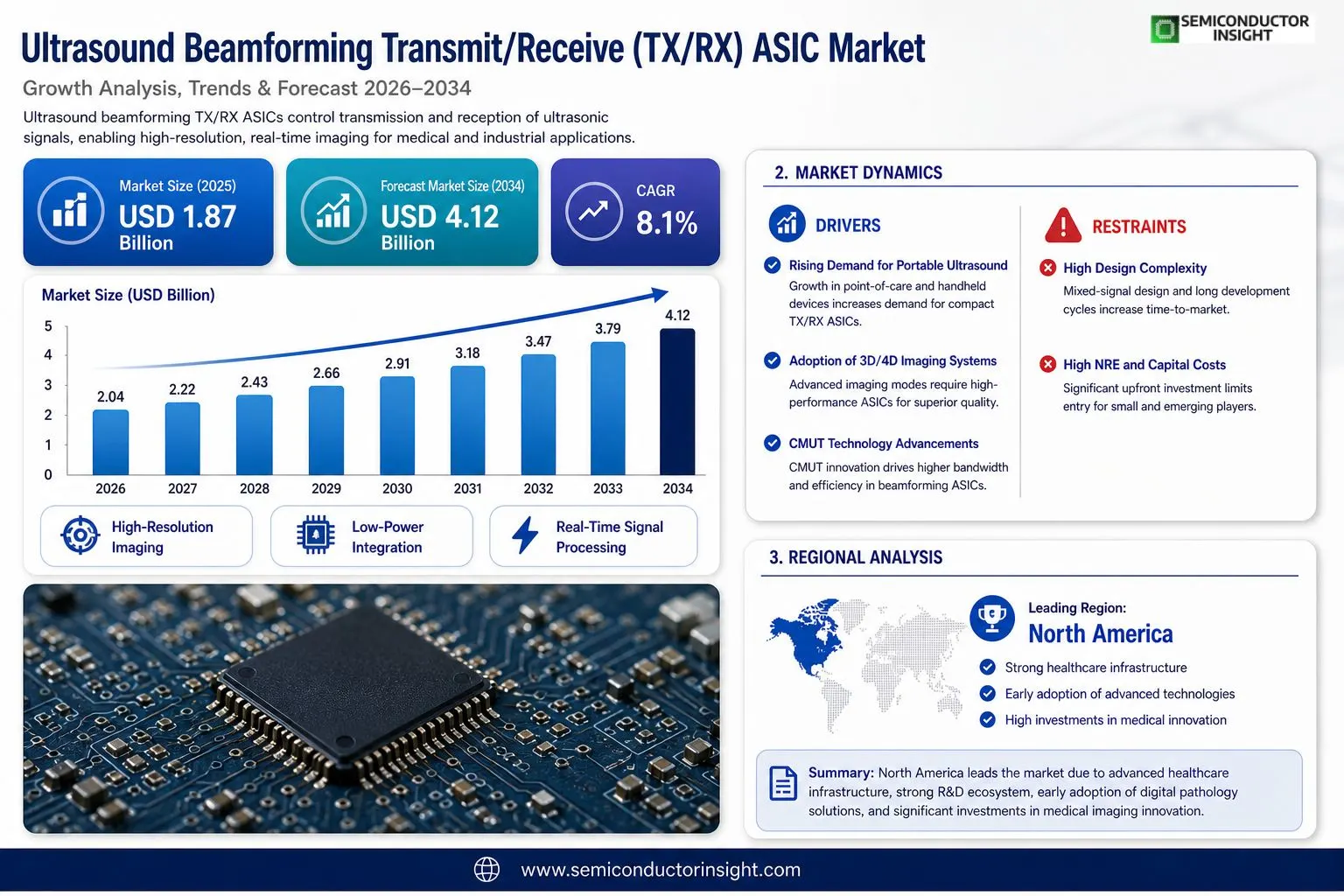
Global Ultrasound Beamforming Transmit/Receive (TX/RX) ASIC Market size was valued at USD 1.87 billion in 2025. The market is projected to grow from USD 2.04 billion in 2026 to USD 4.12 billion by 2034, exhibiting a CAGR of 8.1% during the forecast period.
Ultrasound beamforming TX/RX ASICs are highly specialized integrated circuits engineered to control the transmission and reception of ultrasonic signals in medical imaging and industrial sensing systems. These chips manage the precise timing, phasing, and amplification of signals across multiple transducer channels, enabling high-resolution, real-time imaging. Core functions embedded within these ASICs include high-voltage pulsers, low-noise amplifiers (LNAs), time-gain compensation (TGC) circuits, analog-to-digital converters (ADCs), and digital beamforming logic, all integrated onto a single compact die to maximize performance while minimizing power consumption and form factor.
The market is witnessing strong momentum driven by rising global demand for point-of-care and portable ultrasound devices, growing adoption of 3D/4D imaging systems, and continued miniaturization of diagnostic equipment. Furthermore, advancements in CMUT (Capacitive Micromachined Ultrasonic Transducer) technology are placing new performance demands on TX/RX ASIC architectures, accelerating design innovation. Key industry participants shaping the competitive landscape include Texas Instruments Inc., Analog Devices Inc., Butterfly Network Inc., Fujifilm SonoSite, and Microsemi Corporation, each offering differentiated beamforming ASIC solutions targeting a broad spectrum of clinical and non-destructive testing applications.
MARKET DRIVERS
Rising Demand for Advanced Medical Imaging Systems
Ultrasound Beamforming Transmit/Receive (TX/RX) ASIC Market is experiencing robust growth driven by the accelerating adoption of high-resolution diagnostic ultrasound systems across hospitals, diagnostic centers, and point-of-care settings. As healthcare providers seek greater imaging precision, the demand for purpose-built application-specific integrated circuits that manage beamforming signal processing has intensified. These ASICs enable real-time, high-channel-count ultrasound signal transmission and reception with significantly lower power consumption compared to conventional programmable processors, making them critical components in next-generation ultrasound platforms.
Proliferation of Portable and Handheld Ultrasound Devices
A key growth driver in Ultrasound Beamforming TX/RX ASIC Market is the rapid expansion of portable, handheld, and wearable ultrasound devices. Miniaturized form factors demand highly integrated beamforming ASICs that can deliver full-featured transmit and receive functionality within tight power and space budgets. The shift toward point-of-care ultrasound (POCUS) , particularly in emergency medicine, cardiology, and obstetrics , has created sustained demand for compact, low-power TX/RX ASICs. This trend is further reinforced by telemedicine adoption and the growing need for remote diagnostic tools in underserved and rural healthcare markets globally.
➤ The convergence of miniaturized ultrasound hardware with AI-assisted image reconstruction is positioning TX/RX beamforming ASICs as foundational silicon components in the next generation of intelligent diagnostic imaging systems.
Technological advancements in semiconductor process nodes have allowed ASIC designers to integrate more transmit/receive channels, high-voltage switching circuitry, time-gain compensation (TGC) amplifiers, and analog-to-digital converters onto a single die. This level of integration directly reduces system-level bill-of-materials costs and printed circuit board complexity for ultrasound OEMs, further strengthening the business case for custom beamforming ASICs over off-the-shelf component solutions. These capabilities are making TX/RX ASICs an increasingly preferred architecture among ultrasound system manufacturers worldwide.
MARKET CHALLENGES
High Design Complexity and Extended Development Timelines
One of the most significant challenges facing Ultrasound Beamforming Transmit/Receive (TX/RX) ASIC Market is the inherent complexity of designing mixed-signal ASICs that must simultaneously manage high-voltage transmit pulses and extremely low-amplitude receive signals within the same integrated circuit. Achieving the required dynamic range, channel isolation, and noise performance demands extensive analog and mixed-signal design expertise. Development cycles for custom ultrasound beamforming ASICs can span multiple years from specification to tape-out, creating substantial time-to-market risks for both semiconductor developers and ultrasound OEM customers.
Other Challenges
High NRE Costs and Capital Investment
The non-recurring engineering (NRE) costs associated with designing and fabricating ultrasound beamforming TX/RX ASICs in advanced process nodes represent a considerable financial barrier, particularly for smaller ultrasound system developers and emerging market entrants. Mask set costs, verification overhead, and post-silicon validation expenses require significant upfront capital commitments before any revenue can be generated, limiting the number of viable participants in this specialized segment of the semiconductor market.
Stringent Regulatory and Safety Requirements
Ultrasound imaging devices are classified as medical equipment and are subject to rigorous regulatory oversight by bodies such as the U.S. FDA, the European MDR framework, and equivalent agencies across Asia-Pacific markets. TX/RX ASICs integrated into diagnostic ultrasound systems must conform to applicable IEC and ISO standards governing acoustic output safety, electromagnetic compatibility, and electrical safety. Navigating this regulatory landscape adds engineering and documentation overhead that can extend product commercialization timelines and increase compliance costs for ASIC vendors and their OEM partners.
MARKET RESTRAINTS
Concentration Among a Limited Number of Specialized Suppliers
Ultrasound Beamforming TX/RX ASIC Market is characterized by a relatively concentrated supplier landscape, with a small number of semiconductor companies possessing the specialized mixed-signal design capabilities, high-voltage process technology access, and domain expertise required to develop competitive beamforming ASIC solutions. This concentration creates supply chain vulnerability for ultrasound OEMs, particularly during periods of semiconductor capacity constraints or geopolitical disruptions affecting foundry access. The limited supplier base also reduces competitive pricing pressure, which can restrain broader adoption among cost-sensitive market segments.
Competition from FPGA-Based and Software-Defined Beamforming Architectures
An important market restraint for Ultrasound Beamforming Transmit/Receive (TX/RX) ASIC Market is the continued viability of FPGA-based and software-defined beamforming architectures in high-end ultrasound systems. For premium cart-based systems where power consumption and board area are less constrained, FPGAs offer design flexibility and shorter development cycles that can be preferable to committing to a fixed-function ASIC. Additionally, GPU-accelerated software beamforming approaches are gaining traction in research and advanced clinical platforms, presenting an alternative architecture that does not rely on dedicated TX/RX beamforming ASICs, thereby moderating demand growth in certain premium system categories.
MARKET OPPORTUNITIES
Expansion into Emerging Markets and Developing Healthcare Infrastructure
Significant growth opportunities exist for Ultrasound Beamforming Transmit/Receive (TX/RX) ASIC Market in emerging economies across Asia-Pacific, Latin America, the Middle East, and Africa, where governments are actively investing in healthcare infrastructure modernization. The demand for affordable, portable ultrasound systems in these regions is creating a substantial addressable market for cost-optimized TX/RX beamforming ASICs that enable high-performance imaging in low-resource settings. Local manufacturing initiatives and favorable medical device import policies in countries such as India, China, Brazil, and Indonesia are further accelerating adoption of compact ultrasound platforms built around integrated beamforming ASIC architectures.
Integration of AI and Machine Learning Capabilities at the ASIC Level
The incorporation of on-chip artificial intelligence inference capabilities into future generations of ultrasound beamforming TX/RX ASICs represents a compelling market opportunity. By embedding lightweight neural processing elements alongside traditional beamforming signal chains, next-generation ASICs can enable real-time AI-assisted image enhancement, automated anatomy recognition, and adaptive beamforming optimization directly at the hardware level. This architectural evolution is expected to create premium product differentiation opportunities for ASIC vendors, as ultrasound OEMs seek to deliver smarter, more autonomous imaging systems without incurring the power and latency penalties associated with off-chip AI processing solutions.
Growth in Therapeutic Ultrasound and Non-Imaging Applications
Beyond conventional diagnostic imaging, Ultrasound Beamforming TX/RX ASIC Market is well-positioned to benefit from expanding applications in therapeutic ultrasound, including high-intensity focused ultrasound (HIFU), transcranial ultrasound neuromodulation, and ultrasound-guided drug delivery. These therapeutic modalities require precise, programmable transmit beamforming with tight phase and amplitude control across large transducer arrays , capabilities that custom TX/RX ASICs are uniquely suited to deliver. As clinical evidence supporting these non-imaging ultrasound applications continues to accumulate, the addressable market for specialized beamforming ASIC solutions is expected to broaden substantially beyond traditional diagnostic imaging end markets.
Ultrasound Beamforming Transmit/Receive (TX/RX) ASIC Market Trends
Rising Demand for Point-of-Care and Portable Ultrasound Devices
Ultrasound Beamforming Transmit/Receive (TX/RX) ASIC Market is experiencing significant momentum driven by the accelerating adoption of point-of-care and portable ultrasound systems across clinical settings. As healthcare providers increasingly prioritize bedside diagnostics and remote patient monitoring, the need for compact, power-efficient TX/RX ASICs has intensified. These highly specialized integrated circuits enable real-time, high-resolution imaging in handheld and cart-based devices by integrating high-voltage pulsers, low-noise amplifiers, time-gain compensation circuits, and analog-to-digital converters onto a single compact die. This level of integration is critical to achieving the miniaturization required by next-generation portable ultrasound platforms without compromising diagnostic image quality.
Other Trends
Advancement in CMUT Technology Driving ASIC Design Innovation
Capacitive Micromachined Ultrasonic Transducer (CMUT) technology is placing new and demanding performance requirements on TX/RX ASIC architectures within the ultrasound beamforming landscape. Unlike conventional piezoelectric transducers, CMUTs offer broader bandwidth and improved integration compatibility with CMOS processes, compelling ASIC designers to rethink signal conditioning, channel density, and power management strategies. This technological shift is accelerating design innovation among key industry participants such as Texas Instruments Inc., Analog Devices Inc., and Butterfly Network Inc., each developing differentiated beamforming ASIC solutions to address evolving transducer requirements across both medical imaging and industrial non-destructive testing applications.
Growing Adoption of 3D/4D Imaging Systems
The growing clinical preference for 3D and 4D ultrasound imaging is emerging as a pivotal trend shaping Ultrasound Beamforming TX/RX ASIC Market. These advanced imaging modalities require ASICs capable of managing significantly higher channel counts, more complex phasing logic, and increased data throughput compared to conventional 2D systems. As a result, semiconductor companies are investing in next-generation digital beamforming logic architectures to support volumetric imaging workflows. Fujifilm SonoSite and Microsemi Corporation are among the established players expanding their ASIC portfolios to serve this demand across obstetrics, cardiology, and oncology specialties.
Miniaturization and System-on-Chip Integration as a Defining Market Trend
Continued miniaturization of diagnostic equipment remains a defining trend within the ultrasound beamforming TX/RX ASIC sector. The industry is witnessing a clear shift toward higher levels of system-on-chip integration, where traditionally discrete functions such as beamforming control, analog front-end processing, and digital signal management are consolidated onto a single ASIC platform. This integration trend reduces overall system power consumption, lowers printed circuit board footprint, and enables cost-effective scaling for both high-end hospital imaging systems and affordable point-of-care devices, reinforcing the long-term growth trajectory of Global Ultrasound Beamforming Transmit/Receive (TX/RX) ASIC Market.
COMPETITIVE LANDSCAPE
Key Industry Players
Ultrasound Beamforming TX/RX ASIC Market , Leading Innovators Driving Next-Generation Medical Imaging and Industrial Sensing Solutions
Global Ultrasound Beamforming Transmit/Receive (TX/RX) ASIC market, valued at USD 1.87 billion in 2025 and projected to reach USD 4.12 billion by 2034 at a CAGR of 8.1%, is characterized by a concentrated yet dynamic competitive environment. Texas Instruments Inc. and Analog Devices Inc. (ADI) collectively hold significant market share by offering high-performance, multi-channel beamforming ASIC solutions that integrate high-voltage pulsers, low-noise amplifiers (LNAs), time-gain compensation (TGC) circuits, and analog-to-digital converters (ADCs) on a single die. These industry leaders leverage decades of mixed-signal expertise and broad distribution networks to serve OEM medical imaging customers across portable, cart-based, and point-of-care ultrasound platforms. Butterfly Network Inc. has emerged as a disruptive force through its proprietary Ultrasound-on-Chip™ architecture built on CMUT transducer technology, enabling fully integrated, smartphone-compatible handheld devices that challenge conventional probe-based imaging paradigms.
Beyond the dominant players, several specialized and emerging companies are carving notable positions within the ultrasound beamforming TX/RX ASIC ecosystem. Microchip Technology Inc. (following its acquisition of Microsemi Corporation) offers robust ASIC and FPGA-based beamforming solutions targeting both clinical and non-destructive testing (NDT) applications. Fujifilm SonoSite and Mindray Medical International continue to develop proprietary ASIC platforms optimized for their portable and handheld ultrasound product lines. On the semiconductor IP and foundry side, companies such as Renesas Electronics, STMicroelectronics, and Maxim Integrated (now part of Analog Devices) contribute enabling technologies including high-voltage CMOS processes and ultra-low-power front-end circuits critical for miniaturized ASIC designs. Semiconductor start-ups and fabless design houses, including Interson Corporation and Verasonics, further enrich the competitive spectrum by targeting high-channel-count research systems and OEM beamforming engine modules. The growing adoption of 3D/4D imaging and CMUT-based transducers continues to accelerate design innovation, intensifying competition across both established and emerging participants.
List of Key Ultrasound Beamforming TX/RX ASIC Companies Profiled
- Texas Instruments Inc.
- Analog Devices Inc.
- Butterfly Network Inc.
- Microchip Technology Inc. (Microsemi)
- Fujifilm SonoSite
- Mindray Medical International
- Renesas Electronics Corporation
- STMicroelectronics
- Maxim Integrated (now part of Analog Devices Inc.)
- Verasonics Inc.
- Interson Corporation
- Qualtek Electronics
- Hitachi Healthcare
- GE HealthCare Technologies Inc.
- Siemens Healthineers AG
Segment Analysis:
| Segment Category | Sub-Segments | Key Insights |
| By Type |
|
Digital Beamforming TX/RX ASICs represent the leading segment within this category, driven by their superior signal processing capabilities and compatibility with advanced imaging modalities.
|
| By Application |
|
Medical Diagnostic Imaging dominates the application landscape and continues to consolidate its position as the primary demand driver for ultrasound beamforming TX/RX ASICs.
|
| By End User |
|
Hospitals and Diagnostic Centers constitute the leading end-user segment, representing the largest and most consistent source of demand for ultrasound beamforming TX/RX ASICs globally.
|
| By Integration Level |
|
Fully Integrated System-on-Chip (SoC) ASICs are emerging as the most strategically significant sub-segment within the integration level category, reflecting the broader industry trend toward miniaturization and functional consolidation.
|
| By Transducer Compatibility |
|
Piezoelectric Transducer (PZT)-Compatible ASICs currently lead this segment owing to the deeply entrenched installed base of PZT-based ultrasound probes across clinical and industrial settings worldwide.
|
Regional Analysis: Ultrasound Beamforming Transmit/Receive (TX/RX) ASIC Market
North America
North America hosts a dense concentration of fabless semiconductor companies and research universities actively advancing TX/RX ASIC architecture. The region’s emphasis on low-power, high-channel-count beamforming chips has positioned it as the primary source of intellectual property in the Ultrasound Beamforming Transmit/Receive ASIC Market, with continuous innovation driven by both defense and medical imaging application demands.
The rapid proliferation of handheld and portable ultrasound devices across U.S. hospitals, emergency departments, and outpatient facilities is a key demand driver for compact TX/RX ASICs. This shift toward decentralized diagnostic imaging is reinforcing the need for highly integrated, energy-efficient beamforming solutions tailored to mobile clinical environments throughout North America.
The FDA’s well-defined approval pathways for ultrasound imaging devices lend commercial predictability to ASIC developers operating in North America. This structured regulatory landscape encourages sustained product development cycles and facilitates partnerships between chip designers and medical device OEMs, strengthening the overall supply chain for Ultrasound Beamforming TX/RX ASIC Market across the region.
Beyond medical imaging, North American demand for TX/RX ASICs is reinforced by non-destructive testing, sonar, and defense-related sonar and sensing programs. Government procurement and defense contractor involvement provide a parallel revenue stream that sustains ASIC design investment, broadening the commercial relevance of beamforming transmit/receive technology across multiple high-value verticals.
Europe
Europe represents a highly sophisticated and innovation-driven regional participant in Ultrasound Beamforming Transmit/Receive (TX/RX) ASIC Market. Countries such as Germany, the Netherlands, France, and the United Kingdom are home to prominent ultrasound system integrators and semiconductor design centers that maintain close collaboration with academic medical institutions. The European regulatory environment, guided by the CE marking framework and the EU Medical Device Regulation, provides a rigorous yet navigable pathway for advanced imaging technologies. The region places strong emphasis on miniaturization, energy efficiency, and system-on-chip integration, aligning well with the technical trajectory of beamforming ASIC development. Additionally, Europe’s substantial investment in healthcare infrastructure modernization and its aging population base are generating sustained demand for advanced diagnostic ultrasound platforms that rely on high-performance TX/RX ASICs. Cross-border research consortia funded through Horizon Europe further accelerate knowledge transfer and applied research in ultrasound signal processing across the continent.
Asia-Pacific
Asia-Pacific is emerging as the fastest-growing regional market within Global Ultrasound Beamforming Transmit/Receive (TX/RX) ASIC landscape. China, Japan, South Korea, and India are collectively reshaping the competitive dynamics of the market through expanding domestic semiconductor manufacturing capabilities, increasing healthcare expenditure, and a rapidly growing base of ultrasound system manufacturers. China, in particular, is investing heavily in indigenous ASIC design capabilities as part of broader national strategies to reduce dependence on foreign semiconductor suppliers. Japan and South Korea contribute through their precision engineering cultures and established presence in consumer and medical electronics. India’s expanding healthcare access initiatives and rising medical device manufacturing ecosystem are creating new demand channels for affordable, high-performance beamforming solutions. The region’s combination of cost-competitive production and rising technological sophistication makes it a pivotal arena for Ultrasound Beamforming TX/RX ASIC Market through 2034.
South America
South America occupies an emerging position in Ultrasound Beamforming Transmit/Receive (TX/RX) ASIC Market, with Brazil and Mexico serving as the primary growth anchors. The region’s healthcare sector is undergoing gradual modernization, with public and private investment directed toward expanding diagnostic imaging infrastructure in urban and semi-urban centers. Demand for cost-effective ultrasound systems equipped with efficient TX/RX ASICs is rising as healthcare providers seek to improve diagnostic accessibility without significant capital outlays. While the region currently relies heavily on imported ultrasound platforms and components, localized assembly and growing medtech entrepreneurship are beginning to shape a more self-sufficient ecosystem. Regulatory harmonization efforts aligned with international standards are also improving market access for global ASIC suppliers. South America’s long-term trajectory in the Ultrasound Beamforming ASIC Market will depend on macroeconomic stability and continued healthcare investment from regional governments.
Middle East & Africa
The Middle East and Africa region presents a nascent but progressively relevant opportunity within Ultrasound Beamforming Transmit/Receive (TX/RX) ASIC Market. Gulf Cooperation Council nations, particularly the United Arab Emirates and Saudi Arabia, are spearheading healthcare infrastructure development through ambitious national vision programs that prioritize advanced medical technology adoption. These investments are creating demand for sophisticated ultrasound imaging systems underpinned by high-performance beamforming ASICs. In Africa, the emphasis is shifting toward affordable, portable ultrasound solutions suitable for low-resource clinical environments, a trend that aligns directly with compact TX/RX ASIC design. Philanthropic initiatives and international development funding are facilitating the deployment of point-of-care ultrasound devices across sub-Saharan markets. While the region currently contributes a modest share to global market revenues, its long-term potential is underpinned by population growth, rising disease burden, and growing awareness of diagnostic imaging’s role in improving health outcomes.
Report Scope
This market research report provides a comprehensive analysis of the Ultrasound Beamforming Transmit/Receive (TX/RX) ASIC Market , covering the forecast period 2026–2034. It offers detailed insights into market dynamics, technological advancements, competitive landscape, and key trends shaping the industry.
Key focus areas of the report include:
- Market Overview: The report begins with an overview outlining its current market scenario, key growth indicators, and industry transformation drivers. It discusses macroeconomic factors, demand–supply balance, regulatory landscape, and the strategic role of semiconductors in powering advancements across industries such as automotive, telecommunications, consumer electronics, and industrial automation.
- Market Size & Forecast: Historical data and future projections for revenue, unit shipments, and market value across major regions and segments.
- Segmentation Analysis: Detailed breakdown by product type, technology, application, and end-user industry to identify high-growth segments and investment opportunities.
- Regional Insights: Insights into market performance across North America, Europe, Asia-Pacific, Latin America, and the Middle East & Africa, including country-level analysis where relevant.
- Competitive Landscape: Profiles of leading market participants, including their product offerings, R&D focus, manufacturing capacity, pricing strategies, and recent developments such as mergers, acquisitions, and partnerships.
- Technology Trends & Innovation: Assessment of emerging technologies, integration of AI/IoT, semiconductor design trends, fabrication techniques, and evolving industry standards.
- Market Drivers & Restraints: Evaluation of factors driving market growth along with challenges, supply chain constraints, regulatory issues, and market-entry barriers.
- Stakeholder Insights: Insights for component suppliers, OEMs, system integrators, investors, and policymakers regarding the evolving ecosystem and strategic opportunities.
Primary and secondary research methods are employed, including interviews with industry experts, data from verified sources, and real-time market intelligence to ensure the accuracy and reliability of the insights presented.
FREQUENTLY ASKED QUESTIONS:
What is the current market size of Ultrasound Beamforming Transmit/Receive (TX/RX) ASIC Market?
-> Global Ultrasound Beamforming Transmit/Receive (TX/RX) ASIC Market size was valued at USD 1.87 billion in 2025 and is projected to grow from USD 2.04 billion in 2026 to USD 4.12 billion by 2034, exhibiting a CAGR of 8.1% during the forecast period.
Which key companies operate in Ultrasound Beamforming Transmit/Receive (TX/RX) ASIC Market?
-> Key players include Texas Instruments Inc., Analog Devices Inc., Butterfly Network Inc., Fujifilm SonoSite, and Microsemi Corporation, among others, each offering differentiated beamforming ASIC solutions targeting a broad spectrum of clinical and non-destructive testing applications.
What are the key growth drivers?
-> Key growth drivers include rising global demand for point-of-care and portable ultrasound devices, growing adoption of 3D/4D imaging systems, continued miniaturization of diagnostic equipment, and advancements in CMUT (Capacitive Micromachined Ultrasonic Transducer) technology placing new performance demands on TX/RX ASIC architectures.
Which region dominates the market?
-> Asia-Pacific is the fastest-growing region, driven by expanding healthcare infrastructure and rising adoption of advanced medical imaging technologies, while North America remains a dominant market owing to strong investments in medical device innovation and the presence of leading ASIC manufacturers.
What are the emerging trends?
-> Emerging trends include integration of AI-driven beamforming algorithms, adoption of CMUT-based transducer platforms, development of ultra-compact and low-power TX/RX ASICs for wearable and handheld ultrasound devices, and increasing use of high-voltage pulsers, low-noise amplifiers (LNAs), time-gain compensation (TGC) circuits, and analog-to-digital converters (ADCs) integrated on a single compact die.

Get Sample Report PDF for Exclusive Insights
Report Sample Includes
- Table of Contents
- List of Tables & Figures
- Charts, Research Methodology, and more...
 Download Sample Report PDF