Tactical VHF Radio Market Insights
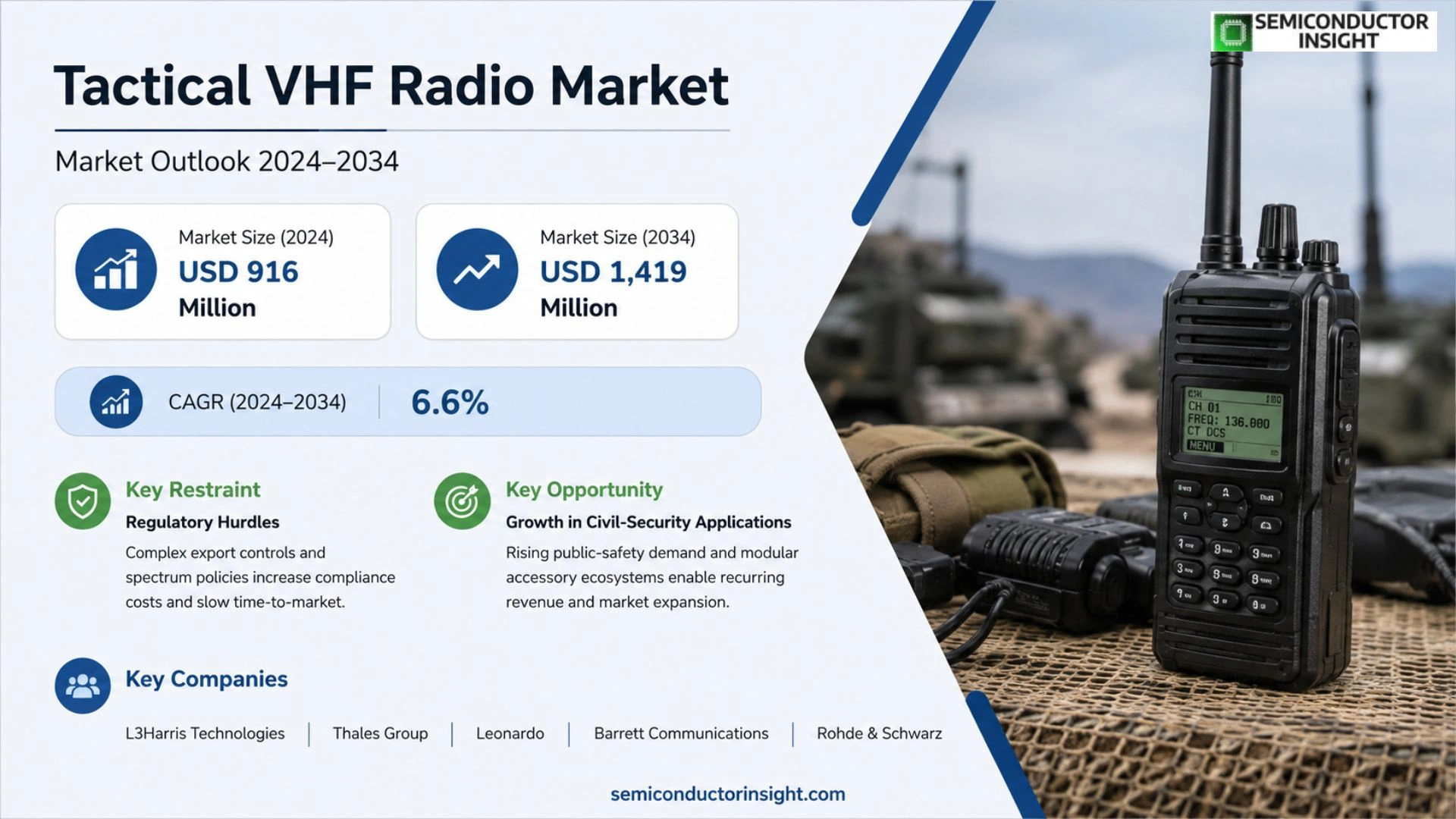
Tactical VHF Radio market size was valued at USD 916 million in 2024 and is forecasted to reach USD 1,419 million by 2034, reflecting a CAGR of 6.6% during the forecast period.
Tactical Very High Frequency (VHF) radio operates between 30 MHz and 300 MHz, offering a compact and lightweight solution compared with HF equipment. The technology relies on line‑of‑sight propagation, which limits effective range to roughly eight kilometres but provides reliable voice and data exchange for small units in the field. Because VHF signals do not bounce off the ionosphere, they remain confined to ground‑level transmission paths.
The upward trajectory stems from heightened demand for secure, anti‑jamming communications in military and law‑enforcement contexts. Encryption capabilities and resilience against electronic interference have become essential as electromagnetic environments grow more contested. Recent product introductions emphasize digital waveforms and network‑centric features that support real‑time intelligence sharing. Major manufacturers such as Harris Corporation, Thales Group, Leonardo and Elbit Systems continue to expand portfolios through modular upgrades and joint development programs.
MARKET DRIVERS
Operational Resilience in Conflict Zones
Military units and first‑response teams increasingly rely on radio systems that survive harsh environments, extreme temperatures and electromagnetic interference. Robust VHF architectures now offer uptime that exceeds traditional alternatives, prompting procurement officers to prioritize equipment that guarantees reliable voice connectivity during extended deployments.
Integration with Digital Command Platforms
Modern battlefield networks demand seamless hand‑off between legacy analog radios and emerging software‑defined solutions. Vendors that embed encryption modules and IP bridging capabilities into VHF units enable commanders to fuse voice traffic with data streams, thereby reducing latency in mission‑critical decision loops.
➤ “The ability to maintain continuous, secure voice links while synchronizing with command‑center applications has become a decisive factor in contract awards.”
Consequently, budget allocations for Tactical VHF Radio market have tilted toward platforms that blend durability with interoperable intelligence, shaping a procurement landscape that values both performance and future‑proofing.
MARKET CHALLENGES
Escalating Cost Pressures
Advanced encryption, ruggedization and modular designs inflate bill‑of‑material costs, forcing defense ministries to stretch limited procurement cycles. When fiscal constraints tighten, decision‑makers often defer upgrades, extending the service life of legacy radios that lack contemporary features.
Other Challenges
Supply‑Chain Volatility
Geopolitical frictions and semiconductor shortages have lengthened lead times for critical components, compelling manufacturers to hold larger inventories or seek secondary sources, both of which erode profit margins.
MARKET RESTRAINTS
Regulatory Hurdles
Export‑control regimes and spectrum‑allocation policies differ markedly across regions, obligating vendors to certify each model for multiple jurisdictions. The administrative burden slows time‑to‑market and discourages smaller players from entering the arena.
Furthermore, mandatory compliance testing adds layers of documentation, increasing the overall cost structure and limiting the agility of firms that aim to iterate product designs rapidly.
MARKET OPPORTUNITIES
Growth in Civil‑Security Applications
Beyond military adoption, public‑safety agencies are upgrading radio fleets to meet evolving urban security mandates. The demand for VHF solutions that can interoperate with existing emergency‑management software opens a niche where manufacturers can capture incremental revenue without competing directly with high‑end defense contracts.
Additionally, the emergence of modular accessory ecosystems,such as detachable GPS, biometric authentication and AI‑assisted noise‑cancellation,creates a platform‑as‑a‑service model that can generate recurring income streams and differentiate suppliers in a crowded field.
Tactical VHF Radio Market Trends
Shift Toward Digitized, Secure LOS Communications
Recent procurement cycles show a clear preference for radios that embed digital voice and packet‑data capabilities within the traditional VHF band. Digital codecs mitigate the distortion caused by multipath reflections and atmospheric noise, delivering intelligible conversation at ranges that hover around eight kilometres. By transmitting compressed data packets, units can exchange situational graphics or brief text messages without adding separate data radios to the load‑out. This convergence reduces overall equipment weight, simplifies training, and lessens the logistical burden of maintaining parallel analogue and digital inventories. Consequently, manufacturers that have re‑engineered their front‑ends for software‑defined radio (SDR) architectures are seeing accelerated adoption across NATO and partner forces.
Other Trends
Miniaturization and Man‑Pack Integration
Advances in surface‑mount technology and low‑power ASIC design have enabled a 30 % reduction in the mass of handheld VHF units compared with models released five years ago. The lighter profile permits soldiers to attach the radio directly to load‑bearing equipment, eliminating the need for separate backpacks. In addition, modular power‑management interfaces allow a single battery pack to serve both radio and ancillary devices such as night‑vision goggles. Field reports indicate that the decreased carry weight improves maneuverability in dense urban or mountainous terrain, while the integrated design enhances the speed of deployment during rapid‑reaction missions. Suppliers are responding with hardened polymer housings that meet MIL‑STD‑810G shock and temperature specifications, ensuring durability despite the slimmer form factor.
Enhanced Anti‑Jamming and Encryption Capabilities
Emerging frequency‑hopping algorithms, combined with built‑in AES‑256 encryption, are now standard features on most new tactical VHF platforms. These safeguards address the increasingly contested electromagnetic environment, where adversaries employ broadband jammers to obscure command channels. By rapidly shifting carrier frequencies on a pseudo‑random schedule, radios make it statistically improbable for hostile emitters to lock onto the signal long enough to disrupt it. At the same time, end‑to‑end encryption guarantees that intercepted transmissions remain unintelligible, protecting operational plans and force composition data. Procurement agencies are prioritizing these capabilities because they directly support mission continuity; a compromised LOS link can stall coordination, expose troop movements, and jeopardize overall operational tempo.
COMPETITIVE LANDSCAPE
Key Industry Players
Tactical VHF Radio Market: Competitive Overview 2024‑2031
The battlefield communications segment is anchored by a handful of large integrators that control the majority of volume in the Tactical VHF Radio arena. Harris Corporation, now part of L3Harris Technologies, commands the top tier through its extensive portfolio of handheld, man‑pack and vehicle‑mounted systems that combine ruggedized hardware with advanced encryption and anti‑jamming modules. Its ability to embed radios within broader command‑and‑control solutions gives it leverage over procurement decisions of armed forces that seek interoperable platforms. Recent contracts with the U.S. Department of Defense and several NATO allies underscore the firm’s entrenched position, while its global service network accelerates aftermarket revenue. The market structure therefore resembles an oligopoly where a small number of multinational OEMs secure bulk orders, and the remaining demand is fragmented among specialist suppliers.
Beyond the dominant tier, a diverse set of competitors injects differentiation through niche capabilities or regional focus. Thales Group leverages its heritage in secure communications to offer VHF sets with integrated data‑link functions, appealing to European defense ministries that prioritize joint‑operation standards. Leonardo’s line‑up, built on its legacy aerospace electronics, emphasizes compact man‑pack units for rapid‑deployment forces. Barrett Communications distinguishes itself with high‑power base‑station kits that extend line‑of‑sight reach, a feature valued by maritime and border‑patrol agencies. Rohde & Schwarz supplies precision‑engineered radios to specialist users requiring laboratory‑grade performance, while Codan Communications and Icom address cost‑sensitive markets in Asia‑Pacific with scalable product families. Smaller innovators such as Eylex, Satcom, DataTron World Communications Incorporated and Elbit Systems focus on encrypted waveforms, digital modulation and integration with unmanned platforms, carving out loyal customer bases despite limited overall volume. This layered competitive fabric creates pressure on pricing, accelerates technology cycles, and obliges the larger players to continuously broaden their feature sets.
List of Key Tactical VHF Radio Companies Profiled
- L3Harris Technologies
- Thales Group
- Leonardo
- Barrett Communications
- Rohde & Schwarz
- Codan Communications
- Icom Incorporated
- Elbit Systems
- Satcom
- Eylex
- DataTron World Communications Incorporated
- Saab Group
Segment Analysis:
| Segment Category | Sub-Segments | Key Insights |
| By Type |
|
Handheld stands out as the preferred type for dismounted personnel due to its compact size and ease of carriage.
|
| By Application |
|
Military drives the core demand as VHF radios fulfill line‑of‑sight communication for coordinated troop maneuvers.
|
| By End User |
|
Armed Forces remain the dominant end‑user, leveraging VHF radios for mission‑critical communications.
|
| By Feature Set |
|
Encrypted Transmission is the leading feature, addressing heightened information‑security concerns.
|
| By Deployment Environment |
|
Urban Tactical Operations emerge as the key deployment environment, where line‑of‑sight constraints are mitigated by dense infrastructure.
|
Regional Analysis: Tactical VHF Radio Market
North America
Recent acquisition programs emphasize spectrum efficiency and survivability, encouraging suppliers to embed anti‑jamming features into handheld and vehicular radios. Program offices favor modular architectures that enable incremental upgrades, reducing long‑term lifecycle costs for armed forces.
Municipalities across the United States are expanding VHF deployments to bridge gaps in rural coverage, where cellular penetration remains uneven. Inter‑agency communication drills stress the need for shared channel plans, prompting joint procurement initiatives that leverage economies of scale.
manufacturers are embedding software‑defined radio (SDR) capabilities, allowing field units to adapt waveforms via firmware updates. This flexibility satisfies both legacy compliance and emerging operational concepts without extensive hardware swaps.
Recent disruptions have motivated distributors to diversify component sourcing across North America and Mexico, shortening lead times for critical antenna assemblies and ensuring uninterrupted delivery to end users.
Europe
European defense ministries are placing a premium on cross‑border interoperability within NATO frameworks, driving demand for VHF radios that can operate seamlessly across member states. Concurrently, civil‑protective agencies in Germany and the United Kingdom are upgrading legacy fleets to meet stricter reliability standards, prompting vendors to showcase robust cryptographic modules. The region’s rigorous type‑approval processes act as a quality filter, fostering a market where reliability is as valuable as raw performance. As urban density rises, authorities also explore VHF solutions that complement 5G rollouts, ensuring continuity in mission‑critical communications during network outages.
Asia‑Pacific
In the Asia‑Pacific arena, rapid urbanization and expansive maritime boundaries create a diverse set of operational needs for tactical VHF radios. Nations such as Australia and Japan invest heavily in hardened devices for both land and naval applications, emphasizing durability against harsh environmental conditions. Emerging economies are beginning to allocate budget toward modernizing border‑security communications, seeing VHF platforms as a cost‑effective bridge before full‑scale digital migration. The region’s fragmented regulatory landscape encourages local manufacturers to partner with global OEMs, blending indigenous design expertise with proven foreign technology to satisfy sovereign requirements.
South America
South American governments are focusing on improving coordination among disaster‑response units, especially in countries prone to earthquakes and floods. Tactical VHF radios are favored for their ability to function in remote terrains where cellular infrastructure is sparse. Procurement decisions often balance price sensitivity with the need for ruggedness, leading to a market niche for mid‑range devices that deliver acceptable performance without premium pricing. Collaborative exercises between military and civilian agencies have highlighted the importance of shared channel protocols, prompting regional forums to standardize frequency allocations.
Middle East & Africa
The Middle East & Africa region presents a mosaic of security challenges, from counter‑terrorism operations to vast desert patrols. Operators value VHF radios for their long‑range capabilities and resistance to sand‑induced wear. Investment patterns reveal a gradual shift from purely imported systems toward locally assembled units, driven by government initiatives to develop indigenous supply chains. In sub‑Saharan Africa, humanitarian NGOs rely on VHF connectivity to maintain communication during humanitarian crises, reinforcing the market’s relevance beyond purely defensive contexts. These dynamics encourage manufacturers to offer flexible licensing options and modular upgrades tailored to diverse operational budgets.
Report Scope
This market research report provides a comprehensive analysis of the Tactical VHF Radio Market , covering the forecast period 2026–2034. It offers detailed insights into market dynamics, technological advancements, competitive landscape, and key trends shaping the industry.
Key focus areas of the report include:
- Market Overview: The report begins with an overview outlining its current market scenario, key growth indicators, and industry transformation drivers. It discusses macroeconomic factors, demand–supply balance, regulatory landscape, and the strategic role of semiconductors in powering advancements across industries such as automotive, telecommunications, consumer electronics, and industrial automation.
- Market Size & Forecast: Historical data and future projections for revenue, unit shipments, and market value across major regions and segments.
- Segmentation Analysis: Detailed breakdown by product type, technology, application, and end-user industry to identify high-growth segments and investment opportunities.
- Regional Insights: Insights into market performance across North America, Europe, Asia-Pacific, Latin America, and the Middle East & Africa, including country-level analysis where relevant.
- Competitive Landscape: Profiles of leading market participants, including their product offerings, R&D focus, manufacturing capacity, pricing strategies, and recent developments such as mergers, acquisitions, and partnerships.
- Technology Trends & Innovation: Assessment of emerging technologies, integration of AI/IoT, semiconductor design trends, fabrication techniques, and evolving industry standards.
- Market Drivers & Restraints: Evaluation of factors driving market growth along with challenges, supply chain constraints, regulatory issues, and market-entry barriers.
- Stakeholder Insights: Insights for component suppliers, OEMs, system integrators, investors, and policymakers regarding the evolving ecosystem and strategic opportunities.
Primary and secondary research methods are employed, including interviews with industry experts, data from verified sources, and real-time market intelligence to ensure the accuracy and reliability of the insights presented.
FREQUENTLY ASKED QUESTIONS:
What is the current market size of Tactical VHF Radio Market?
-> Tactical VHF Radio market is forecasted to reach USD 1,419 million by 2034, reflecting a CAGR of 6.6% during the forecast period.
Which key companies operate in Tactical VHF Radio Market?
-> Key players include Harris Corporation, Thales Group, Sapura Thales Electronic, Leonardo, Barrett Communications, Datron World Communications, Eylex, Rohde‑Schwarz, Satcom, Codan Communications, Icom Incorporated, Elbit Systems.
What are the key growth drivers?
-> Key growth drivers include advancements in military communications, demand for anti‑jamming and encrypted capabilities, digitization of tactical radios, and increasing defense budgets worldwide.
Which region dominates the market?
-> North America holds a leading position due to high defense spending and extensive adoption of advanced tactical communication systems, while Europe and Asia‑Pacific show strong growth potential.
What are the emerging trends?
-> Emerging trends include software‑defined radios, integration of AI/ML for spectrum management, increased use of secure digital waveforms, and the shift towards network‑centric warfare.

Get Sample Report PDF for Exclusive Insights
Report Sample Includes
- Table of Contents
- List of Tables & Figures
- Charts, Research Methodology, and more...
 Download Sample Report PDF