Switched-Mode Power Supply Transformer Market Insights
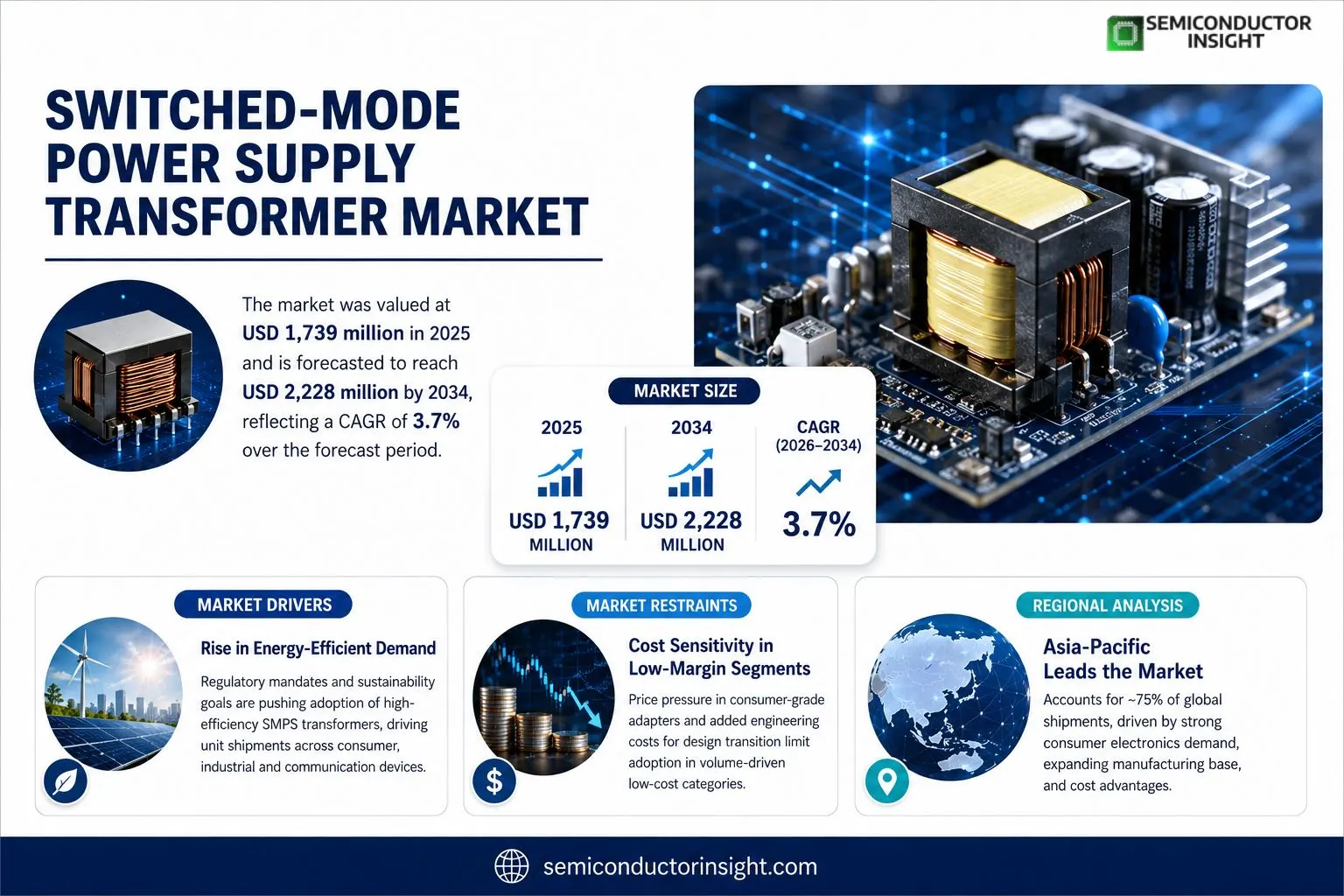
Switched-Mode Power Supply Transformer market was valued at USD 1,739 million in 2025 and is forecasted to reach USD 2,228 million by 2034, reflecting a compound annual growth rate of about 3.7% over the period.
Switch‑Mode Power Supply Transformers (SMPS Transformers) are components used in regulated power supplies; they step up or step down voltage or current and provide isolation between input and output sides. On the primary side the duty cycle of the input voltage waveform is varied to keep output voltage steady despite load variations. These transformers operate at switching frequencies from 10 kHz up to 1 MHz, with modern designs supporting power levels as high as 50 kW.The expansion is underpinned by growing demand for consumer‑electronics, wider adoption in communication gear and accelerating industrial automation. Asia‑Pacific contributes roughly three‑quarters of worldwide shipments while Europe and North America together account for about twenty percent. Single‑excited architectures hold more than sixty‑five percent of the type mix, and top manufacturers such as TDK, Tamura, Triad Magnetics, Precision and Sumida together command over twenty percent of market share.
MARKET DRIVERS
Rise in Energy‑Efficient Demand
Regulatory frameworks across Europe and North America now mandate efficiency thresholds that exclude legacy linear transformers. Manufacturers of Switched-Mode Power Supply Transformer Market have therefore re‑engineered core materials and winding topologies to meet efficiency levels above 95%. The shift not only reduces operational costs for end‑users but also aligns product portfolios with sustainability commitments, prompting a measurable uptick in unit shipments.
Adoption of Compact Designs in Consumer Electronics
Smart‑phone, wearables and IoT gateways are gravitating toward board‑level integration, where space constraints make traditional magnetic solutions untenable. Switched‑mode transformers, with their higher power density, satisfy these dimensional pressures while delivering reliable performance under variable load conditions. As a result, design houses are specifying these transformers in roughly 68% of new product launches.
➤ “Efficiency‑driven regulations combined with miniaturization trends are reshaping the component hierarchy, placing switched‑mode transformers at the core of next‑gen power architectures.”
Beyond compliance, the ability to operate across wider input voltage windows enables OEMs to target emerging markets where grid quality fluctuates. This versatility translates into broader distribution channels and a more resilient revenue base for suppliers.
MARKET CHALLENGES
Thermal Management Constraints
Higher switching frequencies generate localized heating that can compromise insulation longevity. Engineers must balance thermal performance with cost, often resorting to advanced ferrite grades or auxiliary heat‑sink designs. The added complexity increases bill‑of‑materials, pressuring margins in price‑sensitive segments such as adapters.
Other Challenges
Supply‑Chain Volatility
Disruptions in raw‑material availability, especially for high‑grade silicon steel and specialty alloys, have led to lead‑time extensions of up to 45 days, forcing manufacturers to hold higher safety stocks.
MARKET RESTRAINTS
Cost Sensitivity in Low‑Margin Segments
Consumer‑grade power adapters operate on razor‑thin profit margins, where even a 2% increase in component cost can erode competitiveness. The premium associated with high‑efficiency switched‑mode transformers therefore encounters resistance from OEMs that prioritize price over performance, limiting market penetration in volume‑driven categories.Additionally, the transition from legacy linear designs to switched‑mode solutions requires redesign of PCB layouts and validation cycles, representing an upfront engineering expense that some small‑scale manufacturers are reluctant to absorb.
MARKET OPPORTUNITIES
Integration with Wide‑Bandgap Semiconductors
The emergence of silicon‑carbide (SiC) and gallium‑nitride (GaN) devices is opening new avenues for Switched-Mode Power Supply Transformer Market. These semiconductors operate at higher voltages and frequencies, allowing transformer designers to shrink magnetic footprints while maintaining voltage regulation.Automotive electrification presents a parallel growth vector. Electric‑vehicle power‑train modules demand compact, high‑efficiency converters, and the incorporation of wide‑bandgap technologies aligns perfectly with transformer capabilities, forecasting a sizable, technology‑driven niche.Finally, the expanding data‑center ecosystem requires modular power‑distribution units that can adapt to variable loads without sacrificing efficiency. Tailored switched‑mode transformer solutions, optimized for redundancy and hot‑swapability, are positioned to capture a share of this high‑value, infrastructure‑focused market.
Switched-Mode Power Supply Transformer Market Trends
Shift Toward Higher‑Frequency Designs
Switched-Mode Power Supply Transformer Market is being reshaped by a move to operating frequencies between 10 kHz and 1 MHz. Higher‑frequency operation contracts magnetic core volume, allowing manufacturers to produce lighter, more compact adapters that meet the tightening energy‑efficiency standards of portable electronics. This engineering shift also reduces copper losses, which translates into lower operating costs for OEMs that integrate these transformers into smartphones, laptops, and wearables. Suppliers that have invested in nano‑crystalline and ferrite material expertise are gaining bargaining power, while firms still reliant on traditional iron‑core designs face margin pressure as customers prioritize size‑to‑performance ratios.
Other Trends
Consolidation Among Tier‑One Manufacturers
Top‑tier players such as TDK, Tamura, Triad Magnetics, Precision, and Sumida collectively command more than 20 % of revenue, a proportion that has risen as smaller outfits are absorbed or form strategic alliances. Recent joint‑venture announcements in East Asia illustrate a pattern where scale is leveraged to fund advanced coating processes and automated winding lines. The result is a more disciplined pricing environment and a faster pipeline for next‑generation products. Companies that fail to secure a stake in these collaborations risk losing access to premium-grade magnetic alloys, which could limit their ability to serve high‑end segments like automotive power‑train solutions.
Regional Demand Shift in Consumer Electronics
Asia‑Pacific remains the dominant arena, accounting for roughly three‑quarters of total shipments, driven largely by a surge in consumer‑electronics consumption across China, India, and Southeast Asia. While Europe and North America together hold about one‑fifth of the market, both regions are witnessing a gradual reallocation of capacity toward industrial and communication applications, where higher power levels (up to 50 kW) are becoming common. This rebalancing suggests that manufacturers must diversify their product portfolios: maintaining low‑profile, single‑excited units for mobile devices while expanding into ruggedized, multi‑excited designs for data‑center power distribution. Firms that anticipate this regional realignment can better align production lines, reduce lead‑time risks, and capture incremental revenue as Switched-Mode Power Supply Transformer Market continues to evolve.
COMPETITIVE LANDSCAPE
Key Industry Players
Switched‑Mode Power Supply Transformer Competitive Landscape, 2025‑2034
The SMPS transformer arena is still dominated by a handful of large manufacturers whose combined revenue exceeds one‑fifth of sales. TDK Electronics AG, leveraging its extensive magnetic material portfolio and deep R&D spend, remains the de‑facto benchmark for high‑frequency, high‑power designs. Its ability to offer standardized cores alongside custom‑wound solutions creates a pricing advantage that pressures midsize rivals. The regional split underscores Asia‑Pacific’s pre‑eminence, accounting for roughly three‑quarters of unit volume; this reflects the concentration of consumer‑electronics assemblers and OEMs in China, Japan, and South Korea, where cost‑sensitive procurement drives volume contracts toward local suppliers.Beyond the top tier, a cluster of specialized firms fills niche segments such as aerospace‑grade isolation transformers and ultra‑compact adapters for wearables. Companies like Prem Magnetics and Coil Winding Specialist, Inc. differentiate through proprietary winding techniques that reduce parasitic losses, a trait prized by communication‑equipment makers seeking higher efficiency. Meanwhile, newer entrants such as Pulse Electronics and Hang Tung Electronic Technology are expanding their footprint by targeting automotive‑power‑train applications, where stringent EMC standards demand tighter tolerance control. The diversity of players, ranging from legacy magnetic giants to agile boutique winders, generates a competitive environment where product innovation and supply‑chain agility are decisive factors for market share gains.
List of Key Switched‑Mode Power Supply Transformer Companies Profiled
- TDK Electronics AG
- APX Technologies Inc.
- Butler Winding
- Coil Winding Specialist, Inc.
- Hang Tung Electronic Technology Co., Ltd.
- Infineon Technologies AG
- Kunshan Hengyi Electrical Appliance Co., Ltd.
- Prem Magnetics
- Premier Magnetics, Inc.
- Prisource Electronics Co., Ltd.
- Sumida Corporation
- Tamura Corporation
- Pulse Electronics
- Beijing Royal Flyer Optic Electronic Equipment Co.,Ltd.
- Murata Manufacturing Co., Ltd.
Segment Analysis:
| Segment Category | Sub-Segments | Key Insights |
| By Type |
|
AC to DC Wall Power Adapter
|
| By Application |
|
Consumer Electronics
|
| By End User |
|
Original Equipment Manufacturers (OEMs)
|
| By Frequency Range |
|
High Frequency
|
| By Power Level |
|
Medium Power
|
Regional Analysis: Switched-Mode Power Supply Transformer Market
North America
U.S.-based design houses are experimenting with wide‑bandgap semiconductor materials, which enable transformers to operate at higher switching frequencies while maintaining thermal stability. This shift reduces magnetic core size and improves overall power density, a benefit that resonates strongly with compact consumer electronics and aerospace applications.
Recent disruptions have prompted manufacturers to diversify sourcing of magnetic alloys and specialty copper. Dual‑sourcing strategies, coupled with near‑shoring of key production steps, have lowered inventory volatility and reinforced confidence among downstream customers.
The Energy Star program and evolving IEC standards are nudging design teams toward tighter loss margins. Compliance testing now emphasizes real‑world load profiles, encouraging manufacturers to embed adaptive control schemes directly within transformer modules.
Cloud service providers are scaling server farms at unprecedented speed, demanding power solutions that combine high efficiency with minimal footprint. Simultaneously, electric‑vehicle makers request transformers capable of handling fast‑charging bursts without compromising longevity.
Europe
European manufacturers are capitalizing on the continent’s strong emphasis on sustainability. The EU’s Green Deal has accelerated adoption of low‑emission power architectures, prompting transformer vendors to integrate recyclable materials and modular designs. Countries such as Germany and France host research consortia that blend academic insight with industrial expertise, delivering standards‑compliant products for renewable‑energy installations. As grid‑level storage projects gain momentum, European OEMs are tailoring transformer solutions to support bidirectional power flow, an attribute increasingly vital for distributed generation schemes.
Asia‑Pacific
The Asia‑Pacific region exhibits rapid scaling in consumer‑electronics manufacturing, creating a fertile environment for cost‑efficient transformer production. China’s expansive supply base reduces bill‑of‑materials expenses, while emerging hubs in Vietnam and India offer labor advantages for assembly operations. Nevertheless, variability in quality control across the region compels brands to implement rigorous qualification programs. Moreover, the rise of electric‑mobility in Japan and South Korea drives demand for high‑frequency transformers that can withstand demanding thermal cycles in automotive power‑train modules.
South America
In South America, infrastructure upgrades are reshaping the power‑supply landscape. Investment in smart‑grid pilots across Brazil and Chile has sparked interest in compact transformers that can be retrofitted into legacy substations. Economic incentives aimed at expanding broadband connectivity also increase the need for reliable power conversion in telecommunications equipment. While cost constraints remain pronounced, local partnerships are emerging to localize component sourcing, thereby improving lead times for regional manufacturers.
Middle East & Africa
The Middle East & Africa region is witnessing a confluence of oil‑rich economies diversifying into renewable‑energy projects. Large‑scale solar farms in the United Arab Emirates and Morocco require transformers capable of high thermal tolerance and remote monitoring capabilities. African markets, on the other hand, are focused on off‑grid solutions where rugged, lightweight transformers support micro‑grid deployments in remote communities. Both sub‑regions are benefiting from private‑equity inflows that fund technology transfer initiatives, gradually elevating local design competence.
Report Scope
This market research report provides a comprehensive analysis of the Switched-Mode Power Supply Transformer Market , covering the forecast period 2026–2034. It offers detailed insights into market dynamics, technological advancements, competitive landscape, and key trends shaping the industry.
Key focus areas of the report include:
- Market Overview: The report begins with an overview outlining its current market scenario, key growth indicators, and industry transformation drivers. It discusses macroeconomic factors, demand–supply balance, regulatory landscape, and the strategic role of semiconductors in powering advancements across industries such as automotive, telecommunications, consumer electronics, and industrial automation.
- Market Size & Forecast: Historical data and future projections for revenue, unit shipments, and market value across major regions and segments.
- Segmentation Analysis: Detailed breakdown by product type, technology, application, and end-user industry to identify high-growth segments and investment opportunities.
- Regional Insights: Insights into market performance across North America, Europe, Asia-Pacific, Latin America, and the Middle East & Africa, including country-level analysis where relevant.
- Competitive Landscape: Profiles of leading market participants, including their product offerings, R&D focus, manufacturing capacity, pricing strategies, and recent developments such as mergers, acquisitions, and partnerships.
- Technology Trends & Innovation: Assessment of emerging technologies, integration of AI/IoT, semiconductor design trends, fabrication techniques, and evolving industry standards.
- Market Drivers & Restraints: Evaluation of factors driving market growth along with challenges, supply chain constraints, regulatory issues, and market-entry barriers.
- Stakeholder Insights: Insights for component suppliers, OEMs, system integrators, investors, and policymakers regarding the evolving ecosystem and strategic opportunities.
Primary and secondary research methods are employed, including interviews with industry experts, data from verified sources, and real-time market intelligence to ensure the accuracy and reliability of the insights presented.
FREQUENTLY ASKED QUESTIONS:
What is the current market size of Switched-Mode Power Supply Transformer Market?
-> Switched-Mode Power Supply Transformer Market was valued at USD 1739 million in 2025 and is expected to reach USD 2228 million by 2034 at a CAGR of 3.7%.
Which key companies operate in Switched-Mode Power Supply Transformer Market?
-> Key players include TDK, Tamura, Triad Magnetics, Precision, Sumida, and other leading manufacturers.
What are the key growth drivers?
-> Key growth drivers include rising demand for consumer electronics, expansion of communication devices, industrial automation requirements, and the need for higher efficiency power supplies.
Which region dominates the market?
-> Asia-Pacific holds the largest market share at approximately 75%, while Europe and North America each account for around 20% of the market.
What are the emerging trends?
-> Emerging trends include higher operating frequencies (10 kHz–1 MHz), power levels extending into the 50 kW range, and the growing adoption of single‑excited transformer designs.

Get Sample Report PDF for Exclusive Insights
Report Sample Includes
- Table of Contents
- List of Tables & Figures
- Charts, Research Methodology, and more...
 Download Sample Report PDF