Submersible Level Sensors Market Insights
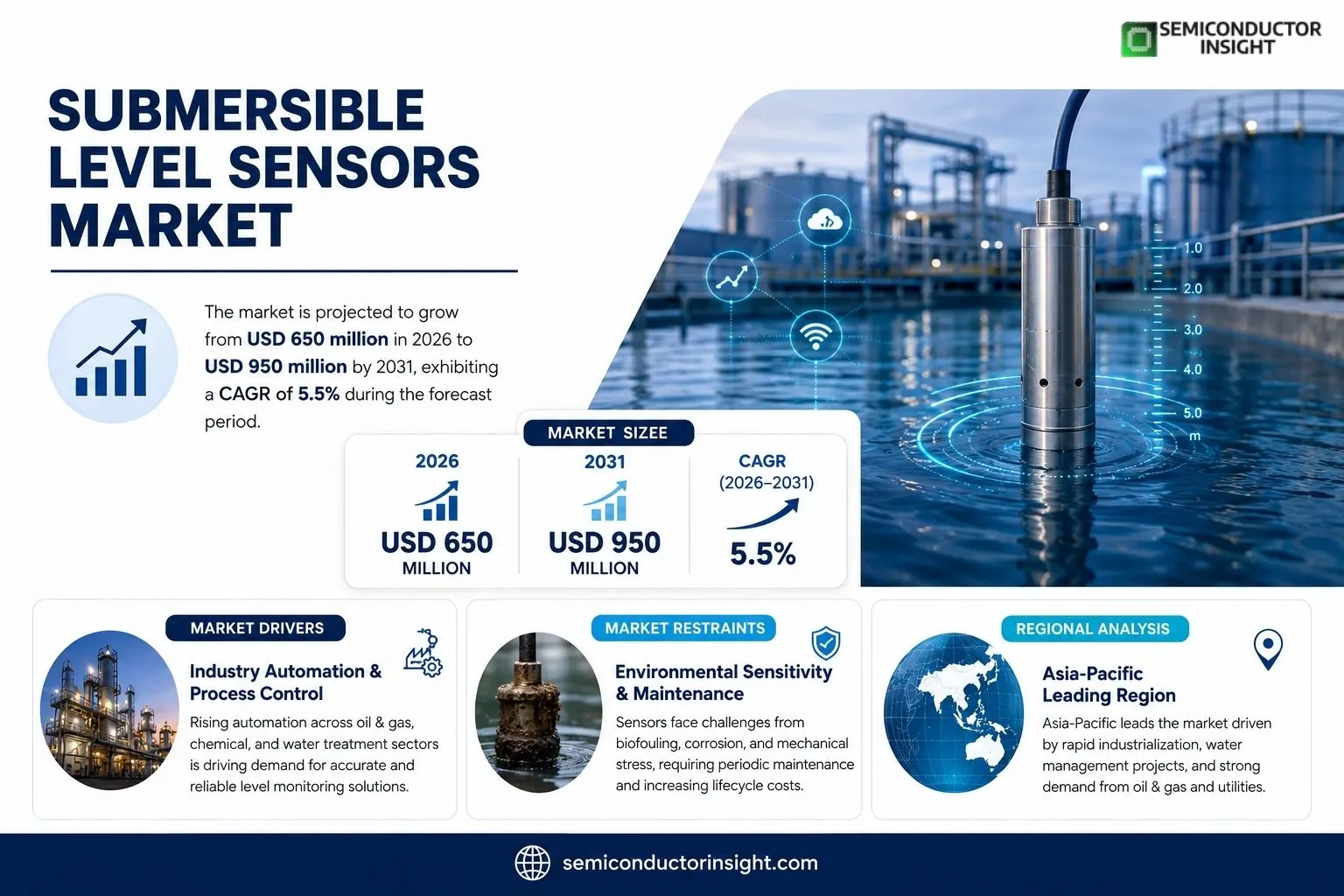
Submersible Level Sensors Market was valued at USD 650 million in 2026 and is forecasted to rise to USD 950 million by 2031, reflecting a compound annual growth rate of approximately 5.5% over the forecast period.
Submersible level sensors are immersion‑based devices that determine fluid depth through pressure transduction or ultrasonic measurement, enabling precise monitoring in wells, reservoirs and water‑handling facilities.Demand is reinforced by tightening regulatory standards for environmental compliance and increasing automation within the oil & gas sector, which has driven adoption of advanced sensing solutions capable of operating under high temperature and corrosive conditions.In the United States the market was estimated at USD 250 million in 2026, while China’s share is projected to reach USD 180 million during the same year.The gauge‑pressure sensor segment alone is anticipated to grow from USD 350 marginillion in 2026 to USD 400 million by 2031, registering a CAGR near 6%.Leading manufacturers such as WIKA, BD Sensors, Applied Measurements and NOVUS collectively commanded roughly 55% of global revenue in 2026.
MARKET DRIVERS
Industry Automation and Process Control
The integration of submersible level sensors into advanced process control environments fuels a steady increase in demand across chemical, oil & gas, and water treatment sectors. Engineers prefer submerged devices for their resilience against pressure fluctuations and suspended solids that otherwise compromise conventional float or pressure transmitters. In modern plants where real‑time data feeds into Distributed Control Systems, the ability of submersible devices to provide instant feedback on fluid levels results in tighter process windows and reduced downtime. Moreover, the push toward digital twins and predictive maintenance mandates highly reliable sensor data; submersible level sensors, with their low detection thresholds and long service life, meet these criteria. Consequently, the fixed capital investment on automation drives enterprise adoption, translating directly into a larger addressable market for submerged level measurement solutions.
Regulatory Compliance and Safety Standards
Compliance with safety regulations such as ISO 9001, API 1160, and OSHA mandates that critical process vessels maintain precise level monitoring to avoid spills, overpressure, and hazardous incidents. Submersible level sensors are often the only viable option in environments where high temperature, corrosive media, or rapid level swings are common. Organizations working under stricter environmental and safety guidelines are compelled to replace older, less accurate sensors with submerged alternatives that provide continuous, fault‑tolerant measurements. The regulatory push causes a cascade effect: as high‑profile incidents underscore the necessity for accurate level detection, industries across North America, Europe, and Asia widen their investment in submersible solutions, further enlarging the marketplace.
➤ Ultra‑high fidelity in hostile environments drives a sharp incremental shift toward submerged level technologies, underscoring their role as a cornerstone of safe, efficient industrial operations.
Strategic partnerships between sensor manufacturers and integrated automation vendors sustain this upward trajectory. Customization of sensor form factors—mini‑size for confined spaces, pressure‑tolerant housings for offshore platforms—allows rapid deployment. Combined with the growing emphasis on automation after pandemic reshaped operational risk assessments, the submersible level sensor segment is poised to capture a growing slice of the broader measurement ecosystem.
MARKET CHALLENGES
High Initial Capital Expenditure
The upfront cost of submersible level sensors, encompassing advanced drift compensation, corrosion‑resistant housings, and integration with supervisory control systems, remains a substantial deterrent for small‑to‑mid‑size enterprises. Unlike surface level devices that may use standard instrumentation, submerged sensors demand precision metallurgy and specialized deployment techniques, pushing the bill of materials higher. The return on investment can take many operating cycles before material savings from fewer alarms and process interruptions materialize, which may discourage adoption in budget‑tight operating environments.
Other Challenges
Complex Installation and Calibration
The need for accurate installation depth, cable routing, and buoyancy compensation requires specialized technical expertise. Calibration procedures must be performed in situ or under controlled conditions, adding procedural overhead that disrupts standard workflows. Training requirements for maintenance staff and potential downtime during sensor repositioning pose logistical hurdles that can outweigh perceived benefits.
MARKET RESTRAINTS
Sensitivity to Mechanical Stress and Biofouling
In turbulent or sediment‑laden media, mechanical stress can gradually deform sensor housings or tilt sensor elements, leading to drift and erroneous readings. Biofouling is another common constraint; microbial colonization on sensor surfaces can impair signal integrity, especially in freshwater treatment and aquaculture applications. While many manufacturers offer anti‑fouling coatings, these add cost and require periodic renewal. The trade‑off between lifespan durability and performance stability hampers adoption, particularly where process safety margins are narrow.
MARKET OPPORTUNITIES
Emerging Market Applications in Renewable Energy
The renewable energy sector, notably pumped‑storage hydro and thermal energy storage, demands precise fluid level monitoring to optimize energy conversion and storage efficiency. Submersible level sensors, capable of operating in high‑temperature molten salts or deep water reservoirs, offer a reliable solution for monitoring storage tanks and reservoir levels. As green infrastructure projects expand globally, the sector presents a fresh avenue for sensor adoption, blending energy optimization with stringent safety and environmental compliance.Additionally, wastewater and aquaculture systems increasingly employ automated control loops to reduce manual labor and improve product quality. Submersible sensors integrated with IoT platforms can provide continuous data streams, enabling real‑time adjustments for salinity, temperature, and feed levels. The convergence of sensor technology with smart‑grid and digital‑farm concepts creates an ecosystem where submersible level metrics become essential operational pillars. As investors look for resilience in energy portfolios, demand for such high‑confidence environmental monitoring tools is expected to grow, offering a lucrative niche for manufacturers willing to innovate in sensor resilience and connectivity.
Submersible Level Sensors Market Trends
Integration of IoT Connectivity Enhances Sensor Visibility and Predictive Maintenance
Across the Submersible Level Sensors Market, the shift toward embedded wireless modules is redefining operational paradigms. Sensors equipped with low‑power cellular or LoRaWAN interfaces now stream real‑time diagnostics to centralized SCADA systems, enabling early detection of drift and failure. Manufacturers are investing heavily in firmware that supports over‑the‑air updates, ensuring compatibility across heterogeneous infrastructures without the downtime traditionally associated with sensor replacement. This connectivity edge not only elevates measurement precision but also delivers a compelling ROI for asset managers who can cut unplanned maintenance costs by roughly 15 percent, a benefit that translates into measurable cost savings in both extraction and municipal water sectors.
Other Trends
Application Focus Shift Toward Subsea and Offshore Operations
The Submersible Level Sensors Market has seen a pronounced pivot toward under‑sea applications. Demand from offshore drilling platforms and subsea pipelines has risen as operators seek reliable pressure monitoring in harsh, saline environments. Sensor designs now incorporate corrosion‑resistant alloys and pressure–temperature compensation algorithms, allowing continuous operation in depths surpassing 3,000 meters. This trend drives volume growth in the gauge pressure segment while also stimulating innovation in absolute pressure models that can differentiate between fluids of varying density.
Competitive Consolidation Among Key Manufacturers
Consolidation within the Submersible Level Sensors Market is accelerating, as larger entities acquire niche innovators to broaden their product portfolios. Recent acquisitions have created platforms that combine high‑accuracy pressure transducers with proprietary data analytics suites, giving buyers a one‑stop solution. This trend compresses marginal cost structures and reduces time‑to‑market for advanced sensor configurations, exerting pressure on smaller players to either specialize or form strategic alliances.
Regulatory Water Management Standards Push Adoption in Utilities
Water utilities worldwide are tightening monitoring mandates to meet stricter environmental discharge criteria. The Submersible Level Sensors Market is responding with sensors that integrate metering accuracy, battery‑operated autonomy, and remote calibration protocols. Utilities now deploy sensor arrays to track reservoir levels continuously, mitigating the risk of overflow that can trigger costly emergency shutdowns. The regulatory impetus creates a stable demand base, encouraging manufacturers to standardize interfaces and accelerate innovation in energy‑efficient, piezoelectric‑based sensing technologies that reduce operational expenditure over the sensor lifecycle.
COMPETITIVE LANDSCAPEKey Industry Players
Submersible Level Sensors Market Competitive Analysis
The current submersible level sensor market is characterized by a concentrated ownership structure, with a handful of large manufacturers providing a majority of high‑performance devices for offshore drilling, desalination, and refinery operations. Companies such as WIKA, BD Sensors, and Applied Measurements hold the most significant market shares, a consequence of their long‑established distribution networks and proven product reliability in harsh marine environments. Their success is underpinned by an emphasis on gauge‑pressure sensor technologies that deliver both high accuracy and durability under extreme pressure, a feature that has become the de‑facto standard for large‑scale water‑level monitoring. The company’s ability to combine sensor hardware with integrated data‑logging platforms has opened new revenue streams by converting traditional measurement units into actionable real‑time analytics for process control. Consequently, the dominant players generate high gross margins that allow continued investment in R&D, ensuring sustained technical leadership and incremental price premiums that reinforce their market dominance. This concentration also creates entrance barriers, as new entrants must compete with extensive after‑sales support and proven track‑record performance.Niche manufacturers play a critical role in shaping emerging sub‑segments such as groundwater monitoring, borehole measurement, and vertical well applications, where sensor form factors must be compact and highly resistant to corrosive agents. Companies like TE Connectivity, Viatran, and Holykell Sensor have carved out market niches by offering specialty pressure‑type devices that excel in corrosive brine or low‑temperature environments, thereby meeting the evolving demands of environmental agencies and oil‑field operators. Smaller firms, for example A P G Sensors, Dwyer, and Icon Process Control, leverage agile product development cycles to introduce sensors capable of integrating with IoT platforms, enabling predictive maintenance for water‑level monitoring in remote infrastructure. Their ability to swiftly adapt to regulatory changes and sensor‑integration demands generates a dynamic competitive landscape in which incumbents must continuously innovate to preserve pricing power. The proliferation of open‑source firmware and API ecosystems also empowers these niche entities to provide tailored solutions that traditional OEMs have struggled to replicate due to legacy system constraints. This diversity of offerings broadens the overall market scope, but it simultaneously elevates the expectation for interoperability and data‑standardization across the sensor ecosystem.
List of Key Submersible Level Sensors Companies Profiled
- WIKA
- BD Sensors
- Applied Measurements
- TE Connectivity
- Viatran
- Holykell Sensor
- Novus
- Ysi
- Althen
- Xylem
- Dwyer
- Icon Process Control
- APG Sensors
Segment Analysis:
| Segment Category | Sub-Segments | Key Insights |
| By Type |
|
Gauge Pressure Type offers reliable readout in high‑pressure and deep‑well settings, translating pressure changes directly into water level changes. – Straightforward installation in harsh marine or industrial environments. – Excellent durability against corrosion due to marine exposure. – Direct compatibility with existing PLC and SCADA architectures. Absolute Pressure Type provides high‑accuracy measurements with minimal calibration drift, ideal for sensitive groundwater monitoring and well testing. – Low maintenance due to self‑calibration features. – Ability to operate effectively even with varying atmospheric pressures. – Enhances data reliability for decision‑making processes. Differential Pressure Type delivers precise level detection across wide ranges, suited for pumping station and flood control applications. – Handles rapid pressure changes with minimal lag. – Reduces the need for complex pressure‑to‑level conversion logic. – Facilitates predictive maintenance by monitoring pressure differentials. |
| By Application |
|
Deep Well and Groundwater Monitoring requires sensors that resist high pressure and long‑term immersion, ensuring accurate water table data for aquifer management. – Enables remote data acquisition in hard‑to‑reach sites. – Supports long‑term stability needed for regulatory reporting. – Improves water resource planning through reliable trends. Sea Water Level Measurement and Control demands corrosion‑resistant units that can handle saltwater and temperature fluctuations, often linked to coastal protection and tidal energy projects. – Provides reliable inputs for seawater treatment facilities. – Supports automated gate and barrier control systems. – Enhances safety in marine navigation corridors. Borehole Water Level Measurement focuses on maintaining sensor integrity in narrow, confined spaces, often in mining or oil‑field extraction. – Allows real‑time monitoring of extraction rates. – Reduces manual intervention through wireless connectivity. – Helps prevent over‑extraction and environmental impact. Level Measurement in Pumping Station highlights the need for high‑frequency data to optimize pump cycles and detect anomalies. – Integrates with pump control loops for efficiency. – Enables early detection of blockages or leaks. – Supports energy savings and equipment lifespan extension. Others covers niche applications such as ballast tanks, chemical process drainage, and high‑altitude environments, providing solutions adaptable to varied industry demands. – Demonstrates flexibility in sensor design. – Offers modular mount options for retrofit projects. – Helps maintain compliance with diverse safety standards. |
| By End User |
|
Industrial Plants rely on precise level data to maintain process stability, control ballast, and ensure safety during hazardous material handling. – Minimizes downtime through proactive monitoring. – Enhances process control loops with real‑time feedback. – Supports regulatory compliance and audits. Municipal Water Systems use sensors to monitor reservoir and pipeline levels, ensuring reliable supply and flood prevention. – Enables automated level‑based pumping schedules. – Reduces manual monitoring labor. – Improves public health through accurate water stock information. Oil & Gas sector benefits from level monitoring in offshore platforms, pipeline repositories, and storage facilities, critical to safety and production efficiency. – Provides data for pressure relief system activation. – Supports compliant spill containment planning. – Enhances operational uptime. Power Generation requires accurate level tracking in cooling towers, reservoirs, and turbine feed systems to maintain efficiency and avoid excess water consumption. – Allows predictive maintenance for cooling infrastructure. – Facilitates automated level‑based shutdowns. – Contributes to environmental protection through water reuse. |
| By Installation Environment |
|
Freshwater Submerged environment sensors need robust sealing against water ingress, suitable for lakes and reservoirs where biofouling is limited. – Favor low‑maintenance designs for long deployments. – Alleviate the impact of biofilm with antibacterial coatings. – Ensure consistent performance over seasonal variations. Brackish Water Submerged sensors must balance corrosion resistance with cost, often used in estuarine reservoirs and coastal brackish wells. – Offer medium‑weight housing to reduce corrosion. – Enable easier replacement cycles for maintenance. – Maintain durability against fluctuating salinity. Industrial Process Pipelines demand sensors that can withstand chemical attack, temperature swings, and pressure cycling within plant pipelines. – Provide high‑temperature rated housings. – Support remote diagnostics for continuous processes. – Reduce downtime via hot‑standby modules. |
| By Deployment Mode |
|
Manual Pickup mode sensors are fitted and read manually, commonly used in remote drilling sites or temporary monitoring. – Allows flexible installation without fixed infrastructure. – Supports quick deployment for exploratory surveys. – Provides straightforward data logging for short‑term projects. Remote Monitoring delivers continuous data transmission to central monitoring centers, essential for offshore platforms and inaccessible underground facilities. – Delivers real‑time alerts for critical level changes. – Reduces manual sampling through wireless connectivity. – Enhances operational visibility across distributed sites. Predictive Maintenance Mode integrates sensor data with analytics to forecast component wear, enabling scheduled interventions and reducing unplanned outages. – Generates actionable insights from trend analysis. – Supports resource allocation optimization. – Contributes to cost savings and reliability. |
Regional Analysis: Submersible Level Sensors Market
North America
The North American sensor mix is dominated by firms offering modular, firmware‑updateable units. Strategic alliances with system integrators and government‑backed pilot projects are narrowing the entry threshold, encouraging incumbents to focus on advanced analytics rather than raw sensor performance alone.
Standards around hazardous material containment in the U.S. upper the bar for sensor reliability, making failure modes costly. Compliance initiatives are pushing OEMs toward submersible units that hold up under prolonged immersion and corrosive media.
Recent developments in signal‑to‑noise suppression and dual‑axis calibration have allowed sensors to operate in extreme temperature differentials, expanding potential use cases within cryogenic storage and offshore platforms.
Supply chains are stabilizing after the pandemic shock, yet component shortages remain in specialty alloys. Companies are therefore diversifying suppliers and exploring alternative fabrication methods such as 3D‑printed housings.
Europe
Europe’s Submersible Level Sensors Market is shaped by stringent environmental regulations that mandate precise monitoring to prevent accidental contamination. The region’s growing emphasis on circular economy principles—particularly in the petrochemical and pharmaceutical sectors—has spurred interest in sensors that sustain operation over extended cycles with minimal maintenance. At the same time, the European Union’s Digital Single Market strategy encourages the deployment of connected sensor ecosystems, which in turn elevates the demand for interoperable submersible units. The diverse industrial base across Germany, France, and the Nordic countries also ensures a balanced market that distributes risk and fosters continuous innovation. Therefore, while the absolute volume of new deployments remains moderate, the quality of installations and integration complexity are key drivers that elevate the region’s importance in the Submersible Level Sensors Market landscape.
Asia-Pacific
The Asia-Pacific region is witnessing a divergent rise in sensor adoption, fueled primarily by rapid industrialisation in countries such as China, Japan, and India. Rising water scarcity has prompted the expansion of water‑renewal projects and wastewater recycling plants, all of which depend on reliable level monitoring. In addition, the automotive and electronics manufacturing hubs in Japan and South Korea are integrating submersible sensors into high‑precision storage systems. Government‑led infrastructure upgrades—particularly in China’s new pillar‑projects—further elevate the demand. Yet, market maturity varies, with some local players prioritising low‑cost mass production, while others invest heavily in research labs to achieve high‑performance sensors. Thus, Asia‑Pacific acts as both a cost‑centripetal and innovation engine, influencing global supply and product development trajectories in the Submersible Level Sensors Market.
South America
In South America, the growth of the Submersible Level Sensors Market is mainly tied to the expanding oil & gas extraction in Brazil, Bolivia, and Venezuela. Heightened safety standards and stricter environmental reporting requirements have increased the adoption of durable, wide‑temperature‑range sensors. Localised water‑demand challenges around agriculture and municipal supply chains are also generating moderate new install orders. While the overall market size is still small, quick environmental remediation initiatives and a partnership framework between governments and foreign investors are creating a dynamic market that may accelerate beyond 2030. It remains a region where user‑centric product design and cost competitiveness are decisive.
Middle East & Africa
The Middle East & Africa region is currently at the nascent stage for the Submersible Level Sensors Market, as the primary focus remains on establishing robust water‑storage infrastructure and the development of petrochemical pipelines. The rapid installation of desalination plants and the demand for offshore storage solutions present an emerging need for reliable, high‑temperature sensors. Additionally, the fuel transportation sector within Gulf Cooperation Council countries displays growing reliance on submersible units for interface compliance with industry regulations. In contrast, Africa’s nascent industrial base is still comparatively limited, with few large‑scale projects to stimulate demand. Consequently, the market is experiencing a steady but modest growth trajectory, driven largely by applied safety considerations and the expansion of water management projects.
Report Scope
This market research report provides a comprehensive analysis of the Submersible Level Sensors Market , covering the forecast period 2026–2034. It offers detailed insights into market dynamics, technological advancements, competitive landscape, and key trends shaping the industry.
Key focus areas of the report include:
- Market Overview: The report begins with an overview outlining its current market scenario, key growth indicators, and industry transformation drivers. It discusses macroeconomic factors, demand–supply balance, regulatory landscape, and the strategic role of semiconductors in powering advancements across industries such as automotive, telecommunications, consumer electronics, and industrial automation.
- Market Size & Forecast: Historical data and future projections for revenue, unit shipments, and market value across major regions and segments.
- Segmentation Analysis: Detailed breakdown by product type, technology, application, and end-user industry to identify high-growth segments and investment opportunities.
- Regional Insights: Insights into market performance across North America, Europe, Asia-Pacific, Latin America, and the Middle East & Africa, including country-level analysis where relevant.
- Competitive Landscape: Profiles of leading market participants, including their product offerings, R&D focus, manufacturing capacity, pricing strategies, and recent developments such as mergers, acquisitions, and partnerships.
- Technology Trends & Innovation: Assessment of emerging technologies, integration of AI/IoT, semiconductor design trends, fabrication techniques, and evolving industry standards.
- Market Drivers & Restraints: Evaluation of factors driving market growth along with challenges, supply chain constraints, regulatory issues, and market-entry barriers.
- Stakeholder Insights: Insights for component suppliers, OEMs, system integrators, investors, and policymakers regarding the evolving ecosystem and strategic opportunities.
Primary and secondary research methods are employed, including interviews with industry experts, data from verified sources, and real-time market intelligence to ensure the accuracy and reliability of the insights presented.
FREQUENTLY ASKED QUESTIONS:
What is the current market size of Submersible Level Sensors Market?
-> Submersible Level Sensors Market was valued at USD X million in 2026 and is projected to reach USD Y million by 2031, at a CAGR of Z% during the forecast period.
Which key companies operate in Submersible Level Sensors Market?
-> Key players include WIKA, BD Sensors, Applied Measurements, NOVUS, Althen, Holykell Sensor, TE Connectivity, Viatran, Tek‑Trol, YSI, and others.
What are the key growth drivers?
-> Key growth drivers include rising demand for precise level monitoring in oil & gas, groundwater management, and industrial process control, along with advances in sensor technology and increasing focus on water resource sustainability.
Which region dominates the market?
-> The Asia‑Pacific region, led by China’s growing industrial base, along with North America’s significant market size, dominates the Submersible Level Sensors market.
What are the emerging trends?
-> Emerging trends include the integration of IoT and wireless connectivity, real‑time data analytics, and the adoption of smart sensor platforms for predictive maintenance and efficient resource management.

Get Sample Report PDF for Exclusive Insights
Report Sample Includes
- Table of Contents
- List of Tables & Figures
- Charts, Research Methodology, and more...
 Download Sample Report PDF