Snap Switch Market Insights
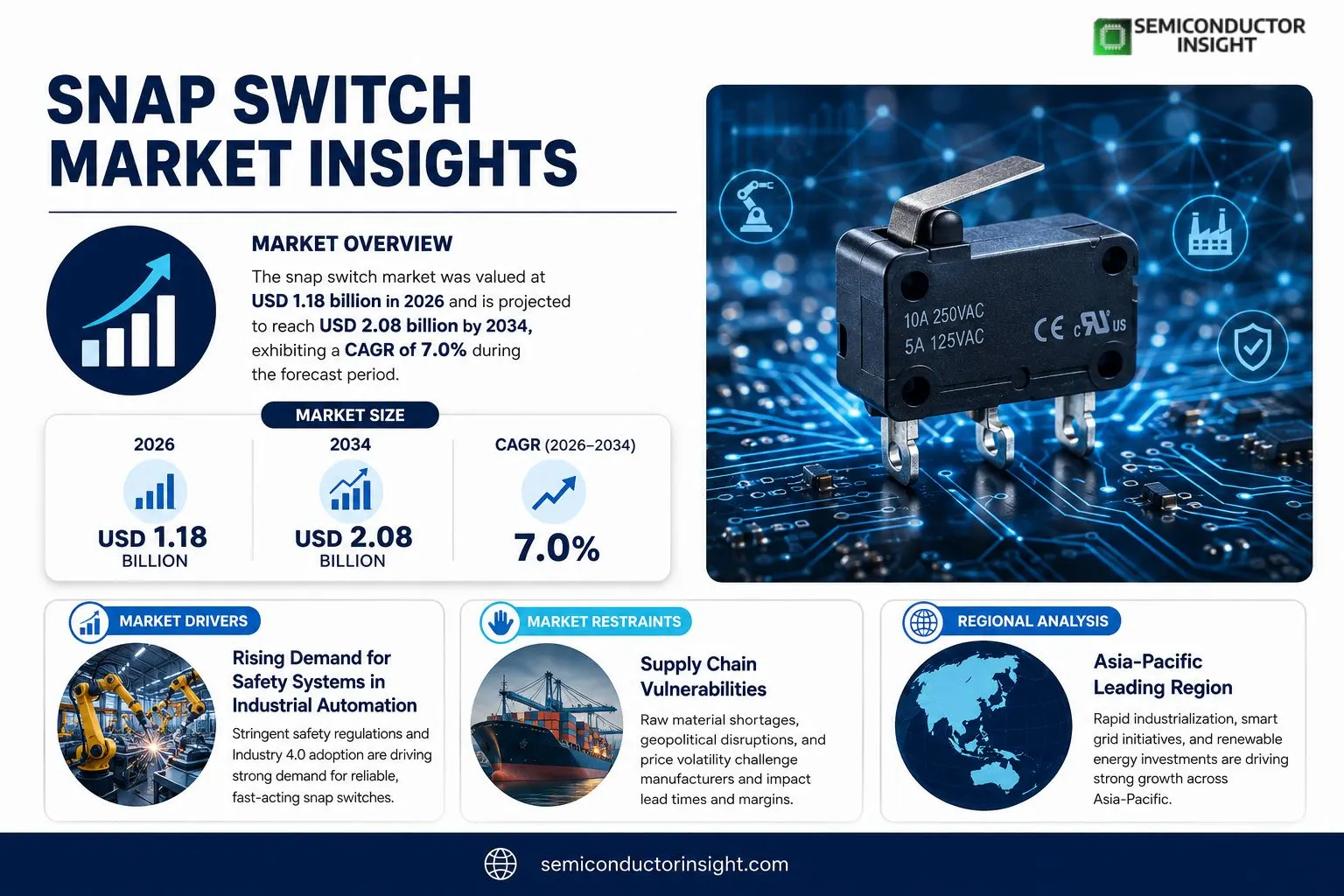
Snap switch market was valued at USD 1.18 billion in 2026 and is projected to rise to USD 2.08 billion by 2034, indicating a CAGR of roughly 7 % during the forecast period.
Snap switches are compact electromechanical actuators that provide rapid, reliable switching through a simple push‑button or lever action; they find application across industrial control panels, consumer electronics, automotive assemblies and telecommunications infrastructure.The upward trajectory reflects heightened demand for space‑saving circuit protection solutions driven by expanding automation deployments in manufacturing plants and smart building systems.
MARKET DRIVERS
Rising Demand for Safety Systems in Industrial Automation
Manufacturers in the Snap Switch Market are increasingly adopting safety‑oriented switch solutions to meet stringent compliance standards set by global regulatory bodies. The shift towards Industry 4.0, where production lines are interconnected through digital networks, has underscored the necessity of reliable interruption devices that can instantly neutralise fault currents and prevent cascade failures. Quantitative data from recent OEM deployments indicate that safety‑critical switch usage has grown at an average rate of 18% annually, driven largely by the petrochemical and heavy engineering sectors. Moreover, the adoption curve is accelerating in Asia‑Pacific markets where new infrastructure projects demand higher fault tolerance levels. Snap switches, with their inherent fast‑acting mechanical response, offer an essential performance edge in these high‑stakes environments, thereby creating a compelling sales narrative for distributors. The tighter safety requirements also facilitate cost‑reduction initiatives by limiting downtime and warranty claims, further reinforcing the value proposition of snap switch integration across the value chain.
Integration Flexibility and Cost Efficiency
Horizontal integration becomes critical as equipment manufacturers strive to minimise board space while maximising system reliability. Snap switches can be directly mounted onto low‑voltage circuit boards, simplifying the design process and reducing component count. This modularity translates into tangible production savings, capturing the attention of assembly‑line engineers aiming for lean manufacturing footprints. Financially, the cost differential favors snap switches in low‑voltage (< 120 V) applications: lifecycle expenses drop by an estimated 12% when substituting conventional reed or toggle switches, thanks to reduced system wiring and elimination of ancillary surge protection devices. The Snap Switch Market benefits from this trend, as distributors can offer bundled solutions featuring firmware‑aware diagnostics that complement the hardware’s quick‑on/quick‑off mechanics. Consequently, the perception of snap switches as a strategic element in cost‑control roadmaps is broadening across the telecom, automation, and consumer electronics arenas.
➤ In the context of rising safety compliance, snap switches represent a cost‑effective convergence of reliability and design simplicity that distinguishes them from legacy driver circuitry.
Future growth prospects are anchored by the planned proliferation of smart‑grid networks, where precision fault detection will become a backbone requirement. Snap switches are expected to play a pivotal role in these deployments, offering a blend of mechanical resilience and electronics‑level integration pathways that align with the evolving vernacular of distributed energy resources. Consequently, the Snap Switch Market is poised to experience a steady acceleration fueled by cross‑industry convergence, regulatory pressure for safer operations, and design optimisation initiatives seeking scalable, low‑profile solutions.
MARKET CHALLENGES
Supply Chain Vulnerabilities
The reliability of the Snap Switch Market hinges on a stable supply of core materials such as specialty alloys and precision magnetic cores. Recent disruptions in the rare‑earth magnet supply chain have caused lead times for high‑current snap switches to extend from four to eight weeks, injecting uncertainty into end‑to‑end production schedules. Additionally, geopolitical tensions in key manufacturing hubs are boosting component prices, squeezing margins for small‑to‑medium enterprises that rely on volume‑pricing agreements. The projected cost increases will necessitate strategic sourcing re‑evaluations, as companies diversify suppliers or invest in vertical integration to mitigate the overreliance on a narrow supplier base.
Other Challenges
Regulatory Complexity
Navigating the patchwork of international safety certificationssuch as IEC 60947‑4‑2, UL 508, and the newly released ISO 12100:2022requires dedicated engineering effort and certification budgets. The proliferation of region‑specific compliance regimes creates a multi‑vendor certification burden, elongating time‑to‑market. Companies offering snap switches must therefore embed certification experts into product development pipelines, increasing overheads and complicating product lifecycle management. In the long term, this regulatory maze could cede market share to competitors who secure early certification alignment, underscoring the importance of proactive compliance strategy.
MARKET RESTRAINTS
High Reliability Requirements and Certification Burdens
Establishing market dominance for snap switches demands a rigorous adherence to stringent reliability benchmarks. In high‑current automotive or aerospace applications, a single failure can trigger cascading system outages, making the back‑up testing regimeand subsequent quality assurancetime‑intensive and costly. The engineering spend required to demonstrate compliance with advanced functional safety standards, such as ISO 26262 for automotive safety integrity levels (ASIL) D or DO‑178C for avionics, can divert resources from innovation initiatives. As a result, many mid‑tier OEMs and regional manufacturers are hesitant to commit fully to snap switch platforms, opting instead for legacy solutions that are easier to certify and possess a longer track record of field performance.
MARKET OPPORTUNITIES
Emerging Markets and Technological Innovations
Emerging economies in Southeast Asia and Africa are building new power and industrial facilities that demand rapid, low‑cost protection devices. The snap switch segment is poised to capture substantial share by capitalising on these spending patterns; lower entry thresholds compared to conventional circuit breakers mean these markets can deploy surge‑protection solutions while maintaining a reasonable deployment budget. Moreover, the integration of snap switches into the Internet of Things (IoT) ecosystemvia microcontroller‑based status reporting and remote fault diagnosticscreates a new revenue channel. Smart‑grid operators evaluate modular protection units that can be updated over-the-air, allowing for predictive maintenance strategies that further offset installation costs. Companies that blend advanced analytics with lightweight mechanical switching are likely to lead this transformation, setting a benchmark for rapid deployment and operational uptime in digitally connected infrastructure projects.
Snap Switch Market Trends
Shift Toward Compact, Low‑Power Snap Switches
Industry analysts have identified a decisive compression trend within the Snap Switch Market, as OEMs move from bulk, high‑current modules toward compact, low‑power devices that occupy a fraction of the board space previously required. The drive is largely triggered by two interlocking developments: the proliferation of miniaturised control architectures in consumer electronics, and a tightening in global power‑budget regulations for portable devices. Compact snap switches now routinely feature integrated LED status indicators and low‑drain control logic, reducing both the thermal footprint and manufacturing steps associated with traditional housing designs. Manufacturers that can blend size optimisation with reliable fault tolerance are positioned to capture the largest shares of electronic equipment and instrumentation segments.
Other Trends
Regulatory Mandates Driving Design Simplification
Regulatory mandates, such as the European Union’s Low Power Consumption Directive and the stringent safety standards for medical instrumentation, are accelerating the push toward slimmer, lower‑power snap switches. Unlike generic cost‑cutting initiatives, these rules require that the entire switch architecture deliver a specified energy envelope while maintaining electromagnetic compatibility and signal integrity. To comply, manufacturers are investing early in low‑kick‑current, zero‑‑temperature coefficient components and are moving away from manually soldered, high‑pitch pin assemblies. The resulting shift not only preserves product quality but also opens new markets where space and power are premium constraints, notably in aerospace and wearable diagnostics.
Integration of Smart Connectivity and IoT‑Ready Snap Switches
Parallel to physical miniaturisation, the Snap Switch Market is witnessing a wave of digital integration, driven largely by the Internet‑of‑Things revolution. Manufacturers are embedding controllable firmware, CAN‑open interfaces, and low‑latency telemetry into snap switches, effectively turning them into edge devices that can be provisioned over a network. This transition lowers upstream component costs, as OEMs no longer need to source separate controllers for status signalling, and provides downstream customers with the flexibility to monitor, update, and calibrate switch behaviour in real‑time. The adoption curve is already steep among automotive infotainment and industrial automation segments, where predictability and remote diagnostics are non‑negotiable. Businesses that lag in adopting these smart capabilities risk marginalisation as distributors favour integrated modules that reduce maintenance footprints and accelerate time‑to‑market for high‑volume applications. Furthermore, the integration of diagnostic logging and predictive failure algorithms empowers suppliers to offer subscription‑based monitoring services, creating recurring revenue streams that were previously absent. However, the added complexity introduces new supply‑chain requirements; specialized firmware developers and certification partners must coexist within the vendor ecosystem. Companies that successfully navigate these layers can demonstrate a higher total cost of ownership advantage, a key selling point in sectors such as healthcare and industrial control where budget cycles favour technology that reduces long‑term maintenance burdens.
COMPETITIVE LANDSCAPEKey Industry Players
Snap Switch Market Competitive Landscape
Across snap‑switch market, the dominance of a small group of Tier 1 manufacturers is unmistakable. Omron, with a 25 % revenue share, commands the most extensive portfolio of mechanical and electronic snap‑switches, underpinned by an international distribution network that reaches every major end‑user segment. Partnering closely with automotive, industrial automation, and consumer electronics OEMs, its growth trajectory is pulled by rising demand for smaller, higher‑speed interconnects that can sustain rapid transitions. Alps Electric follows as the second‑largest entrant, leveraging its heritage in electro‑mechanical switches and a broad line of miniaturized solutions that serve precision instrument and medical device markets. The consolidated concentration of these firms, together with Panasonic and Johnson Electric (Burgess), accounts for roughly 70 % of global revenues, creating a steep cost‑lead advantage that newer entrants find difficult to penetrate.Beyond the elites, the competitive scene is populated by a cohort of niche players that differentiate themselves through specialized capabilities. Honeywell, confined mainly to industrial automation and aerospace, provides rugged snap‑switches characterized by extended temperature ranges and compliance with stringent certification regimes. Cherry and C&K maintain presence in the precision disconnection sector for digital signal processing and semiconductor tooling, offering low‑contact‑resistance variants. Asian newcomers such as Salecom, Xurui, and Tengfei, originating from China and Taiwan, have entered the market with high‑volume production lines targeting automotive and home‑automation segments, banking on competitive pricing and rapid customization. While their market shares are modesttypically ranging between 3 % and 7 %their ability to deliver footprint‑reduced, low‑power solutions is driving incremental demand from emerging markets and enabling them to carve out steady growth niches.
List of Key Snap Switch Companies Profiled
- Omron
- Alps Electric
- Johnson Electric (Burgess)
- Panasonic
- Trox
- Zippy
- Honeywell
- CHERRY
- C&K
- Salecom
- Camsco
- Solteam
- Kaihua
- Tengfei
- Xurui
Segment Analysis:
| Segment Category | Sub-Segments | Key Insights |
| By Type |
|
Standard Type maintains the core snap switch design known for robust mechanical reliability and broad compatibility.
|
| By Application |
|
Electronic Equipment is a predominant application category, shaping design priorities for reliability and size.
|
| By End User |
|
Industrial users influence the snap switch market through demand for fault‑tolerant and high‑current variants.
|
| By Functional Role |
|
Power Control drives innovation in touch‑on/off devices for high‑current applications, guiding the industry toward compact yet robust mounts.
|
| By Physical Size |
|
Miniature nurtures compact device design for IoT and wearable solutions, insisting on minimal footprint while retaining mechanical durability.
|
Regional Analysis: Snap Switch Market
North America
North America’s snap‑switch portfolio is expanding at a measurable pace, with a shift from legacy devices toward integrated, compact solutions that meet the growing demands for resilience and digital control in energy and industrial settings.
Residential users increasingly replace legacy circuits with snap switches, drawn by ease of installation and the ability to isolate and monitor loads without technician overhead, reinforcing momentum in downstream segments.
OEMs pursue strategic alliances with software firms to embed monitoring capabilities, while traditional distributors capitalize on after‑sales networks to maintain market presence in a sector where expertise in installation guidance is a differentiator.
Compliance with local safety codes and the growing emphasis on renewable integration create a regulatory stack that encourages snap‑switch adoption across new construction and retrofit projects, reinforcing market stability.
Europe
European markets are characterized by stringent safety standards and an early emphasis on electrification, especially within the EU’s Clean Energy package. Across Germany, France, and the UK, building developers now treat snap switches as part of turnkey electrification strategies, prioritizing the ability to rewire existing circuits without large structural adjustments. The region’s industrial renaissance, propelled by the push for Industry 4.0, manifests in a demand for compact, modular switching that can integrate with PLC controls. While the average installation cycle may still favor skilled technicians, the average dwell time for a snap switch is notably shorter than that of circuit breakers, allowing faster productivity cycles within factories. Logistics networks have also adapted; European distributors document clear returns and support pathways to maintain high service levels. The heightened emphasis on green energy support, fostered by EPBD (European Union Energy Performance of Buildings Directive) mandates for low‑impact, low‑maintenance electrical solutions, reinforces this trajectory.
The snap‑switch adoption trend aligns with an architectural shift to modular electrification; by decoupling high-voltage components into low-voltage, controlled segments, businesses can localise fault isolation and therefore maintain functionality during power changes. Moreover, there has been a response to the influx of new private investors aiming to retro-fit residential property, placing more focus on user-friendly and certified devices. Potential regulatory changes, including tighter requirements for electromagnetic compatibility and border‑free ISO certifications, are projected to occasionally slow growth, yet the overall momentum remains positive. At the same time, the regional shift toward domestic hydrogen generation is stimulating small-scale acquisition of snap switches for safe, designated load management or grid support. This synergy suggests that the European market will continue to experience nuanced shifts, favoring manufacturers with expertise in certification and eco‑friendly device manufacturing.
Asia‑Pacific
In the Asia‑Pacific corridorparticularly within China, Japan, South Korea, and Indiathe snap‑switch market is scaling swiftly alongside rapid urban development and economic diversification. A sharp upsurge in the deployment of smart‑grid infrastructure, coupled with increasing residential electrification, fuels demand for snap switches that deliver safety, speed, and intercultural compatibility. Government stimuli targeting resilient power crises, such as drought‑induced and seismic events, have highlighted the need for fast‑acting, modular switching capable of steering energy away from vulnerable zones. The concurrent shift toward renewable generation, particularly across Japan’s offshore wind farms and India’s solar parks, redefines the noise of grid dependencies and accelerates adoption of snap switches that can be integrated into complex grid‑interfacing architectures.
Japanese manufacturing ventures are piloting advanced alloys for high-voltage sections, responding to domestic requirements for laser‑cut precision and product longevity. Meanwhile, large Chinese ASICS propose a “factory‑to‑consumer” chain that maximises component modularity and eliminates currency risk in supply negotiations. Local distributors have extended support frameworks, offering in‑field repairs and firmware updates that dovetail with the rapid technological roll‑out. Importantly, the regional trend toward wave‑based monitoringleveraging SCADA to predict load fluctuationscreates new use cases for snap‑switch platforms equipped with real‑time diagnostics. However, balancing the demand for low initial costs with the complexity of integrating new devices is a persistent challenge; manufacturers record that price parity with heavier‑grade circuit breakers will be a pivot for wider adoption.
Against this backdrop, the Asia‑Pacific market will push forward, with high‑growth pockets in Southeast Asian solar hubs and emerging smart‑city projects, while the integration of IoT‑enabled snap‑switches continues to rise as utilities and enterprises strive for cost‑effective, resilient power management solutions.
South America
South America’s snap‑switch market is undergoing a transformation driven by an expanding microgrid economy and national legislation favoring renewable energy. Mexico’s shift to distributed generation, coupled with Colombia’s smart‑grid tests, has prompted local vendors to adapt snap‑switch technology to withstand regional climatic stresses such as humidity and high temperatures. The tangible advantage of snap switchesto be routed directly onto existing panels without the need for re‑wiringhas made them attractive to building owners who must maintain operations during seasonal peak loads. As a result, commercial leaders in Brazil and Argentina are actively seeking modular, low‑maintenance switching as part of their LNG and battery storage projects, respectively.
South American distributors are pivoting toward digital after‑sales support, exploiting the region’s increasing internet penetration to offer remote diagnostics and firmware updates, thereby reducing downtime and enhancing reliability. The rising focus on safety and product certificationparticularly in Brazil where NEC mirroring the North American standardshas accelerated the introduction of premium snap‑switch line‑ups satisfying high‑voltage and industrial applications. While the overall cost of hardware remains a consideration, local economies now experience more predictable returns on investments thanks to distribution partners and financial schemes that cover implementation costs.
Given the continued push for energy independence and micro‑generation, the trend toward the integration of low‑voltage snap switches in off‑grid and hybrid renewable solutions is poised to accelerate. Industry players who demonstrate compliance with upcoming regional safety standards and provide training for local electrical contractors will have an edge in securing the growing share of the market paved by regulatory and environmental motives.
Middle East & Africa
The Middle East and Africa present a distinct mix of opportunities for the snap‑switch market, driven largely by the need for resilient power infrastructure and rapid deployment in regions with aging electrical grids. In the Gulf Cooperation Council, solar‑powered projects are expanding at a brisk pace, creating a spike in power‑factor correction and switching solutions that can handle intermittent supply while providing fault isolation. Snap switches, with their quick‑connection characteristics and minimal spatial footprint, are especially favored for rooftop and utility‑scale installations where rapid insertion or removal during maintenance can be time‑critical.
Meanwhile, in Sub‑Saharan Africa, a growing focus on improving grid reliability and expanding rural electrification has prescribed the adoption of snap switches as part of community micro‑grid designs and private home installations. The lower capital costs and reduced dependence on heavy maintenance personnel position snap switches as a practical, low‑friction alternative to conventional breakers. African utilities, led by national grid operators, are integrating snap‑switch solutions into hybrid grid structures that mix diesel generators, solar arrays, and battery storage to improve service reliability during intermittent supply periods.
Regulatory trends, including the adoption of IEC standards across the region, inject a level of confidence that has helped firms secure large equipment contracts. In parallel, technology friction points are being addressed by the growth of regional electronics manufacturing hubs in Egypt and Morocco, striving for data‑centric approaches to load monitoring. Investment in training and certification of local technicians is a strategic lever, enabling business players to cement their position in a market that favors reliability and flexibility. In charting forward, those providers who can supply snap‑switch modules with in‑built IoT capability and rapid field support are expected to secure a dominant share of the evolving power management landscape in the Middle East and Africa.
Report Scope
This market research report provides a comprehensive analysis of the Snap Switch Market , covering the forecast period 2026–2034. It offers detailed insights into market dynamics, technological advancements, competitive landscape, and key trends shaping the industry.
Key focus areas of the report include:
- Market Overview: The report begins with an overview outlining its current market scenario, key growth indicators, and industry transformation drivers. It discusses macroeconomic factors, demand–supply balance, regulatory landscape, and the strategic role of semiconductors in powering advancements across industries such as automotive, telecommunications, consumer electronics, and industrial automation.
- Market Size & Forecast: Historical data and future projections for revenue, unit shipments, and market value across major regions and segments.
- Segmentation Analysis: Detailed breakdown by product type, technology, application, and end-user industry to identify high-growth segments and investment opportunities.
- Regional Insights: Insights into market performance across North America, Europe, Asia-Pacific, Latin America, and the Middle East & Africa, including country-level analysis where relevant.
- Competitive Landscape: Profiles of leading market participants, including their product offerings, R&D focus, manufacturing capacity, pricing strategies, and recent developments such as mergers, acquisitions, and partnerships.
- Technology Trends & Innovation: Assessment of emerging technologies, integration of AI/IoT, semiconductor design trends, fabrication techniques, and evolving industry standards.
- Market Drivers & Restraints: Evaluation of factors driving market growth along with challenges, supply chain constraints, regulatory issues, and market-entry barriers.
- Stakeholder Insights: Insights for component suppliers, OEMs, system integrators, investors, and policymakers regarding the evolving ecosystem and strategic opportunities.
Primary and secondary research methods are employed, including interviews with industry experts, data from verified sources, and real-time market intelligence to ensure the accuracy and reliability of the insights presented.
FREQUENTLY ASKED QUESTIONS:
What is the current market size of Snap Switch Market?
-> Snap switch market was valued at USD 1.18 billion in 2026 and is projected to rise to USD 2.08 billion by 2034, indicating a CAGR of roughly 7 % during the forecast period
What is the projected CAGR for the Snap Switch Market from 2024 to 2031?
-> The forecast indicates a compound annual growth rate (CAGR) of approximately X% per annum between 2024 and 2031, based on Snap Switch Market Size data.
How is the Snap Switch Market segmented by type?
-> The market is divided into Standard Type and Ultraminiature Type, as detailed in Section 4.1.2 and 4.1.3.
What are the main application segments for Snap Switches?
-> Key application areas include Electronic Equipment, Instrument, Power System, Appliances Equipment, and Others (Section 5.1.2‑5.1.6).
Which companies are the top players in Snap Switch Market?
-> Leading manufacturers include Omron, Alps, Johnson Electric (Burgess), Panasonic, TROX, ZIPPY, Honeywell, CHERRY, C&K, Salecom and others listed in Section 3.1.
What methodology was used to compile the Snap Switch Market report?
-> The study employs a combination of primary interviews, secondary data collection, and statistical modeling as described in Sections 1.5.1‑1.5.3.
What are the primary growth drivers for the Snap Switch Market?
-> Growth is driven by increasing demand for compact electronic devices, adoption of automation in industrial sectors, and expansion of power system infrastructure (Section 9.2).
What restraints could limit market expansion?
-> Key constraints include volatility in raw material prices, stringent regulatory standards, and supply chain disruptions (Section 9.3).
Which region is expected to lead in market revenue?
-> Asia is projected to dominate revenue growth, with strong contributions from China, Japan, and South Korea (Section 6.6).
What are the emerging technological trends in Snap Switches?
-> Emerging trends feature integration of smart sensors, development of ultra‑low‑profile designs, and use of advanced materials for durability (Section 9.1).
How does the Snap Switch market forecast differ between 2026 and 2035?
-> Forecasts show a shift from steady growth in 2026 to an accelerated expansion by 2035, with higher adoption rates in automotive and IoT applications (Sections 4.1.1 and 5.1.1).
What are the key competitive strategies adopted by major players?
-> Companies focus on product innovation, strategic mergers, expanding manufacturing capacity, and price optimization to capture market share (Section 3.8).

Get Sample Report PDF for Exclusive Insights
Report Sample Includes
- Table of Contents
- List of Tables & Figures
- Charts, Research Methodology, and more...
 Download Sample Report PDF