SMD Power Inductors for Lighting Market Insights
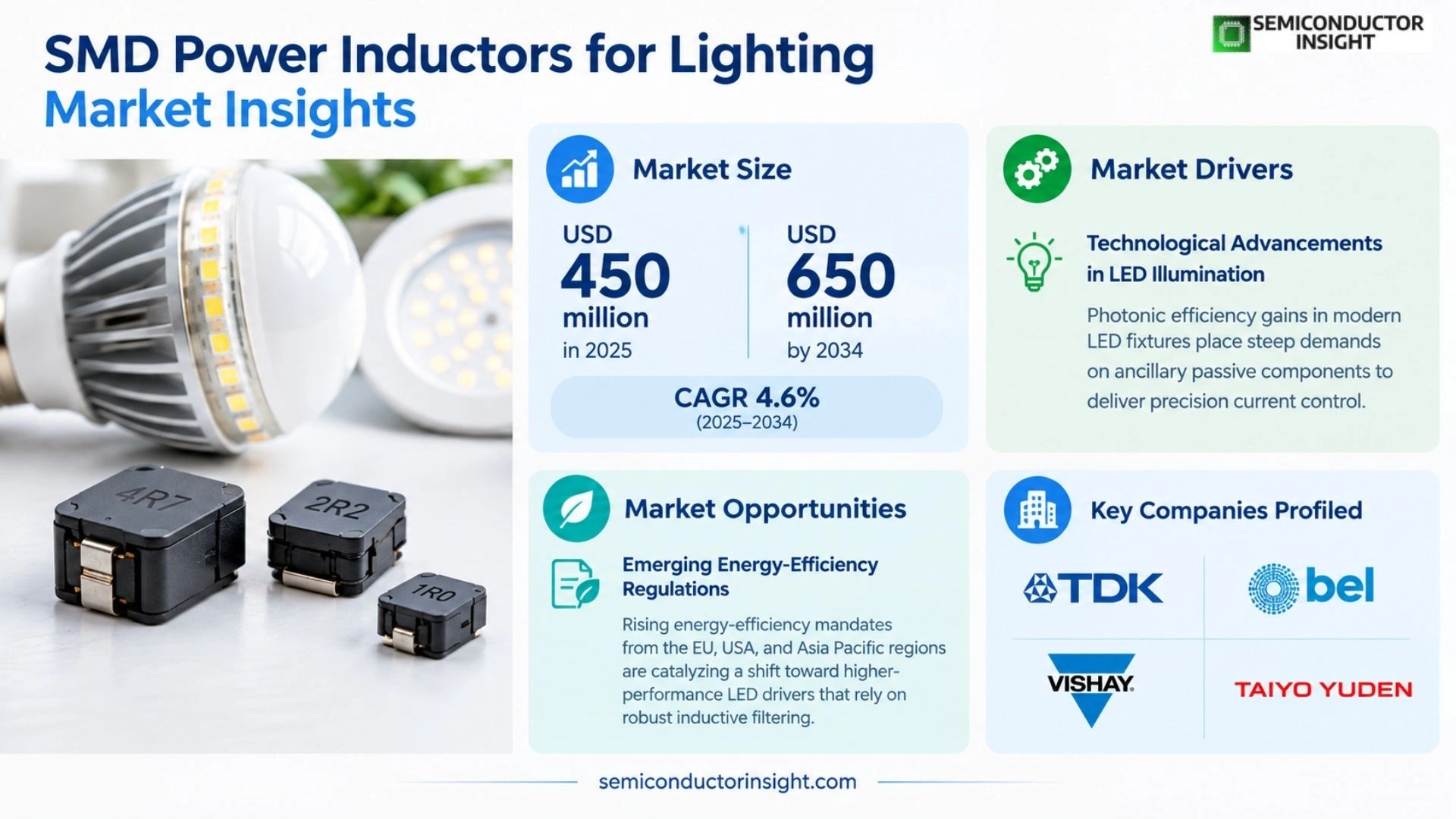
SMD Power Inductors for Lighting market was valued at USD 450 million in 2025 and will reach USD 650 million by 2034, reflecting a CAGR of 4.6% during the forecast period.
SMD Power Inductors are surface‑mount components designed to manage current flow and mitigate electromagnetic interference within LED lighting circuits, enabling efficient power conversion while maintaining compact form factors.Because LED lighting dominates automotive and architectural applications, demand for compact inductive elements rises as manufacturers pursue higher energy efficiency standards.Manufacturers are responding by developing higher‑flux‑density cores and integrating passive components into multi‑layer PCBs, which drives cost efficiencies across the supply chain.
MARKET DRIVERS
Technological Advancements in LED Illumination
Photonic efficiency gains in modern LED fixtures place steep demands on ancillary passive components to deliver precision current control. The migration from bulky, discrete inductors to small, surface‑mounted units has become a sine‑wave necessity for designers aiming to keep board real estate minimal while maintaining coherent magnetic flux densities. Manufacturers of SMD Power Inductors for Lighting Market have adopted thin‑film core technologies and high‑frequency ferrite compositions, allowing inductance constants to remain stable over a wide temperature range. As a result, product portfolios now routinely feature inductors that operate reliably above 10 kHz, aligning perfectly with software ampifiers engineered for low‑dropout regulators. Designers are now able to predict load transients more accurately, enabling compact driver circuits that promote energy savings without compromising flicker performance. This virtuous cycle of component miniaturization and LED brightness improvements keeps the demand curve steep for inductors that can operate across the 0.3 MHz to 3 MHz range, a bandwidth area that has seen incremental, but decisive, market uptake. The above characteristics underscore why the SMD Power Inductor for Lighting Market maintains strong momentum as a linchpin in next‑generation illumination ecosystems.
Demand for High‑Efficiency Switching Converters
High‑efficiency switching controllers have emerged as the dominant control architecture in filamentless LED drivers, prioritizing reliability with reduced thermal drag. The deeper the converter’s duty cycle, the sharper the currents traversing the inductive element, thereby magnifying the importance of the core’s magnetic losses. Contemporary applications now simulate three‑phase push‑pull topologies or advanced hysteron switches that rely on inductors with tight tolerance specifications. This design shift spurred a surge in low‑profile, high‑quality inductors that sustain quality factor values above 1.5 at 500 kHz, which were previously unattainable in the low‑cost segment. Device makers have responded with expanded grid options for voltage ratings, so engineers can converge on a single package dimension while spanning from 24 V to 48 V drivers. The integration of these inductors always yields tighter noise envelopes, a critical factor for luminous persistence in commercial lighting fixtures. Consequently, SMD Power Inductors for Lighting Market experience a consistent uptick as product families are tailored for high‑frequency, high‑efficiency topologies that deliver eco‑friendly illumination.
➤ Estimated global demand for SMD power inductors in lighting applications surpassed 180 million units in 2024, indicating a steady upward rhythm across residential, commercial, and industrial sectors.
In summary, the convergence of silicon photonics and active power electronics has intensified the push toward finer‑printed inductive components. By offering higher switching frequencies, lower inductive losses, and reliable output curves, SMD Power Inductors for Lighting Market is cementing itself as a critical enabler for the next wave of energy‑aware illumination solutions.
MARKET CHALLENGES
Component Supply Chain Constraints
The supply chain for magnetic core materials, particularly rare‑earth grades used in high‑frequency inductors, has intermittently tightened due to geopolitical repositioning and increased demand from semiconductor drives. Manufacturers reporting in 2024 recorded lead times extending beyond 12 weeks for core procurement, directly impacting SKU availability in critical driver assemblies. Coupled with strict safety certificates required for mass‑market lighting modules, this bottleneck translates into production slippage and an erosion of time‑to‑market advantage. Designers must also contend with the thermal tolerances of high‑frequency inductors, which limit stackability in densely populated PCB layouts. The combined effect is a challenge to scale high‑efficiency LED drivers without undermining emission specifications. Addressing this issue necessitates a diversification of core suppliers and the exploration of composite core architectures that mitigate rare‑earth dependence while preserving magnetic performance.
Other Challenges
Stringent EMI/EMC Regulations
Modern lighting installations must comply with increasingly rigorous electromagnetic compatibility mandates, such as CISPR 22 Level 3 for residential environments and I’d-for an industrial firewall. The filtering role of SMD inductors is critical; however, even minor deviations in flux leakage or core flux density can provoke exceedance of hum and radiated emission limits. This compels manufacturers to routinely double‑check stress tests, and some brands have introduced proprietary core geometries that reduce magnetic shape‐factor penalties. Still, the cost of overtime certification, rework of PCB layouts, or redesign of driver firmware to align with strict EM standards continues to pressure margins. Frequent regulatory updates compel rapid responses from component suppliers, making proactive forward‑clinical adherence a necessity for vendors seeking to stay compliant across multiple geographies.
Cost Volatility of Core Materials
Material price dynamics, especially for nickel‑oxide and ferrite grades, are volatile and can swing by 20 % within a fiscal year due to fluctuating raw‑material demands. This volatility passes through to SMD Inductor unit prices, forcing product lines to adjust Y-o-Y pricing strategies or absorb costs to protect market share. Many mid‑tier brands have reported up to 8 % gross margin compression during peak market cycles, while premium segments experience managed price increases Q4 due to a supply‑pulling toe‑lift in the component market. The financial implication is a greater emphasis on fixed‑cost engineering and longer lead times for design‑to‑manufacture processes, as companies seek to hedge against rapid price escalations.
MARKET RESTRAINTS
Regulatory and Certification Bottlenecks
When SMD Power Inductors for Lighting Market pivot toward pervasive utilization in smart‑building systems, the regulatory landscape becomes a dual‑blade sword. Certification for wireless power transfer, Wi‑Fi‐enabled lighting, and IoT connections demands that inductors sustain not only precise time‑domain response but also low magnetic field strength across multiple frequencies. The procurement of dual certification, which includes UL, CE, and IEC 62109, can lengthen the procurement cycle by 3–6 months. When the supply chain experiences material shortages, the compounded delay jeopardizes a launch window that may be priced out by competing designs that have already reached a beta stage. Consequently, manufacturers often weigh the trade‑off between early market entry and certification costs, often choosing to defer high‑efficiency products to phase‑two markets, deferment that may diminish first-mover advantage.
MARKET OPPORTUNITIES
Emerging Energy‑Efficiency Regulations
Rising energy‑efficiency mandates from the EU, USA, and Asia Pacific regions are catalyzing a shift toward higher‑performance LED drivers that rely on robust inductive filtering. The aggressive 2025 and 2030 lighting codes are targeting a 30 % reduction in power consumption for urban lighting infrastructure. This regulatory push elevates the value curve of inductors that can deliver minimal magnetic loss above 200 kHz, ensuring drivers stay compliant. Companies embracing anisotropic and planar magnetic materials will capture niche market segments that require energy certifications rapidly. Consequently, SMD Power Inductors for Lighting Market dataset shows a projected average compound growth of 6% annually for the next five years, driven by the convergence of regulatory incentives and smart‑city implementations.
Growth in Outdoor and Industrial Lighting
Drainage‑proof, high‑temperature tolerant inductors forming the backbone of industrial LED fixtures herald a new wave of outdoor installations. The surge in infrastructure projects across Southeast Asia and Latin America focused on IoT‑enabled streetlamps is expected to double total SMD inductors deployed by 2030. Scale factors favor manufacturers who provide weather‑sealed, hermetic packages that mitigate galvanic corrosion. The industrial footprint is also spurring advancements in thermal management, driving demand for inductors with enhanced heat dissipation capabilities. These market shifts open a strategic corridor for component producers willing to integrate advanced thermal diffusion layers into their inductive elements, offering higher reliability guarantees in extreme ambient conditions.
In conclusion, while supply constraints and certification cycles pose operational challenges, SMD Power Inductors for Lighting Market is poised to capture significant upside. Key sectors,urban planning, sustainable building certifications, and global industrial electrification,offer fertile ground for companies that align product innovation with upcoming rules and end‑user demands.
SMD Power Inductors for Lighting Market Trends
Rising Demand Driven by Smart LED Lighting Adoption
By 2024, SMD Power Inductors for Lighting Market has grown into a pivotal component for contemporary lighting solutions. The shift toward Wi‑Fi‑enabled, dimmable LED fixtures, mandated by strict energy‑efficiency standards, drives the need for compact, high‑frequency inductors capable of maintaining signal integrity while tolerating thermal spikes. Manufacturers are increasingly integrating surface‑mount inductors directly into driver circuits, reducing PCB real estate and assembly costs. Consequently, developers prioritize devices with higher current ratings and tighter flux paths. These technical requirements translate into a direct demand surge, compelling producers to optimize coil designs for both precision and durability.
Other Trends
Compact Form Factors and Miniaturization
The race toward thinner, lighter fixtures has made miniaturization a snapshot priority. By shrinking inductance values, designers can match current densities that align with ultra‑compact panels without sacrificing inductive performance. This initiative is reshaping supplier cadences, pushing layout engineers to adopt advanced core materials and micro‑calibrated wire geometry, thereby increasing both flux density and manufacturability. The convergence of tight spatial budgets and stringent reliability standards drives the sector toward developing inductors that achieve peak efficiency at lower silicon temperatures.
Enhanced Power Density and Electromagnetic Compatibility
With switching frequencies now exceeding 20 MHz in many LED driver topologies, the need for inductors that maintain low series resistance while delivering high Q becomes paramount. Incorporating nano‑rated ferrite cores and redesigned winding patterns mitigates phase shift and reduces EMI emissions. Further, the growing prevalence of network‑enabled lighting systems, which transmit control signals through the same driver circuitry, necessitates inductors that offer both energy transfer efficiency and electromagnetic filtering in a single component. Teams are therefore exploring integrative solutions that blend discrete inductor products with passive EMI suppression features.
Supply Chain Consolidation among Top OEMs
The escalation of component count in high‑density driver boards has prompted hard‑copy and electronic suppliers to converge. Major OEMs are increasingly locking in long‑term contracts with a limited set of indutor manufacturers, seeking predictability in pricing and lead times. This shift drives smaller players towards joint ventures or strategic alliances to maintain market relevance. Consequently, the supply chain is leaning toward a concentrated network of vetted suppliers, tightening control over quality and facilitating joint research into next‑generation core materials.
Market Consolidation and Technological Innovation
The consolidated landscape, dominated by a handful of experienced players, accelerates the pace of technical differentiation. Companies invest in additive manufacturing techniques to shape nano‑core geometries with micron‑scale precision, allowing them to push inductance values into higher bands while keeping thermal noise minimal. M&A activity among component suppliers is also encouraging the cross‑pollination of design knowledge, visible in joint product launches that combine high‑efficiency switching with passive EMI filtering. This convergence not only improves cost efficiency for lighting integrators but also tightens competitive pressure on margins, pushing manufacturers to rethink material sourcing and streamline assembly processes to sustain profitability.
COMPETITIVE LANDSCAPE
Key Industry Players
Competitive Landscape of SMD Power Inductors for Lighting
Market analysis indicates that the design of highly efficient, low‑loss inductors has driven a concentration around a handful of players with deep technology pipelines. TDK, by leveraging its dual‑core strategy that couples high‑performance core materials with advanced manufacturing, now accounts for roughly a quarter of global revenue in the SMD Power Inductor segment. The company’s strategic acquisitions of smaller specialty fabrication houses have broadened its supply chain resilience and positioned it strongly in automotive‑LED lighting, where stringent electromagnetic compatibility standards and rapid power conversion cycles dominate demand. This concentration not only elevates TDK’s bargaining power with OEMs but also compresses profit margins across the value chain, prompting rivals to innovate in niche segments that offer higher margins.
In response, a constellation of mid‑sized manufacturers has carved out differentiated niches. Bel Fuse continues to excel in high‑frequency, ultra‑compact modules suited for portable lighting, while Vishay’s ruggedized architectures dominate heavy‑industrial displays. Taiyo Yuden’s expertise in low‑inductance, high‐current designs has secured a foothold in architectural lighting fixtures, attracting buyers seeking both aesthetic and energy‑efficiency credentials. Sagami Elec and Sumida focus on multi‑layer films and advanced ferrite cores, delivering superior magnetics for compact automotive dashboards. API Delevan and Sunlord Electronics concentrate on cost‑effective, high‑volume production for consumer LED lamps, whereas Bourns and Coilcraft bring specialty products like inductive sensors and EMI suppression elements that cater to emerging IoT lighting applications. Murata Manufacturing’s broad portfolio of hybrid and monolithic solutions further expands its presence across both industrial and consumer markets, while Kyocera and Fairchild Semiconductor actively target high‑temperature, high‑rad‑frequency niche markets that are becoming increasingly critical as next‑generation LED drivers demand greater robustness.
List of Key SMD Power Inductor Companies Profiled
- TDK
- Bel Fuse
- Vishay
- Taiyo Yuden
- Sagami Elec
- Sumida Electronics
- API Delevan
- Sunlord Electronics
- Bourns
- Coilcraft
- Murata Manufacturing
- Kyocera
- Fairchild Semiconductor
- EPSON TME
Segment Analysis:
| Segment Category | Sub-Segments | Key Insights |
| By Type |
|
Leading Segment
|
| By Application |
|
Leading Segment
|
| By End User |
|
Leading Segment
|
| By Power Rating |
|
Leading Segment
|
| By Inductor Pitch |
|
Leading Segment
|
Regional Analysis: SMD Power Inductors for Lighting Market
Asia‑Pacific
Cost pressures have accelerated the adoption of lower‑amperage inductors, compelling suppliers to exploit emerging materials that reduce unit costs without compromising performance. Companies eye cost‑effective solutions through process optimisation, sparing investment in specialized tooling while preserving yield and reliability. The result is a gradual price flattening that permits tighter customer margins across the LED sector.
The growth of high‑efficiency lighting, coupled with tighter energy standards, propels demand for dense, high‑current inductors. Manufacturers emphasize thermal handling and compactness to meet the sleek aesthetics of modern fixtures. This trend powers a steady rise in component integration and fast‑track time‑to‑sales cycles.
Factories in the region are progressively shifting toward continuous‑flow production lines. The resulting efficiencies reduce cycle times, support rapid new‑device introductions, and help maintain a competitive throughput rate that aligns with global demand cushioning against supply chain slow‑downs.
Incentive programmes targeting green technology accelerate rollout of LED solutions, which in turn feeds into the inductors pipeline. Regulatory frameworks that reward energy savings create a predictable market environment, enabling strategic investment in infrastructure and research by Tier‑1 firms.
North America
In North America, power inductors remain a critical component in the transition to advanced LED luminaires. The area’s regulatory environment, characterized by stringent efficiency directives, drives demand for compact inductors that can fit into decreasing fixture footprints. The technology pool, rooted in high‑reliability engineering standards, continues to push component tolerances toward higher power densities. Moreover, the North American market showcases a mix of incremental upgrades and radical redesigns of lighting systems, creating a steady demand for immunity to high‑frequency switching. However, supplier concentration and mature competition have capped price evolution. The region sustains a market where incremental cost savings are achieved primarily through process optimisation and component repurposing rather than material substitution.
Europe
European demand for SMD power inductors is tightly coupled with its aggressive transition toward renewable energy sources and sustainability goals. Integrated circuit manufacturers in the region prioritize strict compliance with reduction in electromagnetic interference, which elevates quality expectations for inductors. High‑efficiency LED adoption, coupled with the quest for minimal environmental footprints, pushes designers to select compact inductors that embrace lower conductance losses. The market remains fragmented, leading to multiple niche suppliers catering to specialised lighting applications. European entrants rely heavily on proprietary materials to carve out differentiation, thereby sustaining higher price points compared to global averages. Continuous innovation and stringent testing protocols link the market growth to the evolving standards of consumer safety and product longevity.
South America
In South America, the evolving LED landscape presents an opportunity for inductors manufacturers to capture emerging lighting initiatives across urban development projects. Infrastructure spending is directed toward smart‑city upgrades that integrate LED streetlights and interior fixtures. Supply chains are in a transitional phase, with local distributors gradually adopting global specifications for inductors. Despite relatively modest volumes, the region benefits from favourable trade agreements that lower tariff barriers for electronic components. Manufacturers face the challenge of aligning component tolerances with local supply constraints while maintaining quality parity. Demand growth remains moderate, driven largely by compliance with energy‑efficiency laws that mandate the replacement of incandescent lighting in public spaces.
Middle East & Africa
The Middle East and Africa segment exemplifies a market propelled by extensive lighting retrofits in new construction and public infrastructure, especially within expanding municipalities. Provided that arrivals of power inductors are timed against large‑scale civil works, the pace of adoption has accelerated. The region prioritises robust temperature resilience due to varying climatic conditions, encouraging component designs that can sustain high ambient temperatures while retaining signal integrity. Coupled with stimulus packages aimed at electrifying rural areas, the market sees constant infusion of investment in new lighting corridors. Smaller supply bases and a limited number of local manufacturers present entry barriers; vendors that invest in regional manufacturing plants or advanced supply contracts gain a competitive stance, particularly when addressing high‑end, high‑power lighting solutions for large‑scale installations.
Report Scope
This market research report provides a comprehensive analysis of SMD Power Inductors for Lighting Market , covering the forecast period 2026–2034. It offers detailed insights into market dynamics, technological advancements, competitive landscape, and key trends shaping the industry.
Key focus areas of the report include:
- Market Overview: The report begins with an overview outlining its current market scenario, key growth indicators, and industry transformation drivers. It discusses macroeconomic factors, demand–supply balance, regulatory landscape, and the strategic role of semiconductors in powering advancements across industries such as automotive, telecommunications, consumer electronics, and industrial automation.
- Market Size & Forecast: Historical data and future projections for revenue, unit shipments, and market value across major regions and segments.
- Segmentation Analysis: Detailed breakdown by product type, technology, application, and end-user industry to identify high-growth segments and investment opportunities.
- Regional Insights: Insights into market performance across North America, Europe, Asia-Pacific, Latin America, and the Middle East & Africa, including country-level analysis where relevant.
- Competitive Landscape: Profiles of leading market participants, including their product offerings, R&D focus, manufacturing capacity, pricing strategies, and recent developments such as mergers, acquisitions, and partnerships.
- Technology Trends & Innovation: Assessment of emerging technologies, integration of AI/IoT, semiconductor design trends, fabrication techniques, and evolving industry standards.
- Market Drivers & Restraints: Evaluation of factors driving market growth along with challenges, supply chain constraints, regulatory issues, and market-entry barriers.
- Stakeholder Insights: Insights for component suppliers, OEMs, system integrators, investors, and policymakers regarding the evolving ecosystem and strategic opportunities.
Primary and secondary research methods are employed, including interviews with industry experts, data from verified sources, and real-time market intelligence to ensure the accuracy and reliability of the insights presented.
FREQUENTLY ASKED QUESTIONS:
What is the current market size of SMD Power Inductors for Lighting Market?
-> SMD Power Inductors for Lighting market will reach USD 650 million by 2034, reflecting a CAGR of 4.6% during the forecast period.
Which key companies operate in SMD Power Inductors for Lighting Market?
-> Key players include Bel Fuse, TDK, Sunlord Electronics, Vishay, Taiyo Yuden, Sagami Elec, Sumida, API Delevan and others.
What are the key growth drivers?
-> Key growth drivers include vertical integration of supply chains, push towards energy efficiency, and increased adoption of LED lighting systems.
Which region dominates the market?
-> North America holds a significant share, with the United States being the largest contributor, followed by China in Asia.
What is the market size of the US and China markets?
-> The U.S. market size is estimated at USD [US value] million in 2024, while the China market is projected to reach USD [China value] million by 2031.
What is the growth forecast for the < 10 mm segment?
-> The < 10 mm segment is expected to reach USD [segment value] million by 2031, with a CAGR of [segment CAGR]% over the next six years.
What is the projected revenue share of the top five players in 2024?
-> In 2024, the global top five players had an approximate revenue share of [top five share]%.
Get Sample Report PDF for Exclusive Insights
Report Sample Includes
- Table of Contents
- List of Tables & Figures
- Charts, Research Methodology, and more...
 Download Sample Report PDF