Smart TV SoC (4K, 8K, AI Upscaling) Market Insights
Global Smart TV SoC (4K, 8K, AI Upscaling) Market size was valued at USD 1.55 billion in 2025. The market is projected to grow from USD 1.62 billion in 2026 to USD 2.90 billion by 2033, exhibiting a CAGR of 6.0% during the forecast period.
Smart TV SoCs are highly integrated semiconductor solutions that combine processing, graphics, memory interfaces, and connectivity functions into a single chip. These advanced system-on-chips power the core functionalities of modern smart televisions, enabling seamless 4K and 8K video decoding, AI-driven upscaling algorithms, smart platform operations, and enhanced user interfaces. Key features include support for high dynamic range (HDR), advanced audio processing, and efficient power management for large display panels.
The market is experiencing steady growth due to several factors, including rising consumer demand for higher resolution displays, rapid adoption of AI technologies for image enhancement, and increasing penetration of smart features in televisions worldwide. Furthermore, advancements in video processing technologies such as real-time AI upscaling from lower resolutions to near-native 4K or 8K quality are contributing to market expansion. While 4K remains dominant, 8K adoption is accelerating in premium segments supported by improving content availability and falling component costs. Initiatives by key players continue to drive innovation, with companies focusing on integrating more powerful neural processing units for on-device AI capabilities. MediaTek, Novatek, and Realtek Semiconductor are some of the key players that operate in the market with a wide range of portfolios.
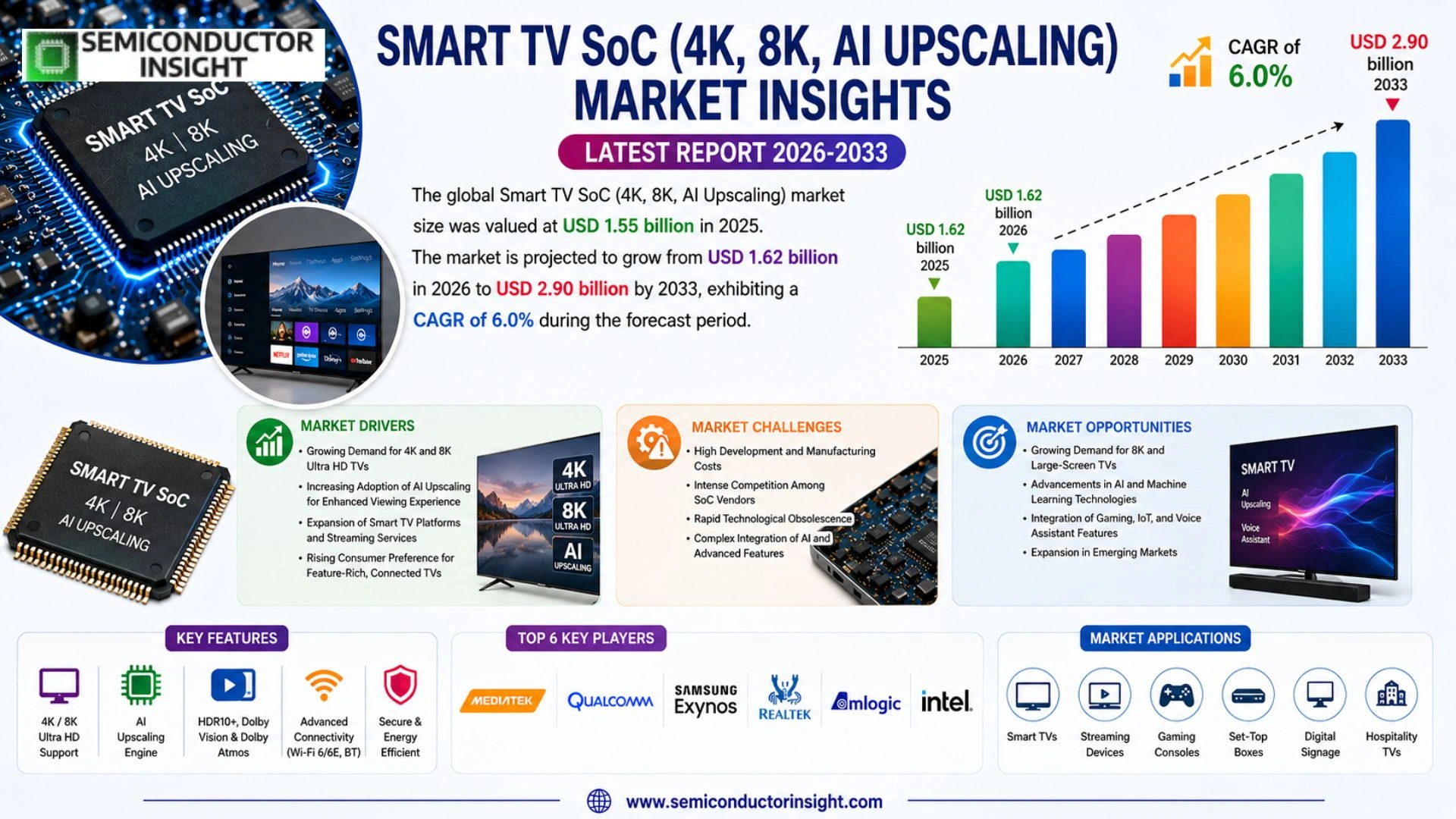
MARKET DRIVERS
Rising Demand for 4K and 8K Resolutions
Smart TV SoC (4K, 8K, AI Upscaling) Market is propelled by the widespread consumer shift toward higher resolution displays. 4K UHD continues to dominate shipments with strong market share, as panel costs have decreased significantly for larger screens, making premium viewing accessible. Advanced SoCs from leaders like MediaTek and Samsung enable efficient decoding and processing of high-resolution content while maintaining low power consumption.
Integration of AI-Powered Upscaling Technologies
AI neural engines embedded in modern Smart TV SoCs deliver real-time image enhancement, upscaling lower-resolution streams to near-4K or 8K quality. This feature maximizes the value of existing content libraries and appeals to consumers with varying broadband speeds. Processors such as Samsung’s NQ8 AI Gen3 and MediaTek’s Pentonic series incorporate dedicated AI capabilities for sharper visuals, motion enhancement, and personalized picture optimization, driving replacement cycles in both premium and mid-tier segments.
➤ The integration of AI upscaling in Smart TV SoCs allows broadcasters and streaming platforms to deliver high-quality experiences without requiring full native high-resolution infrastructure, significantly expanding addressable market opportunities.
Growing adoption of streaming services and smart home ecosystems further accelerates demand, as SoCs must support seamless connectivity, voice control, and advanced multimedia processing to meet evolving consumer expectations for immersive entertainment.
MARKET CHALLENGES
High Development Costs and Technical Complexity
Designing SoCs capable of handling 8K decoding, real-time AI inference, and multiple HDR formats requires substantial R&D investment and advanced semiconductor manufacturing processes. Balancing performance with thermal management and power efficiency remains a key technical hurdle for chip designers serving the competitive Smart TV market.
Other Challenges
Intense Competition Among SoC Vendors
Leading players including MediaTek, Broadcom, Realtek, and Novatek compete aggressively on price, performance, and feature integration, pressuring margins while raising the bar for innovation in AI upscaling and connectivity solutions.
Content Availability and Ecosystem Readiness
Limited native 8K content availability slows premium adoption, forcing reliance on AI upscaling. Fragmented software platforms and varying regional broadcasting standards add complexity to SoC optimization for global markets.
MARKET RESTRAINTS
Price Sensitivity and Premium Feature Adoption
Many consumers remain reluctant to pay premiums for advanced SoCs featuring full 8K support and sophisticated AI upscaling, particularly in price-sensitive emerging markets. While 4K has achieved mass adoption, the higher bill-of-materials cost for 8K-ready chips limits broader penetration despite performance gains.
Supply chain complexities and geopolitical factors affecting semiconductor production can lead to component shortages or increased costs, restraining rapid market expansion for next-generation Smart TV SoCs.
MARKET OPPORTUNITIES
Expansion of AI and Gaming Integration
Embedding dedicated neural processing units (NPUs) in Smart TV SoCs opens significant opportunities for real-time AI upscaling, voice interfaces, personalized recommendations, and low-latency cloud gaming support. This convergence positions SoCs as central hubs in smart home entertainment ecosystems.
Advancements toward more efficient 8K processing combined with energy-saving designs align with global sustainability requirements and premium content growth, creating pathways for higher average selling prices and differentiation among manufacturers.
Smart TV SoC (4K, 8K, AI Upscaling) Market Trends
Rising Integration of AI for Real-Time Upscaling
Smart TV SoC (4K, 8K, AI Upscaling) Market continues to evolve as manufacturers prioritize advanced processing capabilities that deliver superior picture quality. These highly integrated semiconductor solutions combine processing, graphics, memory interfaces, and connectivity functions into a single chip, powering core functionalities of modern smart televisions. A primary trend involves the widespread adoption of AI-driven upscaling algorithms that enhance lower-resolution content to near-native 4K or 8K quality in real time.
This technological shift addresses consumer demand for sharper visuals across diverse content sources while optimizing performance on large display panels. Support for high dynamic range (HDR) and advanced video decoding remains central to these SoCs, enabling seamless playback and enhanced user experiences.
Other Trends
Transition Toward Higher Resolution Capabilities
While 4K resolutions maintain dominance Smart TV SoC (4K, 8K, AI Upscaling) Market, 8K adoption is accelerating particularly in premium television segments. This growth is supported by improving content availability and ongoing advancements in video processing technologies. System-on-chips are increasingly designed to handle demanding 8K workloads efficiently, incorporating better power management features suitable for large screens.
Enhanced On-Device AI Processing
Market participants are focusing on embedding more powerful neural processing units within Smart TV SoC designs. This enables sophisticated on-device AI capabilities for image enhancement, smart platform operations, and intuitive user interfaces without relying heavily on cloud resources.
Competitive Innovation Among Key Players
Leading semiconductor companies continue to drive progress Smart TV SoC (4K, 8K, AI Upscaling) Market through expanded portfolios that address diverse performance needs. Innovations center on integrating efficient graphics processing, advanced audio capabilities, and robust connectivity options. MediaTek, Novatek, and Realtek Semiconductor maintain significant presence by developing solutions that balance high performance with power efficiency. These developments support broader penetration of smart features in televisions globally, as rising consumer expectations for premium viewing experiences encourage continuous technological refinement in both 4K and emerging 8K applications.
COMPETITIVE LANDSCAPE
Key Industry Players
Smart TV SoC (4K, 8K, AI Upscaling) Market Competitive Analysis
The Smart TV SoC market for 4K, 8K, and AI upscaling solutions is led by MediaTek, which commands a dominant position with approximately 70% global market share. The company’s Pentonic series of highly integrated chipsets excels in delivering advanced 8K video decoding, powerful neural processing units for real-time AI upscaling, HDR support, and efficient connectivity features. This consolidated structure sees the top three players,MediaTek, Novatek Microelectronics, and Realtek Semiconductor,accounting for the vast majority of the market, driving innovation while maintaining cost competitiveness for mass-market and premium TV segments.
Other significant players include Amlogic, HiSilicon, and Broadcom, which cater to niche segments such as OTT streaming devices, hybrid broadcast solutions, and high-end proprietary ecosystems. Companies like Qualcomm, Samsung Electronics (LSI), Synaptics, Rockchip, and Allwinner Technology also contribute specialized SoCs focused on AI-enhanced image processing, power efficiency, and integration with smart home platforms, fostering healthy competition and accelerating technological advancements across resolution tiers.
List of Key Smart TV SoC Companies Profiled
- MediaTek
- Novatek Microelectronics
- Realtek Semiconductor
- Amlogic
- HiSilicon
- Broadcom
- Qualcomm
- Samsung Electronics (LSI)
- Synaptics
- Rockchip
- Allwinner Technology
- NXP Semiconductors
- STMicroelectronics
Segment Analysis:
| Segment Category | Sub-Segments | Key Insights |
| By Type |
|
AI-Enhanced SoCs represent the leading segment by delivering superior image quality through intelligent algorithms that enhance detail, color accuracy, and smoothness in real time. These chips excel at handling complex video decoding while integrating neural processing for adaptive upscaling from lower resolutions. They provide seamless support for high dynamic range content and advanced audio synchronization, resulting in immersive viewing experiences. Manufacturers prioritize these solutions for premium smart TVs due to their ability to future-proof devices against evolving content standards and user expectations for intelligent features. |
| By Application |
|
Real-time AI Upscaling stands out as the dominant application area. It enables televisions to transform standard definition and high definition content into near-native 4K or 8K quality with remarkable clarity and reduced artifacts. This capability enhances user satisfaction by making diverse content libraries visually appealing without requiring constant high-resolution source material. Integration of dedicated processing units allows for dynamic scene analysis, optimizing contrast, sharpness, and motion handling on-the-fly. The result is a more versatile smart TV that adapts intelligently to varied viewing scenarios, from sports broadcasts to cinematic films. |
| By End User |
|
Individual Consumers drive the leading segment through their preference for advanced home entertainment systems featuring crystal-clear visuals and smart functionalities. These users seek SoCs that deliver personalized viewing experiences with voice control integration, app ecosystems, and energy-efficient performance for daily use. The emphasis on AI upscaling appeals strongly to families and enthusiasts who value high-quality content consumption across streaming platforms. This segment benefits from continuous innovation that balances performance with user-friendly interfaces, fostering greater adoption of premium smart television models in residential settings. |
| By AI Integration Level |
|
Full On-Device AI emerges as the leading category by enabling sophisticated image enhancement and predictive features directly within the SoC without cloud dependency. This integration supports faster response times for upscaling algorithms, personalized content recommendations, and adaptive picture settings based on ambient conditions. It ensures privacy-conscious processing while delivering consistent performance across different network environments. Such capabilities position smart TVs as truly intelligent devices capable of continuous learning and optimization for superior visual fidelity. |
| By Video Processing Technology |
|
HDR Optimization leads this segment by providing exceptional contrast, brightness control, and color depth that bring content to life with cinematic realism. Advanced SoCs in this area utilize precise algorithms to maintain detail in both bright and dark scenes simultaneously. Combined with AI upscaling, they ensure compatibility across various content sources while minimizing latency. This technology significantly elevates the overall viewing experience, making it particularly valuable for high-quality entertainment and supporting broader ecosystem integration with next-generation display panels. |
Regional Analysis: Smart TV SoC (4K, 8K, AI Upscaling) Market
Asia-Pacific
The region benefits from dense clusters of semiconductor talent and research institutions focused on AI acceleration for video upscaling. Collaborative efforts between universities and industry leaders result in SoC architectures that efficiently manage 8K decoding while maintaining low power consumption, giving manufacturers a competitive edge in premium Smart TV segments.
Advanced fabrication facilities and established component supply networks allow rapid prototyping and volume production of Smart TV SoCs. This infrastructure supports customization for specific regional demands, such as enhanced AI upscaling tailored to varied broadcasting standards across Asia-Pacific markets.
Rising middle-class populations with increasing disposable incomes fuel demand for Smart TVs featuring sophisticated SoCs. Consumers actively seek devices with superior 4K and 8K performance combined with AI features that deliver cinematic experiences at home, encouraging continuous SoC upgrades.
Deep alliances between SoC developers, display makers, and platform providers create integrated solutions. These partnerships streamline the deployment of AI upscaling technologies, ensuring Smart TVs deliver consistent performance across diverse content sources prevalent in the region.
North America
North America maintains a significant position Smart TV SoC (4K, 8K, AI Upscaling) Market through its focus on premium innovation and software integration. The region excels in developing advanced AI algorithms that enhance user experiences beyond basic upscaling, emphasizing content personalization and smart home connectivity. Major technology firms prioritize energy-efficient SoC designs that support high dynamic range and low-latency gaming features. Consumer preferences lean toward high-end models with robust processing capabilities, driving demand for chips that handle multiple AI tasks simultaneously. Strategic investments in research and development ensure North American brands lead in user interface responsiveness and voice-activated controls integrated with video processing SoCs.
Europe
Europe demonstrates steady growth Smart TV SoC (4K, 8K, AI Upscaling) Market, characterized by strong emphasis on sustainability and regulatory compliance. Manufacturers focus on creating power-efficient SoCs that deliver excellent 4K performance while minimizing environmental impact. The region shows particular interest in AI upscaling solutions that preserve artistic integrity of content across various streaming platforms. Collaborative standards development among member countries facilitates smoother adoption of 8K-ready technologies. European consumers value privacy-focused features alongside picture quality enhancements, pushing SoC developers to incorporate secure processing environments for AI computations.
South America
South America is emerging as an important growth area for Smart TV SoC (4K, 8K, AI Upscaling) Market, with increasing urbanization driving demand for affordable yet capable Smart TVs. Local preferences favor SoCs that excel in upscaling lower-resolution content common in regional broadcasting. Economic development and expanding digital infrastructure support gradual adoption of 4K technologies with AI enhancements. Market players adapt their strategies to address cost sensitivity while delivering meaningful improvements in visual quality. Partnerships with global SoC suppliers help introduce suitable solutions that balance performance with accessibility across diverse economic conditions in the region.
Middle East & Africa
The Middle East and Africa region presents promising opportunities Smart TV SoC (4K, 8K, AI Upscaling) Market fueled by infrastructure modernization and young demographics. Urban centers show growing appetite for Smart TVs featuring reliable 4K processing and basic AI upscaling to improve viewing of international content. Governments investing in digital transformation create favorable conditions for technology penetration. Challenges related to varying power stability encourage development of robust, efficient SoC designs. The market evolves with emphasis on durability and performance optimization for challenging environmental conditions while gradually incorporating advanced video enhancement features.
Report Scope
This market research report provides a comprehensive analysis of the Smart TV SoC (4K, 8K, AI Upscaling) Market , covering the forecast period 2026–2034. It offers detailed insights into market dynamics, technological advancements, competitive landscape, and key trends shaping the industry.
Key focus areas of the report include:
- Market Overview: The report begins with an overview outlining its current market scenario, key growth indicators, and industry transformation drivers. It discusses macroeconomic factors, demand–supply balance, regulatory landscape, and the strategic role of semiconductors in powering advancements across industries such as automotive, telecommunications, consumer electronics, and industrial automation.
- Market Size & Forecast: Historical data and future projections for revenue, unit shipments, and market value across major regions and segments.
- Segmentation Analysis: Detailed breakdown by product type, technology, application, and end-user industry to identify high-growth segments and investment opportunities.
- Regional Insights: Insights into market performance across North America, Europe, Asia-Pacific, Latin America, and the Middle East & Africa, including country-level analysis where relevant.
- Competitive Landscape: Profiles of leading market participants, including their product offerings, R&D focus, manufacturing capacity, pricing strategies, and recent developments such as mergers, acquisitions, and partnerships.
- Technology Trends & Innovation: Assessment of emerging technologies, integration of AI/IoT, semiconductor design trends, fabrication techniques, and evolving industry standards.
- Market Drivers & Restraints: Evaluation of factors driving market growth along with challenges, supply chain constraints, regulatory issues, and market-entry barriers.
- Stakeholder Insights: Insights for component suppliers, OEMs, system integrators, investors, and policymakers regarding the evolving ecosystem and strategic opportunities.
Primary and secondary research methods are employed, including interviews with industry experts, data from verified sources, and real-time market intelligence to ensure the accuracy and reliability of the insights presented.
FREQUENTLY ASKED QUESTIONS:
What is the current market size of Smart TV SoC (4K, 8K, AI Upscaling) Market?
-> Smart TV SoC (4K, 8K, AI Upscaling) Market was valued at USD 1.55 billion in 2025 and is expected to reach USD 2.90 billion by 2033.
Which key companies operate Smart TV SoC (4K, 8K, AI Upscaling) Market?
-> Key players include MediaTek, Novatek, and Realtek Semiconductor, among others.
What are the key growth drivers?
-> Key growth drivers include rising consumer demand for higher resolution displays, rapid adoption of AI technologies for image enhancement, and increasing penetration of smart features in televisions worldwide.
Which region dominates the market?
-> Asia-Pacific is the fastest-growing region, while North America remains a dominant market.
What are the emerging trends?
-> Emerging trends include real-time AI upscaling, 8K adoption in premium segments, and integration of powerful neural processing units for on-device AI capabilities.

Get Sample Report PDF for Exclusive Insights
Report Sample Includes
- Table of Contents
- List of Tables & Figures
- Charts, Research Methodology, and more...
 Download Sample Report PDF