Smart Speaker Application Processor Market Insights
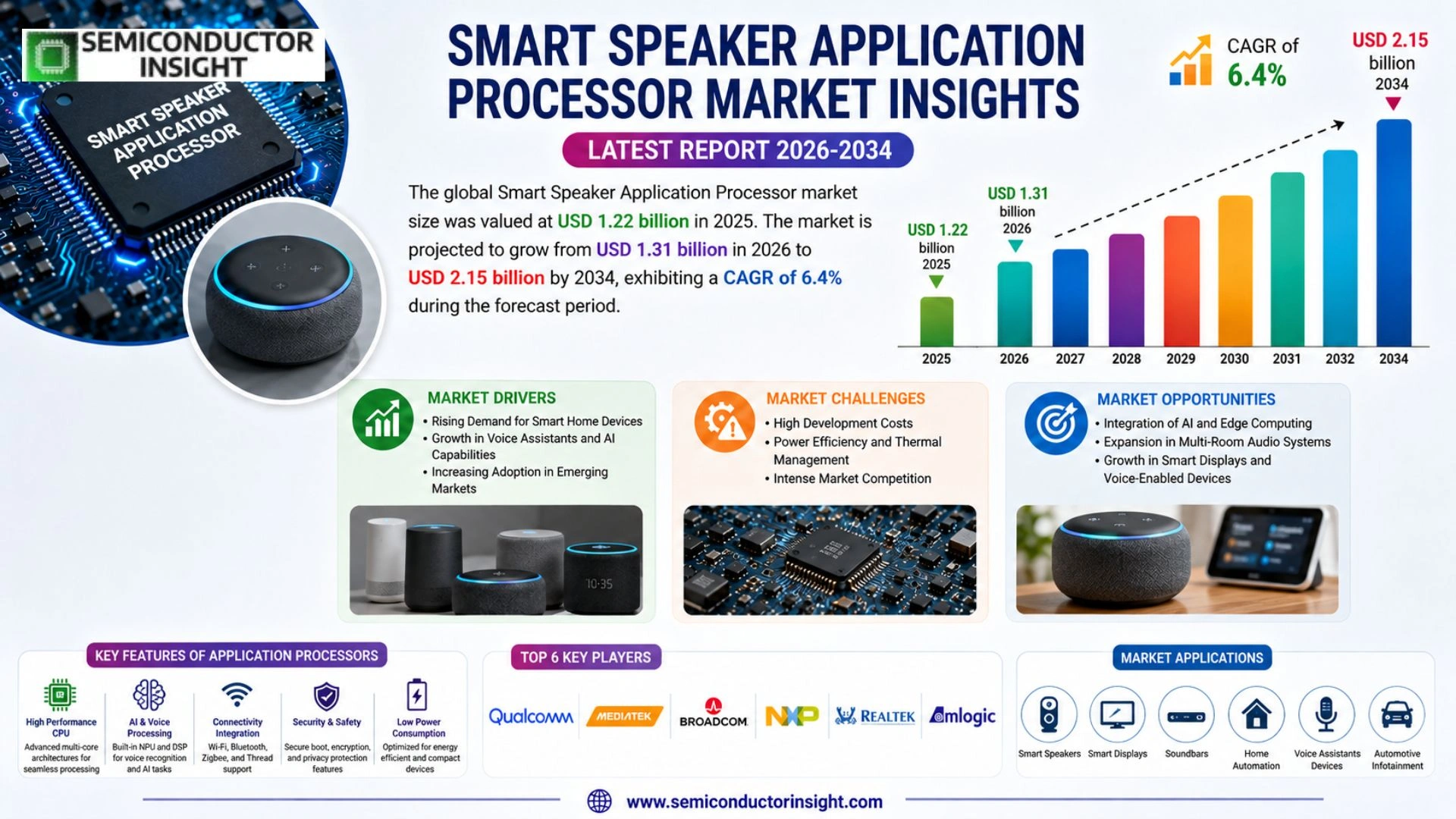
Global Smart Speaker Application Processor Market size was valued at USD 1.22 billion in 2025. The market is projected to grow from USD 1.31 billion in 2026 to USD 2.15 billion by 2034, exhibiting a CAGR of 6.4% during the forecast period.
Smart Speaker Application Processors are specialized system-on-chip (SoC) solutions designed to power voice-enabled smart speakers. These processors integrate CPU cores, digital signal processing (DSP) units, neural processing engines for AI inference, connectivity modules such as Wi-Fi and Bluetooth, and audio codecs to enable far-field voice recognition, natural language processing, and seamless integration with smart home ecosystems.
The market is experiencing steady growth due to several factors, including the rising adoption of voice assistants in consumer homes, increasing demand for edge AI capabilities that reduce latency and enhance privacy, and the expansion of smart home automation. Advancements in low-power semiconductor designs allow these processors to deliver high performance while maintaining energy efficiency, which is critical for always-listening devices. Furthermore, the proliferation of multi-room audio setups and integration with broader IoT platforms continue to drive innovation and market expansion. Key players are focusing on developing more powerful yet cost-effective solutions with enhanced security features and support for advanced audio processing. Major companies operating in this space include Qualcomm, MediaTek, and specialized semiconductor firms offering tailored chipsets for leading smart speaker brands.
MARKET DRIVERS
Rising Demand for AI-Enabled Voice Processing
Smart Speaker Application Processor Market is experiencing robust growth driven by the increasing integration of advanced AI capabilities in smart speakers. Application processors with efficient neural processing units enable on-device voice recognition, reducing latency and enhancing user experience while lowering dependency on cloud services. As consumers seek seamless voice interactions for home automation and entertainment, manufacturers are prioritizing high-performance SoCs that support natural language processing and multi-user detection.
Expansion of Smart Home Ecosystems
Growing adoption of IoT devices has positioned smart speakers as central hubs, fueling demand for powerful application processors capable of handling multiple connectivity protocols like Wi-Fi, Bluetooth, and Zigbee. Processors from leading vendors support interoperability standards such as Matter, enabling smoother integration across diverse smart home devices and driving volume growth Smart Speaker Application Processor Market.
➤ Edge AI capabilities in modern application processors allow for enhanced privacy through local processing of voice commands, addressing consumer concerns while maintaining high functionality.
Advancements in semiconductor technology, including smaller process nodes and improved power efficiency, have enabled cost-effective yet powerful solutions suitable for mass-market smart speakers, further accelerating market expansion.
MARKET CHALLENGES
Intense Competition and Rapid Technological Evolution
Smart Speaker Application Processor Market faces significant challenges from fierce competition among established players like MediaTek, Realtek, and Amlogic, alongside custom silicon developments by major ecosystem leaders. Keeping pace with evolving AI algorithms and audio processing requirements demands continuous heavy R&D investment.
Other Challenges
Supply Chain Vulnerabilities
Geopolitical tensions and semiconductor shortages continue to impact production timelines and component costs for application processors designed for smart speakers.
Integration Complexity
Ensuring seamless compatibility with various voice assistants and evolving wireless standards adds layers of engineering complexity for SoC designers.
MARKET RESTRAINTS
Data Privacy and Security Concerns
Persistent worries regarding data collection and potential unauthorized access in always-listening devices restrain broader consumer adoption, indirectly affecting demand for advanced application processors Smart Speaker Application Processor Market. Regulatory scrutiny across regions requires additional security features that increase design complexity and costs.
High Development Costs for Advanced Features
Developing application processors with integrated AI accelerators, multi-core architectures, and low-power consumption profiles requires substantial capital expenditure. Smaller manufacturers struggle to compete, leading to market consolidation and limiting innovation diversity.
MARKET OPPORTUNITIES
Premium Audio and Multi-Modal Integration
Opportunities abound in premium smart speakers featuring high-fidelity audio processing and display integration, driving demand for more sophisticated application processors. The shift toward on-device generative AI features presents a significant growth avenue for next-generation SoCs Smart Speaker Application Processor Market.
The expansion into emerging markets, combined with falling average selling prices for capable processors, opens doors for wider penetration in mid-range and budget segments, while partnerships for customized solutions with smart home brands offer differentiated revenue streams.
Smart Speaker Application Processor Market Trends
Rising Adoption of Edge AI Capabilities
Smart Speaker Application Processor Market is witnessing significant momentum driven by the increasing integration of edge AI capabilities in voice-enabled devices. These specialized system-on-chip solutions combine CPU cores, digital signal processing units, neural processing engines, and advanced connectivity modules to support far-field voice recognition and natural language processing directly on the device. This shift toward edge computing helps minimize latency while enhancing user privacy by reducing reliance on cloud processing for routine voice commands.
Manufacturers are prioritizing low-power semiconductor designs that deliver robust performance without compromising energy efficiency, a critical requirement for always-listening smart speakers. As consumers increasingly incorporate voice assistants into daily routines, application processors are evolving to handle complex AI inference tasks locally, supporting seamless interaction with smart home ecosystems.
Other Trends
Expansion of Smart Home Integration and Multi-Room Audio
Another key development Smart Speaker Application Processor Market involves the growing support for multi-room audio setups and broader IoT platform compatibility. Processors now feature enhanced audio codecs and connectivity options such as Wi-Fi and Bluetooth, enabling synchronized audio experiences across multiple devices. This trend aligns with the expansion of smart home automation, where smart speakers serve as central hubs for controlling lighting, security, and entertainment systems.
Focus on Security and Cost-Effective Innovations
Industry leaders are embedding advanced security features into application processors to protect user data and prevent unauthorized access in connected environments. At the same time, there is a strong emphasis on developing more powerful yet affordable chipsets that maintain high audio processing standards. These improvements allow smart speaker brands to offer premium features at competitive price points, accelerating market penetration in both premium and mainstream consumer segments.
Technological Advancements Driving Processor Evolution
Smart Speaker Application Processor Market continues to benefit from rapid innovations in semiconductor technology. Companies such as Qualcomm and MediaTek are at the forefront, delivering tailored solutions that balance computational power with energy efficiency. These processors support sophisticated voice-enabled features while integrating smoothly with existing smart home infrastructure. As demand for intuitive voice interfaces grows, application processors are incorporating more efficient neural engines and improved signal processing to handle diverse acoustic environments and multiple voice commands simultaneously.
Overall, the market trends point toward continued refinement of integrated SoC designs that prioritize performance, privacy, and interoperability. This evolution is expected to sustain innovation as smart speakers become even more embedded in modern lifestyles, with processors playing a pivotal role in delivering responsive and secure voice experiences. Enhanced support for emerging audio formats and AI-driven personalization features further positions these components as essential elements in the connected home landscape.
COMPETITIVE LANDSCAPE
Key Industry Players
Smart Speaker Application Processor Market Competitive Analysis
Smart Speaker Application Processor Market is led by semiconductor giants Qualcomm and MediaTek, which dominate through advanced SoC solutions integrating CPU, DSP, neural engines, and connectivity for voice AI and edge processing. The competitive structure features a concentrated tier of established players offering comprehensive platforms for major OEMs, while the market exhibits moderate fragmentation with specialized firms addressing cost-sensitive and niche segments. High barriers to entry stem from the need for optimized low-power designs, far-field voice capabilities, and ecosystem integration.
Other significant players include Realtek, Rockchip, and Amlogic, which provide competitive alternatives focused on cost-efficiency and targeted features for regional and mid-tier smart speaker manufacturers. Innovation centers on enhanced AI inference, security features, and multi-protocol support, with companies investing heavily in R&D to capture share in the expanding voice-enabled IoT ecosystem.
List of Key Smart Speaker Application Processor Companies Profiled
- Qualcomm
- Qualcomm
- MediaTek
- Realtek Semiconductor
- Rockchip Electronics
- Amlogic
- Synaptics
- Allwinner Technology
- STMicroelectronics
- Infineon Technologies
- Texas Instruments
- NXP Semiconductors
- Cirrus Logic
- Analog Devices
Segment Analysis:
| Segment Category | Sub-Segments | Key Insights |
| By Type |
|
AI-Accelerated Chipsets represent the leading segment due to their ability to handle complex neural network tasks directly on the device. These processors excel in delivering rapid voice recognition and natural language understanding while minimizing dependency on cloud resources. Key advantages include enhanced privacy through local processing, reduced latency in command execution, and superior power optimization for continuous listening modes. Manufacturers prioritize these solutions to support evolving voice assistant ecosystems and deliver seamless user experiences in dynamic home environments. |
| By Application |
|
Far-Field Voice Recognition stands out as the dominant application area. Processors optimized for this function incorporate advanced digital signal processing and microphone array support to accurately capture commands from greater distances amid background noise. This enables more intuitive and hands-free interactions, fostering greater user adoption across households. The segment drives innovation in noise suppression algorithms and wake-word detection, ensuring reliable performance even in challenging acoustic conditions while maintaining low power consumption essential for always-on devices. |
| By End User |
|
Residential Consumers constitute the primary end-user segment. These processors are tailored to meet the needs of everyday home environments, emphasizing ease of setup, compatibility with popular voice assistants, and integration within broader smart home ecosystems. Demand stems from the desire for convenient control of lighting, entertainment, and security systems through natural voice commands. This segment benefits from ongoing improvements in user interface responsiveness and energy efficiency, making smart speakers an indispensable part of modern connected living spaces. |
| By Processor Architecture |
|
ARM-Based Designs lead this category through their proven balance of performance and power efficiency. These architectures support sophisticated on-device AI workloads while consuming minimal energy, which is vital for battery-conscious or perpetually powered smart speakers. Their widespread ecosystem compatibility accelerates development cycles for manufacturers and enables seamless software optimization. This foundation allows for scalable solutions that evolve with emerging voice and audio technologies without compromising thermal or energy profiles. |
| By Connectivity Features |
|
Wi-Fi and Bluetooth Integration emerges as the foremost choice for enabling robust device connectivity. These processors facilitate stable network links for streaming high-quality audio and maintaining constant communication with cloud services when needed, while Bluetooth ensures quick pairing with mobile devices and other peripherals. Such comprehensive connectivity supports multi-room audio experiences and expansive smart home networks. The focus remains on secure, interference-resistant implementations that deliver reliable performance across varied home layouts and usage scenarios. |
Regional Analysis: Smart Speaker Application Processor Market
Asia-Pacific
Asia-Pacific’s unparalleled electronics manufacturing base provides a competitive edge Smart Speaker Application Processor Market. Integrated supply chains from wafer fabrication to final assembly enable rapid prototyping and cost-efficient scaling. This environment fosters close partnerships between processor designers and device OEMs, resulting in highly customized solutions optimized for smart speaker requirements such as thermal management and audio signal processing.
The region leads in embedding advanced AI accelerators within application processors for smart speakers. Focus on on-device machine learning supports improved voice recognition accuracy across multiple Asian languages and dialects. Companies invest heavily in R&D to enhance noise cancellation and context-aware processing, positioning Asia-Pacific processors as preferred choices for premium and mid-range smart audio devices.
High smartphone penetration and growing smart home awareness propel demand for intelligent voice interfaces. Processors in this market emphasize seamless connectivity with IoT ecosystems prevalent in urban households. Cultural affinity for technology-driven convenience, combined with supportive policies for digital transformation, creates sustained growth momentum for smart speaker application processors.
Investments in 5G networks and edge computing infrastructure complement the capabilities of modern application processors. This synergy supports more sophisticated voice AI features in smart speakers, including real-time translation and personalized user experiences. The region’s dynamic startup scene further enriches the processor innovation pipeline.
North America
North America maintains a strong position Smart Speaker Application Processor Market through technological leadership and premium product innovation. The United States, in particular, excels in developing cutting-edge AI algorithms and software-hardware co-design that power high-performance processors for flagship smart speakers. Emphasis on privacy-by-design and secure enclaves addresses consumer concerns regarding data handling. Mature consumer markets favor devices with superior audio quality and integration with comprehensive smart home platforms. Companies focus on processors that deliver exceptional natural language understanding and multi-user support, catering to sophisticated household needs. Strategic partnerships between semiconductor innovators and major tech giants ensure continuous advancement in low-latency processing and energy-efficient designs suitable for battery-powered or always-on applications.
Europe
Europe demonstrates steady progress Smart Speaker Application Processor Market, characterized by a focus on regulatory compliance, sustainability, and high-quality engineering. Countries such as Germany, the UK, and France prioritize processors that meet stringent data protection standards like GDPR while maintaining robust performance. The region’s emphasis on energy efficiency aligns with green technology initiatives, driving demand for low-power application processors in eco-conscious smart home deployments. European manufacturers differentiate through specialized audio processing capabilities tailored for multilingual environments and accessibility features. Collaborative research across the EU enhances innovation in secure voice biometrics and seamless interoperability with diverse IoT standards, supporting broader adoption in both residential and commercial settings.
South America
South America is emerging as a promising region Smart Speaker Application Processor Market, fueled by increasing digital inclusion and urban modernization efforts. Brazil and Argentina lead in adopting affordable smart speaker solutions powered by cost-optimized application processors. Growing internet penetration and rising interest in voice-assisted services for home automation create opportunities for processors that excel in handling regional language variations and accents. Local market players work on adapting global processor technologies to address infrastructure challenges, such as variable network reliability. The focus remains on balancing performance with affordability to drive mass-market penetration across diverse socioeconomic segments.
Middle East & Africa
The Middle East and Africa region shows accelerating interest Smart Speaker Application Processor Market, supported by smart city initiatives and expanding consumer technology access. Gulf countries invest in advanced processors for luxury smart home ecosystems featuring premium voice interaction capabilities. In Africa, opportunities arise from leapfrogging traditional interfaces through voice-first devices that overcome literacy barriers. Application processors are tailored for challenging environmental conditions, including dust resistance and efficient operation in high temperatures. Regional dynamics emphasize multilingual support and integration with local services, positioning smart speakers as key tools for information access and home management in rapidly digitizing societies.
Report Scope
This market research report provides a comprehensive analysis of the Smart Speaker Application Processor Market , covering the forecast period 2026–2034. It offers detailed insights into market dynamics, technological advancements, competitive landscape, and key trends shaping the industry.
Key focus areas of the report include:
- Market Overview: The report begins with an overview outlining its current market scenario, key growth indicators, and industry transformation drivers. It discusses macroeconomic factors, demand–supply balance, regulatory landscape, and the strategic role of semiconductors in powering advancements across industries such as automotive, telecommunications, consumer electronics, and industrial automation.
- Market Size & Forecast: Historical data and future projections for revenue, unit shipments, and market value across major regions and segments.
- Segmentation Analysis: Detailed breakdown by product type, technology, application, and end-user industry to identify high-growth segments and investment opportunities.
- Regional Insights: Insights into market performance across North America, Europe, Asia-Pacific, Latin America, and the Middle East & Africa, including country-level analysis where relevant.
- Competitive Landscape: Profiles of leading market participants, including their product offerings, R&D focus, manufacturing capacity, pricing strategies, and recent developments such as mergers, acquisitions, and partnerships.
- Technology Trends & Innovation: Assessment of emerging technologies, integration of AI/IoT, semiconductor design trends, fabrication techniques, and evolving industry standards.
- Market Drivers & Restraints: Evaluation of factors driving market growth along with challenges, supply chain constraints, regulatory issues, and market-entry barriers.
- Stakeholder Insights: Insights for component suppliers, OEMs, system integrators, investors, and policymakers regarding the evolving ecosystem and strategic opportunities.
Primary and secondary research methods are employed, including interviews with industry experts, data from verified sources, and real-time market intelligence to ensure the accuracy and reliability of the insights presented.
FREQUENTLY ASKED QUESTIONS:
What is the current market size of Smart Speaker Application Processor Market?
-> Smart Speaker Application Processor Market was valued at USD 1.22 billion in 2025 and is expected to reach USD 2.15 billion by 2034.
Which key companies operate Smart Speaker Application Processor Market?
-> Key players include Qualcomm, MediaTek, and specialized semiconductor firms offering tailored chipsets for leading smart speaker brands.
What are the key growth drivers?
-> Key growth drivers include rising adoption of voice assistants in consumer homes, increasing demand for edge AI capabilities, expansion of smart home automation, and advancements in low-power semiconductor designs.
Which region dominates the market?
-> Asia-Pacific is the fastest-growing region due to strong consumer electronics manufacturing and smart home adoption.
What are the emerging trends?
-> Emerging trends include enhanced neural processing engines for AI inference, improved far-field voice recognition, integration with broader IoT platforms, and focus on energy-efficient designs with advanced security features.

Get Sample Report PDF for Exclusive Insights
Report Sample Includes
- Table of Contents
- List of Tables & Figures
- Charts, Research Methodology, and more...
 Download Sample Report PDF