Smart Pill (Ingestible) Sensor IC Market Insights
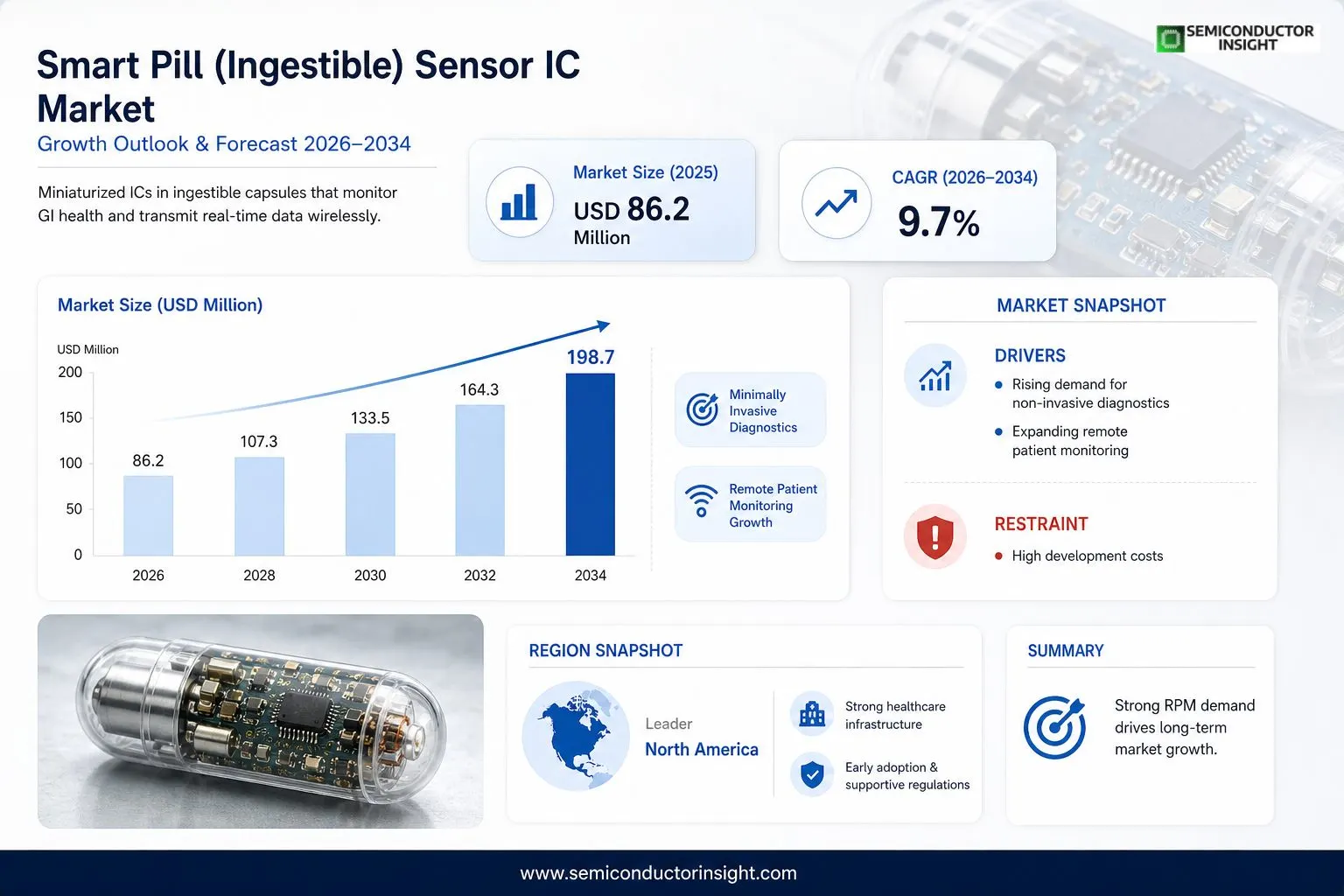
Global Smart Pill (Ingestible) Sensor IC Market size was valued at USD 78.4 million in 2024. The market is projected to grow from USD 86.2 million in 2025 to USD 198.7 million by 2034, exhibiting a CAGR of 9.7% during the forecast period.
Smart pill ingestible sensor integrated circuits (ICs) are miniaturized electronic components embedded within capsule-sized devices designed to be swallowed by patients. Once ingested, these sensor ICs perform a range of diagnostic and monitoring functions from within the gastrointestinal tract, transmitting real-time physiological data , including pH levels, temperature, pressure, and medication adherence confirmation , to external receivers. The technology encompasses application-specific integrated circuits (ASICs), wireless communication modules, bio-sensing elements, and ultra-low-power microcontrollers, all engineered to operate within the highly constrained form factor of an ingestible capsule.
The market is gaining strong momentum, driven by the rising global burden of gastrointestinal disorders, increasing demand for minimally invasive diagnostic tools, and growing emphasis on remote patient monitoring. Furthermore, advancements in semiconductor miniaturization and low-power wireless communication protocols such as Bluetooth Low Energy (BLE) are enabling more capable and cost-efficient ingestible sensor IC designs. Strategic collaborations among medical device manufacturers and semiconductor companies are accelerating commercialization. Proteus Digital Health, Medtronic plc, Olympus Corporation, and CapsoVision Inc. are among the key players actively shaping the competitive landscape of this market with innovative product portfolios.
MARKET DRIVERS
Rising Demand for Non-Invasive Diagnostic Technologies Fueling Smart Pill Sensor IC Adoption
Global Smart Pill (Ingestible) Sensor IC Market is experiencing accelerating momentum driven by the healthcare industry’s shift toward minimally invasive and patient-friendly diagnostic solutions. Traditional endoscopy and biopsy procedures, while effective, carry risks of discomfort, infection, and procedural complications. Ingestible sensor ICs embedded within smart capsules offer a compelling alternative, enabling clinicians to obtain real-time gastrointestinal imaging, pH monitoring, pressure measurement, and temperature tracking without surgical intervention. This transition is particularly significant for aging populations across North America, Europe, and Asia-Pacific, where chronic gastrointestinal disorders such as Crohn’s disease, colorectal cancer, and irritable bowel syndrome are highly prevalent.
Expanding Remote Patient Monitoring Ecosystem Strengthening Ingestible Sensor IC Market Growth
The proliferation of remote patient monitoring (RPM) platforms has emerged as a powerful catalyst for Smart Pill (Ingestible) Sensor IC Market. Healthcare systems globally are under pressure to reduce in-hospital patient loads while maintaining continuous care quality, a challenge that ingestible sensor technologies are uniquely positioned to address. These sensor ICs transmit physiological and biochemical data wirelessly to external receivers and connected devices, enabling physicians to monitor patients in real time from remote locations. The integration of ingestible sensors with electronic health record (EHR) systems and cloud-based analytics platforms is further amplifying their clinical utility, driving hospital procurement and broadening the commercial market.
➤ The convergence of IoT connectivity, low-power semiconductor design, and miniaturized CMOS fabrication techniques is enabling next-generation ingestible sensor ICs to achieve unprecedented diagnostic precision within a swallowable form factor, representing a transformative leap in point-of-care medicine.
Regulatory support across major markets is further reinforcing demand. The U.S. Food and Drug Administration has cleared multiple ingestible capsule-based diagnostic devices, establishing a credible pathway for new entrants and encouraging R&D investment. Similarly, the European Medicines Agency’s evolving digital health frameworks are facilitating faster market access for smart pill technologies. These regulatory tailwinds, combined with growing reimbursement coverage for capsule endoscopy procedures in developed markets, are collectively strengthening the commercial foundation of Smart Pill (Ingestible) Sensor IC Market.
MARKET CHALLENGES
Miniaturization and Power Management Constraints Posing Significant Engineering Challenges for Ingestible Sensor IC Development
One of the foremost challenges confronting Smart Pill (Ingestible) Sensor IC Market is the extreme engineering complexity involved in designing functional, reliable sensor integrated circuits within the spatial and power constraints of a swallowable capsule. The human gastrointestinal tract imposes stringent size requirements , typically limiting capsule dimensions to approximately 11mm in diameter and 26mm in length , leaving minimal physical space for sensor arrays, processing units, wireless communication modules, and power sources. Achieving adequate battery life to traverse the full gastrointestinal tract, which can take anywhere from 24 to 72 hours, while simultaneously transmitting continuous data wirelessly, demands highly optimized ultra-low-power IC architectures that represent the frontier of semiconductor engineering.
Other Challenges
Data Security and Patient Privacy Concerns
As smart pill sensor ICs generate continuous streams of sensitive physiological data transmitted wirelessly to external systems, the risk of unauthorized data interception or breaches presents a serious challenge. Ensuring end-to-end encryption and compliance with healthcare data protection regulations such as HIPAA in the United States and GDPR in Europe adds substantial design and compliance complexity for manufacturers operating in Smart Pill (Ingestible) Sensor IC Market.
High Development and Manufacturing Costs
The fabrication of biocompatible, miniaturized ingestible sensor ICs requires advanced semiconductor processes, specialized materials, and rigorous quality control protocols, all of which contribute to elevated per-unit production costs. For single-use disposable smart pill devices, these costs must be absorbed within a price point acceptable to healthcare providers and payers, creating significant margin pressure on manufacturers and limiting broader market penetration, particularly in cost-sensitive emerging markets.
MARKET RESTRAINTS
Limited Reimbursement Frameworks in Emerging Economies Constraining Smart Pill Sensor IC Market Expansion
Despite growing clinical validation and technological advancement, Smart Pill (Ingestible) Sensor IC Market faces a significant restraint in the form of inconsistent and inadequate reimbursement policies across many global markets. While capsule endoscopy has achieved reimbursement coverage for specific indications in the United States and several Western European countries, large and potentially high-growth markets across Latin America, Southeast Asia, the Middle East, and Africa lack standardized reimbursement pathways for ingestible diagnostic technologies. Without assured reimbursement, hospitals and clinics face difficulty justifying the cost of adopting smart pill systems, effectively suppressing demand and delaying market penetration in regions where gastrointestinal disease burden is substantial.
Regulatory Complexity and Extended Approval Timelines Slowing Commercialization Across Key Markets
The dual classification of ingestible sensor devices as both medical devices and combination products in certain jurisdictions creates a layered and time-consuming regulatory approval process. Manufacturers entering Smart Pill (Ingestible) Sensor IC Market must navigate distinct regulatory frameworks across the United States, European Union, Japan, China, and other major markets, each with unique technical documentation requirements, clinical evidence standards, and post-market surveillance obligations. This regulatory fragmentation not only extends time-to-market for new ingestible sensor IC products but also increases the financial burden on developers, particularly smaller companies and start-ups that may lack the regulatory expertise and resources to manage multi-market submissions concurrently.
MARKET OPPORTUNITIES
Integration of Artificial Intelligence and Advanced Analytics Creating High-Value Growth Avenues in the Smart Pill Sensor IC Market
The integration of artificial intelligence and machine learning algorithms with data generated by ingestible sensor ICs represents one of the most transformative opportunities in Smart Pill (Ingestible) Sensor IC Market. As smart capsules collect multi-parametric physiological data , including gastrointestinal motility patterns, luminal pH profiles, bleeding detection signals, and localized pressure readings , AI-powered analytics platforms can process this information to generate actionable clinical insights with a speed and accuracy that surpasses conventional manual interpretation. Several medical technology companies are actively developing AI-assisted diagnostic platforms tailored specifically for capsule endoscopy data, creating a strong and expanding ecosystem that drives incremental value beyond the sensor IC hardware itself.
Expanding Applications Beyond Gastroenterology Unlocking New Revenue Streams for Ingestible Sensor IC Developers
While the gastrointestinal diagnostic segment has historically anchored Smart Pill (Ingestible) Sensor IC Market, emerging applications in drug delivery monitoring, medication adherence verification, and core body temperature tracking are opening substantial new revenue opportunities. Pharmaceutical companies are exploring ingestible sensor-enabled smart pills to confirm patient medication ingestion in clinical trials and post-market pharmacovigilance studies, addressing a long-standing challenge in drug development. The U.S. FDA’s approval of the first digital pill with an embedded ingestible sensor for medication adherence tracking has established a meaningful regulatory precedent, validating the commercial viability of this application segment and encouraging further investment and innovation across Smart Pill (Ingestible) Sensor IC Market.
Trends
Rising Demand for Minimally Invasive Diagnostics Drives Smart Pill (Ingestible) Sensor IC Market Growth
Smart Pill (Ingestible) Sensor IC Market is experiencing significant momentum as healthcare systems worldwide pivot toward minimally invasive diagnostic solutions. The growing global burden of gastrointestinal disorders has intensified the need for ingestible sensor integrated circuits capable of delivering real-time physiological data , including pH levels, temperature, pressure, and medication adherence confirmation , directly from within the gastrointestinal tract. This shift away from traditional endoscopic procedures toward capsule-based diagnostics is one of the most defining trends shaping the competitive landscape of this market today.
Other Trends
Semiconductor Miniaturization Enabling Advanced Ingestible Sensor IC Designs
Continued advancements in semiconductor miniaturization are playing a pivotal role in the evolution of the Smart Pill Ingestible Sensor IC Market. Engineers are now able to integrate application-specific integrated circuits (ASICs), ultra-low-power microcontrollers, bio-sensing elements, and wireless communication modules into capsule-sized form factors without compromising diagnostic performance. This has expanded the functional scope of ingestible sensor ICs, making them viable for a broader range of clinical applications and patient demographics.
Adoption of Low-Power Wireless Communication Protocols
The widespread adoption of low-power wireless communication protocols, particularly Bluetooth Low Energy (BLE), is transforming how ingestible sensor ICs transmit data to external receivers. These protocols enable seamless, energy-efficient communication between the ingested capsule and patient-worn or room-based monitoring devices, supporting the broader trend of remote patient monitoring. As healthcare providers increasingly embrace digital health infrastructure, demand for ingestible sensor ICs compatible with established wireless standards continues to strengthen across clinical and home-care settings.
Strategic Collaborations Between Medical Device and Semiconductor Companies
A notable trend within the Smart Pill Ingestible Sensor IC Market is the acceleration of strategic partnerships between medical device manufacturers and semiconductor companies. These collaborations are aimed at combining clinical expertise with advanced chip design capabilities to fast-track commercialization of next-generation ingestible sensor platforms. Key players such as Proteus Digital Health, Medtronic plc, Olympus Corporation, and CapsoVision Inc. are actively leveraging such alliances to differentiate their product portfolios and expand their presence in this emerging market.
Growing Emphasis on Remote Patient Monitoring Reinforces Market Trajectory
The increasing emphasis on remote patient monitoring across global healthcare systems is reinforcing the long-term growth trajectory of Smart Pill (Ingestible) Sensor IC Market. As patients and clinicians alike seek non-invasive, continuous monitoring alternatives, ingestible sensor ICs are emerging as a compelling solution that bridges diagnostic precision with patient comfort. This trend is expected to remain a central driver as digital health adoption deepens across both developed and emerging healthcare markets.
COMPETITIVE LANDSCAPE
Key Industry Players
Smart Pill (Ingestible) Sensor IC Market: Competitive Dynamics and Leading Innovators Shaping the Future of Ingestible Diagnostics
Global Smart Pill (Ingestible) Sensor IC Market is characterized by a moderately consolidated competitive landscape, with a mix of established medical device giants and specialized semiconductor innovators driving technological progress. Medtronic plc stands as a dominant force in the broader ingestible diagnostics space, leveraging its extensive R&D infrastructure and global distribution network to advance gastrointestinal monitoring solutions embedded with sophisticated sensor IC platforms. Olympus Corporation similarly commands significant market presence through its endoscopy and capsule endoscopy product lines, integrating miniaturized ASICs and wireless communication modules to deliver high-resolution, real-time gastrointestinal imaging and physiological data. These leading players benefit from deep regulatory expertise, established clinical partnerships, and substantial capital investment in semiconductor miniaturization, positioning them ahead of emerging competitors. The market’s expansion , projected to grow from USD 86.2 million in 2025 to USD 198.7 million by 2034 at a CAGR of 9.7% , is further fueled by strategic collaborations between medical device manufacturers and semiconductor firms, accelerating the commercialization of next-generation ingestible sensor ICs capable of monitoring pH, temperature, pressure, and medication adherence confirmation.
Beyond the dominant players, a range of niche innovators and specialized semiconductor companies are carving out meaningful positions within Smart Pill (Ingestible) Sensor IC Market. Proteus Digital Health has been a pioneering force in digital medicine, developing ingestible sensor systems that confirm medication ingestion through integrated IC-based signal transmission. CapsoVision Inc. has differentiated itself with its panoramic capsule endoscopy platform, which relies on advanced imaging sensor ICs to capture 360-degree visualization of the gastrointestinal tract. Given Imaging, now part of Medtronic, contributed foundational capsule camera and sensor IC technology that continues to influence product development across the competitive landscape. Companies such as Koninklijke Philips N.V. and Jinshan Science and Technology are also active participants, focusing on wireless capsule endoscopy systems embedded with proprietary low-power sensor ICs. Meanwhile, semiconductor specialists including Texas Instruments Incorporated, Analog Devices Inc., and STMicroelectronics N.V. supply critical ultra-low-power microcontroller and analog front-end IC components that underpin ingestible sensor system designs developed by medical device OEMs. The growing adoption of Bluetooth Low Energy (BLE) and other wireless communication protocols continues to lower design barriers, enabling emerging players to introduce competitive ingestible sensor IC solutions targeting remote patient monitoring and minimally invasive diagnostics.
List of Key Smart Pill (Ingestible) Sensor IC Companies Profiled
- Medtronic plc
- Olympus Corporation
- CapsoVision Inc.
- Texas Instruments Incorporated
- Proteus Digital Health
- Given Imaging (Medtronic)
- Koninklijke Philips N.V.
- Jinshan Science and Technology
- Analog Devices Inc.
- STMicroelectronics N.V.
- IntroMedic Co., Ltd.
- Chongqing Jinshan Science and Technology Group
- Check-Cap Ltd.
- Microchip Technology Inc.
- Semtech Corporation
Segment Analysis:
| Segment Category | Sub-Segments | Key Insights |
| By Type |
|
Application-Specific Integrated Circuits (ASICs) represent the leading segment within the By Type category, driven by their inherent ability to be precisely tailored for the stringent demands of ingestible capsule environments.
|
| By Application |
|
Capsule Endoscopy stands as the dominant application segment, having established the foundational commercial framework upon which the broader smart pill sensor IC market has been built.
|
| By End User |
|
Hospitals and Clinics constitute the leading end-user segment, serving as the primary deployment environment for smart pill ingestible sensor IC-enabled diagnostic and monitoring systems.
|
| By Wireless Communication Technology |
|
Bluetooth Low Energy (BLE) is the leading wireless communication technology segment, having emerged as the preferred standard for ingestible sensor IC data transmission due to its compelling balance of low power consumption and robust data throughput.
|
| By Sensing Modality |
|
Imaging Sensing leads the sensing modality segment, underpinned by its established clinical utility in gastrointestinal diagnostics and the substantial investment that semiconductor and medical device companies have directed toward improving ingestible image sensor IC performance.
|
Regional Analysis: Smart Pill (Ingestible) Sensor IC Market
North America
The U.S. Food and Drug Administration has developed increasingly defined pathways for evaluating ingestible sensor IC devices, offering regulatory clarity that attracts manufacturers to prioritize North American market entry. This structured approval landscape reduces time-to-market uncertainty and fosters greater confidence among healthcare providers and institutional investors seeking to commit resources to Smart Pill (Ingestible) Sensor IC Market.
North America commands a substantial share of global research and development activity related to ingestible sensor IC technologies. Leading semiconductor firms and biotech startups headquartered in the United States are consistently advancing chip miniaturization, low-power wireless transmission, and biocompatible encapsulation techniques, positioning the region as the primary engine of technological breakthroughs shaping Smart Pill (Ingestible) Sensor IC Market through 2034.
The region’s sophisticated hospital networks, specialty gastroenterology centers, and digitally integrated clinical environments provide an ideal deployment ecosystem for smart pill sensor solutions. High physician awareness and patient willingness to embrace digital diagnostic tools further accelerate adoption, creating a favorable demand environment that sustains North America’s market leadership in ingestible sensor IC platforms across the forecast horizon.
North America benefits from an active landscape of strategic alliances between pharmaceutical companies, medical device OEMs, and semiconductor developers focused on commercializing ingestible sensor IC solutions. These partnerships facilitate rapid product development cycles, shared clinical trial infrastructure, and co-developed go-to-market strategies that collectively strengthen the region’s competitive advantage in the evolving Smart Pill (Ingestible) Sensor IC Market.
Europe
Europe represents the second most significant regional market within Global Smart Pill (Ingestible) Sensor IC Market, underpinned by a strong culture of preventive healthcare, widespread adoption of digital health technologies, and a harmonized regulatory framework through the European Medical Device Regulation that provides structured guidance for novel ingestible diagnostic devices. Germany, the United Kingdom, France, and the Netherlands are among the primary contributors to regional market activity, supported by well-funded public health systems and growing private sector investment in precision medicine. European academic institutions and research consortia are actively engaged in collaborative projects exploring the clinical utility of ingestible sensor ICs for conditions ranging from inflammatory bowel disease to medication adherence monitoring. The region’s emphasis on data privacy, governed by GDPR, also shapes how smart pill data ecosystems are developed and deployed, influencing product architecture decisions by market participants targeting European healthcare providers. As patient-centric care models gain momentum across EU member states, demand for minimally invasive, real-time gastrointestinal monitoring solutions is expected to grow steadily throughout the 2026–2034 forecast period.
Asia-Pacific
Asia-Pacific is emerging as the fastest-growing regional market in Smart Pill (Ingestible) Sensor IC Market, propelled by rapidly expanding healthcare expenditure, a massive patient population burdened by gastrointestinal and chronic diseases, and increasing government commitment to healthcare modernization across key economies including China, Japan, South Korea, and India. China’s aggressive investment in domestic semiconductor manufacturing capabilities and its push toward healthcare digitalization position it as a pivotal growth engine within the region. Japan brings advanced engineering expertise and a mature medical device industry that increasingly integrates ingestible sensor technologies into its clinical practice. South Korea’s technology-forward healthcare ecosystem and India’s expanding hospital infrastructure are also contributing to rising regional adoption. While regulatory heterogeneity across Asia-Pacific markets can present challenges for multinational companies seeking streamlined market entry, the sheer scale of unmet diagnostic need and the pace of infrastructure development make this region a critical long-term opportunity for participants in the ingestible sensor IC space through 2034.
South America
South America occupies a developing but increasingly relevant position within Global Smart Pill (Ingestible) Sensor IC Market, with Brazil and Argentina serving as the primary hubs of healthcare technology adoption and medical device procurement across the region. While economic volatility and constrained public healthcare budgets have historically limited the penetration of high-cost diagnostic technologies, growing private healthcare sectors and expanding medical tourism infrastructure are creating new channels for ingestible sensor IC adoption. Regional governments are progressively prioritizing digital health as part of broader healthcare reform agendas, which is expected to generate a more accommodating market environment over the forecast period. International manufacturers are beginning to tailor market entry strategies for South America, including localized pricing models and partnerships with regional distributors, to capture emerging demand driven by rising gastrointestinal disease prevalence and growing physician familiarity with smart pill diagnostic platforms.
Middle East & Africa
The Middle East & Africa region currently represents the nascent stage of development within Smart Pill (Ingestible) Sensor IC Market, yet holds meaningful long-term potential driven by healthcare infrastructure investments, medical tourism expansion, and a growing emphasis on non-communicable disease management. Gulf Cooperation Council nations, particularly the United Arab Emirates and Saudi Arabia, are leading regional adoption efforts through ambitious national health transformation programs that incorporate advanced medical technologies into both public and private healthcare systems. South Africa serves as a key access point in the sub-Saharan African market, where gradual improvements in diagnostic capabilities and international partnerships are beginning to introduce awareness of ingestible sensor IC technologies among clinical communities. While affordability constraints and limited regulatory infrastructure remain challenges across much of the broader region, the medium-to-long-term trajectory is cautiously optimistic as international health organizations and governments continue to invest in bridging diagnostic technology gaps through the 2026–2034 period.
Report Scope
This market research report provides a comprehensive analysis of the Smart Pill (Ingestible) Sensor IC Market , covering the forecast period 2026–2034. It offers detailed insights into market dynamics, technological advancements, competitive landscape, and key trends shaping the industry.
Key focus areas of the report include:
- Market Overview: The report begins with an overview outlining its current market scenario, key growth indicators, and industry transformation drivers. It discusses macroeconomic factors, demand–supply balance, regulatory landscape, and the strategic role of semiconductors in powering advancements across industries such as automotive, telecommunications, consumer electronics, and industrial automation.
- Market Size & Forecast: Historical data and future projections for revenue, unit shipments, and market value across major regions and segments.
- Segmentation Analysis: Detailed breakdown by product type, technology, application, and end-user industry to identify high-growth segments and investment opportunities.
- Regional Insights: Insights into market performance across North America, Europe, Asia-Pacific, Latin America, and the Middle East & Africa, including country-level analysis where relevant.
- Competitive Landscape: Profiles of leading market participants, including their product offerings, R&D focus, manufacturing capacity, pricing strategies, and recent developments such as mergers, acquisitions, and partnerships.
- Technology Trends & Innovation: Assessment of emerging technologies, integration of AI/IoT, semiconductor design trends, fabrication techniques, and evolving industry standards.
- Market Drivers & Restraints: Evaluation of factors driving market growth along with challenges, supply chain constraints, regulatory issues, and market-entry barriers.
- Stakeholder Insights: Insights for component suppliers, OEMs, system integrators, investors, and policymakers regarding the evolving ecosystem and strategic opportunities.
Primary and secondary research methods are employed, including interviews with industry experts, data from verified sources, and real-time market intelligence to ensure the accuracy and reliability of the insights presented.
FREQUENTLY ASKED QUESTIONS:
What is the current market size of Smart Pill (Ingestible) Sensor IC Market?
-> Global Smart Pill (Ingestible) Sensor IC Market was valued at USD 86.2 million in 2025 and is expected to reach USD 198.7 million by 2034, exhibiting a CAGR of 9.7% during the forecast period.
Which key companies operate in Smart Pill (Ingestible) Sensor IC Market?
-> Key players include Proteus Digital Health, Medtronic plc, Olympus Corporation, and CapsoVision Inc., among others.
What are the key growth drivers?
-> Key growth drivers include the rising global burden of gastrointestinal disorders, increasing demand for minimally invasive diagnostic tools, growing emphasis on remote patient monitoring, and advancements in semiconductor miniaturization and low-power wireless communication protocols such as Bluetooth Low Energy (BLE).
Which region dominates the market?
-> Asia-Pacific is the fastest-growing region, while North America remains a dominant market driven by strong adoption of advanced medical technologies and remote patient monitoring solutions.
What are the emerging trends?
-> Emerging trends include ultra-low-power microcontroller integration, application-specific integrated circuits (ASICs), wireless communication modules, bio-sensing elements, and strategic collaborations between medical device manufacturers and semiconductor companies accelerating commercialization of ingestible sensor IC technologies.
Get Sample Report PDF for Exclusive Insights
Report Sample Includes
- Table of Contents
- List of Tables & Figures
- Charts, Research Methodology, and more...
 Download Sample Report PDF