Smart Device OLED DDIC Market Insights
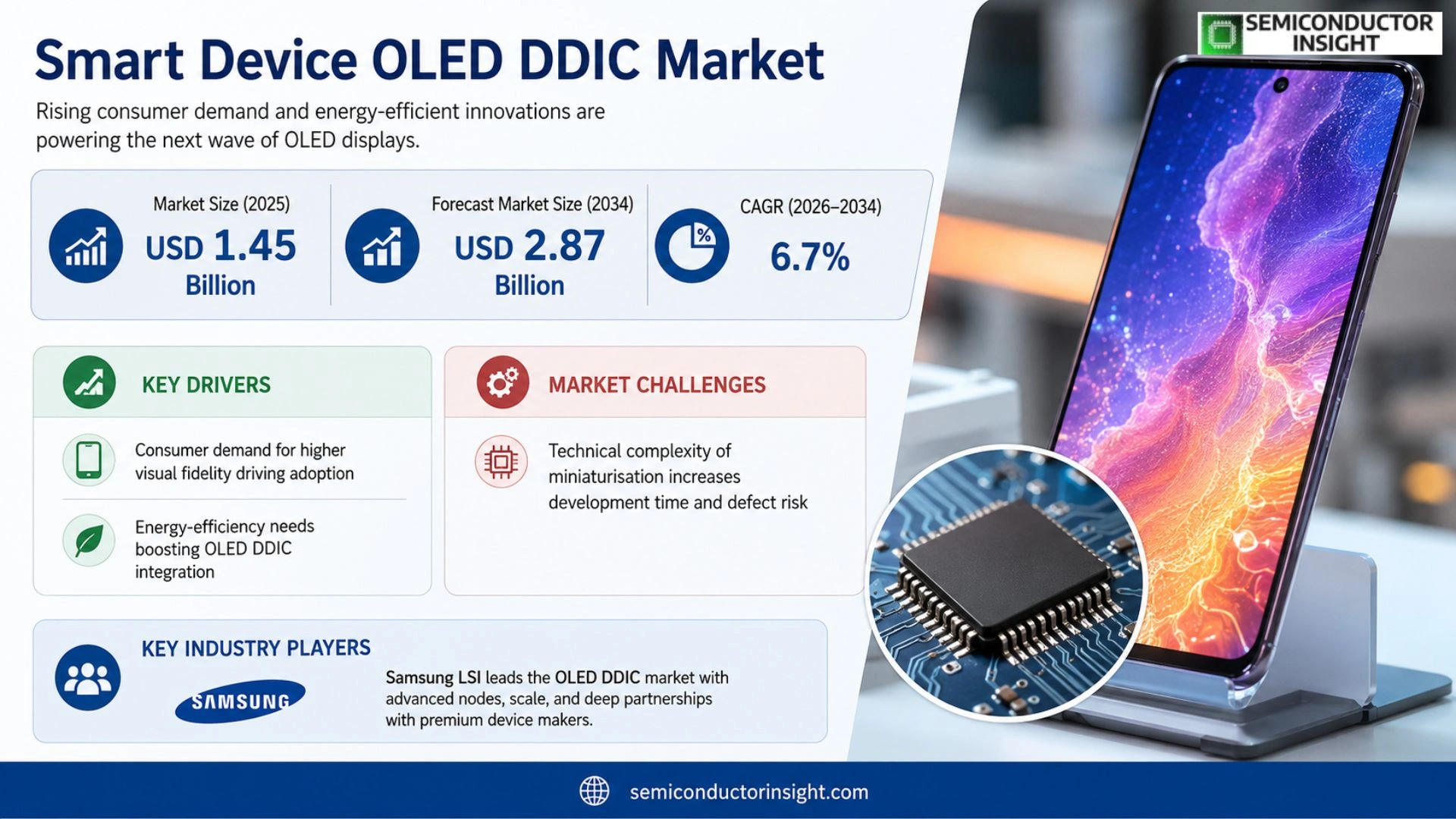
Global Smart Device OLED DDIC market was valued at USD 1.45 billion in 2025 and is forecasted to reach USD 2.87 billion by 2034, showing a CAGR of 6.7% during the forecast period.
Smart Device OLED DDIC (Display Driver Integrated Circuit) is a semiconductor component that converts digital video signals into analog voltages required by organic light‑emitting diode panels. It manages pixel driving, power sequencing, brightness control, and touch‑screen interfacing, enabling high‑resolution visual output while optimizing energy consumption.
The market expands because smartphone manufacturers are increasingly adopting full‑screen OLED displays for premium models, while wearable devices demand compact yet power‑efficient driver solutions. Additionally, rising consumer expectations for higher refresh rates and HDR performance push OEMs toward advanced driver architectures such as 40 nm and sub‑28 nm processes. Leading suppliers,including Samsung LSI, Magnachip, Novatek, Synaptics, LX Semicon and Raydium Semiconductor,have announced new product roadmaps aimed at supporting foldable phones and AR glasses, reinforcing competitive pressure across the ecosystem.
MARKET DRIVERS
Consumer Demand for Higher Visual Fidelity
The proliferation of premium smartphones and wearables has raised expectations for colour accuracy, contrast ratios, and thin form factors. Smart Device OLED DDIC Market suppliers that can deliver tighter pixel pitches and faster refresh rates are witnessing accelerated adoption, because manufacturers see these attributes as direct differentiators in crowded product portfolios.
Energy‑Efficiency Imperatives
Regulatory pressure on device power consumption, coupled with consumer preference for longer battery life, pushes OEMs toward OLED panels that integrate advanced driver‑integrated circuits (DDIC). The ability of DDICs to modulate each pixel independently translates into measurable energy savings, making them a strategic lever for cost‑conscious product planning.
➤ “The transition to integrated OLED driver solutions is reshaping design cycles, shortening time‑to‑market for flagship devices.”
From a supply‑chain perspective, the consolidation of driver and display functions reduces bill‑of‑materials and simplifies assembly lines. Companies that have already invested in high‑volume DDIC production enjoy margin leverage, while new entrants must contend with steep capital requirements to stay relevant.
MARKET CHALLENGES
Technical Complexity of Miniaturisation
Embedding DDICs within ever‑thinner displays demands sub‑micron lithography and precise thermal management. Small‑scale manufacturers often lack the wafer‑fab sophistication required, leading to longer development cycles and higher defect rates.
Other Challenges
Talent Scarcity
The niche expertise needed for OLED‑DDIC co‑design is concentrated in a handful of research hubs, making recruitment a persistent bottleneck for firms seeking to accelerate innovation pipelines.
MARKET RESTRAINTS
Cost Sensitivity in Mid‑Tier Segments
While premium devices readily absorb the price premium of integrated OLED drivers, mid‑tier smartphones remain price‑constrained. The higher per‑unit cost of DDIC‑enabled panels forces manufacturers to either accept narrower margins or postpone adoption, limiting overall market breadth.
MARKET OPPORTUNITIES
Emerging Applications in Augmented Reality
AR head‑sets and smart glasses demand ultra‑high resolution, low‑latency displays that can operate within tight power envelopes. The Smart Device OLED DDIC Market stands to supply the core technology, as DDICs enable pixel‑level control essential for realistic overlay graphics. Early movers that align their roadmaps with AR hardware timelines could capture a sizable share of this nascent revenue stream.
Smart Device OLED DDIC Market Trends
Shift Toward Advanced Process Nodes
The migration from legacy 65nm architectures to finer geometries such as 40nm and 28nm is reshaping the competitive landscape. Manufacturers that successfully integrate these nodes gain measurable advantages in power efficiency and pixel density, which are decisive for premium smartphones and emerging wearables. The transition is not driven merely by cost reduction; rather, it reflects the industry’s response to consumer demand for longer battery life and richer visual experiences. Companies that lag in adopting the newer process technologies risk losing market share to rivals that can deliver thinner, lighter modules without compromising performance. This technological drift also forces the supply chain to recalibrate, prompting fab partners to expand capacity for high‑volume, low‑defect production runs.
Other Trends
Geographic Realignment of Production Hubs
Recent investment patterns reveal a pronounced shift of OLED DDIC assembly toward East Asian locales, especially China and South Korea. The rationale lies in the convergence of skilled labor pools, favorable policy incentives, and proximity to key component suppliers such as display panel makers. Simultaneously, North American firms are consolidating R&D functions to retain intellectual property while outsourcing fabrication to cost‑effective sites. This bifurcated approach balances innovation speed with manufacturing economics, allowing vendors to respond swiftly to shifting demand cycles across smartphone, tablet, and smart‑wearable segments. The geographic reallocation also introduces new competitive pressures, as regional players vie for the same OEM contracts, intensifying price negotiations and prompting collaborative development agreements.
Implications for OEM Procurement Strategies
Original equipment manufacturers are re‑evaluating sourcing models in light of the evolving process node landscape and the relocation of production capacity. Rather than relying on single‑source contracts, many OEMs are adopting multi‑vendor portfolios to mitigate supply‑chain disruptions and to extract incremental value through volume‑based discounts. This strategic diversification is coupled with a heightened focus on long‑term road‑map alignment, ensuring that component specifications remain compatible with future device form factors. Consequently, the Smart Device OLED DDIC Market is witnessing tighter collaboration between OEMs and component makers, with joint technology‑development programs becoming a staple of contract negotiations. Such partnerships are expected to accelerate the rollout of next‑generation display solutions while preserving cost discipline across the product lifecycle.
COMPETITIVE LANDSCAPE
Key Industry Players
Smart Device OLED DDIC Competitive Overview
Samsung LSI continues to dominate the OLED display driver IC segment through a blend of scale, advanced process technology, and deep integration with flagship smartphone OEMs. Its 28‑nm and emerging 40‑nm nodes secure high‑performance panels for premium devices, allowing Samsung to capture a disproportionate share of revenue despite a crowded supplier base. The firm’s ability to co‑develop custom driver architectures with Tier‑1 handset makers creates a barrier to entry that smaller rivals struggle to match, reinforcing a tiered market where a handful of large fabs set pricing and roadmap expectations.
Beyond Samsung, a constellation of specialized firms fuels niche growth across wearables, tablets and emerging form factors. Magnachip leverages its expertise in power‑efficient mixed‑signal design to serve cost‑sensitive mid‑range smartphones, while Novatek’s aggressive portfolio expansion in 48‑nm solutions targets high‑volume Asian manufacturers. Synaptics, LX Semicon and Raydium focus on integrating touch‑sense and image‑signal processing within the DDIC, offering differentiated value for devices that demand compact, multifunctional ICs. Smaller players such as Anapass, Viewtrix, SinoWealth, Sitronix, Chipone, Eswin, Jadard Technology and Chip Wealth Technology round out the ecosystem, each carving out segments by tailoring node choices or emphasizing rapid time‑to‑market for emerging applications like foldables and AR wearables.
List of Key Smart Device OLED DDIC Companies Profiled
- Samsung LSI
- Magnachip
- Novatek
- Synaptics
- LX Semicon
- Raydium Semiconductor
- Anapass
- Viewtrix
- SinoWealth
- Sitronix
- Chipone
- Eswin
- Jadard Technology
- Chip Wealth Technology
Segment Analysis:
| Segment Category | Sub-Segments | Key Insights |
| By Type |
|
40nm
|
| By Application |
|
Smartphone
|
| By End User |
|
Consumer Electronics
|
| By Technology |
|
AMOLED
|
| By Integration |
|
Integrated Driver
|
Regional Analysis: Smart Device OLED DDIC Market
Asia-Pacific
Major fabs in China, South Korea, and Taiwan dominate panel output, leveraging economies of scale to lower unit costs. Their ability to integrate driver ICs during substrate processing grants them a competitive edge, prompting OEMs to align sourcing strategies with these hubs.
Recent geopolitical tensions have encouraged diversification of component sources. Companies are establishing secondary logistics nodes in Southeast Asia to mitigate disruptions, ensuring continuity for high‑volume device launches.
Flagship smartphones in the region increasingly showcase bezel‑less designs and foldable form factors, raising the bar for driver precision and flexibility. This pushes DDIC suppliers to innovate around bendable substrates while maintaining signal integrity.
Energy‑efficiency standards imposed by national bodies are nudging manufacturers toward lower‑power driver architectures. Compliance incentives are accelerating R&D spend on voltage‑scalable DDIC designs.
North America
The North American market remains anchored by premium device adoption, where brand loyalty drives demand for cutting‑edge display performance. OEMs tend to source driver ICs from established U.S. and Japanese suppliers, emphasizing reliability over cost. Integration of OLED DDICs into wearables and augmented‑reality headsets is gaining traction, prompting manufacturers to tailor driver specifications for mixed‑use scenarios. As data‑intensive applications proliferate, the emphasis on low‑latency, high‑bandwidth driver solutions intensifies, shaping vendor negotiations around performance guarantees rather than volume discounts.
Europe
European buyers exhibit a strong preference for sustainability and regulatory compliance, compelling manufacturers to adopt greener driver technologies. The region’s fragmented market, with multiple high‑end brands, encourages a modular approach to OLED DDIC integration, allowing swift adaptation to varying form factors. Collaborative projects across the EU focus on standardising driver interfaces, which could simplify cross‑border component sourcing and reduce time‑to‑market for new devices.
South America
In South America, market growth is anchored by mid‑range smartphones that balance cost with visual appeal. While volume is modest compared to Asia‑Pacific, the region is witnessing a gradual shift toward locally assembled devices, creating opportunities for regional distributors to act as aggregators for OLED DDICs. Price sensitivity forces manufacturers to optimise driver designs for cost efficiency without sacrificing essential performance metrics.
Middle East & Africa
The Middle East & Africa region displays a dichotomy: affluent Gulf markets demand high‑spec flagship models, whereas many African economies prioritize affordability. This split drives a bifurcated supply strategy where premium driver ICs serve luxury segments, while stripped‑down variants support budget‑focused devices. Emerging interest in smart‑city installations, such as interactive display kiosks, introduces a niche for robust, weather‑tolerant OLED DDICs, widening the application horizon beyond consumer gadgets.
Report Scope
This market research report provides a comprehensive analysis of the Smart Device OLED DDIC Market , covering the forecast period 2026–2034. It offers detailed insights into market dynamics, technological advancements, competitive landscape, and key trends shaping the industry.
Key focus areas of the report include:
- Market Overview: The report begins with an overview outlining its current market scenario, key growth indicators, and industry transformation drivers. It discusses macroeconomic factors, demand–supply balance, regulatory landscape, and the strategic role of semiconductors in powering advancements across industries such as automotive, telecommunications, consumer electronics, and industrial automation.
- Market Size & Forecast: Historical data and future projections for revenue, unit shipments, and market value across major regions and segments.
- Segmentation Analysis: Detailed breakdown by product type, technology, application, and end-user industry to identify high-growth segments and investment opportunities.
- Regional Insights: Insights into market performance across North America, Europe, Asia-Pacific, Latin America, and the Middle East & Africa, including country-level analysis where relevant.
- Competitive Landscape: Profiles of leading market participants, including their product offerings, R&D focus, manufacturing capacity, pricing strategies, and recent developments such as mergers, acquisitions, and partnerships.
- Technology Trends & Innovation: Assessment of emerging technologies, integration of AI/IoT, semiconductor design trends, fabrication techniques, and evolving industry standards.
- Market Drivers & Restraints: Evaluation of factors driving market growth along with challenges, supply chain constraints, regulatory issues, and market-entry barriers.
- Stakeholder Insights: Insights for component suppliers, OEMs, system integrators, investors, and policymakers regarding the evolving ecosystem and strategic opportunities.
Primary and secondary research methods are employed, including interviews with industry experts, data from verified sources, and real-time market intelligence to ensure the accuracy and reliability of the insights presented.
FREQUENTLY ASKED QUESTIONS:
What is the current market size of Smart Device OLED DDIC Market?
-> Global Smart Device OLED DDIC market is forecasted to reach USD 2.87 billion by 2034, showing a CAGR of 6.7% during the forecast period.
Which key companies operate in Smart Device OLED DDIC Market?
-> Key players include Samsung LSI, Magnachip, Novatek, Synaptics, LX Semicon, Raydium Semiconductor, Anapass, Viewtrix, SinoWealth, Sitronix, Chipone, Eswin, Jadard Technology, Chip Wealth Technology.
What is the projected CAGR for the market?
-> The market is projected to grow at a compound annual growth rate of % from 2024 to 2031.
How large is the U.S. market and China market?
-> The U.S. market size is estimated at USD million in 2025, while the China market is projected to reach USD million in 2025.
What are the forecasts for the 40nm segment?
-> The 40nm segment will reach USD million by 2036, with a % CAGR over the next ten years.
Which region dominates the Smart Device OLED DDIC market?
-> Asia remains the dominant region, driven by strong demand in China, Japan, and South Korea.
What are the major application areas?
-> Key applications include Smartphone, Smart Wearable Device, Tablet Computer, Laptop, and Others, with smartphones accounting for the largest share in 2025.
Get Sample Report PDF for Exclusive Insights
Report Sample Includes
- Table of Contents
- List of Tables & Figures
- Charts, Research Methodology, and more...
 Download Sample Report PDF