Key Statistics
Key Takeaways
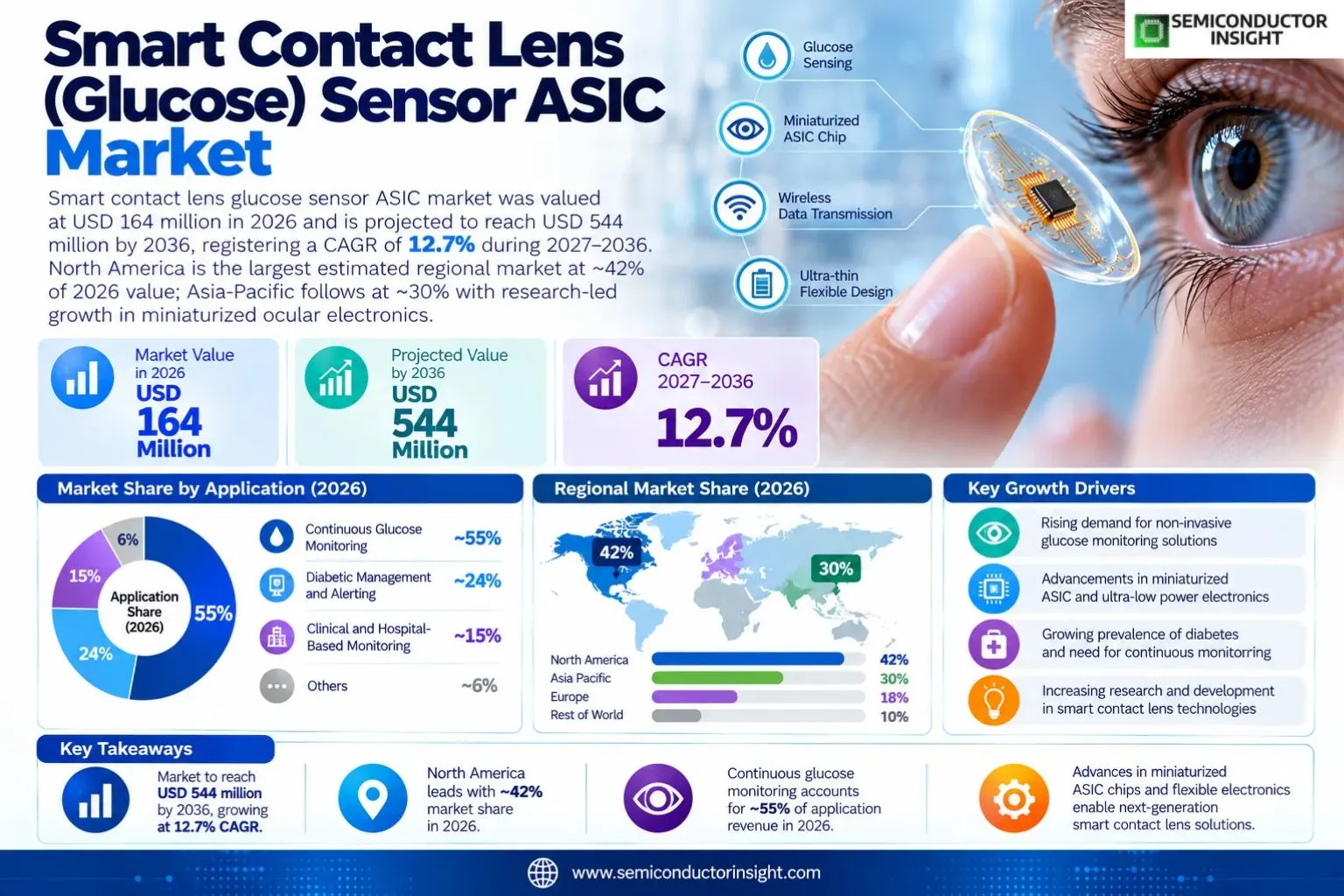
- Global market: USD 164 million in 2026 is forecast to reach USD 544 million by 2036 at a CAGR of 12.7% across the 2027–2036 forecast window, including early-stage design, prototype and pilot-program revenue associated with ocular glucose-sensing electronics.
- Wireless-enabled ASICs hold an estimated ~56% of 2026 value and expand near ~13.4% CAGR as the need for energy-efficient telemetry and continuous data capture favors wireless microelectronics over tethered or passive-only architectures.
- Continuous glucose monitoring accounts for an estimated ~55% of application revenue; diabetes management and alerting holds ~24%, clinical and hospital monitoring ~15%, and other exploratory applications ~6%.
- North America leads with an estimated ~42% share, followed by Asia-Pacific (~30%) and Europe (~18%); Asia-Pacific has the fastest modeled regional growth at ~13.9% CAGR, reflecting electronics integration research and a large potential patient population.
- Clinical evidence and ocular safety remain principal constraints: tear-to-blood glucose lag, biochemical calibration, lens oxygen permeability, device encapsulation and regulatory evaluation can extend the period between prototype demonstration and reimbursed clinical use.
Smart Contact Lens (Glucose) Sensor ASIC Market Overview
Smart contact lens glucose sensor ASIC market was valued at USD 164 million in 2026 and is projected to reach USD 544 million by 2036, registering a CAGR of 12.7% during 2027–2036. North America is the largest estimated regional market at ~42% of 2026 value; Asia-Pacific follows at ~30% with research-led growth in miniaturized ocular electronics.
Smart contact-lens glucose sensor ASICs combine analog signal acquisition, low-noise biochemical detection, signal conversion, timing control and miniature wireless interfaces inside a lens-compatible electronics assembly. The intended function is to detect glucose-related changes in tear fluid and convert the response into interpretable data while preserving lens flexibility and the wearer’s normal visual field. Electronics integration is only one component of a complete ocular diagnostic system.
The market includes custom chips, co-designed chip-lens modules, non-recurring engineering, prototype development and pilot supply associated with tear-glucose sensing as described in the product scope. It excludes finished conventional skin-worn glucose monitors, unrelated ophthalmic display lenses, glucose test strips and standalone contact-lens materials without sensing electronics. Revenue should not be interpreted as a count of regulator-cleared glucose-measuring contact lenses in routine patient use.
A 2024 Nature Communications study of a wireless soft contact lens investigated tear-to-blood glucose correlation, emphasizing personalized physiological lag time and sub-minute tear measurements. This evidence establishes why signal-processing architecture must accommodate biological variation rather than merely detect glucose at a laboratory concentration. Sensor packaging, calibration and data quality are central to the practical value of an ASIC in an ocular wearable.
Wireless power delivery is attractive because a lens offers little space for a conventional battery, yet a radio interface, analog front end and sensor require reliable energy during operation. RF and NFC coupling can reduce onboard energy storage while introducing reader-alignment and duty-cycle limitations. Biofuel cells and miniature batteries remain alternative experimental approaches, and their commercialization depends on maintaining comfort, oxygen transmission and thermal safety.
The demand backdrop is large but not equivalent to immediate product sales. The World Health Organization reported 830 million people living with diabetes in 2022, while the International Diabetes Federation estimated 589 million adults aged 20–79 with diabetes in 2024 under a different age definition. FDA clearance of skin-worn over-the-counter continuous glucose monitoring illustrates a functioning comparator market; tear-sensing lenses still require independent clinical performance evidence.
Segment Analysis: By Type
The market comprises Wireless-Enabled Glucose Sensor ASIC, Wired/Passive Glucose Sensor ASIC and Hybrid Multi-Sensor ASIC. Wireless-enabled designs lead at an estimated ~56% of 2026 value and modeled ~13.4% CAGR, compared with ~29% for wired/passive and ~15% for hybrid designs. These proportions describe revenue allocation among the published classes rather than counts of commercially approved contact lenses.
| Type | Function | Market position |
|---|---|---|
| Wireless-Enabled Glucose Sensor ASIC | An integrated radio or near-field telemetry circuit couples glucose measurement to a compatible external reader while preserving extremely low power draw. The architecture must coordinate biochemical sensing, analog conversion and data packets within a contact lens whose electronics cannot block the pupil or irritate ocular tissue. For Wireless-Enabled Glucose Sensor ASIC, procurement and research decisions depend on signal acquisition, low-power circuit integration and ocular materials; those conditions affect the pace at which engineering results can become reproducible, safe and commercially supportable ocular sensing products. | Wireless operation dominates research attention because continuous measurement has limited value unless measurements can be transferred without a physical cable. The estimated ~56% 2026 share reflects telemetry-intensive prototype design, and the modeled ~13.4% CAGR reflects incremental integration and low-power component improvements. For Wireless-Enabled Glucose Sensor ASIC, procurement and research decisions depend on development partnerships, testing budgets and medical-device readiness; those conditions affect the pace at which engineering results can become reproducible, safe and commercially supportable ocular sensing products. |
| Wired/Passive Glucose Sensor ASIC | Passive interrogation and externally read circuits can simplify power budgeting in a lens by minimizing active radio time. The approach is particularly relevant to bench tests, proof-of-concept lenses and optical or electrochemical configurations where continuous remote transmission is not essential to the development objective. For Wired/Passive Glucose Sensor ASIC, procurement and research decisions depend on signal acquisition, low-power circuit integration and ocular materials; those conditions affect the pace at which engineering results can become reproducible, safe and commercially supportable ocular sensing products. | This class represents an estimated ~29% of 2026 value with modeled ~11.6% CAGR. Lower system complexity can shorten laboratory experiments, although reader dependence and less autonomous telemetry limit its position in future daily-wear patient monitoring designs. For Wired/Passive Glucose Sensor ASIC, procurement and research decisions depend on development partnerships, testing budgets and medical-device readiness; those conditions affect the pace at which engineering results can become reproducible, safe and commercially supportable ocular sensing products. |
| Hybrid Multi-Sensor ASIC | Hybrid designs combine glucose sensing with another ocular or physiological measurement channel, such as pressure, temperature or an additional tear biomarker. Multiplexed analog acquisition increases the demands on signal isolation, on-chip timing and packaging, especially when the biochemical sensor has a different response curve from the companion modality. For Hybrid Multi-Sensor ASIC, procurement and research decisions depend on signal acquisition, low-power circuit integration and ocular materials; those conditions affect the pace at which engineering results can become reproducible, safe and commercially supportable ocular sensing products. | Hybrid systems account for an estimated ~15% of 2026 value and a modeled ~12.6% CAGR. Research on microfluidic lenses shows the broader technical opportunity, but each extra channel increases validation and biocompatibility work before a device can serve a clinical population. For Hybrid Multi-Sensor ASIC, procurement and research decisions depend on development partnerships, testing budgets and medical-device readiness; those conditions affect the pace at which engineering results can become reproducible, safe and commercially supportable ocular sensing products. |
Additional Segmentation: End User, Power Source and Distribution Channel
Three further commercial dimensions distinguish the intended user, power source and procurement channel. They are separate classification axes and do not add to the type market total; each assigns the same market value according to a different design or customer attribute. Shares are modeled estimates for the base year. For secondary segmentation, procurement and research decisions depend on user needs, power architecture and supplier relationships; those conditions affect the pace at which engineering results can become reproducible, safe and commercially supportable ocular sensing products.
| Axis | Members | Commercial role |
|---|---|---|
| End User | Diabetic Patients (Type 1 and Type 2) · Hospitals and Specialty Clinics · Research and Academic Institutions | End-user demand is concentrated in people requiring regular glycemic observation; hospitals validate clinical performance, while academic institutions test sensing materials, chip layouts and calibration protocols. The leading Diabetic Patients (Type 1 and Type 2) category represents an estimated ~58% of 2026 value, while alternative members address narrower engineering and distribution requirements. Classification follows the project’s primary declared purpose to prevent a single design contract being counted twice within this axis. |
| Power Source | RF/NFC Energy Harvesting · Biofuel Cell (Tear-Powered) · Micro-Battery Integrated | Energy-harvesting interfaces reduce dependence on bulky onboard cells but place demanding limits on available power, antenna design, data duty cycle and reader geometry. The leading RF/NFC Energy Harvesting category represents an estimated ~64% of 2026 value, while alternative members address narrower engineering and distribution requirements. Classification follows the project’s primary declared purpose to prevent a single design contract being counted twice within this axis. |
| Distribution Channel | Direct Sales to Medical Device Manufacturers (OEM) · Semiconductor Distributors and Partners · Licensing and Technology Transfer Agreements | Early regulated wearables rely on co-development contracts and technology transfer because ASIC performance must be qualified with the lens material, sensor chemistry and complete reader system. The leading Direct Sales to Medical Device Manufacturers (OEM) category represents an estimated ~59% of 2026 value, while alternative members address narrower engineering and distribution requirements. Classification follows the project’s primary declared purpose to prevent a single design contract being counted twice within this axis. |
Segment Analysis: By Application
Continuous Glucose Monitoring leads with an estimated ~55% of application revenue in 2026, followed by Diabetic Management and Alerting (~24%), Clinical and Hospital-Based Monitoring (~15%) and Others (~6%). The application split distinguishes the principal project objective; the same sensor platform can support several future use cases without creating additional revenue for each one.
| Application | Demand characteristics |
|---|---|
| Continuous Glucose Monitoring (CGM) | Continuous measurement is the principal design target, requiring the ASIC to record low-concentration tear signals with stable calibration while controlling noise, thermal output and wireless duty cycles. An estimated ~55% of 2026 value belongs to this application, with modeled ~13.3% growth. The commercial challenge is to translate laboratory correlation into dependable day-to-day clinical accuracy across users. |
| Diabetic Management and Alerting | Alerting systems aim to turn measured glucose trends into prompts that can support diabetes management, but safe alarm logic depends on validated correspondence with blood glucose and acceptable delay. The estimated ~24% share and ~12.1% modeled CAGR reflect the potential for smartphone-linked feedback. This application remains distinct from a medical claim that any ocular lens has obtained approval for dosing decisions. |
| Clinical and Hospital-Based Monitoring | Hospitals and specialist clinics provide structured environments for testing the sensor against established measurement standards, including repeated calibration and supervised wear. The modeled ~15% application share and ~12.0% CAGR reflect pilot testing, validation services and research deployments. Hospitals must also consider infection prevention, lens handling and patient-specific suitability before expanding any novel monitoring technology. |
| Others | Other applications include controlled laboratory experiments, multimodal ocular research and exploratory diagnostic interfaces that may eventually inform non-glucose sensing products. They represent an estimated ~6% of 2026 market value and modeled ~12.2% growth. Revenue in this category reflects electronics and development activity connected to the specified glucose-sensing platform rather than the broader smart-contact-lens industry. |
The commercialization channel remains predominantly collaborative. Medical-device manufacturers and electronics developers jointly choose lens chemistry, antenna configuration, readout electronics and patient interface before committing to tooling or clinical trials. That favors direct OEM agreements, estimated at ~59% of 2026 distribution value, over catalog distribution at ~19%; licensing and technology transfer represent another ~22% of specialized arrangements.
Regional Analysis
North America leads at an estimated ~42% of 2026 market value, Asia-Pacific follows at ~30%, and Europe represents ~18%; South America holds ~6% and Middle East & Africa ~4%. Asia-Pacific shows the fastest modeled growth at ~13.9% CAGR, supported by research on wireless lens sensing and electronics integration. Regional allocation reflects research, development and early-stage supply activity.
Which regions have the strongest development and clinical demand?
Regional positioning is driven by different factors at different stages of product maturity. In North America, device developers and clinical specialists influence evidence requirements; in Asia-Pacific, academic demonstrations and semiconductor production capabilities strengthen engineering capacity. Europe contributes precision microelectronics and regulated medical-device design. South America and Middle East & Africa provide potential clinical demand, but their share is limited by the small installed base of ocular biosensor production.
| Region | Position | Growth outlook | Demand profile | What decides supplier selection |
|---|---|---|---|---|
| North America | Largest (~42%) | ~12.5% CAGR | U.S. device-development networks and regulatory review expertise support the largest estimated regional share, while Canada contributes biomedical research and Mexico presents longer-term access opportunities. Its estimated ~42% 2026 share reflects the distribution of design and development work. For North America, procurement and research decisions depend on local research capacity and relevant patient populations; those conditions affect the pace at which engineering results can become reproducible, safe and commercially supportable ocular sensing products. | Customer selection emphasizes lens safety, reader compatibility, documented sensing precision and the ability to sustain development. These requirements are material for North America because device buyers must validate both ocular wear and data interpretation before expanding beyond controlled studies. For North America, procurement and research decisions depend on biocompatibility evidence, data interpretation and product traceability; those conditions affect the pace at which engineering results can become reproducible, safe and commercially supportable ocular sensing products. |
| Asia-Pacific | Second largest (~30%) | ~13.9% CAGR | The region combines Korean experimental lens results with Japanese precision electronics, Chinese production capacity and significant clinical demand across emerging economies. Its estimated ~30% 2026 share reflects the distribution of design and development work. For Asia-Pacific, procurement and research decisions depend on local research capacity and relevant patient populations; those conditions affect the pace at which engineering results can become reproducible, safe and commercially supportable ocular sensing products. | Customer selection emphasizes lens safety, reader compatibility, documented sensing precision and the ability to sustain development. These requirements are material for Asia-Pacific because device buyers must validate both ocular wear and data interpretation before expanding beyond controlled studies. For Asia-Pacific, procurement and research decisions depend on biocompatibility evidence, data interpretation and product traceability; those conditions affect the pace at which engineering results can become reproducible, safe and commercially supportable ocular sensing products. |
| Europe | Third largest (~18%) | ~11.9% CAGR | European biomedical research and regulatory evidence requirements emphasize verified sensor performance, materials safety and controlled development partnerships. Its estimated ~18% 2026 share reflects the distribution of design and development work. For Europe, procurement and research decisions depend on local research capacity and relevant patient populations; those conditions affect the pace at which engineering results can become reproducible, safe and commercially supportable ocular sensing products. | Customer selection emphasizes lens safety, reader compatibility, documented sensing precision and the ability to sustain development. These requirements are material for Europe because device buyers must validate both ocular wear and data interpretation before expanding beyond controlled studies. For Europe, procurement and research decisions depend on biocompatibility evidence, data interpretation and product traceability; those conditions affect the pace at which engineering results can become reproducible, safe and commercially supportable ocular sensing products. |
| South America | Emerging (~6%) | ~11.8% CAGR | The region is an emerging clinical-evaluation opportunity, with Brazil and Argentina providing potential study populations but limited direct ocular-ASIC manufacturing capacity. Its estimated ~6% 2026 share reflects the distribution of design and development work. For South America, procurement and research decisions depend on local research capacity and relevant patient populations; those conditions affect the pace at which engineering results can become reproducible, safe and commercially supportable ocular sensing products. | Customer selection emphasizes lens safety, reader compatibility, documented sensing precision and the ability to sustain development. These requirements are material for South America because device buyers must validate both ocular wear and data interpretation before expanding beyond controlled studies. For South America, procurement and research decisions depend on biocompatibility evidence, data interpretation and product traceability; those conditions affect the pace at which engineering results can become reproducible, safe and commercially supportable ocular sensing products. |
| Middle East & Africa | Developing (~4%) | ~12.1% CAGR | Regional demand is shaped by diabetes burden and digital-health investment, while limited direct ocular electronics capacity favors imported modules and supervised clinical programmes. Its estimated ~4% 2026 share reflects the distribution of design and development work. For Middle East & Africa, procurement and research decisions depend on local research capacity and relevant patient populations; those conditions affect the pace at which engineering results can become reproducible, safe and commercially supportable ocular sensing products. | Customer selection emphasizes lens safety, reader compatibility, documented sensing precision and the ability to sustain development. These requirements are material for Middle East & Africa because device buyers must validate both ocular wear and data interpretation before expanding beyond controlled studies. For Middle East & Africa, procurement and research decisions depend on biocompatibility evidence, data interpretation and product traceability; those conditions affect the pace at which engineering results can become reproducible, safe and commercially supportable ocular sensing products. |
Key Smart Contact Lens Glucose Sensor ASIC Developers and Competitive Landscape
Competition remains research-led and spans microelectronics companies, ophthalmic-device developers, university laboratories and glucose-monitoring incumbents. A named company in the wider ecosystem is not automatically a supplier of a commercial ocular ASIC. The strongest technical positions depend on credible tear-glucose measurement, extremely low energy consumption, biocompatible packaging and the ability to execute regulated clinical development.
Wireless smart-lens research at South Korean institutions has demonstrated continuous tear-glucose data acquisition and explored personalized lag time. This work is commercially significant because it links electrochemical sensing with a soft lens and wireless readout rather than treating the chip as an isolated electronic component. The next competitive hurdle is reproducible performance across a diverse patient population and reliable long-term wear.
Texas Instruments and STMicroelectronics provide relevant analog, low-power and wireless semiconductor technologies, but their general-purpose biosensing components should not be described as proven volume shipments of glucose-contact-lens ASICs. TI’s low-power continuous glucose monitor reference design uses an electrochemical analog front end and BLE communications for a compact skin-worn architecture. Transferring those principles into an ocular device requires a separate engineering and validation effort.
Historical development programmes matter as technical precedent without establishing current supplier status. Verily and Alcon investigated tear-glucose smart contact lenses, but that programme was discontinued; the companies remain in the profiled ecosystem for history rather than as current Tier 1 or Tier 2 suppliers. Medical-device manufacturers such as Abbott and Medtronic compete through established monitoring technologies, which set performance and usability expectations for emerging non-invasive alternatives.
University and institute research is distributed across Korea, Japan, Europe and other regions. A 2025 Scientific Reports paper on plasmonic etalon lenses and a separate 2024 ACS paper on colorimetric glucose sensing demonstrate alternative readout mechanisms. Those approaches compete at the architecture level, but neither result should be converted into an unsupported assertion of finished medical-device sales or a supplier market share.
Tier structure
| Tier | Companies | Basis of competition |
|---|---|---|
| Tier 1 research developers | Yonsei University smart-lens research consortium; Korea Advanced Institute of Science and Technology (KAIST) | Research groups demonstrating or advancing glucose-related lens sensing and associated electronics integration. Their role is design evidence, testing and development collaboration rather than proven large-scale commercial ASIC shipment. Differentiation comes from signal accuracy, soft-lens integration and ability to explain physiological lag, with publications supplying technical validation milestones. For Tier 1 research developers, procurement and research decisions depend on technical readiness, customer qualification and supply responsibilities; those conditions affect the pace at which engineering results can become reproducible, safe and commercially supportable ocular sensing products. |
| Tier 2 enabling semiconductor suppliers | Texas Instruments Incorporated; STMicroelectronics N.V.; Infineon Technologies AG; NXP Semiconductors N.V. | Established semiconductor suppliers with low-power sensing, analog conversion, wireless or energy-management portfolios relevant to ocular electronics. Their participation is described as enabling technology capability, not as confirmed commercial shipments of a purpose-built glucose-lens ASIC. Selection depends on power draw, miniaturization, documentation and long-term component support. For Tier 2 enabling semiconductor suppliers, procurement and research decisions depend on technical readiness, customer qualification and supply responsibilities; those conditions affect the pace at which engineering results can become reproducible, safe and commercially supportable ocular sensing products. |
| Historical and adjacent ecosystem | Verily Life Sciences; Novartis AG / Alcon; Mojo Vision; Abbott Laboratories; Medtronic plc; Sony Semiconductor Solutions; Samsung Electronics; Imec; Sensirion AG | The profiled ecosystem includes discontinued smart-lens programmes, other ocular electronics, established skin-worn glucose-monitoring businesses and microelectronics research organizations. These entities influence technology directions or competitive benchmarks, but they are not counted as direct suppliers of a cleared glucose-sensing contact-lens ASIC without supporting evidence of that activity. For Historical and adjacent ecosystem, procurement and research decisions depend on technical readiness, customer qualification and supply responsibilities; those conditions affect the pace at which engineering results can become reproducible, safe and commercially supportable ocular sensing products. |
Key companies profiled
- Verily Life Sciences (Google/Alphabet)
- Novartis AG (in collaboration with Alcon)
- Texas Instruments Incorporated
- STMicroelectronics N.V.
- Samsung Electronics Co., Ltd.
- Sony Semiconductor Solutions Corporation
- Mojo Vision, Inc.
- Imec (Interuniversity Microelectronics Centre)
- Medtronic plc
- Abbott Laboratories
- Infineon Technologies AG
- NXP Semiconductors N.V.
- Tohoku University (Research Consortium, Japan)
- Korea Advanced Institute of Science and Technology (KAIST)
- Sensirion AG
Smart Contact Lens Glucose Sensor ASIC Production Capacity Analysis
The market is dominated by development and pilot manufacturing rather than a documented network of dedicated high-volume ocular glucose ASIC fabs. Existing semiconductor foundries can produce low-power circuits, but successful ocular integration also needs lens-compatible assembly, biocompatible encapsulation, sensor chemistry, specialized testing and quality systems. Production capacity must therefore be evaluated across several linked steps.
Prototype fabrication combines semiconductor design tools, wafer processing, thin-die handling and flexible or curved lens substrates. A circuit that works on a rigid test board may fail when subjected to lens curvature, moisture exposure, oxygen-permeability constraints or repeated wear. Capacity is limited by the ability to repeat all assembly and calibration steps at acceptable yields, not simply by the number of wafers a foundry can process.
Academic research in South Korea and work in other microelectronics clusters demonstrate multiple sensing architectures, including wireless electrochemical and colorimetric approaches. These experiments show technical feasibility but do not quantify commercial unit output. Scaling requires standardized sensor materials, traceable device lots, optical inspection and testing under realistic tear-fluid conditions, followed by coordinated clinical evidence and post-manufacturing quality control.
Upstream bottlenecks include miniature antennas, low-noise readout circuitry, compatible encapsulants, microfluidic structures and repeatable calibration. A 2025 microfluidic contact-lens review describes the challenge of manipulating tiny tear volumes, while FDA guidance emphasizes evaluation of the finished body-contacting device. Suppliers that can integrate electronics and biocompatibility requirements into a reproducible process are better positioned than companies offering an ASIC die alone.
Smart Contact Lens Glucose Sensor ASIC Market Dynamics: Drivers, Restraints and Opportunities
Growth depends on diabetes-monitoring needs, non-invasive wearable research, miniaturized sensing electronics, wireless data transmission and engineering partnerships. These drivers are moderated by clinical correlation uncertainty, ocular biocompatibility, high development costs and competition from established skin-worn CGM products. Impact contributions are analytical percentage-point allocations over the forecast window. For market dynamics, procurement and research decisions depend on clinical evidence, miniature circuits and device qualification; those conditions affect the pace at which engineering results can become reproducible, safe and commercially supportable ocular sensing products.
MARKET DRIVERS
Drivers Impact Analysis*
| Market Drivers | Impact Rank | CAGR Contribution (%) | 2027–2029 | 2030–2032 | 2033–2036 |
|---|---|---|---|---|---|
| Demand for comfortable diabetes monitoring | High | +4.40% | High | High | High |
| Low-power wireless ASIC integration | High | +3.90% | High | High | Medium |
| Tear-glucose research and calibration progress | Medium-High | +3.40% | High | High | Medium |
| Flexible and microfluidic lens engineering | Medium | +2.60% | Medium | High | High |
| OEM co-development and licensing | Low-Medium | +1.90% | Medium | High | High |
| Others (digital health, sensor chemistry, optical readout, research grants) | Low | +1.00% | Medium | Medium | High |
Diabetes burden motivates less intrusive measurement
WHO and IDF figures show a large population requiring reliable glucose monitoring, but the opportunity for contact-lens electronics is conditional on demonstrating clinical usefulness. Developers seek comfortable, frequent measurement without repeated skin puncture. That requirement supports research into tear sensing, miniaturized analog acquisition and wireless data links that could ultimately reduce the burden of monitoring.
Low-power electronics enable lens-scale systems
A lens offers far less volume than a skin-worn monitor, making power management and sensor readout central design problems. Research teams therefore pursue RF-powered communication, energy harvesting and highly integrated analog front ends. Successful integration can reduce bulky components and improve wearability, while requiring stringent checks on temperature rise and interference with optical transparency.
Clinical research improves signal interpretation
A 2024 Nature Communications study investigated personalized lag time between tear and blood glucose in a wireless smart lens. This is important because an electrochemical measurement is not automatically a clinically actionable blood-glucose value. Better signal processing, user calibration and longitudinal evidence could raise confidence in the measurement approach and create additional demand for specialized sensor ASIC design.
Flexible microfabrication broadens technical options
A 2025 review of microfluidic contact lenses discussed sensors for glucose, pH and electrolytes, while other publications explored plasmonic and colorimetric techniques. These developments broaden the range of possible chip interfaces and packaging methods. Semiconductor developers that can support multiple sensor chemistries may win prototype contracts and licensing opportunities before a dominant commercial architecture emerges.
MARKET RESTRAINTS
Restraints Impact Analysis*
| Market Restraints | Impact Rank | CAGR Contribution (%) | 2027–2029 | 2030–2032 | 2033–2036 |
|---|---|---|---|---|---|
| Tear-to-blood glucose correlation uncertainty | High | -1.80% | High | Medium | Medium |
| Ocular safety and regulatory validation | Medium-High | -1.30% | High | High | Medium |
| Prototype manufacturing cost and low yields | Medium | -0.90% | High | Medium | Low |
| Others (reader alignment, reimbursement, incumbent CGM competition) | Low | -0.50% | Medium | Medium | Low |
Physiological variability complicates clinical claims
Tear glucose can vary with blinking, reflex tearing, ocular conditions and time lag relative to blood glucose. A single laboratory calibration may not work across patients or extended wear periods. These uncertainties require careful signal processing and clinical studies, slowing decisions to commit to high-volume production even when sensor sensitivity looks promising in controlled experiments.
Eye-contact materials require extensive safety evidence
Electronics, conductors, adhesives and encapsulants must remain compatible with the ocular surface. FDA guidance on ISO 10993-1 emphasizes evaluating the finished body-contacting device rather than assuming that individual components are safe. Lens oxygen permeability, irritation and long-duration wear are additional concerns, increasing test costs and extending qualification compared with many ordinary wearable electronics products.
Specialized assembly limits manufacturing economics
An ocular sensor needs thin chips, flexible electrical connections, miniature antennas and repeatable biochemical surfaces. Each assembly step can reduce yield or introduce drift, especially under wet operating conditions. Without established high-volume process control, prototype and pilot costs remain high, which limits the number of development teams able to sustain long clinical-validation programmes.
Established CGM platforms set a demanding benchmark
The FDA cleared an over-the-counter skin-worn continuous glucose monitor in March 2024 and expanded its use to children in June 2026. These products have established manufacturing and clinical pathways, so a glucose-sensing lens must offer meaningful advantages in comfort, accuracy or convenience. An unproven ocular product cannot rely on the appeal of non-invasiveness alone to win clinical adoption.
MARKET OPPORTUNITIES
Personalized signal-processing and calibration ASICs
The personalized lag-time findings reported in 2024 create opportunities for specialized algorithms and on-chip signal-conditioning functions. Designers can differentiate by reducing noise, accommodating tear-fluid variability and managing communication timing. These capabilities may become valuable intellectual property in future partnerships with lens manufacturers and clinical software providers, provided they are validated across relevant patient groups.
Multianalyte ocular electronics platforms
Microfluidic lens research has explored several tear biomarkers, while optical and electronic architectures provide different routes to detection. A modular ASIC with configurable analog channels could support glucose as the initial application and other ocular sensing functions later. This approach may spread development costs across more projects, although each medical use requires its own evidence and authorization.
OEM and academic licensing collaborations
Research groups may lack commercial manufacturing and regulatory infrastructure, while established device firms may lack a proven ocular glucose sensing design. Licensing and co-development can connect these complementary capabilities. The estimated ~22% distribution-channel allocation for licensing reflects the relevance of technology transfer in an early-stage market where design validation precedes routine component purchasing.
Cost-effective monitoring for underserved populations
WHO and IDF data identify substantial diabetes burdens in regions where conventional monitoring can be difficult to access. A future safe, reliable and affordable ocular system could offer another way to collect data, but commercial success depends on fitting services, reader cost, training and clinical benefit. Research programmes should therefore test total patient economics rather than semiconductor cost alone.
Smart Contact Lens Glucose Sensor ASIC Supply Chain Analysis
The supply chain links electrochemical and optical sensor materials with miniature integrated circuits, flexible interconnects, contact-lens fabrication, external readers and clinical monitoring software. A successful product requires coordinated verification across all stages because an accurate sensor chip cannot compensate for a lens that is uncomfortable, unstable or unable to transmit reliable measurements.
Upstream. The choice of sensor chemistry determines the signal amplitude and the front-end architecture needed to interpret it. Boronic-acid colorimetry, electrochemical sensing and plasmonic structures have different power and readout requirements. Designers therefore need early access to materials data and lens-fabrication constraints so that circuit specifications remain compatible with transparency, oxygen transfer and tear exposure.
Manufacturing. The most demanding production step is not conventional wafer fabrication alone but joining rigid or thinned electronics to a soft ocular platform. Lens geometry, encapsulation integrity, antenna performance and biochemical calibration must remain stable after assembly. Each prototype lot should be traceable to its sensor chemistry and electrical test results to support later clinical studies and quality review.
Distribution. The primary channel is likely to involve direct OEM co-design and licensing rather than broad distribution of off-the-shelf ocular ASICs. Developers need agreements that assign responsibility for clinical data, intellectual property, materials testing and software interoperability. The estimated ~59% direct OEM share reflects this integration requirement, while distributors may supply enabling components used in research prototypes.
Downstream. Clinical researchers and future device users need understandable glucose information, safe lens handling and reliable reader connectivity. The measured tear signal must be interpreted in light of physiological lag and comparison with accepted monitoring methods. Healthcare providers will evaluate whether the device changes clinical decisions or improves adherence, not simply whether an embedded ASIC can produce a wireless data stream.
Recent Developments in Smart Contact Lens Glucose Sensor ASIC Technology
- 1 July 2026 Published
A peer-reviewed npj Flexible Electronics study presented a smart contact lens using plasmonic nanowire structures to monitor ocular blood oxygen saturation. Although the measurement target is not glucose, the work expands the evidence base for functional electronic and optical elements on contact-lens platforms. It signals technical progress in lens-integrated sensing without demonstrating regulatory clearance of a glucose-monitoring ASIC. Source - 12 June 2026 Announced
The FDA cleared Dexcom Stelo over-the-counter continuous glucose monitoring for children aged two and older who do not use insulin, extending its earlier adult clearance. The decision concerns a skin-worn monitor, not an electronic contact lens. It raises the competitive benchmark for any ocular alternative by emphasizing established clinical evidence, user instructions and real-world performance. Source - 22 August 2025 Published
Scientific Reports published work on integrating graphene inks into commercial contact lenses, addressing materials and fabrication methods relevant to future wearable ocular electronics. The study is adjacent to glucose sensing rather than proof of a glucose-monitoring product launch. It illustrates why flexible conductors, mechanical integrity and compatibility with existing lens materials are central issues for ASIC-integrated platforms. Source - 29 April 2025 Published
Researchers reported a plasmonic etalon-based smart contact lens for tear-glucose sensing, with experiments spanning glucose solutions from 0.15 to 10 mM. The optical approach provides a comparison for chip-based electrochemical designs and may shape future sensor-interface choices. Laboratory sensing results should not be equated with continuous clinical monitoring or commercial ASIC shipments. Source - 3 April 2025 Published
Microsystems & Nanoengineering published a review of microfluidic contact-lens fabrication and applications, including glucose, pH and electrolyte monitoring. The article describes approaches to controlling tiny tear-fluid volumes and integrating sensing functions within limited lens space. For ASIC developers, these considerations affect packaging, analog front-end requirements and the feasibility of multianalyte architectures. Source - 23 May 2024 Published
ACS Biomaterials Science & Engineering published a contact-lens glucose-sensing study using boronic-acid functionalization and a colorimetric readout, while evaluating transparency and oxygen permeability. This alternative sensing pathway broadens the technical landscape around ocular glucose detection. It does not establish that the studied lens contains a commercial wireless ASIC or has been cleared for medical use. Source - 2 April 2024 Published
Nature Communications published a wireless soft smart-contact-lens study examining correlations between tear and blood glucose and the importance of personalized lag time. The paper included human and animal investigations and frequent tear-glucose measurements. The findings are relevant to low-power sensor readout and calibration logic, while further evidence is needed before routine medical-device commercialization. Source
REPORT SCOPE & SEGMENTATION
| Attribute | Details |
|---|---|
| Study Period | 2021–2036 |
| Base Year | 2026 |
| Estimated Year | 2027 |
| Forecast Period | 2027–2036 |
| Historical Period | 2021–2025 |
| Market Size 2026 | USD 164 million |
| Market Size 2027 | USD 184 million |
| Market Size 2036 | USD 544 million |
| Growth Rate | CAGR of 12.7% from 2027–2036 |
| Unit | Value (USD Million); early-stage chip design, prototype and pilot supply |
| Segmentation | By Type, Application, End User, Power Source, Distribution Channel and Region |
| By Type | Wireless-Enabled Glucose Sensor ASIC · Wired/Passive Glucose Sensor ASIC · Hybrid Multi-Sensor ASIC |
| By Application | Continuous Glucose Monitoring (CGM) · Diabetic Management and Alerting · Clinical and Hospital-Based Monitoring · Others |
| By End User | Diabetic Patients (Type 1 and Type 2) · Hospitals and Specialty Clinics · Research and Academic Institutions |
| By Power Source | RF/NFC Energy Harvesting · Biofuel Cell (Tear-Powered) · Micro-Battery Integrated |
| By Distribution Channel | Direct Sales to Medical Device Manufacturers (OEM) · Semiconductor Distributors and Partners · Licensing and Technology Transfer Agreements |
| By Region | Global regions, with leading countries and development clusters North AmericaUnited States, Canada, Mexico Asia-PacificSouth Korea, Japan, China, India EuropeBelgium, Germany, United Kingdom South AmericaBrazil, Argentina, Chile Middle East & AfricaSaudi Arabia, United Arab Emirates, South Africa |
| Key Companies Profiled | Verily Life Sciences (Google/Alphabet), Novartis AG (in collaboration with Alcon), Texas Instruments Incorporated, STMicroelectronics N.V., Samsung Electronics Co., Ltd., Sony Semiconductor Solutions Corporation, Mojo Vision, Inc., Imec (Interuniversity Microelectronics Centre), Medtronic plc, Abbott Laboratories, Infineon Technologies AG, NXP Semiconductors N.V., Tohoku University (Research Consortium, Japan), Korea Advanced Institute of Science and Technology (KAIST), Sensirion AG |
| Customization Scope | Customized review of ASIC architectures, research partners, clinical readiness, pilot manufacturing, glucose-sensing accuracy, intellectual property and regional commercialization. |
Frequently Asked Questions
How large is the smart contact lens glucose sensor ASIC market?
The market is valued at USD 164 million in 2026 and is forecast to reach USD 544 million by 2036, growing at a CAGR of 12.7% over 2027–2036. It covers chip development, pilot assemblies and related early-stage activity rather than claiming that glucose-measuring contact lenses are already widely cleared and sold to patients.
Which ASIC type leads the market?
Wireless-Enabled Glucose Sensor ASIC leads with an estimated ~56% share in 2026 and modeled ~13.4% growth. Wireless designs connect biochemical measurements with external readers while respecting tight power and space limits. Wired/passive designs hold ~29%, and hybrid multi-sensor designs ~15%, with both serving narrower engineering or research requirements. For which asic type leads the market, procurement and research decisions depend on clinical validity, lens compatibility and reader design; those conditions affect the pace at which engineering results can become reproducible, safe and commercially supportable ocular sensing products.
What is the largest application?
Continuous Glucose Monitoring accounts for an estimated ~55% of 2026 application value, reflecting the goal of repeated glucose measurements without conventional skin puncture. Diabetic Management and Alerting represents ~24%, Clinical and Hospital-Based Monitoring ~15%, and Others ~6%. These are modeled classifications of development activity, not approved indications for an ocular medical device. For what is the largest application, procurement and research decisions depend on clinical validity, lens compatibility and reader design; those conditions affect the pace at which engineering results can become reproducible, safe and commercially supportable ocular sensing products.
Which region is largest and fastest growing?
North America has the largest estimated share at ~42% in 2026, followed by Asia-Pacific (~30%) and Europe (~18%). Asia-Pacific has the fastest modeled regional CAGR at ~13.9%, helped by academic lens-sensing research and electronics integration capacity. South America and Middle East & Africa represent smaller potential clinical and research markets. For which region is largest and fastest growing, procurement and research decisions depend on clinical validity, lens compatibility and reader design; those conditions affect the pace at which engineering results can become reproducible, safe and commercially supportable ocular sensing products.
Why does tear-to-blood glucose correlation matter?
Glucose concentrations and timing in tear fluid do not necessarily track blood glucose in a simple, uniform way. A 2024 wireless-lens study investigated personalized lag time, showing why calibration and signal interpretation are essential. ASIC designers must consider physiological variability, sensor drift and the consequences of incorrect alerts before making clinical performance claims.
How are smart contact lens ASICs powered?
RF and NFC energy harvesting is the largest modeled power-source class at ~64% of 2026 value. Tear-powered biofuel cells represent ~20%, and integrated micro-batteries ~16%. Energy harvesting can reduce lens thickness and battery burden, but it creates trade-offs involving reader distance, duty cycle, antenna layout and available electrical power. For how are smart contact lens asics powered, procurement and research decisions depend on clinical validity, lens compatibility and reader design; those conditions affect the pace at which engineering results can become reproducible, safe and commercially supportable ocular sensing products.
Are glucose-monitoring smart contact lenses approved for routine use?
The research evidence cited here documents prototypes, sensing experiments and technology development, not broad regulatory clearance of glucose-sensing contact lenses for routine patient monitoring. The FDA decisions in 2024 and 2026 concern Dexcom’s skin-worn Stelo system. Ocular devices need their own clinical evidence, biocompatibility evaluation and applicable authorization before medical deployment. For are glucose-monitoring smart contact lenses approved for routine use, procurement and research decisions depend on clinical validity, lens compatibility and reader design; those conditions affect the pace at which engineering results can become reproducible, safe and commercially supportable ocular sensing products.
Which companies and institutes participate?
The ecosystem includes Texas Instruments, STMicroelectronics, Samsung Electronics, Sony Semiconductor Solutions, Imec, KAIST, academic research teams and medical-device manufacturers. These organizations have different roles in enabling electronics, research and established glucose monitoring. Historical Verily-Alcon work is included for context, not as evidence of a current commercially shipped glucose-lens ASIC. For which companies and institutes participate, procurement and research decisions depend on clinical validity, lens compatibility and reader design; those conditions affect the pace at which engineering results can become reproducible, safe and commercially supportable ocular sensing products.
What restrains market development?
The main constraints are uncertain physiological correlation, ocular material safety, high prototype assembly costs and competition from established continuous glucose monitoring systems. Lens electronics must also remain comfortable and reliable in a wet environment. Clinical studies and manufacturing controls can take longer than electronic proof-of-concept work, so commercialization schedules should not be inferred from laboratory demonstrations alone.
What is included in the report scope?
The scope includes custom ASICs and integrated chip-lens modules for tear-glucose sensing, including prototype, non-recurring engineering and pilot revenue. It covers three types, four applications, three end-user classes, three power-source classes, three distribution channels and five geographic regions. It excludes conventional CGM devices and unrelated lens technologies without glucose-sensing electronics. For what is included in the report scope, procurement and research decisions depend on clinical validity, lens compatibility and reader design; those conditions affect the pace at which engineering results can become reproducible, safe and commercially supportable ocular sensing products.
Research Sources & Evidence Base
Get Sample Report PDF for Exclusive Insights
Report Sample Includes
- Table of Contents
- List of Tables & Figures
- Charts, Research Methodology, and more...
 Download Sample Report PDF