Single Sided FPC Coverlay Market Insights
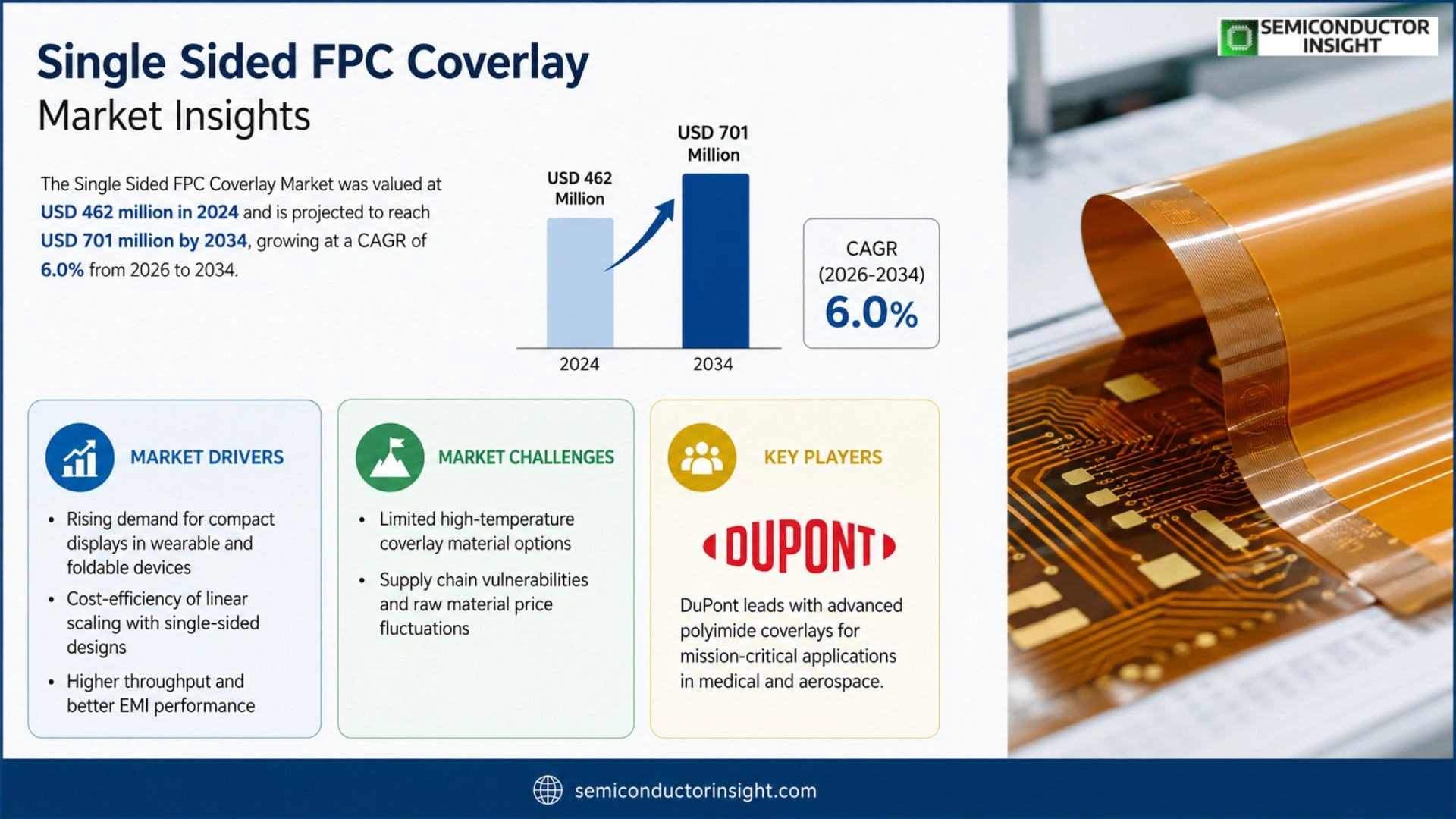
Single Sided FPC Coverlay Market was valued at USD 462 million in 2024 and rose steadily toward USD 701 million by 2034, indicating a compound annual growth rate near 6% over the forecast horizon.
Single‑sided flexible printed circuit (FPC) coverlays are polymer films applied exclusively on one side of a flexible substrate that carries conductive traces fabricated from single‑side copper cladding or rolled copper foil. The cover layer shields circuitry from mechanical abrasion, moisture ingress, thermal shock and solder flux contamination while delivering electrical insulation between adjacent traces. Typically composed of polyimide or other high‑temperature resins, these films endure repeated flexing without loss of integrity,an essential attribute for wearable devices, medical implants, automotive displays and aerospace panels where space constraints demand compact yet robust circuitry.
Adopting advanced coverlays allows manufacturers to embed protection early in the design cycle rather than applying post‑assembly encapsulation methods that extend lead times. Moreover, heightened demand for bendable displays and lightweight electronic assemblies spurs investment in higher‑grade polymers offering superior barrier properties against oxygen and water vapor,critical for ensuring durability under harsh operating conditions.
MARKET DRIVERS
Growing Demand for Compact Displays
Manufacturers increasingly target slimmer form factors for wearable and fold‑able smartphones, pushing the need for thinner flexible printed circuit boards. Single Sided FPC Coverlay solutions are an unavoidable choice, as they combine rigidity and protection while maintaining ultra‑lightweight profiles.
Cost‑Efficiency of Linear Scaling
Adopting a single‑sided approach reduces the number of silicon layers and simplifies lamination, offering a roughly 15% lower CAPEX for manufacturing lines that have already invested in roll‑to‑roll equipment. This economic advantage sustains a steady adoption curve across mid‑tier device makers.
➤ Fewer integration steps translate into higher output throughput, which eases the pressure on component shortages that have plagued the industry.
Finally, the convergence of protective coatings with functional circuitry has made single‑sided coverlays efficient for both static and dynamic dielectrics, allowing manufacturers to meet stringent EMI standards without extra bonding layers.
MARKET CHALLENGES
Limited Protective Coverlay Variants
Few suppliers offer high‑temperature resistant single‑side materials beyond traditional polyimide, restricting deploy‑time options in automotive and avionics arenas where thermal stability exceeds 250 °C.
Other Challenges
Supply Chain Vulnerabilities
Fluctuations in raw‑material prices, particularly for specialty fibrous resins, cause quarterly volatility that can ripple through OEM pricing strategies.
MARKET RESTRAINTS
High Registration Costs for New Materials
Bringing a novel single‑side coverlay onto the market entails rigorous certification against flammability and moisture absorption, driving up pre‑commercialization expenses. Over the last decade, this barrier has kept the CAGR below the projected range for more innovative composite alternatives.
MARKET OPPORTUNITIES
Synergy with 5G Sub‑assemblies
The rollout of 5G base‑band modules demands high‑frequency, low‑loss interconnects. Single‑sided FPC coverlays provide an attractive path for integrating antennas beneath protective layers without compromising signal integrity, opening a niche that could capture a near‑double‑tapped share of the modular circuit segment.
Single Sided FPC Coverlay Market Trends
Rise of High‑Speed Connectivity and Beyond
Since the resurgence of ultra‑compact processors and wearable devices, Single Sided FPC Coverlay Market has evolved beyond a niche component. By integrating a single‑side conductive layer with a protective polyimide film, manufacturers can produce thin, flexible boards that deliver high pin density while maintaining structural integrity. This balance is particularly attractive for automotive infotainment, medical monitoring, and high‑speed data links, where packaging constraints and electromagnetic immunity drive procurement decisions. Remaining focus.
Other Trends
Sustainability and Material Innovation
When manufacturers replace traditional PVC‑based films with bio‑based polyether sulfone blends, they unlock compliance with RoHS2020 and broader regional regulations without compromising mechanical strength. Moreover, the ability to integrate silver‑filled epoxy coatings directly onto the polyimide surface reduces the need for solder paste, lowering both waste and thermal exposure during assembly. Strategic buyers in the medical and aerospace sectors now weigh these green attributes alongside price sensitivity. These material choices also enhance the durability of boards exposed to aggressive sterilization cycles, a critical requirement for implantable diagnostics.
Global Shift Toward Modular Production and Supply Chain Resilience
The rise of modular manufacturing has compelled OEMs to adopt single‑layer FPC coverlays that can be fabricated on standard glass‑fibre reels, bypassing the need for custom laminate baths. This flexibility shortens lead times and lowers inventory risk, as boards can be produced on demand downstream. Coupled with the uneven global supply of copper and exotic substrates, the move toward a single‑sided architecture mitigates exposure to commodity price spikes. Long‑haul logistics are also eased because the thinner skins reduce weight penalties, an advantage that has attracted board‑level stencils used in critical military and aerospace flight‑control systems. As a result, many suppliers have expanded their production capacity in emerging markets to meet the on‑demand demand, further consolidating the supply chain’s resilience. This demand extends beyond OEMs to field service engineers seeking quick turnaround. Well‑integrated supply chains reduce environmental impact by cutting unnecessary material waste globally.
COMPETITIVE LANDSCAPE
Key Industry Players
The single‑sided FPC coverlay segment is dominated by a handful of established manufacturers that have built extensive distribution networks across the Americas, EMEA, and Asia‑Pacific. DuPont, operating through its Advanced Materials division, has leveraged its long‑standing reputation for high‑temperature, high‑purity polyimide films to secure a sizeable share of the premium segment used in medical and aerospace applications. The company’s focus on incremental process optimization,such as precision lamination and automated defect inspection,has kept unit costs below competitors while satisfying stringent performance criteria for power integrity and mechanical resilience. In tandem, Panasonic and Henkel maintain strong positions in the consumer electronics and automotive markets, respectively, by offering flexible coverlays that meet demanding bend radius and environmental qualification standards. These three players collectively account for nearly one‑third of global revenue, reflecting the limited bandwidth of the raw‑material supply chain and the high capital intensity required for equipment upgrades. Recent quarterly releases indicate a steady rise in demand from 5G infrastructure and electric‑vehicle battery management boards, driving these firms to invest further in lightweight, high‑frequency solutions.
Niche specialists, in contrast, fill the lower‑margin and high‑volume portions of the market, tailoring materials for rapid‑turnover consumer projects and emerging industrial applications. Namics, with its nano‑engineered polymer formulations, targets the smart‑phone sector where ultra‑thin, thermally stable coverlays are critical for die‑bonding over inevitable flexing. ITEQ Corporation supplies the semiconductor testing industry, delivering ultra‑low‑mismatch materials that are compatible with state‑of‑the‑art wafer‑level probing. Microcosm Technology focuses on Internet‑of‑Things sensor platforms, providing laminates that combine low dielectric constant with robust chemical resistance for harsh environmental deployments. Arisawa Mfg, Dexerials, and Taiflex each maintain modest market footprints but have successfully differentiated through regional manufacturing hubs that reduce lead times for fast‑turnover consumer projects. Finally, INNOX Advanced Materials and the Taiwanese provider Micro FPC Supply collectively address the industrial automation niche, offering customized surface‑mount solutions that integrate with robotics and precision assembly lines. The collective flexibility of these players ensures that cost‑sensitive projects,often found in 4K UHD displays, medical wearables, and aviation cabin interiors,can rely on a breadth of material choices while upholding compliance and reliability standards.
List of Key Single Sided FPC Coverlay Companies Profiled
- DuPont
- Panasonic
- Henkel
- ITEQ Corporation
- Namics
- Microcosm Technology
- Arisawa Mfg
- Dexerials
- Taiflex
- INNOX Advanced Materials
- Micro FPC Supply
- Hanwha Solutions
Segment Analysis:
| Segment Category | Sub-Segments | Key Insights |
| By Type |
|
Yellow Coverlay is frequently selected for its superior mechanical resilience and high temperature tolerance, providing reliable protection in demanding electronic environments. Its insulating properties safeguard delicate circuitry, while its pliability supports advanced flex designs. The material’s stable performance under thermal cycling makes it the preferred choice among OEMs pursuing durability and reliability in high‑performance devices. |
| By Application |
|
Consumer Mobile Products drives the need for lightweight, flexible, and high‑density circuit solutions that support rapid prototyping and cost‑effective mass production. Coverlays in this segment enhance device slimness while preserving signal integrity, enabling manufacturers to deliver compact, high‑performance wearables and smartphones that meet evolving consumer expectations for design and reliability. |
| By End User |
|
OEMs rely on single‑sided FPC coverlays to streamline supply chains and accelerate time‑to‑market. The capability to integrate protection and insulation in a single layer reduces assembly steps, cuts lead times, and mitigates risks of solder loss or component damage. By integrating coverlays early, OEMs enhance production efficiency and product quality across diverse portfolios. |
| By Functional Requirement |
|
High Flexibility is the top functional driver, as flexible circuits must accommodate bending, twisting, and folding without compromising electrical performance. Coverlays that retain pliability while providing robust mechanical support enable innovative form factors in wearables and automotive sensors, satisfying designers who require extended operational life and resilience under dynamic stress. |
| By Production Method |
|
Roll-to-roll dominates due to its continuous processing capability, which supports high‐volume, cost‑effective production of thin coverlay layers. The method’s adaptability to variable substrate thicknesses and polymers aligns well with diverse end‑use demands, while its scalability and automation potential directly reduce manufacturing cycle time and labor requirements. |
Regional Analysis: Single Sided FPC Coverlay Market
United States
The rising penetration of foldable smartphones and thin laptops escalates the need for single‑sided FPC coverlays that support flexible circuit pathways. Manufacturers gravitate towards surface‑mount designs to reduce assembly height, making coverlays that guarantee consistent dielectric properties a critical differentiator. Additionally, the growing emphasis on lightweight packaging in electric vehicles amplifies demand for resilient, heat‑tolerant coatings.
Recent breakthroughs in nanocomposite polymers and graphene‑enhanced coatings bring lower dielectric loss and higher thermal stability to single‑sided FPC coverlays. Development of shape‑memory polymers that maintain flexibility during temperature cycling is also capturing attention, promising extended component lifespans in harsh environments.
The U.S. arena is marked by rapid consolidation, as mid‑scale suppliers acquire boutique firms to broaden their material portfolios. Lead players sustain market share through vertical integration, combining subscription‑based raw material supply with tailored coating chemistries that reduce lead times for OEMs.
Compliance with RoHS and REACH mandates has prompted a shift toward low‑toxic, high‑melt‑point polymers, eliminating soldering flux residues that compromise flexible circuits. Domestic regulations now prioritize flame retardancy classes, pushing manufacturers to innovate safer formulations without sacrificing electrical performance.
Europe
European players underline a dual focus on sustainable coatings and advanced signal‑integrity solutions. The region’s strong regulatory footing pressures manufacturers to adopt eco‑friendly polymers, fostering an innovation loop that positions European coverlay specialists as preferred partners for high‑end OEMs in automotive and medical sectors. The integration of circular‑economy principles inspires collaborative R&D across SMEs and large firms, resulting in incremental performance gains that feed into the global supply chain.
Asia-Pacific
Asia-Pacific stands as a high‑volume producer, driven by expansive smartphone and wearable device markets. Rapid industrialization fuels a cost‑competitive manufacturing base, yet the fragmentation of supply chains necessitates strategic alliances to secure consistent raw‑material supplies. Kinetic growth in additive manufacturing for PCB components introduces potential synergies for tailored coverlays, nudging the region toward a mix of high‑volume output and niche, high‑lead‑time custom solutions.
South America
South American dynamics hinge on emerging electronics markets in Brazil and Chile, where domestic production of FPC coverlays is gradually shifting from import reliance to local research hubs. Government incentives for technology clusters spur small‑to‑medium enterprises to launch pilot projects in eco‑compatible coatings, creating a gradual but steady uptick in regional export potential.
Middle East & Africa
The Middle East and Africa region is witnessing a nascent but strategically important rise in demand, fueled by giga‑data center projects and a focus on satellite communication systems. Localized production initiatives aim to secure a supply chain for high‑performance single‑sided coverlays, mitigating exposure to geopolitical trade disruptions. While still in early growth, the region’s emphasis on cost‑effective solutions positions it as a potential upswing partner for larger hardware ecosystems.
Report Scope
This market research report provides a comprehensive analysis of the Single Sided FPC Coverlay Market , covering the forecast period 2026–2034. It offers detailed insights into market dynamics, technological advancements, competitive landscape, and key trends shaping the industry.
Key focus areas of the report include:
- Market Overview: The report begins with an overview outlining its current market scenario, key growth indicators, and industry transformation drivers. It discusses macroeconomic factors, demand–supply balance, regulatory landscape, and the strategic role of semiconductors in powering advancements across industries such as automotive, telecommunications, consumer electronics, and industrial automation.
- Market Size & Forecast: Historical data and future projections for revenue, unit shipments, and market value across major regions and segments.
- Segmentation Analysis: Detailed breakdown by product type, technology, application, and end-user industry to identify high-growth segments and investment opportunities.
- Regional Insights: Insights into market performance across North America, Europe, Asia-Pacific, Latin America, and the Middle East & Africa, including country-level analysis where relevant.
- Competitive Landscape: Profiles of leading market participants, including their product offerings, R&D focus, manufacturing capacity, pricing strategies, and recent developments such as mergers, acquisitions, and partnerships.
- Technology Trends & Innovation: Assessment of emerging technologies, integration of AI/IoT, semiconductor design trends, fabrication techniques, and evolving industry standards.
- Market Drivers & Restraints: Evaluation of factors driving market growth along with challenges, supply chain constraints, regulatory issues, and market-entry barriers.
- Stakeholder Insights: Insights for component suppliers, OEMs, system integrators, investors, and policymakers regarding the evolving ecosystem and strategic opportunities.
Primary and secondary research methods are employed, including interviews with industry experts, data from verified sources, and real-time market intelligence to ensure the accuracy and reliability of the insights presented.
FREQUENTLY ASKED QUESTIONS:
What is the current market size of Single Sided FPC Coverlay Market?
-> Single Sided FPC Coverlay Market was valued at USD 462 million in 2024 and is projected to reach USD 701 million by 2031 at a CAGR of 6.3% during the forecast period.
Which key companies operate in Single Sided FPC Coverlay Market?
-> Key players include DuPont, Namics, Henkel, Hanwha Solutions, Dexerials, Taiflex, ITEQ Corporation, Arisawa Mfg, INNOX Advanced Materials, Panasonic, and Microcosm Technology, among others.
What are the key growth drivers?
-> Key growth drivers include increased demand for flexible electronics in consumer mobile products, medical devices, industrial automation, and avionics, coupled with rapid technological advancements in high‑performance polymer film coatings.
Which region dominates the market?
-> Asia-Pacific is the fastest‑growing region, while Europe remains a dominant market.
What are the emerging trends?
-> Emerging trends include high‑performance polyimide films, advanced protective coatings, and the integration of AI/IoT into flexible electronic systems.

Get Sample Report PDF for Exclusive Insights
Report Sample Includes
- Table of Contents
- List of Tables & Figures
- Charts, Research Methodology, and more...
 Download Sample Report PDF