Silicon Carbide (SiC) Power Device Market Insights
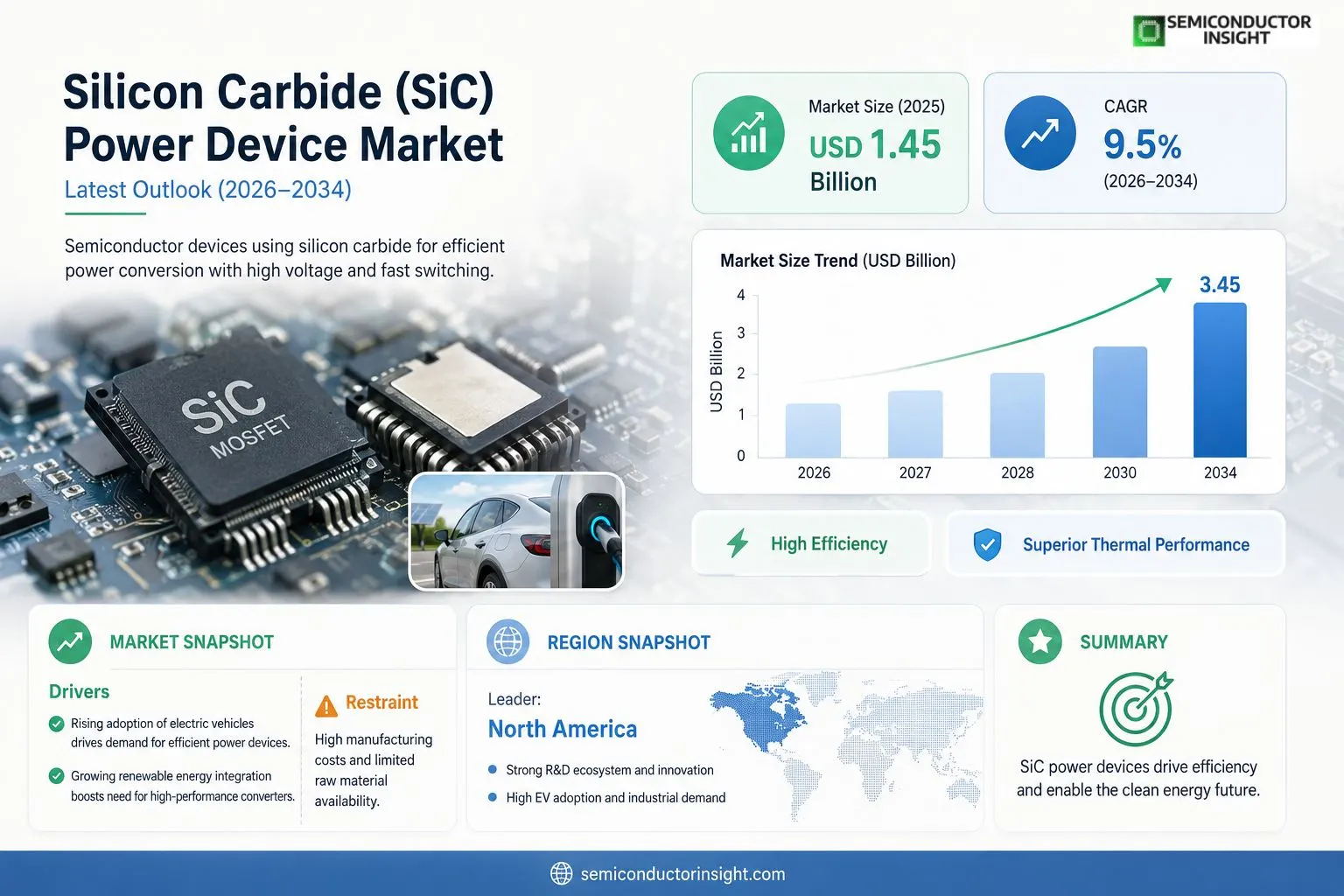
Global Silicon Carbide (SiC) power device market size was valued at USD 1.45 billion in 2025. The market is projected to grow from USD 1.57 billion in 2025 to USD 3.45 billion by 2034, exhibiting a CAGR of 9.5% during the forecast period.
Silicon Carbide (SiC) power devices are semiconductor components that utilize silicon carbide material to enable efficient power conversion and management. These devices include power MOSFETs, Schottky diodes, and insulated gate bipolar transistors (IGBTs), which are widely used in electric vehicles, renewable energy systems, and industrial power supplies. SiC devices offer superior performance in terms of higher voltage tolerance, faster switching speeds, and improved thermal conductivity compared to traditional silicon-based devices.
The market is witnessing significant growth driven by the increasing adoption of electric vehicles and the expanding renewable energy sector. Furthermore, advancements in SiC fabrication technology and growing demand for energy-efficient power electronics are propelling market expansion. However, challenges such as high manufacturing costs and limited availability of raw materials continue to affect widespread adoption. Leading companies are investing heavily in research and development to overcome these barriers and capitalize on the rising demand for SiC power devices across automotive, industrial, and consumer electronics applications.
MARKET DRIVERS
Advancements in Electric Vehicle Technology
The growing adoption of electric vehicles (EVs) is a primary driver for Silicon Carbide (SiC) Power Device Market. SiC devices offer higher efficiency, better thermal management, and improved power density, which are crucial for enhancing EV battery life and driving range. The automotive sector’s shift toward electrification has significantly increased demand for high-performance power devices that contribute to energy savings and emissions reduction.
Rising Demand in Renewable Energy Systems
The integration of renewable energy sources such as solar and wind into power grids requires efficient power conversion solutions. Silicon Carbide power devices provide superior switching performance and lower conduction losses, making them indispensable in inverters and power conditioning systems. This trend positively influences the growth trajectory of the SiC power device market globally.
➤ SiC devices enable higher switching frequencies with reduced energy losses, contributing to overall system reliability and efficiency improvements in power conversion applications.
Furthermore, demand from industrial applications, including smart grids and uninterruptible power supplies (UPS), continues to bolster market growth as these sectors require robust and energy-efficient power semiconductors.
MARKET CHALLENGES
High Manufacturing Costs and Complexity
Manufacturing Silicon Carbide power devices involves complex processes and requires sophisticated equipment, resulting in significantly higher costs compared to traditional silicon-based devices. This cost premium remains a significant challenge for widespread adoption in price-sensitive sectors.
Other Challenges
Material Defects and Yield Issues
The production of high-quality SiC wafers is hindered by defects such as micropipes and dislocations, which negatively impact device yield and performance consistency, leading to increased costs and supply limitations.
Integration with Existing Silicon-based Systems
Compatibility issues and the need for redesigning power electronics architectures to fully utilize SiC device advantages pose additional challenges, slowing the pace of adoption across certain applications.
MARKET RESTRAINTS
Limited Supply Chain and Resource Constraints
Silicon Carbide (SiC) Power Device Market faces restraints from limited availability of raw materials and a constrained supply chain. The sourcing of high-grade SiC substrates and epitaxial layers is limited to a few specialized manufacturers, which affects production scalability and lead times. Additionally, geopolitical factors and trade restrictions can impose further challenges on the supply chain.
MARKET OPPORTUNITIES
Expansion into Emerging Applications
There is a growing opportunity for Silicon Carbide power devices in emerging markets such as 5G telecommunications infrastructure and aerospace applications, where higher power efficiency and reliability are paramount. These sectors are beginning to integrate SiC solutions to enhance performance under demanding operational conditions.Advancements in packaging technologies and the development of cost-effective manufacturing techniques also present opportunities to overcome existing barriers and expand market penetration. Collaborations between semiconductor manufacturers and end-users are fostering innovation to tailor SiC devices for specific industry requirements, driving future growth.
Silicon Carbide (SiC) Power Device Market Trends
Rising Adoption in Electric Vehicles and Renewable Energy
Silicon Carbide (SiC) Power Device Market is experiencing significant growth driven primarily by the increasing adoption of electric vehicles (EVs) and the expanding renewable energy sector. SiC power devices, including MOSFETs, Schottky diodes, and insulated gate bipolar transistors (IGBTs), are preferred for their superior electrical performance. These devices facilitate efficient power conversion and management with enhanced voltage tolerance and faster switching speeds, which are critical for EV drivetrains and solar inverters. Additionally, their improved thermal conductivity supports reliable functioning in high-temperature environments, supporting their growing integration across automotive and energy applications.
Other Trends
Technological Advancements in Fabrication Process
Ongoing advancements in the fabrication technology of Silicon Carbide power devices are enabling manufacturers to produce higher-quality components with improved efficiency and reduced defect rates. These improvements are crucial in addressing some of the traditional challenges related to manufacturing complexities and cost limitations. Enhanced fabrication processes are making SiC devices more accessible to various applications by incrementally lowering production costs and boosting device reliability, thus encouraging broader industry adoption.
Challenges in Raw Material Supply and Cost
Despite the promising growth prospects, Silicon Carbide (SiC) Power Device Market faces challenges related to the high manufacturing costs and limited availability of raw silicon carbide materials. These factors can hinder market expansion by impacting the price competitiveness of SiC-enabled products compared to conventional silicon devices. Manufacturers and industry players are actively investing in research and development to find cost-effective solutions and secure supply chains to mitigate these constraints.
Strategic Investments to Capitalize Market Potential
Leading companies in Silicon Carbide (SiC) Power Device Market are increasingly focusing on strategic research and development investments. These efforts aim to innovate new SiC device designs while optimizing existing products for broader applications, including industrial power supplies, consumer electronics, and electric vehicle components. Such investments are essential to overcoming current technical and economic barriers and tapping into the expanding demand for energy-efficient power electronics across multiple sectors.
COMPETITIVE LANDSCAPE
Key Industry Players
Market Leaders Driving Innovation and Growth in Silicon Carbide (SiC) Power Devices
Silicon Carbide (SiC) Power Device Market is characterized by a mix of large multinational semiconductor companies and specialized firms focusing on SiC technologies. Market leadership is predominantly held by key players such as Wolfspeed (a Cree company), Infineon Technologies, and STMicroelectronics, which have established strong footholds through continuous investments in research and development and the ability to deliver high-performance SiC MOSFETs and Schottky diodes. These companies benefit from extensive manufacturing capabilities and solid customer bases in automotive, industrial, and renewable energy applications, solidifying the market structure around a few dominant players.
In addition to the primary leaders, several niche and emerging players contribute significantly to market dynamics through specialized SiC device offerings and collaborations. Companies like ON Semiconductor, Rohm Semiconductor, II-VI Incorporated, and Mitsubishi Electric focus on expanding their SiC portfolios to cater to rising electric vehicle powertrain demands and grid infrastructure upgrades. Other notable participants include GeneSiC Semiconductor, STMicroelectronics, and Sanken Electric, which further diversify the competitive landscape. Collectively, these companies drive innovation toward improving device efficiency and reducing manufacturing costs, addressing market challenges and fostering broader adoption of SiC power devices.
List of Key Silicon Carbide (SiC) Power Device Companies Profiled
- Wolfspeed (Cree Inc.)
- Infineon Technologies
- STMicroelectronics
- ON Semiconductor
- Rohm Semiconductor
- II-VI Incorporated
- Mitsubishi Electric
- GeneSiC Semiconductor
- Sanken Electric
- Fuji Electric
- Texas Instruments
- Power Integrations
- STATS ChipPAC
- ONEX
- General Electric
Segment Analysis:
| Segment Category | Sub-Segments | Key Insights |
| By Type |
|
Power MOSFETs dominate due to their exceptional switching speeds and efficiency in managing high voltage applications.
|
| By Application |
|
Electric Vehicles lead due to the critical requirement of efficient power management and high thermal robustness.
|
| By End User |
|
Automotive Industry is at the forefront due to the escalating demand for electric and hybrid vehicles.
|
| By Fabrication Technology |
|
Bulk SiC Substrate technology is leading as it facilitates high-quality crystal growth essential for device performance.
|
| By Device Voltage Range |
|
High Voltage Devices segment is crucial, addressing needs of grid infrastructure and heavy industrial equipment.
|
Regional Analysis: North America
North America
North America benefits from rapid advancements in SiC device fabrication processes. Leading firms implement cutting-edge techniques that enhance device reliability, efficiency, and scalability, supporting diverse end-use sectors requiring high-performance power devices.
The shift to electric vehicles and renewable energy sources drives substantial demand for SiC power devices. North American industries focus on integrating these components for improved power conversion and reduced energy losses across applications.
Regulatory frameworks and incentives aimed at sustainability stimulate investments in SiC technology. North America benefits from supportive policies that encourage the adoption of energy-efficient power solutions aligned with climate objectives.
Focused partnerships between manufacturers and research institutions in North America strengthen the supply chain resilience, fostering innovation and ensuring consistent delivery of high-quality SiC power devices.
Europe
Europe is emerging as a significant contender in Silicon Carbide (SiC) Power Device Market with substantial investments in power electronics and semiconductor manufacturing. The region’s commitment to carbon neutrality and the adoption of electrified transportation fuel demand for efficient power devices. Europe’s established automotive industry propels innovation and deployment, incorporating SiC technology in electric vehicles and renewable infrastructure. Collaborative research efforts between academia and industries promote advancements, while regulatory standards enforce energy efficiency practices, further encouraging market growth. Overall, Europe’s progressive approach towards decarbonization and sustainable technology adoption creates a favorable environment for Silicon Carbide power device expansion.
Asia-Pacific
Asia-Pacific remains a vital region in Silicon Carbide (SiC) Power Device Market with rapid industrialization and growing electric vehicle adoption. Countries like China, Japan, and South Korea lead investments in semiconductor research and SiC applications. The expanding solar and wind power markets also contribute to heightened demand for SiC devices in power conversion systems. Despite challenges related to supply chain complexities and manufacturing scale, Asia-Pacific leverages cost advantages and increasing government focus on clean technologies, nurturing continuous growth in this advanced power semiconductor segment.
South America
South America’s Silicon Carbide (SiC) Power Device Market is in the early stages of development but shows promising potential due to rising industrial electrification and renewable energy initiatives. Growing awareness about energy efficiency coupled with government policies promoting green technologies supports gradual adoption of SiC power devices. However, infrastructure limitations and relatively low industrial base moderate rapid expansion. Increasing collaborations with global suppliers and gradual improvements in manufacturing capabilities aim to overcome these challenges, positioning South America as a developing player in this niche semiconductor market.
Middle East & Africa
The Middle East & Africa region presents a niche but promising opportunity for Silicon Carbide (SiC) Power Device Market, driven primarily by rising investments in renewable energy projects and grid modernization. The focus on solar power plants and electrification supports the integration of high-efficiency SiC power devices. Market growth is also influenced by ongoing efforts to diversify economies and reduce fossil fuel dependency. Despite facing challenges linked to technology adoption and market maturity, increased regional collaborations and infrastructure development programs contribute to a gradually expanding demand landscape.
Report Scope
This market research report provides a comprehensive analysis of the Silicon Carbide (SiC) Power Device Market , covering the forecast period 2026–2034. It offers detailed insights into market dynamics, technological advancements, competitive landscape, and key trends shaping the industry.
Key focus areas of the report include:
- Market Overview: The report begins with an overview outlining its current market scenario, key growth indicators, and industry transformation drivers. It discusses macroeconomic factors, demand–supply balance, regulatory landscape, and the strategic role of semiconductors in powering advancements across industries such as automotive, telecommunications, consumer electronics, and industrial automation.
- Market Size & Forecast: Historical data and future projections for revenue, unit shipments, and market value across major regions and segments.
- Segmentation Analysis: Detailed breakdown by product type, technology, application, and end-user industry to identify high-growth segments and investment opportunities.
- Regional Insights: Insights into market performance across North America, Europe, Asia-Pacific, Latin America, and the Middle East & Africa, including country-level analysis where relevant.
- Competitive Landscape: Profiles of leading market participants, including their product offerings, R&D focus, manufacturing capacity, pricing strategies, and recent developments such as mergers, acquisitions, and partnerships.
- Technology Trends & Innovation: Assessment of emerging technologies, integration of AI/IoT, semiconductor design trends, fabrication techniques, and evolving industry standards.
- Market Drivers & Restraints: Evaluation of factors driving market growth along with challenges, supply chain constraints, regulatory issues, and market-entry barriers.
- Stakeholder Insights: Insights for component suppliers, OEMs, system integrators, investors, and policymakers regarding the evolving ecosystem and strategic opportunities.
Primary and secondary research methods are employed, including interviews with industry experts, data from verified sources, and real-time market intelligence to ensure the accuracy and reliability of the insights presented.
FREQUENTLY ASKED QUESTIONS:
What is the current market size of Silicon Carbide (SiC) Power Device Market?
-> Silicon Carbide (SiC) Power Device Market was valued at USD 1.45 billion in 2025 and is expected to reach USD 3.45 billion by 2034.
Which key companies operate in Silicon Carbide (SiC) Power Device Market?
-> Key players include leading semiconductor manufacturers and innovators focused on power electronics for electric vehicles, renewable energy, and industrial applications, among others.
What are the key growth drivers?
-> Key growth drivers include increasing adoption of electric vehicles, expanding renewable energy sector, advancements in SiC fabrication technology, and growing demand for energy-efficient power electronics.
Which region dominates the market?
-> Asia-Pacific is the fastest-growing region, driven by automotive and industrial power electronics industries, while North America and Europe also hold significant market shares.
What are the emerging trends?
-> Emerging trends include improvements in device performance such as higher voltage tolerance, faster switching speeds, and better thermal conductivity, as well as focused R&D efforts to reduce high manufacturing costs and address raw material limitations.

Get Sample Report PDF for Exclusive Insights
Report Sample Includes
- Table of Contents
- List of Tables & Figures
- Charts, Research Methodology, and more...
 Download Sample Report PDF