Semiconductor Microchannel Coolers Market Insights
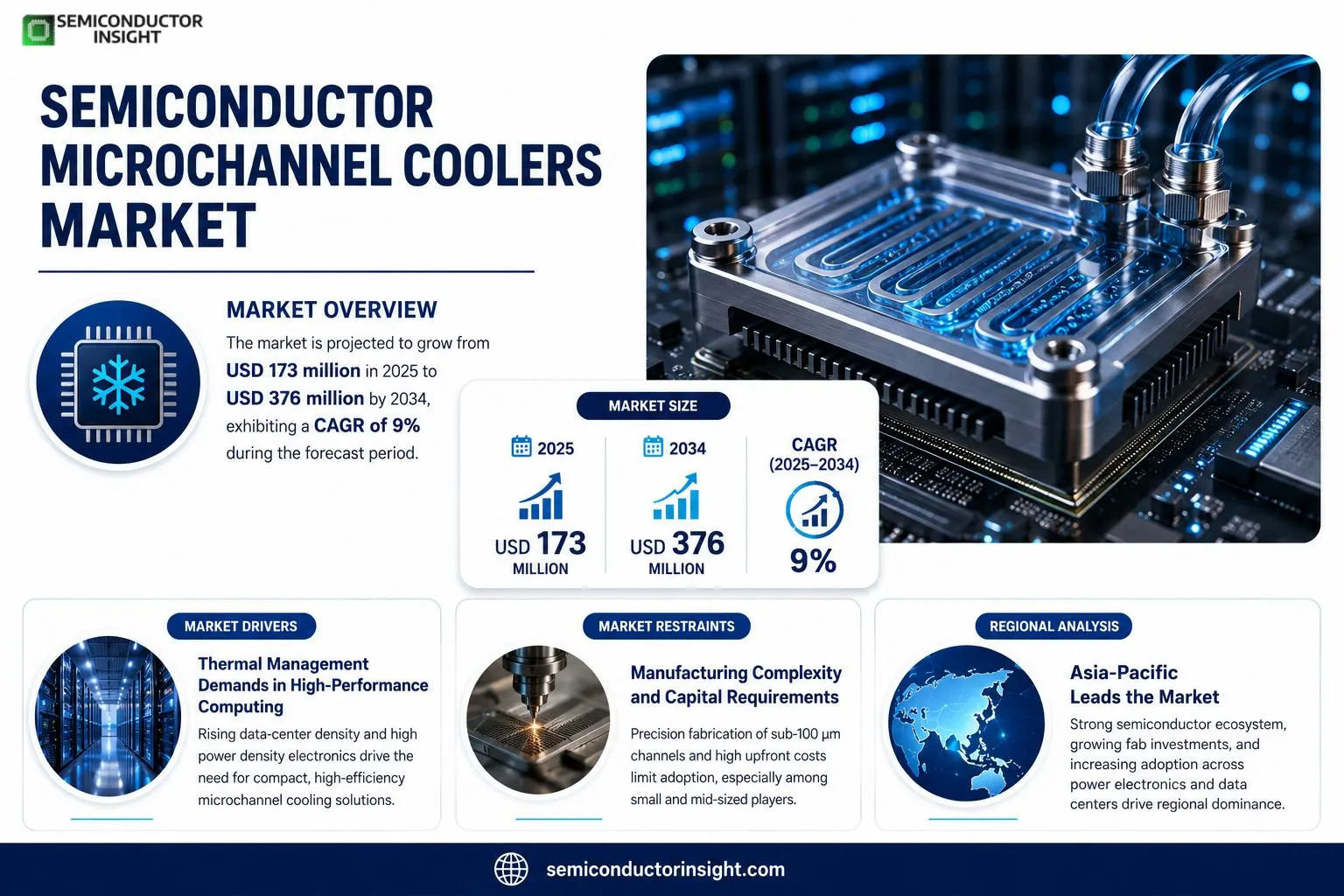
Semiconductor Microchannel Coolers market size was valued at USD 173 million in 2025. The market is projected to grow from USD 173 million in 2025 to USD 376 million by 2034, exhibiting a CAGR of 9 % during the forecast period.
Semiconductor Microchannel Coolers are compact heat‑sink assemblies built on high‑thermal‑conductivity substrates that incorporate densely packed parallel channels typically ranging from tens to hundreds of micrometres in diameter. By permitting coolantoften water or dielectric fluidsto undergo phase change within these channels, they achieve heat‑transfer coefficients far above those possible with conventional single‑phase liquid cooling, making them well suited for high‑power‑density applications such as laser diodes, power‑electronics modules, and advanced optical components.
MARKET DRIVERS
Thermal Management Demands in High‑Performance Computing
The surge in data‑center density has forced equipment designers to confront heat‑removal limits that traditional heat sinks cannot meet. Semiconductor Microchannel Coolers offer a compact pathway for liquid refrigerants, keeping processor junction temperatures within safe margins while preserving form‑factor constraints. This capability is reshaping server architecture decisions, especially in hyperscale facilities where downtime translates directly into revenue loss.
Regulatory Push for Energy Efficiency
Stringent energy‑consumption standards imposed by regional bodies have nudged manufacturers toward solutions that lower power draw of cooling subsystems. By integrating microchannel coolers, OEMs can reduce fan speeds and, consequently, the electrical load of auxiliary components. The ripple effect is a measurable drop in overall PUE (Power Usage Effectiveness), a metric that many corporate sustainability programs now monitor quarterly.
➤ Adoption of microchannel technology has already cut coolant pump power by up to 30 % in several benchmark tests.
Beyond operational savings, the ability to maintain tighter thermal envelopes extends component lifetimes, allowing customers to defer costly refresh cycles. This economic incentive, coupled with the technical merits, fuels a steady increase in procurement across sectors such as aerospace, automotive electrification, and telecom edge devices.
MARKET CHALLENGES
Manufacturing Complexity and Yield Concerns
Fabricating sub‑100 µm channels demands precision lithography and wafer‑level bonding steps that push current semiconductor fabs to their limits. Yield penalties arising from channel blockage or leakage can erode profit margins, especially for early‑stage adopters lacking dedicated process lines.
Other Challenges
Supply‑Chain Vulnerabilities
The reliance on high‑purity silicon and specialty polymers ties the market to a narrow supplier base, making it susceptible to material shortages that have historically disrupted related sectors.
MARKET RESTRAINTS
Capital Expenditure Requirements
Initial outlay for integrating microchannel cooling modules into existing product lines often exceeds the budget thresholds of small‑to‑mid‑size manufacturers. The need for redesigning thermal interfaces, procuring new fitting hardware, and qualifying fluid compatibility compounds the financial hurdle, slowing broader market diffusion.
MARKET OPPORTUNITIES
Emerging Applications in EV Power Electronics
Electric‑vehicle power‑train modules generate heat densities that rival those of high‑performance CPUs. Integrating Semiconductor Microchannel Coolers directly onto inverter substrates presents an untapped avenue for reducing thermal resistance without adding bulk, a proposition that aligns with the automotive industry’s push for lighter, more efficient designs.
Semiconductor Microchannel Coolers Market Trends
Intensifying Thermal Management Demands in High‑Performance Devices
The relentless push for higher transistor densities and clock frequencies in processors, power‑electronics modules, and laser‑based systems is squeezing traditional heat‑sink designs to their limits. Engineers are turning to micro‑channel cooling because it concentrates coolant flow within millimetre‑scale passages, achieving heat‑transfer coefficients that far exceed those of bulk liquid solutions. This architectural shift reduces overall package height, a benefit that aligns with the miniaturisation trends seen across consumer electronics and aerospace‑grade equipment. Moreover, the ability of these channels to support phase‑change boiling creates a self‑regulating thermal buffer, dampening temperature spikes during peak workloads. For manufacturers, adopting this technology translates into longer product lifecycles and lower warranty costs, while end‑users gain reliability gains that are critical for mission‑critical applications.
Other Trends
Material and Manufacturing Innovations
Recent advances in silicon‑carbide and high‑thermal‑conductivity polymer composites are reshaping the cost‑structure of micro‑channel cooler production. Unlike earlier designs that relied on expensive metallic substrates, the newer materials can be micromachined using standard semiconductor fab equipment, enabling higher throughput and tighter tolerances. This convergence of material science and existing wafer‑scale processes lowers entry barriers for smaller suppliers and encourages broader ecosystem participation. In parallel, additive manufacturing techniques are being refined to produce complex three‑dimensional channel networks in a single build step, cutting assembly time and reducing leak‑risk. These production efficiencies are prompting OEMs to integrate cooling solutions earlier in the product development cycle, rather than treating them as afterthoughts.
Geographic Shifts in Adoption Patterns
Asia‑Pacific remains the focal point of demand, driven by aggressive semiconductor expansion plans in China, Japan, and South Korea. However, North America is gaining traction as data‑center operators deploy edge‑computing nodes that require compact, high‑efficiency thermal solutions. European manufacturers are leveraging strict energy‑efficiency regulations to justify the incremental expense of micro‑channel systems, particularly in automotive power‑electronics where thermal resilience directly impacts safety certifications. These regional dynamics are prompting vendors to customise product portfoliosoffering higher‑pressure tolerances for Asian fab lines while emphasising modular, plug‑and‑play designs for Western market segments. The resulting diversification of offerings enhances market resilience and creates opportunities for differentiated value‑added services such as predictive‑maintenance analytics tied to coolant flow monitoring.
COMPETITIVE LANDSCAPE
Key Industry Players
Semiconductor Microchannel Coolers: Competitive Overview
The market is anchored by a handful of firms that have leveraged thin‑film processing and high‑precision etching to deliver compact, high‑performance coolers. Micro Cooling Concepts leads the field, largely because of its early investment in silicon‑based heat‑sink platforms and a supply‑chain model that synchronises with the top‑tier semiconductor fabs. Its product line covers stackable and array configurations, allowing it to address both power‑electronics and laser‑optics segments. The concentration of revenue among the five largest suppliers hovers around forty‑five percent, indicating a competitive yet fragmented structure where specialised niches still provide room for challengers.Beyond the dominant tier, several manufacturers have carved out distinct value propositions. Mikros Technologies distinguishes itself with proprietary ceramic channel arrays that excel under high‑temperature cycling. Stellar Industries focuses on modular designs for automotive power modules, while Rogers supplies custom‑shape micro‑channels for optical communication equipment. Tecnisco’s recent acquisition of a fluid‑dynamics start‑up has expanded its portfolio into additive‑manufactured coolant pathways. Oasis Materials, Advanced Thermal Solutions, CoolTech Labs, ThermoFlow Systems, CryoChip Innovations, NanoCool Corp, HeatX, FlowStar Inc., and QuantumCool are active across the stackable‑type and array‑type segments, each targeting specific regional demand pockets in North America, Europe, and Asia‑Pacific.
List of Key Semiconductor Microchannel Coolers Companies Profiled
- Micro Cooling Concepts
- Mikros Technologies
- Stellar Industries
- Rogers
- Tecnisco
- Oasis Materials
- Advanced Thermal Solutions
- CoolTech Labs
- ThermoFlow Systems
- CryoChip Innovations
- NanoCool Corp
- HeatX
- FlowStar Inc.
- QuantumCool
- HeatWave Technologies
Segment Analysis:
| Segment Category | Sub-Segments | Key Insights |
| By Type |
|
Stackable Type – This architecture is favored for its modularity, allowing manufacturers to tailor cooling capacity to specific power densities while maintaining a compact footprint across diverse semiconductor packages.
|
| By Application |
|
Power Electronics – Power‑electronics modules generate intense localized heat, and microchannel coolers are essential for preserving efficiency and reliability in high‑frequency conversion systems.
|
| By End User |
|
Data Centers – As server densities increase, microchannel coolers provide silent, high‑efficiency heat extraction that directly impacts uptime and equipment lifespan.
|
| By Coolant Medium |
|
Dielectric Fluids – These fluids combine electrical insulation with high thermal conductivity, making them ideal for direct contact cooling of active semiconductor surfaces.
|
| By Integration Approach |
|
Embedded Microchannel – Integrating cooling channels directly into the silicon substrate minimizes thermal resistance and enables rapid response to transient power spikes.
|
Regional Analysis: Semiconductor Microchannel Coolers Market
Asia‑Pacific
A cluster of fabs in Taiwan, South Korea, and China concentrates production volumes, fostering close collaboration between wafer producers and cooling‑technology firms. Proximity reduces lead times for prototype iterations, encouraging rapid refinement of micro‑channel geometries tailored to specific process nodes.
Regional research institutes receive sizable backing for fluidic‑thermal studies, spawning joint ventures that blend academic insight with commercial engineering. This environment accelerates the translation of lab‑scale breakthroughs into manufacturable solutions.
Multinational suppliers have localized inventory hubs, mitigating disruptions that previously plagued cross‑border logistics. A more resilient supply chain heightens confidence among Foundry clients when committing to new cooling architectures.
Government initiatives aimed at securing semiconductor self‑sufficiency incorporate incentives for advanced cooling technologies, reinforcing the business case for early adoption of micro‑channel designs.
North America
North America maintains a strong foothold in the semiconductor micro‑channel cooler space through a blend of mature design houses and venture‑backed start‑ups. The region’s emphasis on performance‑critical applicationsparticularly in defense and autonomous systemspushes manufacturers to seek cooling solutions that can sustain high power densities without compromising reliability. Partnerships between hardware OEMs and specialty fluid‑ics firms are emerging, enabling customized cooling modules that fit within tightly constrained system footprints. Although the market scale trails Asia‑Pacific, the depth of engineering talent and access to premium silicon resources give North America a strategic edge for next‑generation thermal management.
Europe
European semiconductor clusters, especially in Germany and the Netherlands, are integrating micro‑channel cooling into precision equipment for automotive and industrial IoT markets. Regulatory emphasis on energy efficiency drives firms to adopt cooling methods that lower overall system power consumption. Collaborative research programs funded by the European Union link universities with equipment manufacturers, producing design guidelines that standardize micro‑channel implementations across diverse product lines. The region’s cautious pace is offset by a focus on reliability and long‑term lifecycle support, qualities prized by automotive OEMs planning for multi‑year vehicle platforms.
South America
In South America, the market remains nascent, yet growing interest is evident among niche electronics manufacturers targeting consumer devices with premium thermal specifications. Local distributors are beginning to stock micro‑channel cooling kits, reflecting an early adoption mindset driven by cost‑effective alternatives to traditional heat‑sink solutions. While infrastructure constraints limit large‑scale fab activity, the region’s emerging electronics assembly sector provides a testing ground for modular cooling components that can be retrofitted onto existing designs.
Middle East & Africa
The Middle East & Africa region shows sporadic activity, primarily centered around data‑center operators seeking to improve cooling efficiency in hot climates. Strategic investments in renewable‑energy‑powered cooling infrastructure have opened dialogue with micro‑channel technology providers, who can deliver compact, low‑profile solutions compatible with limited space footprints. Although market size is modest, the combination of climate‑driven demand and government‑sponsored technology parks creates a fertile ground for pilot projects that could expand the regional adoption curve.
Report Scope
This market research report provides a comprehensive analysis of the Semiconductor Microchannel Coolers Market , covering the forecast period 2026–2034. It offers detailed insights into market dynamics, technological advancements, competitive landscape, and key trends shaping the industry.
Key focus areas of the report include:
- Market Overview: The report begins with an overview outlining its current market scenario, key growth indicators, and industry transformation drivers. It discusses macroeconomic factors, demand–supply balance, regulatory landscape, and the strategic role of semiconductors in powering advancements across industries such as automotive, telecommunications, consumer electronics, and industrial automation.
- Market Size & Forecast: Historical data and future projections for revenue, unit shipments, and market value across major regions and segments.
- Segmentation Analysis: Detailed breakdown by product type, technology, application, and end-user industry to identify high-growth segments and investment opportunities.
- Regional Insights: Insights into market performance across North America, Europe, Asia-Pacific, Latin America, and the Middle East & Africa, including country-level analysis where relevant.
- Competitive Landscape: Profiles of leading market participants, including their product offerings, R&D focus, manufacturing capacity, pricing strategies, and recent developments such as mergers, acquisitions, and partnerships.
- Technology Trends & Innovation: Assessment of emerging technologies, integration of AI/IoT, semiconductor design trends, fabrication techniques, and evolving industry standards.
- Market Drivers & Restraints: Evaluation of factors driving market growth along with challenges, supply chain constraints, regulatory issues, and market-entry barriers.
- Stakeholder Insights: Insights for component suppliers, OEMs, system integrators, investors, and policymakers regarding the evolving ecosystem and strategic opportunities.
Primary and secondary research methods are employed, including interviews with industry experts, data from verified sources, and real-time market intelligence to ensure the accuracy and reliability of the insights presented.
FREQUENTLY ASKED QUESTIONS:
What is the current market size of Semiconductor Microchannel Coolers Market?
-> Semiconductor Microchannel Coolers Market was valued at USD 159 million in 2024 and is expected to reach USD 291 million by 2031 at a CAGR of 9.2% during the forecast period.
Which key companies operate in Semiconductor Microchannel Coolers Market?
-> Key players include Micro Cooling Concepts, Mikros Technologies, Stellar Industries, Rogers, Tecnisco, and Oasis Materials, among others.
What are the key growth drivers?
-> Key growth drivers include increasing demand for high‑performance cooling in power electronics and laser systems, the rise of IoT‑based devices requiring compact thermal solutions, and the superior heat‑transfer efficiency of phase‑change micro‑channel heat sinks.
Which region dominates the market?
-> Asia-Pacific is a leading region due to its extensive semiconductor manufacturing base and growing adoption of advanced cooling technologies, while Europe also holds significant market share.
What are the emerging trends?
-> Emerging trends include integration of micro‑channel cooling with power electronics, development of lightweight array‑type coolers for laser and optics applications, and exploration of new high‑conductivity substrate materials to further boost heat‑transfer coefficients.

Get Sample Report PDF for Exclusive Insights
Report Sample Includes
- Table of Contents
- List of Tables & Figures
- Charts, Research Methodology, and more...
 Download Sample Report PDF