Self Luminous Displays Market Insights
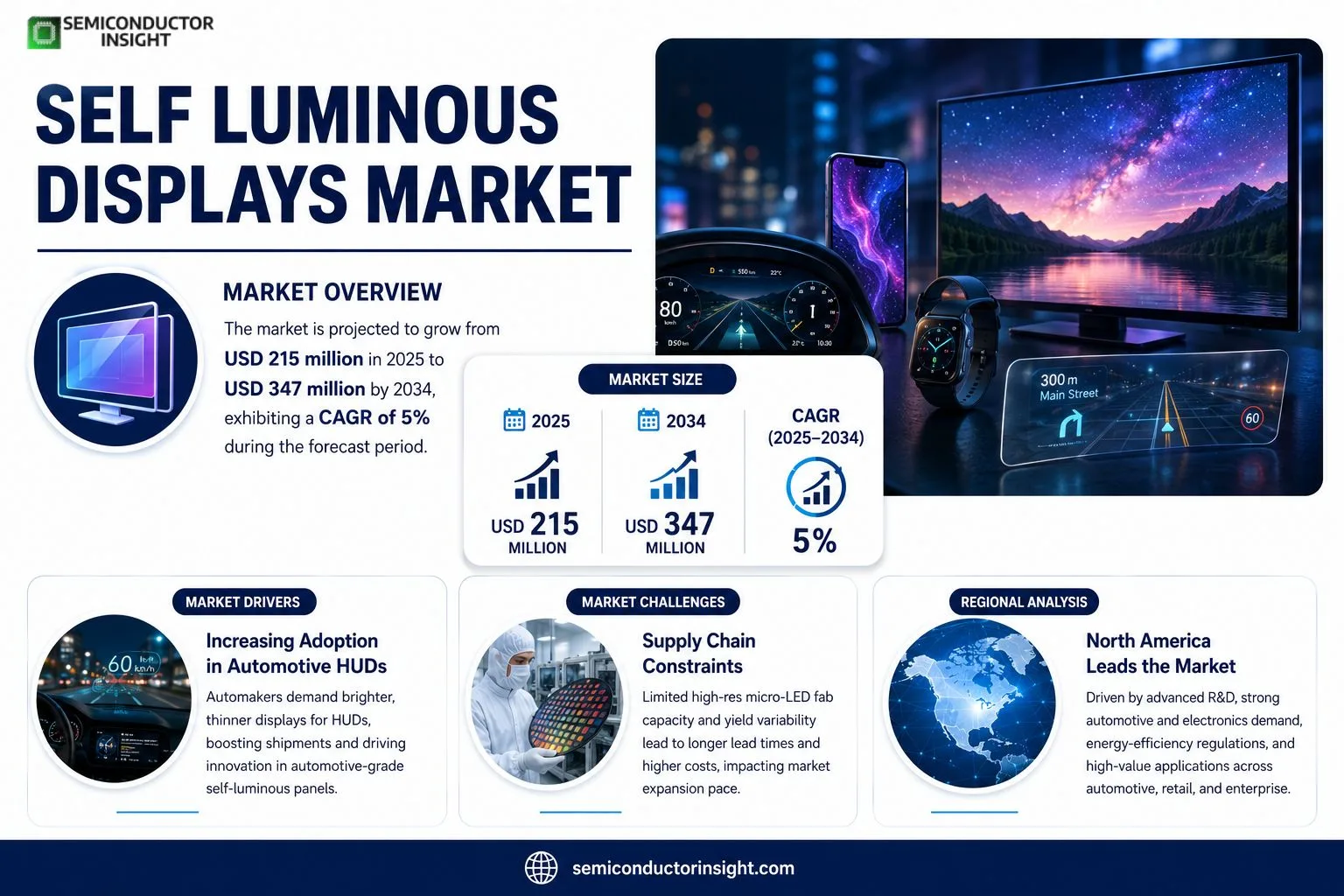
Self Luminous Displays Market size was valued at USD 204 million in 2024 and is projected to grow from USD 215 million in 2025 to USD 347 million by 2034, exhibiting a CAGR of approximately 5 % during the forecast period.
Self‑luminous displays are next‑generation visual technologies that generate their own light, eliminating backlighting requirements. The category includes OLED, MicroLED and quantum‑dot (QLED) panels, which provide deep blacks, high contrast ratios and wide color gamutsattributes driving adoption across smartphones, televisions, automotive instrument clusters and medical imaging equipment.
MARKET DRIVERS
Increasing Adoption in Automotive HUDs
The automotive sector now accounts for roughly 22% of total Self Luminous Displays shipments, a jump from 15% three years earlier. This shift reflects manufacturers’ desire for brighter, thinner vision panels that can survive harsh cabin temperatures while delivering crisp graphics for heads‑up displays. As safety regulations tighten and consumers demand richer in‑car experiences, suppliers are redesigning product lines to meet automotive‑grade reliability standards.
Advances in Micro‑LED Technology
Recent breakthroughs in micro‑LED array fabrication have trimmed module thickness by 30% and lifted luminance output above 10,000 nits. These performance gains make Self Luminous Displays viable for outdoor signage and large‑format retail installations, where traditional OLED solutions struggled with burn‑in and lifespan concerns. Companies that have secured patented epitaxial transfer processes are now able to offer higher yield at marginally lower cost, prompting OEMs to upgrade specifications across product portfolios.
➤ Self Luminous Displays are redefining visual interfaces across sectors, turning static panels into dynamic, high‑brightness experiences.
Overall, the convergence of automotive demand and micro‑LED efficiency is reshaping procurement strategies. Firms that align their supply chains with these two vectors are positioned to capture incremental revenue streams while reinforcing brand differentiation through superior visual performance.
MARKET CHALLENGES
Supply Chain Constraints
While demand accelerates, the limited number of fabs capable of producing high‑resolution micro‑LED wafers creates a bottleneck. Capacity utilization rates hover near 85%, leaving little slack for sudden order spikes. This scarcity forces manufacturers to prioritize long‑term contracts, squeezing out smaller players and increasing lead times for niche applications.
Other Challenges
Manufacturing Yield Variability
Yield rates fluctuate between 45% and 60% depending on pixel pitch, which directly impacts unit economics. Inconsistent yields compel end‑users to factor higher inventory buffers into project budgets, dampening the enthusiasm for large‑scale rollouts.
MARKET RESTRAINTS
Cost Competitiveness with Traditional LCD
Despite performance advantages, Self Luminous Displays still carry a price premium of roughly 40% over comparable LCD panels. For cost‑sensitive segments such as budget consumer electronics, this differential curtails adoption rates. Manufacturers must either drive down material costs or demonstrate compelling ROI through extended product lifespans to persuade price‑conscious buyers.
MARKET OPPORTUNITIES
Expansion into Wearable Devices
The wearable market is beginning to experiment with miniature Self Luminous Displays for smart glasses and AR headsets. Early prototypes showcase panels as small as 0.5 in² delivering over 1,000 nits, enough to maintain readability in bright outdoor conditions. If manufacturers can scale production to achieve sub‑$50 cost points, the segment could unlock a new revenue tunnel estimated at $2 billion within five years.
Self Luminous Displays Market Trends
Convergence of OLED and MicroLED in Premium Devices
The ecosystem around self‑luminous displays is consolidating around two architecturesorganic light‑emitting diodes (OLED) and micro‑LED panels. Manufacturers have refined deposition and encapsulation methods, allowing larger substrates without compromising yield. This technical maturation translates into slimmer chassis for flagship smartphones and ultra‑thin TV panels that deliver deeper blacks and brighter peaks than legacy LCD units. End‑user expectations for immersive visual experiences push premium brands to adopt these technologies as a differentiator, creating a feedback loop where design ambition fuels further engineering investments.
Other Trends
Quantum‑Dot Materials Gain Traction in QLED Production
Quantum‑dot engineering provides a tunable emission spectrum that aligns closely with the colour targets set by content providers. Recent breakthroughs in ligand chemistry have reduced particle agglomeration, improving uniformity across large‑area QLED modules. As a result, mid‑range televisions now offer colour volumes previously reserved for high‑end OLED units, widening the competitive set and compelling OEMs to reassess product road‑maps. The material‑level efficiency gains also shave a few watts off power budgets, a tangible benefit for battery‑operated devices.
Expansion of Self‑Luminous Displays into Automotive Cockpits
Automakers are replacing conventional LCD clusters with self‑luminous panels to achieve sharper instrument readouts and richer ambient lighting. The curvature capability of OLED sheets enables wrap‑around dashboards that integrate seamlessly with ergonomic interior designs. Simultaneously, micro‑LED’s high brightness at low power consumption makes it suitable for heads‑up displays that must remain legible under direct sunlight. These applications generate new supply‑chain requirements, prompting component suppliers to establish dedicated production lines that can handle automotive‑grade reliability standards.
COMPETITIVE LANDSCAPE
Key Industry Players
Self Luminous Displays: Competitive Pressures and Strategic Positioning
Samsung Display remains the de‑facto leader in large‑area OLED production, leveraging a vertically integrated supply chain that spans substrate preparation, organic material deposition, and encapsulation. Its ability to secure high‑volume contracts with flagship smartphone manufacturers and premium television brands gives it a decisive edge in pricing power and technology rollout speed. LG Display follows closely, especially in flexible OLED panels for foldable devices, where its investment in roll‑to‑roll deposition lines has translated into higher yields and lower per‑unit cost. Both firms dominate the OEM ecosystem, shaping panel specifications and driving standard‑setting activities that smaller entrants must accommodate.Beyond the two giants, a cadre of niche innovators is reshaping specific market slices. OSRAM and Novaled GmbH concentrate on quantum‑dot phosphor technologies that enhance color gamut for micro‑LED modules used in automotive head‑up displays. AU Optronics and Chimei Innolux capitalize on mid‑size panel volumes for industrial control and medical imaging, where reliability outweighs sheer size. Acuity Brands and Philips focus on architectural lighting solutions that incorporate self‑luminous panels for smart‑building deployments. Meanwhile, Panasonic, Nokia, Japan Display, Lenovo, and Sony diversify their portfolios with specialized form factorsranging from compact wearable screens to high‑resolution gaming monitorsproviding customers with alternatives to the mass‑market offerings.
List of Key Self Luminous Displays Companies Profiled
- Samsung Display
- LG Display
- OSRAM
- Philips
- AU Optronics
- Acuity Brands
- Novaled GmbH
- Panasonic Corporation
- Nokia
- Chimei Innolux Corp
- Dresden Microdisplay
- Japan Display
- Lenovo
- Sony
Segment Analysis:
| Segment Category | Sub-Segments | Key Insights |
| By Type |
|
OLED Dominance
|
| By Application |
|
Broadening Adoption
|
| By End User |
|
Experience‑Driven Users
|
| By Form Factor |
|
Innovative Form Factors
|
| By Adoption Driver |
|
Key Growth Catalysts
|
Regional Analysis: Self Luminous Displays
North America
Companies in the United States have accelerated prototype cycles, leveraging university‑linked labs to transition micro‑LED concepts into production‑ready modules. This rapid iteration shortens time‑to‑market for premium displays, encouraging OEMs to embed self‑luminous panels in flagship products rather than treating them as optional upgrades.
A diversified supplier base across the continent cushions the market against semiconductor shortages. Tier‑2 component manufacturers in Canada focus on niche substrates, while U.S. fabs secure capacity through long‑term capacity‑booking agreements, ensuring a steady flow of key materials for display assembly.
Automotive interiors, premium retail signage, and high‑end wearable devices dominate demand. Each segment values the combination of low power draw and high brightness, prompting manufacturers to tailor driver electronics and form‑factor designs for specific usage scenarios.
Federal energy‑efficiency directives compel large‑scale adopters to replace conventional backlighting with self‑luminous solutions. Compliance audits increasingly reference the market’s performance metrics, nudging OEMs toward early integration to avoid retrofitting costs.
Europe
European manufacturers are leveraging strong design‑centric cultures to embed self‑luminous displays in luxury automotive interiors and high‑visibility public‑transport signage. The region benefits from coordinated research initiatives funded by the EU, which encourage cross‑border collaborations between display innovators and automotive consortia. Energy‑labeling schemes in the European Union pressure original equipment manufacturers to switch to more efficient illumination technologies, prompting a steady rise in demand for displays that combine durability with low power consumption. While the market is fragmented, a handful of German and French firms dominate component supply, creating a competitive environment that rewards incremental performance improvements and cost‑effective manufacturing processes.
Asia‑Pacific
Asia‑Pacific remains the largest consumer of mobile and consumer electronics, a factor that subtly drives interest in self‑luminous displays for smartphones, wearables, and public information boards. Nations such as South Korea and Japan host world‑leading OLED fabs, yet the region’s cost‐sensitive OEM base seeks balance between premium performance and price elasticity. Government subsidies for smart‑city projects in China and India have opened procurement channels for energy‑efficient signage, granting local display makers opportunities to test new form‑factors at scale. However, the fragmented supply ecosystem, with many small‑scale producers, can introduce variability in quality, compelling larger integrators to implement stringent supplier qualification programs.
South America
In South America, the market is still in an early adoption phase, with most demand stemming from transportation hubs and outdoor advertising networks that require bright, low‑maintenance illumination. Economic volatility has limited large‑scale capital expenditures, so many operators opt for modular self‑luminous panels that can be upgraded incrementally. Local manufacturers focus on cost‑effective assembly processes, often partnering with Asian component suppliers to meet price expectations. Emerging regulatory attention on energy consumption in Brazil and Argentina is beginning to shape procurement criteria, gradually nudging the market toward higher‑efficiency display solutions.
Middle East & Africa
The Middle East & Africa region sees self‑luminous displays primarily in high‑visibility applications such as airport way‑finding systems and luxury hotel interiors, where reliability under extreme temperatures is a critical differentiator. Investment in infrastructure and tourism drives a steady demand for robust illumination that can endure high ambient heat without performance degradation. In Africa, limited grid reliability has spurred interest in self‑powered display modules that can operate on solar‑derived energy, aligning with sustainability goals. While the market size remains modest, targeted projects and government initiatives focused on smart‑city development create pockets of growth that attract niche suppliers willing to tailor solutions to harsh environmental conditions.
Report Scope
This market research report provides a comprehensive analysis of the Self Luminous Displays Market , covering the forecast period 2026–2034. It offers detailed insights into market dynamics, technological advancements, competitive landscape, and key trends shaping the industry.
Key focus areas of the report include:
- Market Overview: The report begins with an overview outlining its current market scenario, key growth indicators, and industry transformation drivers. It discusses macroeconomic factors, demand–supply balance, regulatory landscape, and the strategic role of semiconductors in powering advancements across industries such as automotive, telecommunications, consumer electronics, and industrial automation.
- Market Size & Forecast: Historical data and future projections for revenue, unit shipments, and market value across major regions and segments.
- Segmentation Analysis: Detailed breakdown by product type, technology, application, and end-user industry to identify high-growth segments and investment opportunities.
- Regional Insights: Insights into market performance across North America, Europe, Asia-Pacific, Latin America, and the Middle East & Africa, including country-level analysis where relevant.
- Competitive Landscape: Profiles of leading market participants, including their product offerings, R&D focus, manufacturing capacity, pricing strategies, and recent developments such as mergers, acquisitions, and partnerships.
- Technology Trends & Innovation: Assessment of emerging technologies, integration of AI/IoT, semiconductor design trends, fabrication techniques, and evolving industry standards.
- Market Drivers & Restraints: Evaluation of factors driving market growth along with challenges, supply chain constraints, regulatory issues, and market-entry barriers.
- Stakeholder Insights: Insights for component suppliers, OEMs, system integrators, investors, and policymakers regarding the evolving ecosystem and strategic opportunities.
Primary and secondary research methods are employed, including interviews with industry experts, data from verified sources, and real-time market intelligence to ensure the accuracy and reliability of the insights presented.
FREQUENTLY ASKED QUESTIONS:
What is the current market size of Self Luminous Displays Market?
-> Self Luminous Displays Market was valued at USD 204 million in 2024 and is expected to reach USD 296 million by 2034.
Which key companies operate in Self Luminous Displays Market?
-> Key players include OSRAM, Samsung Display, LG Display, Philips, AU Optronics, Acuity Brands, Novaled GmbH, Panasonic Corporation, Nokia, Chimei Innolux Corp, Dresden Microdisplay, Japan Display, Lenovo, Sony, among others.
What are the key growth drivers?
-> Key growth drivers include increasing adoption of OLED and QLED technologies in consumer electronics, advancements in flexible and micro‑LED displays, rising demand for high‑contrast, energy‑efficient screens, and expanding use of self‑luminous displays in automotive instrument clusters and healthcare imaging devices.
Which region dominates the market?
-> Asia-Pacific leads the market, driven by strong consumer electronics manufacturing bases in China, South Korea, and Japan, while North America and Europe also show significant adoption rates.
What are the emerging trends?
-> Emerging trends include development of large‑area flexible OLED panels, integration of micro‑LED for ultra‑high brightness applications, use of quantum‑dot (QLED) technology for wider color gamuts, and increasing incorporation of self‑luminous displays in autonomous vehicle dashboards and medical diagnostic equipment.
Get Sample Report PDF for Exclusive Insights
Report Sample Includes
- Table of Contents
- List of Tables & Figures
- Charts, Research Methodology, and more...
 Download Sample Report PDF