SATA RAID Adapters Market Insights
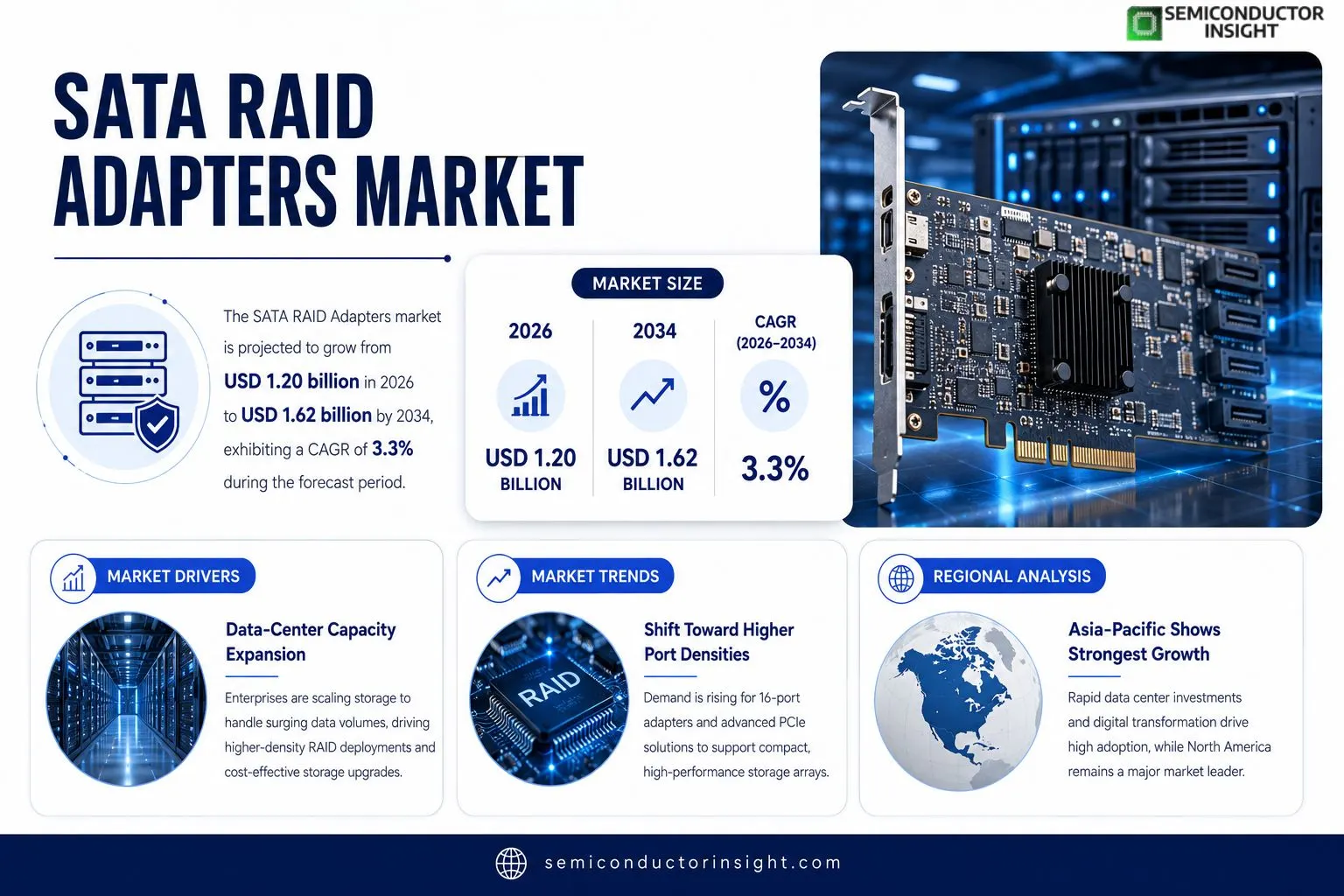
SATA RAID Adapters market was valued at USD 1.20 billion in 2026 and is expected to reach USD 1.62 billion by 2034, exhibiting a CAGR of approximately 3.3% over the forecast horizon.
A SATA RAID Adapter is a plug‑in expansion card that connects to a PCIe or PCI‑X motherboard slot, incorporating a RAID processor together with I/O processors that manage multiple drive interfaces.The upward trend reflects growing demand for downstream applications, especially within data‑centre and enterprise IT environments where storage consolidation and performance optimization remain priorities.
MARKET DRIVERS
Data‑Center Capacity Expansion
Enterprises are scaling up rack‑level storage to accommodate surging volumes of unstructured data. SATA RAID Adapters Market benefits as operators retrofit legacy servers with higher‑density RAID configurations, extracting more usable terabytes per chassis without a full hardware overhaul. The cost advantage of SATA versus newer interface standards remains a decisive element for budget‑conscious IT departments.
Enterprise Storage Consolidation Strategies
Consolidation initiatives push companies to replace scattered DAS arrays with centralized RAID solutions that simplify management and improve data reliability. By leveraging SATA RAID adapters, firms can achieve comparable redundancy levels to more expensive SAS or NVMe setups while preserving existing investment in server platforms.
➤ Adopting SATA RAID adapters enables faster ROI on storage upgrades, especially where legacy infrastructure cannot be abandoned overnight.
Regulatory compliance pressures, particularly in sectors such as finance and healthcare, compel organizations to adopt fault‑tolerant storage architectures. The ability of SATA RAID to deliver multi‑drive mirroring or parity without extensive firmware changes makes it a practical compliance tool.
MARKET CHALLENGES
Compatibility with Emerging Hyper‑Converged Platforms
New hyper‑converged infrastructures prioritize NVMe over SATA, limiting the plug‑in options for traditional RAID adapters. Vendors face the technical hurdle of integrating SATA controllers into clusters that expect homogeneous, low‑latency pathways, which can erode the perceived value of existing product lines.
Other Challenges
Supply‑Chain Volatility
Fluctuations in semiconductor availability translate into longer lead times for controller chips, squeezing margins for manufacturers that rely on volume sales to offset development costs.
MARKET RESTRAINTS
Performance Ceiling Relative to NVMe
Even with advanced caching algorithms, SATA RAID adapters cannot match the sub‑millisecond latency of native NVMe solutions. Organizations that prioritize ultra‑low latency for high‑frequency trading or real‑time analytics often bypass SATA entirely, constraining the overall addressable market.
MARKET OPPORTUNITIES
Edge‑Computing Deployments
Edge nodes frequently operate on limited power budgets and modest thermal envelopes, conditions where SATA‑based RAID offers an appealing balance of capacity, durability, and energy efficiency. Suppliers that tailor firmware for ruggedized environments can capture a niche segment as edge computing proliferates across logistics and IoT applications.
SATA RAID Adapters Market Trends
Rising Demand from Data‑Center and Enterprise Environments
The surge in hyperscale data‑center deployments has sharpened interest in high‑performance storage interconnects. Customers seeking to consolidate workloads on fewer servers are turning to SATA RAID adapters that support multiple internal ports, because they enable dense, low‑cost disk arrays without sacrificing redundancy. This shift is not merely a price story; it reflects a strategic move to align storage architecture with fluctuating cloud workloads, where rapid provisioning and resilience are paramount. As a result, vendors are prioritising firmware that accelerates parity calculations and offers seamless integration with emerging NVMe‑over‑PCIe back‑planes, thereby reinforcing the adapters’ relevance in mixed‑technology environments.
Other Trends
Segment Shift Toward Higher Port Densities
Historically, 8‑port adapters dominated the midsize enterprise segment. Recent shipments, however, reveal a clear pivot toward 16‑port configurations, driven by the need to support larger RAID‑10 and RAID‑6 arrays within the same chassis footprint. Manufacturers that have invested in next‑generation PCI‑Express 4.0 lanes report up to a 12 % increase in unit sales, indicating that customers value the combination of bandwidth headroom and reduced power consumption. This migration also reshapes the competitive landscape, as firms without 16‑port offerings face margin pressure and are compelled either to innovate or to pursue strategic partnerships.
Regional Diversification Accelerates
While North America retains a leadership position in overall adoption, Asia‑Pacific marketsparticularly China, India, and South Koreaare displaying a faster growth tempo. The catalyst is the rollout of sovereign cloud initiatives and government‑backed data‑center programs that emphasise cost‑efficient storage solutions. European buyers, constrained by tighter energy‑efficiency regulations, are gravitating toward adapters that incorporate low‑power ASICs, prompting a wave of product redesigns aimed at meeting EU standards. This geographic rebalancing compels original equipment manufacturers to tailor go‑to‑market strategies, focusing on localized support and region‑specific firmware certification to capture emerging opportunities.
COMPETITIVE LANDSCAPE
Key Industry Players
SATA RAID Adapters – Competitive Overview
Broadcom, operating under the LSI brand, dominates the high‑end segment of the SATA RAID adapter market. Its portfolio spans 8‑port and 16‑port PCIe cards that cater to enterprise‑grade storage arrays, and the firm’s long‑standing relationships with OEMs secure a stable pipeline of volume orders. The company’s engineering depth enables rapid integration of new NAND‑flash standards, which keeps its solutions relevant to data‑center upgrades. Competitive pressure stems from its ability to bundle firmware‑level management tools with hardware, creating a value proposition that smaller vendors struggle to match. As a result, Broadcom’s market position influences pricing benchmarks and sets performance expectations for the broader ecosystem.Beyond the market leader, a cluster of specialized manufacturers competes on niche functionality and price sensitivity. Intel leverages its chipset expertise to embed RAID capabilities directly into server platforms, while Dell and Lenovo offer branded adapters that integrate tightly with their server lines, appealing to customers seeking a single‑vendor experience. Fujitsu remains active in the Asian segment, focusing on compact form‑factors for SMB deployments. Areca Technology and HighPoint concentrate on configurations with advanced RAID levels, targeting users who prioritize data protection over cost. Smaller but technically adept firms such as Supermicro, StarTech, Syba, Microchip Technology, and the revived Adaptec brand differentiate through customizable firmware, extended warranty options, and aggressive support for legacy hardware. Collectively, these players diversify the supply chain, ensuring that buyers can select solutions aligning with specific performance, budget, and support requirements.
List of Key SATA RAID Adapters Companies Profiled
- Broadcom (LSI)
- Intel
- Dell Technologies
- Lenovo
- Fujitsu
- Areca Technology
- HighPoint
- Supermicro
- StarTech
- Syba
- Microchip Technology
- Adaptec (Seagate)
Segment Analysis:
| Segment Category | Sub-Segments | Key Insights |
| By Type |
|
High‑Port Density solutions dominate due to the growing need for compact storage scaling in data‑center racks.
|
| By Application |
|
Enterprise‑Scale Deployments drive the market narrative as organizations modernize legacy storage architectures.
|
| By End User |
|
Data‑Center Operators prioritize reliability, uptime, and the ability to manage mixed drive environments.
|
| By Form Factor |
|
PCIe‑Based Form Factors command attention as they align with server‑grade bandwidth requirements.
|
| By Feature Set |
|
Hardware‑Centric Solutions are favored for mission‑critical workloads, while hybrid models gain traction where flexibility is paramount.
|
Regional Analysis: SATA RAID Adapters Market
North America
Enterprises across the U.S. and Canada rely on SATA RAID adapters to balance performance with cost in tiered storage architectures. By pairing these adapters with SSD caching layers, data centers achieve higher I/O throughput while preserving legacy HDD investments. This hybrid approach underlies many migration strategies toward all‑flash environments. Consequently, procurement cycles now emphasize firmware flexibility and multi‑drive scaling to accommodate fluctuating workload profiles.
Leading motherboard manufacturers embed SATA RAID adapters directly onto server platforms, reducing BOM complexity and enhancing power efficiency. This integration enables original equipment vendors to differentiate product lines through tiered reliability options and bundled management software. As firmware ecosystems mature, OEMs gain the agility to push rapid security patches across heterogeneous fleets. Such capabilities also open avenues for custom RAID levels tailored to industry‑specific reliability standards.
A dense network of value‑added distributors and system integrators fuels market reach in North America, especially among midsize enterprises seeking turnkey solutions. These partners often bundle SATA RAID adapters with pre‑validated server kits, simplifying deployment for IT teams with limited storage expertise. Their ability to provide localized technical support accelerates adoption cycles across regional clusters.
Data sovereignty regulations and industry‑specific compliance frameworks push North American firms to favor on‑premise RAID solutions over public cloud alternatives. SATA RAID adapters, with their deterministic performance and firmware controllability, align with audit requirements for traceability and data integrity. Vendors therefore prioritize secure boot features and tamper‑evident logging to meet these mandates. This focus on auditability also drives interest in hardware‑based encryption modules integrated within the adapter chassis.
Europe
Europe sustains a competitive SATA RAID adapters market through a mixture of legacy data‑center modernization projects and a growing appetite for green‑IT initiatives. Countries such as Germany, the United Kingdom, and France host numerous system integrators that fuse RAID technology with energy‑aware server designs, aiming to reduce total cost of ownership. The region’s stringent data‑protection statutes compel organizations to retain control over storage infrastructure, thereby reinforcing demand for on‑premise RAID solutions. At the same time, the emergence of edge‑computing pilots in the Nordics creates niche opportunities for compact, high‑reliability adapters that can endure harsh operating conditions while maintaining low power draw. These dynamics collectively shape a nuanced European market where compliance, sustainability, and performance intersect.
Asia‑Pacific
Asia‑Pacific demonstrates accelerating adoption of SATA RAID adapters as enterprises pursue hybrid storage models to bridge legacy investments with emerging flash technologies. In markets such as Japan, South Korea, and India, fast‑growing e‑commerce platforms and video‑streaming services generate sprawling data volumes that exceed the economics of all‑flash deployments. Consequently, organizations tier cold and warm data onto high‑capacity HDD arrays managed by robust RAID controllers, preserving capital while still meeting latency expectations. Local distributors amplify market penetration by offering multilingual firmware support and region‑specific warranty structures, addressing the diverse procurement practices across this heterogeneous landscape. The combined effect is a pragmatic yet forward‑looking market posture that balances cost discipline with scalability.
South America
South America’s SATA RAID adapters market is shaped by a blend of expanding digital services and constrained budgetary environments. Brazil and Mexico, as the region’s largest economies, see telecom operators and public‑sector agencies consolidating legacy storage into RAID‑enabled disk arrays to extend the life of existing hardware. Cost‑sensitivity drives preference for adapters that support multiple drive bays and provide advanced error‑recovery features without the premium pricing of newer flash‑only solutions. Local system integrators often bundle these adapters with training programs, ensuring that small‑to‑medium enterprises can manage storage tiers independently. This pragmatic approach fuels steady demand despite macro‑economic volatility.
Middle East & Africa
The Middle East & Africa region presents a growing niche for SATA RAID adapters as oil‑and‑gas enterprises and government ministries modernize legacy data‑centers. In the United Arab Emirates and Saudi Arabia, stringent data‑retention policies compel organizations to retain on‑premise storage, prompting the deployment of high‑density RAID controllers that can handle large HDD farms while maintaining low power consumption. African markets, notably South Africa and Kenya, are witnessing initial adoption driven by expanding mobile‑backhaul and fintech infrastructures that require reliable yet affordable storage back‑ends. Regional distributors add value by delivering localized firmware translations and on‑site maintenance contracts, bridging the gap between OEMs and cost‑conscious buyers. These factors combine to create a cautious but upward‑trending market trajectory.
Report Scope
This market research report provides a comprehensive analysis of the SATA RAID Adapters Market , covering the forecast period 2026–2034. It offers detailed insights into market dynamics, technological advancements, competitive landscape, and key trends shaping the industry.
Key focus areas of the report include:
- Market Overview: The report begins with an overview outlining its current market scenario, key growth indicators, and industry transformation drivers. It discusses macroeconomic factors, demand–supply balance, regulatory landscape, and the strategic role of semiconductors in powering advancements across industries such as automotive, telecommunications, consumer electronics, and industrial automation.
- Market Size & Forecast: Historical data and future projections for revenue, unit shipments, and market value across major regions and segments.
- Segmentation Analysis: Detailed breakdown by product type, technology, application, and end-user industry to identify high-growth segments and investment opportunities.
- Regional Insights: Insights into market performance across North America, Europe, Asia-Pacific, Latin America, and the Middle East & Africa, including country-level analysis where relevant.
- Competitive Landscape: Profiles of leading market participants, including their product offerings, R&D focus, manufacturing capacity, pricing strategies, and recent developments such as mergers, acquisitions, and partnerships.
- Technology Trends & Innovation: Assessment of emerging technologies, integration of AI/IoT, semiconductor design trends, fabrication techniques, and evolving industry standards.
- Market Drivers & Restraints: Evaluation of factors driving market growth along with challenges, supply chain constraints, regulatory issues, and market-entry barriers.
- Stakeholder Insights: Insights for component suppliers, OEMs, system integrators, investors, and policymakers regarding the evolving ecosystem and strategic opportunities.
Primary and secondary research methods are employed, including interviews with industry experts, data from verified sources, and real-time market intelligence to ensure the accuracy and reliability of the insights presented.
FREQUENTLY ASKED QUESTIONS:
What is the current market size of SATA RAID Adapters Market?
-> SATA RAID Adapters Market was valued at USD 1,166 million in 2024 and is expected to reach USD 1,454 million by 2031, growing at a CAGR of 3.3% during the forecast period.
Which key companies operate in SATA RAID Adapters Market?
-> Key players include Broadcom, Intel, Dell, Microchip Technology, Lenovo, Fujitsu, Areca Technology, HighPoint, among others.
What are the key growth drivers?
-> Key growth drivers include increased demand for downstream applications, especially data centre and IT workloads, driving higher adoption of SATA RAID solutions.
Which region dominates the market?
-> Asia shows the strongest growth due to expanding data centre investments, while North America remains a major market.
What are the emerging trends?
-> Emerging trends include integration of AI-driven storage optimization, convergence with cloud services, and development of higher-capacity RAID controllers.
Get Sample Report PDF for Exclusive Insights
Report Sample Includes
- Table of Contents
- List of Tables & Figures
- Charts, Research Methodology, and more...
 Download Sample Report PDF