RF Envelope Tracking (ET) Power Supply IC Market Insights
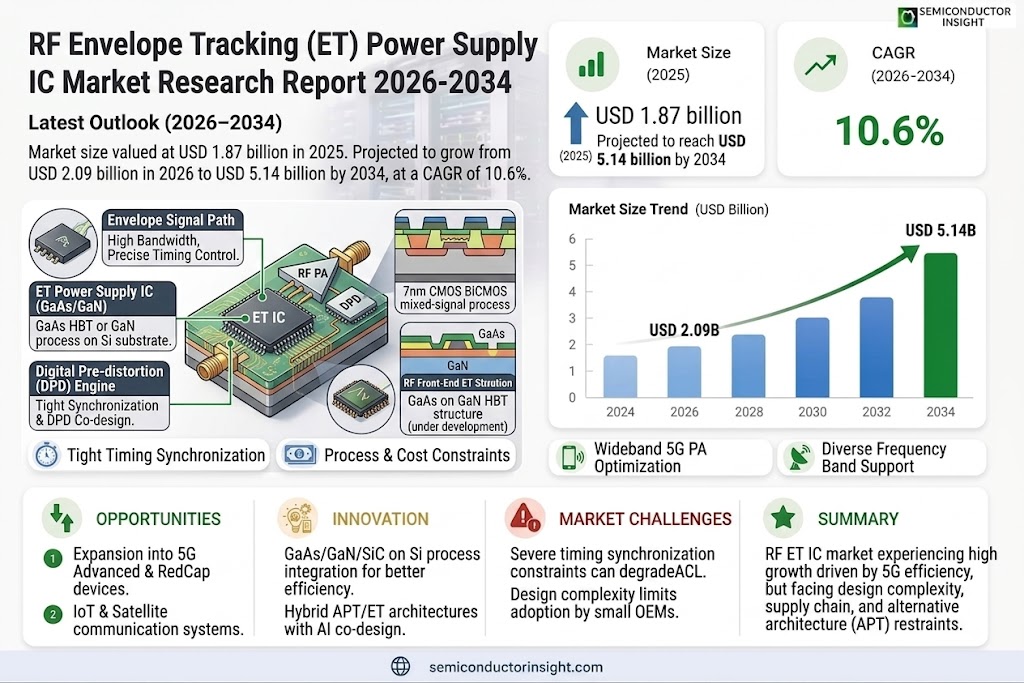
RF Envelope Tracking (ET) Power Supply IC Market size was valued at USD 1.87 billion in 2025. The market is projected to grow from USD 2.09 billion in 2026 to USD 5.14 billion by 2034, exhibiting a CAGR of 10.6% during the forecast period.
RF Envelope Tracking Power Supply ICs are advanced semiconductor devices designed to dynamically adjust the supply voltage of power amplifiers (PAs) in real time, closely tracking the envelope of the transmitted RF signal. This approach significantly improves power amplifier efficiency, reduces heat dissipation, and extends battery life in wireless communication devices. The core components of this technology include envelope modulators, DC-DC converters, linear amplifiers, and multi-mode power management controllers, all of which work in concert to optimize energy delivery across varying signal conditions.
The market is witnessing robust growth driven by the accelerating global rollout of 5G networks, the surging demand for power-efficient smartphones, and the proliferation of high-bandwidth wireless applications. As 5G handsets require power amplifiers capable of handling complex waveforms with high peak-to-average power ratios (PAPR), envelope tracking ICs have become indispensable. Furthermore, strategic initiatives among leading semiconductor companies are reinforcing market momentum. Qualcomm, Samsung Semiconductor, and Qorvo are among the key players operating in this space with comprehensive and competitive product portfolios.
MARKET DRIVERS
Surging Demand for Power-Efficient RF Front-End Solutions in 5G Infrastructure
RF Envelope Tracking (ET) Power Supply IC Market is experiencing robust growth momentum, driven primarily by the rapid global rollout of 5G networks. As mobile network operators accelerate base station deployments and upgrade existing LTE infrastructure to support sub-6 GHz and millimeter-wave (mmWave) frequency bands, the demand for highly efficient power amplifier (PA) supply solutions has intensified. Envelope tracking technology dynamically adjusts the supply voltage to the power amplifier in real time, closely following the instantaneous envelope of the RF signal. This approach significantly reduces wasted power dissipation compared to fixed-supply architectures, making it indispensable in modern 5G radio units where thermal management and energy efficiency are critical design priorities.
Proliferation of Multi-Band, Multi-Mode Smartphones Accelerating ET IC Adoption
Consumer demand for flagship and mid-range smartphones supporting an ever-expanding set of frequency bands and carrier aggregation configurations is a fundamental driver of RF Envelope Tracking (ET) Power Supply IC Market. Modern handsets must operate efficiently across 4G LTE, sub-6 GHz 5G NR, and, increasingly, mmWave bands simultaneously. ET power supply ICs enable smartphone OEMs to achieve longer battery life and reduced heat generation without sacrificing transmit output power or linearity. Leading chipset vendors have integrated advanced ET modulators capable of tracking signal envelopes at bandwidths exceeding 100 MHz, directly addressing the requirements of high-order carrier aggregation and wideband 5G NR deployments in premium devices.
➤ Envelope tracking technology enables power amplifier efficiency improvements of approximately 30–40% compared to conventional average power tracking (APT) methods in 5G handset designs, making it a strategic differentiator for OEMs competing on battery longevity and thermal performance.
Beyond smartphones, RF Envelope Tracking (ET) Power Supply IC Market is benefiting from expanding applications in fixed wireless access (FWA) customer premises equipment (CPE), small cells, and emerging IoT devices requiring efficient RF transmission. The convergence of higher modulation orders such as 256-QAM and 1024-QAM with wide signal bandwidths creates significant peak-to-average power ratio (PAPR) challenges, further reinforcing the technical and commercial case for envelope tracking supply ICs as a standard component in next-generation RF system designs.
MARKET CHALLENGES
Design Complexity and System Integration Barriers Constraining Wider Adoption
Despite compelling efficiency advantages, RF Envelope Tracking (ET) Power Supply IC Market faces meaningful headwinds related to design complexity. Implementing an ET system requires precise co-design and co-optimization between the ET modulator IC, the RF power amplifier, and the associated digital pre-distortion (DPD) engine. Achieving stable, linear operation across wide modulation bandwidths demands tight synchronization between the envelope signal path and the RF signal path, with timing misalignments of even a few nanoseconds capable of degrading adjacent channel leakage ratio (ACLR) performance. This integration challenge increases engineering development time and cost, particularly for smaller OEMs and module vendors that lack dedicated RF systems expertise.
Other Challenges
Semiconductor Process and Cost Constraints
ET power supply ICs must deliver both high switching speed and high current output efficiency simultaneously, requirements that place demanding constraints on the underlying semiconductor process technology. Achieving competitive performance often necessitates advanced CMOS or BiCMOS process nodes, which carry higher fabrication costs. For cost-sensitive mid-range device segments, the bill-of-materials impact of a discrete ET IC can be a deterrent, leading some OEMs to revert to average power tracking or hybrid approaches. Bridging the performance-cost gap remains an ongoing challenge for IC vendors targeting volume market segments RF Envelope Tracking (ET) Power Supply IC Market.
Regulatory and Standards Evolution Uncertainty
Evolving 5G NR standards, including ongoing 3GPP Release updates introducing new frequency ranges, bandwidths, and waveform configurations, create a moving target for ET IC developers. Ensuring forward compatibility with future standards while maintaining design stability for near-term product qualification cycles adds engineering risk. Additionally, regional spectrum allocation variations require ET solutions to support heterogeneous band combinations, complicating chipset qualification and increasing validation workloads for both IC vendors and their OEM customers active RF Envelope Tracking (ET) Power Supply IC Market.
MARKET RESTRAINTS
Competition from Alternative Power Management Architectures Limiting Market Penetration
One of the primary restraints facing RF Envelope Tracking (ET) Power Supply IC Market is the sustained competition from alternative PA supply management techniques, most notably average power tracking (APT) and hybrid ET-APT architectures. APT systems are considerably simpler to implement, require less stringent timing coordination, and carry a lower system cost, making them an attractive option in mid-tier and entry-level smartphone segments. While ET delivers measurably superior efficiency for high-PAPR waveforms, the incremental gain may not justify the added system complexity in devices targeting less demanding spectral efficiency requirements. This cost-benefit calculus continues to moderate the addressable market for pure ET solutions across certain device tiers.
Supply Chain Vulnerabilities and Advanced Node Fabrication Dependencies
RF Envelope Tracking (ET) Power Supply IC Market is exposed to restraints stemming from semiconductor supply chain concentration. ET ICs frequently rely on specialized analog or mixed-signal process nodes available at a limited number of foundries globally. Geopolitical tensions affecting semiconductor manufacturing and export controls on advanced fabrication equipment have introduced supply predictability risks that complicate long-term capacity planning for ET IC vendors. OEM customers, wary of component shortages experienced during recent industry-wide supply disruptions, have in some cases hedged toward architectures with more diversified component sourcing options, creating a structural restraint on ET IC volume commitments in certain procurement cycles within the broader RF Envelope Tracking (ET) Power Supply IC Market.
MARKET OPPORTUNITIES
Expansion into 5G Advanced and RedCap Device Categories Opening New Revenue Streams
The introduction of 5G Advanced (3GPP Release 18 and beyond) and Reduced Capability (RedCap) NR device categories presents a significant growth opportunity for RF Envelope Tracking (ET) Power Supply IC Market. RedCap devices, designed to address industrial IoT, wearables, and mid-tier connected devices with a simplified 5G NR feature set, will nonetheless require efficient PA supply management to meet battery life expectations. As RedCap chipset platforms proliferate, ET IC vendors have the opportunity to develop cost-optimized, narrower-bandwidth envelope tracking solutions specifically architected for this emerging device segment, expanding the addressable market well beyond premium smartphones and into high-volume IoT and industrial wireless categories.
Integration of ET Functionality into System-on-Chip Platforms Driving Next-Generation Design Wins
A strategically important opportunity RF Envelope Tracking (ET) Power Supply IC Market lies in the progressive integration of ET modulator functionality directly into RF front-end module (FEM) SoCs and power management ICs (PMICs). Leading mobile chipset and RF component vendors are actively pursuing tighter monolithic or multi-chip module integration of ET supply functions alongside PA, antenna tuner, and filter components. This integration trend reduces PCB footprint, shortens signal path lengths critical to timing accuracy, and lowers total system cost , collectively addressing key barriers that have historically limited ET adoption in mid-range devices. IC vendors that successfully deliver validated, integrated ET solutions compatible with leading application processor platforms are well positioned to capture substantial design win momentum across the next product cycle Global RF Envelope Tracking (ET) Power Supply IC Market.
The ongoing densification of heterogeneous networks through small cell deployments, combined with growing interest in non-terrestrial network (NTN) applications including low-earth orbit satellite communications, further broadens the long-term addressable opportunity for high-efficiency ET power supply ICs. In NTN terminals and small cell radio units, the combination of stringent size, weight, and power (SWaP) constraints with demanding output power requirements creates a compelling fit for envelope tracking technology, positioning RF Envelope Tracking (ET) Power Supply IC Market for sustained diversification beyond its traditional handset-centric revenue base.
Trends
5G Network Expansion Accelerating Demand for Envelope Tracking Power Supply ICs
RF Envelope Tracking (ET) Power Supply IC Market is experiencing a significant shift driven by the accelerating global rollout of 5G networks. As wireless carriers expand 5G infrastructure across major economies, smartphone manufacturers are increasingly integrating envelope tracking ICs into next-generation handsets to manage the complex waveform demands of 5G communication. Unlike previous wireless generations, 5G signals exhibit high peak-to-average power ratios (PAPR), making dynamic voltage adjustment through envelope tracking technology not merely advantageous but essential. This fundamental requirement is reshaping design priorities across the semiconductor supply chain, prompting leading chipmakers to develop more advanced and efficient envelope tracking solutions tailored specifically for 5G power amplifier architectures.
Other Trends
Power Efficiency and Battery Life Optimization Driving Adoption in Smartphones
A persistent and growing trend withRF Envelope Tracking (ET) Power Supply IC Market is the intensifying focus on power efficiency, particularly in smartphones and other portable wireless devices. Envelope tracking ICs dynamically adjust the supply voltage of power amplifiers in real time, closely following the transmitted RF signal envelope. This approach reduces unnecessary power dissipation and heat generation, directly contributing to extended battery life , a critical differentiator in consumer electronics. As smartphone users demand longer usage cycles without compromising connectivity performance, device manufacturers are prioritizing power amplifier efficiency at the silicon level, strengthening the strategic position of envelope tracking IC suppliers across the value chain.
Strategic Initiatives Among Leading Semiconductor Companies Reinforcing Market Momentum
The competitive landscape of RF Envelope Tracking (ET) Power Supply IC Market is being actively shaped by strategic investments and product portfolio expansions among major semiconductor players. Companies such as Qualcomm, Samsung Semiconductor, and Qorvo maintain comprehensive and competitive envelope tracking product lines designed to meet the evolving requirements of multi-band, multi-mode wireless systems. These organizations are channeling resources into research and development to advance envelope modulator performance, DC-DC converter integration, and multi-mode power management controller capabilities. Such initiatives are accelerating technological innovation and raising performance benchmarks across the broader RF power management semiconductor segment.
Integration of Advanced Components Elevating Envelope Tracking IC Capabilities
Another notable trend shaping RF Envelope Tracking (ET) Power Supply IC Market is the increasing integration of core functional components , including envelope modulators, linear amplifiers, DC-DC converters, and multi-mode power management controllers , within compact, high-performance IC packages. This system-level integration reduces board space, lowers bill-of-materials complexity, and improves overall energy delivery precision across varying signal conditions. As wireless devices evolve toward greater miniaturization and functional density, the ability to consolidate envelope tracking functions within a single optimized IC is emerging as a decisive competitive advantage for semiconductor suppliers serving the global wireless communication market.
COMPETITIVE LANDSCAPE
Key Industry Players
RF Envelope Tracking (ET) Power Supply IC Market: Competitive Dynamics and Strategic Positioning of Leading Semiconductor Companies
Global RF Envelope Tracking (ET) Power Supply IC Market is characterized by a moderately consolidated competitive landscape, with a handful of leading semiconductor companies commanding significant market share. Qualcomm stands out as a dominant force, leveraging its deeply integrated ecosystem of baseband and RF front-end solutions to embed envelope tracking capabilities directly into its Snapdragon platform architectures. Samsung Semiconductor and Qorvo are also prominent players with comprehensive ET IC portfolios targeting 5G handsets and other high-bandwidth wireless applications. These leading companies invest heavily in research and development to address the growing demand for power amplifier efficiency enhancements, particularly as 5G networks proliferate globally and handsets must manage complex waveforms with high peak-to-average power ratios (PAPR). Strategic partnerships, acquisitions, and continuous product innovation remain central competitive strategies across the top tier of this market.
Beyond the market leaders, several specialized semiconductor firms and mixed-signal IC developers occupy significant niches within the RF Envelope Tracking Power Supply IC space. Companies such as Murata Manufacturing, Skyworks Solutions, and Analog Devices have established strong footholds by offering envelope modulators, multi-mode power management controllers, and integrated DC-DC converter solutions tailored for mobile and wireless infrastructure applications. MediaTek and NXP Semiconductors are also recognized participants, addressing envelope tracking requirements within their broader RF and power management product lines. The competitive intensity in this market is expected to remain elevated through the forecast period, as the transition to advanced 5G and future wireless standards continues to drive demand for highly efficient, thermally optimized power supply ICs capable of real-time supply voltage modulation.
List of Key RF Envelope Tracking (ET) Power Supply IC Companies Profiled
- Qualcomm Incorporated
- Samsung Semiconductor
- Qorvo, Inc.
- Skyworks Solutions, Inc.
- Analog Devices, Inc.
- Murata Manufacturing Co., Ltd.
- MediaTek Inc.
- NXP Semiconductors N.V.
- Maxim Integrated (now part of Analog Devices)
- Broadcom Inc.
- Texas Instruments Incorporated
- MACOM Technology Solutions Holdings, Inc.
- Renesas Electronics Corporation
- pSemi Corporation (a Murata Company)
- Richwave Technology Corp.
Segment Analysis:
| Segment Category | Sub-Segments | Key Insights |
| By Type |
|
Multi-Mode ET Power Supply ICs represent the leading segment within this category, driven by the increasing complexity of modern wireless communication standards that demand flexible and adaptive power management solutions.
|
| By Application |
|
Smartphones and Mobile Devices constitute the dominant application segment for RF Envelope Tracking Power Supply ICs, underpinned by relentless consumer demand for devices that balance high-performance connectivity with extended battery longevity.
|
| By End User |
|
Consumer Electronics Manufacturers form the most prominent end-user group in the RF Envelope Tracking Power Supply IC market, reflecting the massive global scale of smartphone and mobile device production and the technology’s central role in enabling power-efficient wireless communication.
|
| By Technology Node |
|
Advanced Process Nodes Below 10nm are emerging as the most strategically significant technology node category as the industry pushes toward greater levels of integration, power efficiency, and signal fidelity in ET IC designs.
|
| By Frequency Band |
|
Sub-6 GHz Band currently leads among frequency band segments, benefiting from its widespread adoption in 5G network deployments and its favorable propagation characteristics that make it the preferred band for broad population coverage and mainstream device compatibility.
|
Regional Analysis: RF Envelope Tracking (ET) Power Supply IC Market
Asia-Pacific
Asia-Pacific’s accelerated 5G network rollout is a defining force shaping demand for RF Envelope Tracking (ET) Power Supply ICs. As carriers across China, South Korea, and India rapidly expand 5G coverage, handset manufacturers are integrating advanced envelope tracking solutions to meet the power efficiency requirements of sophisticated sub-6 GHz and millimeter-wave radio frequency architectures embedded in next-generation devices.
The region benefits from an unparalleled semiconductor manufacturing ecosystem encompassing advanced logic foundries, packaging specialists, and substrate suppliers. Taiwan’s and South Korea’s world-class fabrication facilities enable production of highly miniaturized, power-efficient envelope tracking ICs at scale, providing regional players with significant time-to-market advantages over competitors operating in less integrated manufacturing environments.
Major Asia-Pacific-based OEMs maintain tightly integrated supply chains that accelerate the adoption of RF Envelope Tracking (ET) Power Supply IC innovations directly into mass-market consumer electronics. Close proximity between IC designers, contract manufacturers, and end-product assemblers shortens qualification cycles, enabling faster commercialization of new envelope tracking architectures tailored to evolving 5G radio frequency specifications.
National semiconductor strategies across China, South Korea, Japan, and India are directing substantial public and private investment into advanced IC research and development. These policy-driven initiatives are cultivating indigenous design capabilities for specialized power management technologies, including envelope tracking solutions, positioning Asia-Pacific to sustain its dominant role RF Envelope Tracking (ET) Power Supply IC Market well into the next decade.
North America
North America represents a strategically vital region withRF Envelope Tracking (ET) Power Supply IC Market, anchored by the presence of globally recognized semiconductor design firms and leading wireless chipset developers concentrated primarily in the United States. The region’s strength lies not in high-volume manufacturing but in intellectual property creation, advanced architecture design, and close collaboration with major wireless platform providers. American fabless semiconductor companies have historically pioneered envelope tracking technology, and their continued investment in next-generation RF power management solutions ensures North America retains a critical innovation leadership role. The region’s robust 5G commercialization trajectory, expanding private network deployments, and strong enterprise wireless adoption further sustain demand. Additionally, defense and aerospace applications of RF power management technology provide an important secondary demand driver unique to the North American market landscape during the 2026 to 2034 forecast period.
Europe
Europe occupies a measured but increasingly important position Global RF Envelope Tracking (ET) Power Supply IC Market, characterized by strong automotive and industrial wireless application demand alongside traditional telecommunications infrastructure investment. Nations including Germany, Finland, Sweden, and the Netherlands are home to influential telecommunications equipment manufacturers and RF system integrators whose platform designs specify advanced envelope tracking power supply ICs for improved energy efficiency. Europe’s regulatory emphasis on energy consumption reduction and carbon footprint minimization is creating a favorable policy environment that indirectly supports the adoption of power-efficient RF envelope tracking solutions across both consumer and industrial wireless segments. The region’s active participation in 5G Open RAN architecture development and ongoing investment in connected mobility infrastructure further sustain its relevance withGlobal RF Envelope Tracking (ET) Power Supply IC Market through the forecast horizon.
South America
South America represents an emerging and gradually evolving market within the RF Envelope Tracking (ET) Power Supply IC landscape, with growth momentum closely tied to the pace of 5G network rollout and smartphone penetration across the region’s major economies. Brazil serves as the primary market hub, benefiting from a sizeable mobile subscriber base and growing operator investment in upgrading network infrastructure to support next-generation wireless standards. While South America currently relies heavily on imported RF semiconductor components, increasing interest from global handset brands in capturing value-tier 5G device market share is gradually pulling demand for envelope tracking power supply ICs into the regional supply chain. Economic stabilization and expanding digital infrastructure investment across Colombia, Chile, and Argentina are expected to contribute incrementally to market growth during the 2026 to 2034 forecast period.
Middle East & Africa
The Middle East and Africa region presents a long-term growth opportunity for RF Envelope Tracking (ET) Power Supply IC Market, underpinned by accelerating telecommunications infrastructure modernization and a young, mobile-first consumer population driving robust demand for affordable 5G-capable handsets. Gulf Cooperation Council nations, particularly Saudi Arabia and the United Arab Emirates, are investing heavily in smart city and advanced connectivity initiatives that require high-performance RF power management solutions. Africa’s leapfrog adoption of mobile connectivity, bypassing legacy fixed-line infrastructure in favor of direct cellular and broadband wireless deployment, introduces new demand vectors for energy-efficient envelope tracking ICs embedded in cost-optimized mobile devices. While the region currently accounts for a modest share of overall market revenue, its strategic telecommunications expansion plans and growing integration into global handset distribution networks position it as a meaningful contributor to RF Envelope Tracking (ET) Power Supply IC Market over the coming forecast years.
Report Scope
This market research report provides a comprehensive analysis of the RF Envelope Tracking (ET) Power Supply IC Market , covering the forecast period 2026–2034. It offers detailed insights into market dynamics, technological advancements, competitive landscape, and key trends shaping the industry.
Key focus areas of the report include:
- Market Overview: The report begins with an overview outlining its current market scenario, key growth indicators, and industry transformation drivers. It discusses macroeconomic factors, demand–supply balance, regulatory landscape, and the strategic role of semiconductors in powering advancements across industries such as automotive, telecommunications, consumer electronics, and industrial automation.
- Market Size & Forecast: Historical data and future projections for revenue, unit shipments, and market value across major regions and segments.
- Segmentation Analysis: Detailed breakdown by product type, technology, application, and end-user industry to identify high-growth segments and investment opportunities.
- Regional Insights: Insights into market performance across North America, Europe, Asia-Pacific, Latin America, and the Middle East & Africa, including country-level analysis where relevant.
- Competitive Landscape: Profiles of leading market participants, including their product offerings, R&D focus, manufacturing capacity, pricing strategies, and recent developments such as mergers, acquisitions, and partnerships.
- Technology Trends & Innovation: Assessment of emerging technologies, integration of AI/IoT, semiconductor design trends, fabrication techniques, and evolving industry standards.
- Market Drivers & Restraints: Evaluation of factors driving market growth along with challenges, supply chain constraints, regulatory issues, and market-entry barriers.
- Stakeholder Insights: Insights for component suppliers, OEMs, system integrators, investors, and policymakers regarding the evolving ecosystem and strategic opportunities.
Primary and secondary research methods are employed, including interviews with industry experts, data from verified sources, and real-time market intelligence to ensure the accuracy and reliability of the insights presented.
FREQUENTLY ASKED QUESTIONS:
What is the current market size of RF Envelope Tracking (ET) Power Supply IC Market?
-> RF Envelope Tracking (ET) Power Supply IC Market was valued at USD 1.87 billion in 2025 and is expected to reach USD 5.14 billion by 2034, growing at a CAGR of 10.6% during the forecast period from 2026 to 2034.
Which key companies operate RF Envelope Tracking (ET) Power Supply IC Market?
-> Key players include Qualcomm, Samsung Semiconductor, and Qorvo, among others, all of which operate in this space with comprehensive and competitive product portfolios.
What are the key growth drivers?
-> Key growth drivers include the accelerating global rollout of 5G networks, surging demand for power-efficient smartphones, and the proliferation of high-bandwidth wireless applications. The need for power amplifiers capable of handling complex waveforms with high peak-to-average power ratios (PAPR) in 5G handsets has made envelope tracking ICs indispensable.
Which region dominates the market?
-> Asia-Pacific is the fastest-growing region, driven by rapid 5G network deployments and large-scale smartphone manufacturing, while North America remains a significant market due to strong semiconductor industry presence and early 5G adoption.
What are the emerging trends?
-> Emerging trends include dynamic voltage adjustment technologies, advanced multi-mode power management controllers, integration of envelope modulators and DC-DC converters, and the development of next-generation ET ICs optimized for 5G and beyond wireless communication standards.

Get Sample Report PDF for Exclusive Insights
Report Sample Includes
- Table of Contents
- List of Tables & Figures
- Charts, Research Methodology, and more...
 Download Sample Report PDF