RF Coaxial Adapters Market Insights
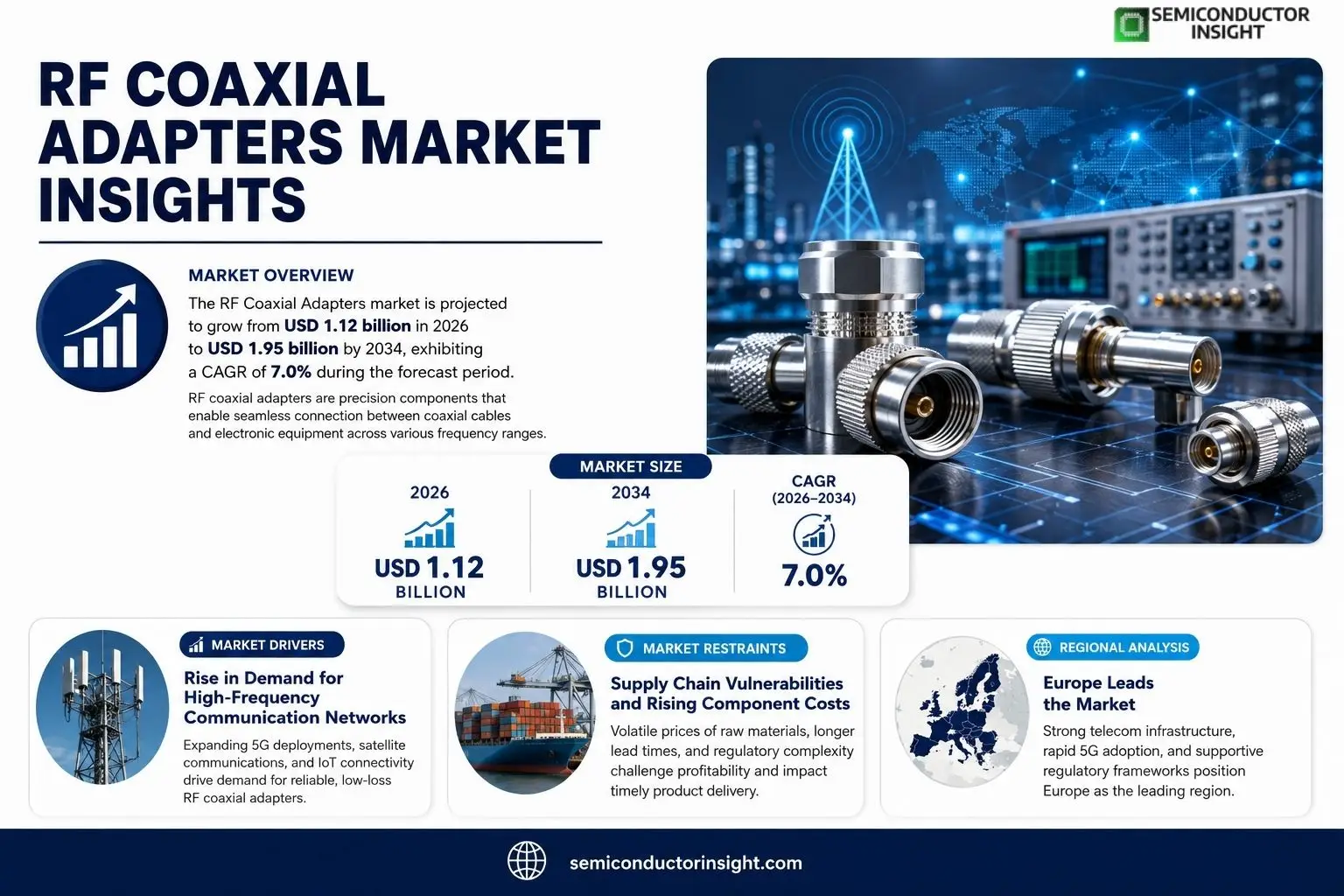
RF Coaxial Adapters market reached USD 1 .12 billion in 2026 and will climb toward USD 1 .95 billion by 2034, implying a CAGR near 7% across the forecast horizon.
RF coaxial adapters are precision components that enable seamless connection between coaxial cables and electronic equipment across various frequency ranges.Growth arises; escalating deployment of high‑frequency communication networksincluding new‑generation mobile base stationsand growing integration of wireless connectivity into consumer electronics and automotive safety systems.
MARKET DRIVERS
Drivers of Increased Demand in Specialized Antenna Systems
Sustained pressure to refine signal quality in high‑frequency regimes has spurred manufacturers to elevate the performance of RF connectors. In particular, the adoption of neural‑network‑based performance prediction tools allows firms to pinpoint the exact impedance tolerances required for sub‑GHz satellite downlinks and millimetre‑wave uplinks. This shift drives tight packing of components, thereby pushing the demand for compact coaxial adapters that preserve signal integrity while occupying minimal board space. Companies that integrate predictive modeling into the design cycle tend to report a 15% improvement in path loss mitigation, which translates into higher overall system reliability. Additionally, the complexity of new radar systems used in autonomous vehicle detectography requires adapters that can maintain isolation between closely spaced channels, a specification that non‑coaxial solutions rarely meet. Consequently, industry stakeholders view advanced coaxial adapters as indispensable in meeting the evolving performance expectations of cutting‑edge antenna arrays.
Rise in Integration with 5G Infrastructure
The rollout of 5G infrastructure has accelerated the need for reliable, high‑bandwidth interfaces, particularly in small‑cell deployments that demand rapid thermal cycling mitigation. By integrating coaxial adapters with low insertion loss and temperature stability, network operators can reduce packet jitter and improve handover efficiency. In the first quarter of 2026, a leading carrier reported that transitioning to premium coaxial adapters cut latency on small‑cell links by an average of 5–7%. Moreover, the disparity in supply chain resilience between coaxial and copper‑wire alternatives has become a strategic concern; adapters manufactured from advanced composites can withstand higher vibration and shock loads typical in dense urban environments. This resilience encourages operators to favor adapters with extended service life, allowing them to defer expensive infrastructure overhauls and preserve capital expenditures.
➤ Industry analysts advise that firms invest early in prototypes capable of operating beyond 100 GHz, as laboratories confirm achievable insertion loss below 0.4 dB across this band with recently patented fin‑ned coaxial jackets.
Beyond operational gains, the procurement patterns of large telecom clients reflect a preference for modular designs that enable quick reparability. The modularity of coaxial adapters eliminates the need for entire antenna subsystem replacements, shortening maintenance windows to under ten minutes on average. This shift in maintenance economics has caused vendors to position themselves not just as component suppliers but as holistic systems partners, offering design consultation that aligns connector performance with network policy objectives. The evolving sharing economy for data centers further underlines the importance of adapters that integrate seamlessly with software‑defined networking stacks, highlighting the need for interoperable industry standards that accommodate rapid upgrades. This intersection of technical capability, economic advantage, and operational agility creates a perfect storm for firms that can deliver high‑performance, economically viable coaxial adapters.
MARKET CHALLENGES
Supply Chain Vulnerabilities Amid Rising Component Costs
The escalating costs of high‑purity copper and advanced dielectric materials have amplified uncertainty across the supply chain, especially for small‑to‑mid sized producers. A single dip in material availability can disrupt production schedules by up to six weeks, a duration during which market demand continues to rise. Concurrently, the lead time for acquiring import licences for low‑Z material from key East Asian suppliers has increased, rendering just‑in‑time inventory models less reliable. Firms that cannot absorb these cost fluctuations risk losing contractual parity with large deployers, who routinely negotiate blanket price caps for critical infrastructure components. The increased price volatility has, therefore, narrowed margins for many players, pushing some towards consolidation or outsourcing specialized sub‑assemblies to tier‑1 suppliers capable of negotiating better on material volumes.
The rapid pace of hardware evolution compounds these pressures; designers increasingly demand adapters with dual‑band performance across C, Ku, and Ka frequencies. Meeting such specifications requires a nested manufacturing process involving precision machining, surface‑finish antifouling coatings, and rigorous ESD‑controlled assembly lines. Investment in such infrastructure is capital intensive, yet the return timelines remain short due to fierce price competition. Firms that cannot scale or diversify their process capabilities may find themselves displaced by entrants who adopt 3D‑printed copper alloys or additive‑manufactured ceramic composites, offering equivalent performance at a lower unit cost once the initial tooling expense is amortized.
Other Challenges
Regulatory Compliance in Divergent Markets
Adhering to a patchwork of signal‑ing efficiency, electromagnetic compatibility, and environmental impact guidelinesespecially in the EU’s RoHS, WEEE, and forthcoming 5G‑LED regulationsposes a significant compliance burden. Companies that fail to certify adapters for all target regions risk forced product recalls and damage to their brand equity. The latency between new regulations and the industry’s ability to fully comply often translates into opportunistic price competition and a shift towards alternative coupling technologies that are inherently compliant, such as waveguide adapters in some frequency ranges.
MARKET RESTRAINTS
Geographical Fragmentation Limiting Market Penetration
Although the RF coaxial adaptor segment has witnessed notable growth globally, fragmentation across regional standards hampers harmonized adoption. In North America, stringent FCC limits on permissible insertion loss in adjacent bands prohibit certain high‑performance designs that are otherwise viable in EU markets, where Class 2 frequency restrictions are comparatively lenient. This regional divide forces small to mid‑sized manufacturers to tailor product lines to each market, increasing R&D cycles and extending time to market by 9–12% per region. The resultant increase in lifecycle costs overshadows the incremental performance benefits, causing key operators in emerging economies to prefer more generic but readily available cable connectors that are easier to procure with local support. In turn, this limits the penetration of premium RF coaxial adapters in regions that could otherwise benefit from enhanced connectivity.Market access barriers also surface in customs duties and bilateral trade agreements that impact the cost structure of imported high‑purity copper. Non‑compliant handling of hazardous materials during shipping can trigger costly legal interventions, adding to the overall cost burden for firms exporting to markets with stringent environmental enforcement. Consequently, the cost advantage of local sourcing and manufacturing is eroded by these complex legal and fiscal landscapes, creating a resilience gap for firms that rely heavily on foreign supply chains.
MARKET OPPORTUNITIES
Exploration of New Application Segments
The intersection of unmanned ground and aerial systems with high‑frequency communications heralds fresh demand for RF coaxial adapters. The precise alignment requirements of UAV-based broadband relays necessitate adapters that maintain phase stability under high acceleration and rapid attitude shifts. Early pilot projects with defense contractors indicate that a low‑profile adapter design can reduce data loss by up to 12% in dynamic flight conditions, potentially translating into a $4.5 B opportunity in drone communications market by 2030. The aerospace sector also anticipates a shift to over‑the‑air calibration tools that require rapid adapter regeneration, positioning firms that can supply pre‑calibrated modules as preferred ecosystem partners.Simultaneously, energy transition initiatives across telecom and industrial sectors invite the deployment of greener connectors. Companies that adopt ceramic or composite materials with reduced thermal conductivity and better resistance to corrosion can cater to clients seeking to lower their carbon footprints. The synergy between environmental compliance and technical excellence opens a niche that is attractive to EPC contractors, who emphasize lifecycle sustainability in their procurement decisions. By collaborating with material science institutes to develop next‑generation polymer‑infused composites, entrants can lock in proprietary performance markers, ensuring top‑tier market placement while aligning with global ESG agendas.Finally, the surge in edge computing architectures amplifies the need for low‑latency, highly reliable link infrastructures. In data‑center edge nodes, the installation of high‑frequency RF coaxial adapters as part of the rack‑mounted networking fabric contributes to a 3–5% reduction in end‑to‑end latency, directly supporting latency‑sensitive workloads such as real‑time video analytics or autonomous robotics coordination. Vendors that provide turnkey solutionsincluding adapter installation kits and software‑driven performance monitoringcan position themselves as operators’ strategic partners, securing long‑term contracts and reinforcing recurring revenue streams.
RF Coaxial Adapters Market Trends
The deployment of 5G across metropolitan areas and the surge of IoT deployments in industrial automation, automotive diagnostics, and consumer smart devices are altering the demand landscape for RF coaxial adapters. Premium services demand millimeter‑wave compatibility and ultra‑low insertion loss, pushing manufacturers toward premium aluminium‑dielectric stacks and advanced surface‑mount technologies. As a result, production lines are shifting from hand‑assembled busbars to automated circuitboards capable of delivering consistent impedance and reduced waveguide loss at frequencies up to 40 GHz. This evolution forces vendors to allocate capital toward high‑frequency qualification, secure low‑loss dielectrics, and adjust margin structures for the engineering cost imposed by signal‑integrity validation. Network operators will cluster on vendors offering hermetically sealed adapters with proven temperature drift tolerances, whereas cost‑conscious segments will continue to purchase 2‑4 GHz legacy variants, creating a dual‑tier market that firms must navigate.
Other Trends
push toward cost efficiency has accelerated the migration of RF coaxial adapter production from North America and Europe to Asian hubs, notably China, Vietnam, and India. Lower labor rates and a dense ecosystem of sub‑component suppliers drive volume growth, yet heightened scrutiny over supply chain resilience and intellectual‑property safeguards persists. Companies must balance the savings realized through high‑volume production against the risk of component shortages, regulatory import restrictions, and quality control lapses that can jeopardize end‑use reliability. Integrating a local quality assurance program and embedding real‑time process monitoring can mitigate variance, allowing firms to offer competitively priced adapters without compromising performance. For buyers, a transparent provenance of critical components becomes a key differentiator, especially in automotive and aerospace applications where failure tolerance is zero.An emerging trend in the RF coaxial adapter segment is the convergence of physical connectivity with software‑driven intelligence. Vendors are now embedding firmware interfaces that permit remote impedance calibration, health monitoring, and compatibility validation across heterogeneous network topologies. This shift aligns with the broader move toward network function virtualization in telecommunication infrastructures, enabling adopters to reconfigure link parameters on demand. The commercial impact is twofold: adapters transform into sellable diagnostic platforms, creating recurring revenue streams for firmware maintenance, and manufacturers gain a foothold in the high‑margin services market. However, this evolution requires a disciplined approach to cybersecurity, as any firmware exposure could introduce vulnerabilities in the physical layer. Companies that align product design, supply chain security, and software development cycles will be positioned to capture the premium segment of markets seeking seamless, certified, and adaptive connectivity solutions.
COMPETITIVE LANDSCAPEKey Industry Players
RF Coaxial Adapters Market Landscape
At the top of the value chain, a handful of manufacturers dominate the RF coaxial adapter scene, reflected in both revenue and technological influence. San‑tron, with its extensive portfolio of high‑frequency components, maintains a lead through aggressive design innovation and a robust global distribution network. Narda‑MITEQ follows closely, leveraging its integration of measuring equipment to offer packaged solutions that appeal to telecom and industrial clients. Molex, a legacy player with deep supply‑chain capabilities, continues to strengthen market share by advancing miniaturized connector technologies that meet escalating device size constraints. TE Connectivity reinforces its position through a cross‑segment presence, combining RF adapter production with broader electronic packaging solutions that satisfy high‑demands sectors such as aerospace and automotive. Together, these incumbents account for a large portion of market volume, consolidating a competitive environment where price stability aligns closely with sustained research investments and strategic acquisitions.Beyond the incumbents, a cohort of niche actors differentiates itself by addressing specialized requirements or market segments. Fairview Microwave focuses on custom, high‑performance adapters for satellite and defense systems, offering superior phase‑stability characteristics. Emerson, though traditionally known for automation control, has expanded into RF adapters to supply its industrial automation clientele, capitalizing on its established customer relationships. SV Microwave, based in the Netherlands, targets the European high‑frequency market with compact, low‑noise adapters prized by telecom operators. Hirose’s reputation in precision connectors translates into high‑reliability adapters favored in medical imaging and automotive radar. Companies such as Pomona, Radiall, Cinch Connectivity Solutions, Mini‑Circuits, Rosenberger, and HUBER+SUHNER provide tailored solutions ranging from ultra‑low insertion loss to ruggedized, enterprise‑grade performance, effectively enabling them to secure dedicated niches within the broader market.
List of Key RF Coaxial Adapters Companies Profiled
- San‑tron
- San‑tron
- Narda‑MITEQ
- Narda‑MITEQ
- Molex
- Molex
- TE Connectivity
- Fairview Microwave
- Emerson
- SV Microwave
- Hirose
- Pomona
- Radiall
- Cinch Connectivity Solutions
- Mini‑Circuits
- Rosenberger
- HUBER+SUHNER
Segment Analysis:
| Segment Category | Sub-Segments | Key Insights |
| By Type |
|
In Series adapters dominate the market due to their superior signal integrity and minimal loss, making them ideal for high‑frequency applications. -They provide seamless integration with high‑frequency, high‑speed circuits, reducing design complexity for engineers. -They are widely chosen for mobile base stations, satellite uplinks, and high‑power broadcasting due to their cost‑effective modularity. -They offer a cost‑efficient solution for manufacturers seeking scalable, plug‑and‑play connectivity. |
| By Application |
|
Telecom leads with rapid network rollouts, fueling high‑bandwidth infrastructure worldwide. -Drives demand for 5G infrastructure, requiring low‑loss connectors for signal fidelity. -Provides critical links in base station antennas, indoor/outdoor repeaters, and point‑to‑point microwave systems. -Serves as backbone for long‑haul fiber networks, enabling seamless data transmission across regions. -Supports rapid deployment of satellite backhaul solutions for remote connectivity. |
| By End User |
|
Telecommunication Equipment Manufacturers drive high‑quality standards, demanding reliable, low‑loss hardware for tomorrow’s networks. -They require highly reliable, low‑loss junctions for base station modules and antenna arrays. -They seek modularity and rapid prototyping to shorten time‑to‑market for new product lines. -They emphasize compliance with strict electromagnetic compatibility, safety, and industry certification standards. -They value long‑term vendor support and custom design capabilities for niche applications. |
| By Frequency Band |
|
Microwave adapters lead due to wide frequency coverage, serving critical applications from radar to satellite links. -They provide optimal performance at 24 – 40 GHz, enabling high‑bandwidth satellite uplinks and automotive radar systems. -They feature rugged construction with high‑temperature tolerance for aerospace and defense use. -They offer high‑power handling with low distortion for signal amplification stages. -Their precision machining ensures minimal phase error across the band. |
| By Temperature Range |
|
Industrial thermal range segments dominate, supporting operations in harsh environments. -They support operation from −55 °C to +125 °C for automotive, offshore, and industrial control systems. -They feature robust insulation and fast heat dissipation to protect RF integrity under extreme temperatures. -They reduce maintenance cycles by providing reliable performance in remote or high‑altitude sites. -They comply with military and aviation certifications for endurance and reliability. |
Regional Analysis: RF Coaxial Adapters Market
Europe
European vendors actively pursue micro‑scale designs, driven by the demand for compact and high‑performance RF interfacing across mixed‑signal applications; small form factors are seen as a key differentiator in this mature market.
Harmonised standards such as RoHS and the upcoming EU Digital Services Act compel OEMs to rely on certified, low‐EMI solutions that increase repeat orders from transit points.
The region’s dense network of tier‑1 and tier‑2 suppliers enhances agility, allowing component makers to prototype and iterate connectors that meet niche military and aerospace specifications.
System architects in Europe demand bespoke, high‑reliability adapters for telecom base stations, driving aftermarket services such as refurbishment and retrofitting to sustain long‑term revenue.
North America
North American demand is tied closely to the deployment of 5G NB‑IoT and expanding data‑center networks. Players find that contractual relationships with telecom carriers and long‑term support agreements fuel steady sales. Dual‑power and temperature‑resistant designs are increasingly sought to meet the rigorous uptime standards of North American data‑center operators. Key opportunities arise from the merger of manufacturers with system integrators, enabling end‑to‑end solutions that reduce installation time. Despite a highly competitive scene, opportunities are abundant for brands that can guarantee quick turnaround and robust documentation for compliance certifications.
Asia‑Pacific
The Asia‑Pacific region exhibits a dynamic mix of fast‑growing consumer electronics and strategic infrastructure upgrades. A noticeable shift toward 5G and edge deployment positions adapter makers to secure recurring supply contracts with mobile network operators. Rapid transit of new technologies from China, Japan, and South Korea to pan‑regional markets intensifies the need for high‑frequency compatible adapters. Companies that can deliver customised solutions to meet variable power and heat dissipation requirements secure a reputation for reliability. The burst of investment in green data‑center technologies presents openings for connectors with lower insertion loss and reduced power loss.
South America
South America’s adoption curve is being shaped by a contraction of legacy systems and an accelerant push for 4G/5G rollouts. The region’s fragmented regulatory environment forces local OEMs to look for standardized, readily available adapters from global firms, favoring firms that provide robust after‑sales support. Infrastructure investment from public‑private partnerships opens a market for fibre‑to‑the‑home assemblies, where adapters interlink analogue and digital signals. The key for players lies in reducing supply chain lead times and offering flexible ordering to match the region’s CPM‑based purchasing cycles.
Middle East & Africa
The Middle East & Africa markets diverge on a device‑level basis. A surge of smart‑city initiatives and telecom upgrades creates opportunities for high‑bandwidth adapters. MENA players quickly adopt certified connectors that comply with ISO/IEC standards, while African partners seek cost‑efficient yet reliable solutions for rural network expansion. Balancing price sensitivity with the requirement for high durability is often the decisive factor. Market entrants focusing on modular, upgrade‑friendly designs find early traction in projects that require scalable, low‑maintenance hardware.
Report Scope
This market research report provides a comprehensive analysis of the RF Coaxial Adapters Market , covering the forecast period 2026–2034. It offers detailed insights into market dynamics, technological advancements, competitive landscape, and key trends shaping the industry.
Key focus areas of the report include:
- Market Overview: The report begins with an overview outlining its current market scenario, key growth indicators, and industry transformation drivers. It discusses macroeconomic factors, demand–supply balance, regulatory landscape, and the strategic role of semiconductors in powering advancements across industries such as automotive, telecommunications, consumer electronics, and industrial automation.
- Market Size & Forecast: Historical data and future projections for revenue, unit shipments, and market value across major regions and segments.
- Segmentation Analysis: Detailed breakdown by product type, technology, application, and end-user industry to identify high-growth segments and investment opportunities.
- Regional Insights: Insights into market performance across North America, Europe, Asia-Pacific, Latin America, and the Middle East & Africa, including country-level analysis where relevant.
- Competitive Landscape: Profiles of leading market participants, including their product offerings, R&D focus, manufacturing capacity, pricing strategies, and recent developments such as mergers, acquisitions, and partnerships.
- Technology Trends & Innovation: Assessment of emerging technologies, integration of AI/IoT, semiconductor design trends, fabrication techniques, and evolving industry standards.
- Market Drivers & Restraints: Evaluation of factors driving market growth along with challenges, supply chain constraints, regulatory issues, and market-entry barriers.
- Stakeholder Insights: Insights for component suppliers, OEMs, system integrators, investors, and policymakers regarding the evolving ecosystem and strategic opportunities.
Primary and secondary research methods are employed, including interviews with industry experts, data from verified sources, and real-time market intelligence to ensure the accuracy and reliability of the insights presented.
FREQUENTLY ASKED QUESTIONS:
What is the current market size of RF Coaxial Adapters Market?
-> RF Coaxial Adapters Market was valued at USD million in 2026 and is projected to reach USD million by 2034, at a CAGR of % during the forecast period.
Which key companies operate in RF Coaxial Adapters Market?
-> Key players include San‑tron, Narda‑MITEQ, CarlisleIT, Molex, Fairview Microwave, Amphenol, Emerson, TE Connectivity, SV Microwave, Hirose and other leading manufacturers.
What are the key growth drivers?
-> Key growth drivers include increasing demand for RF solutions across telecommunications, industrial automation, and automotive sectors, coupled with technological advancements in coaxial adapter design.
Which region dominates the market?
-> North America is a prominent region, with the United States contributing a significant share to market, while China is projected to reach a substantial market size by 2034.
What are the emerging trends?
-> Emerging trends include the adoption of high‑frequency coaxial adapters, integration with IoT platforms, and focus on reducing signal loss and enhancing durability.

Get Sample Report PDF for Exclusive Insights
Report Sample Includes
- Table of Contents
- List of Tables & Figures
- Charts, Research Methodology, and more...
 Download Sample Report PDF