Retinal Implant (Stimulator) ASIC Market Insights
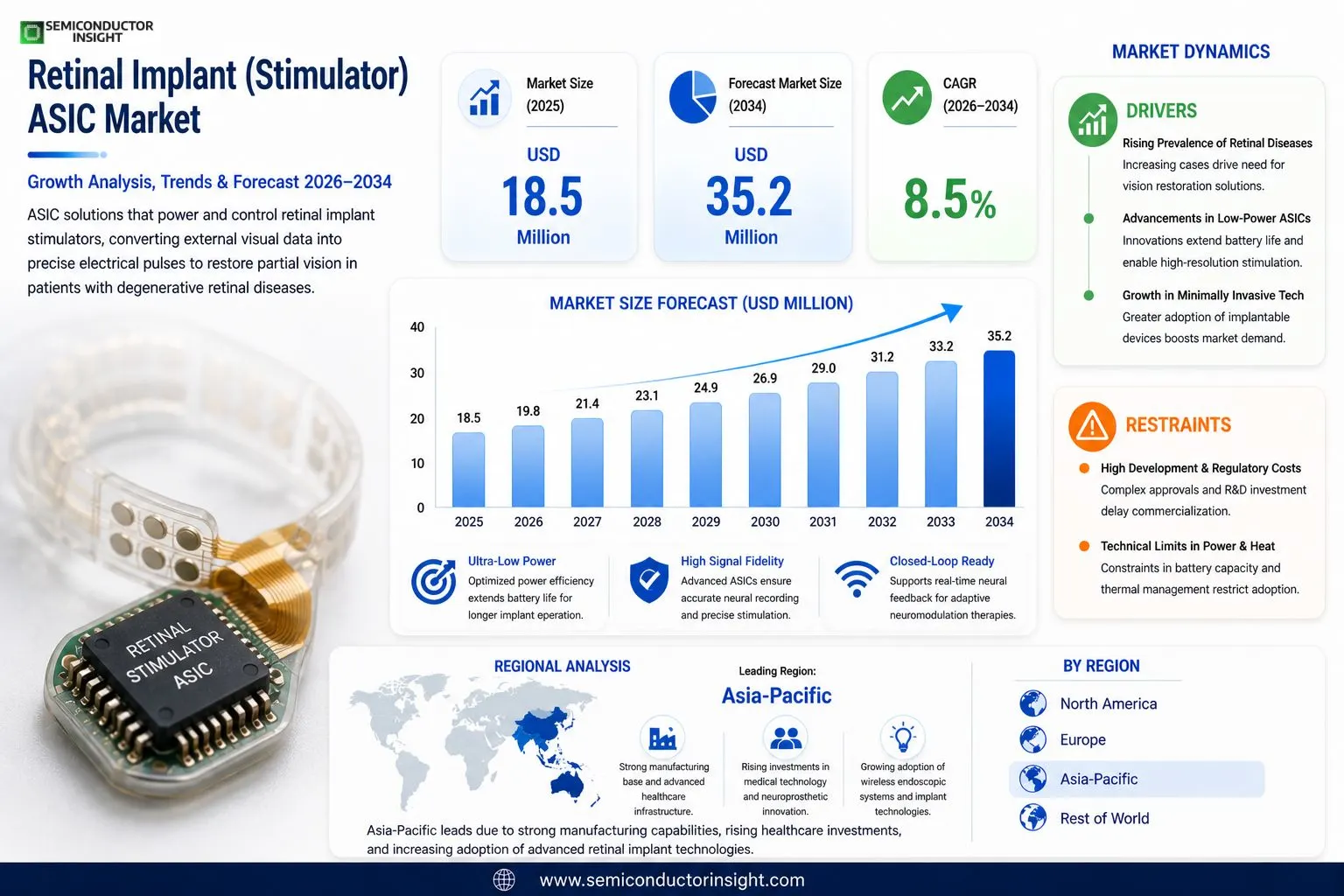
The global retinal implant (stimulator) ASIC market size was valued at USD 18.5 million in 2025. The market is projected to grow from USD 19.8 million in 2026 to USD 35.2 million by 2034, exhibiting a CAGR of 8.5% during the forecast period.
Retinal implant (stimulator) ASICs are specialized application-specific integrated circuits designed to power and control the stimulation electronics within retinal prostheses. These microchips manage the conversion of external visual data into precise electrical pulses that stimulate surviving retinal neurons, enabling partial restoration of functional vision for patients with severe degenerative retinal conditions such as retinitis pigmentosa and advanced age-related macular degeneration.
The market is experiencing steady growth due to several factors, including rising prevalence of retinal degenerative diseases among aging populations, continuous advancements in microelectronics and wireless power delivery systems, and increasing clinical validation of vision restoration outcomes. Furthermore, the demand for higher-resolution stimulation with lower power consumption drives innovation in ASIC design, as these components are critical for miniaturization, biocompatibility, and long-term implant reliability. While challenges remain around surgical complexity and patient selection, ongoing technological refinements are expanding accessibility. For instance, recent progress in photovoltaic subretinal systems has demonstrated meaningful improvements in visual acuity, allowing patients to perform daily tasks such as reading letters and recognizing objects. Key players advancing solutions in this space include organizations focused on next-generation neuroprosthetic technologies with integrated ASIC platforms to support enhanced image processing and efficient neural stimulation.
MARKET DRIVERS
Rising Prevalence of Retinal Degenerative Diseases
Retinal Implant (Stimulator) ASIC Market is primarily driven by the increasing incidence of conditions such as retinitis pigmentosa and age-related macular degeneration, which cause profound vision loss and create demand for advanced prosthetic solutions. These devices rely on sophisticated application-specific integrated circuits to deliver precise electrical stimulation to surviving retinal cells, enabling partial restoration of functional vision. Growing elderly populations worldwide further amplify the need for such neurostimulator technologies.
Technological Advancements in Neurostimulation ASICs
Continuous innovation in low-power, high-density ASIC design has significantly enhanced the performance of retinal implants. Modern stimulator ASICs support hundreds of electrodes with improved wireless data and power transmission, allowing for more natural visual perception. Integration of advanced signal processing capabilities within these custom chips helps optimize stimulation patterns, contributing to better patient outcomes and broader clinical adoption.
➤ Emerging wireless and photovoltaic approaches in retinal prostheses reduce reliance on bulky external components, improving patient comfort and device longevity through efficient ASIC architectures.
Supportive regulatory pathways, including breakthrough device designations, are accelerating development timelines for next-generation retinal stimulator systems that incorporate highly configurable ASICs tailored for implantable use.
MARKET CHALLENGES
Technical Limitations in Resolution and Longevity
Developing high-resolution Retinal Implant (Stimulator) ASIC solutions faces hurdles in achieving sufficient electrode density and reliable long-term performance within the constrained space of the eye. Power management, heat dissipation, and hermetic sealing remain critical engineering challenges that impact device durability and visual acuity outcomes for patients.
Other Challenges
High Development and Manufacturing Costs
The specialized nature of custom ASICs for retinal stimulation drives elevated R&D expenses, limiting the pace of iteration and scaling for many developers in this niche market.
Surgical and Clinical Adoption Barriers
Complex implantation procedures require highly skilled surgeons, while variable patient responses to electrical stimulation create inconsistencies in real-world efficacy, slowing mainstream acceptance of retinal implant technologies.
MARKET RESTRAINTS
Regulatory and Reimbursement Hurdles
Stringent regulatory requirements for Class III implantable devices, combined with lengthy approval processes, continue to restrain faster commercialization of new Retinal Implant (Stimulator) ASIC platforms. Reimbursement coverage remains limited in many regions, restricting patient access despite clinical potential.
High Device Costs and Limited Accessibility
The premium pricing associated with advanced ASIC-enabled retinal implants poses a significant barrier, particularly in emerging markets. Production complexities for miniaturized, biocompatible stimulator chips contribute to elevated costs that challenge widespread adoption beyond specialized centers.
MARKET OPPORTUNITIES
Advancements in AI and Wireless Integration
Retinal Implant (Stimulator) ASIC Market presents substantial opportunities through deeper integration of artificial intelligence for real-time image processing and adaptive stimulation algorithms. Next-generation ASICs capable of supporting photovoltaic or laser-powered systems could eliminate external hardware dependencies, expanding the addressable patient population.
Expansion into Emerging Markets and New Indications
Increasing investment in neuroprosthetics, alongside growing healthcare infrastructure in Asia-Pacific regions, offers pathways for market expansion. Potential applications beyond retinitis pigmentosa, such as in advanced diabetic retinopathy cases, combined with ongoing improvements in ASIC miniaturization and electrode density, position the sector for accelerated growth in the coming years.
Trends
Advancements Shaping High‑Precision Retinal Stimulation
Retinal Implant (Stimulator) ASIC Market continues to progress as developers refine microelectronic architectures that support more precise neural stimulation for degenerative retinal conditions. Growth is primarily influenced by increasing prevalence of disorders such as retinitis pigmentosa and advanced age-related macular degeneration, where vision loss is driven by photoreceptor degeneration while key retinal neurons remain receptive to targeted electrical activation. Improvements in ASIC efficiency directly support more stable power management, reduced thermal output, and enhanced signal fidelity,critical factors that contribute to long-term implant safety and reliable functional vision outcomes. With clinical data increasingly demonstrating the feasibility of restoring limited visual perception through retinal prostheses, demand for higher‑resolution, low‑energy ASIC platforms continues to gain traction among manufacturers and research institutions.
Other Trends
Innovation in Wireless Power and Data Transmission
Wireless power delivery remains an essential trend shaping ASIC development as engineers work to minimize external hardware while maintaining consistent intraocular energy flow. New circuit optimization approaches are being implemented to strengthen inductive coupling efficiency and improve data transfer stability. These enhancements help reduce power fluctuations that could otherwise compromise stimulation accuracy or the user experience. As newer retinal implant prototypes integrate more sophisticated electrode arrays, ASICs capable of supporting broader data bandwidths and refined modulation techniques become fundamental to successful device performance.
Advances in Biocompatibility and Device Miniaturization
Device miniaturization has become increasingly important as implantable components must fit within highly constrained anatomical spaces without disrupting surrounding ocular structures. ASICs designed with advanced packaging techniques and biocompatible materials contribute to system durability while maintaining stringent safety requirements. This trend is reinforced by ongoing progress in microfabrication processes, enabling thinner and more efficient integrated circuits compatible with long-term implantation. These enhancements also support flexible system architectures for future retinal prosthetic iterations.
Emergence of Photovoltaic and High‑Density Stimulation Platforms
Recent advancements in photovoltaic subretinal systems have demonstrated the ability to improve visual acuity, particularly through more responsive electrode activation mechanisms coupled with optimized ASIC support circuitry. These systems rely on high-density stimulation patterns that require ASICs capable of real‑time processing with minimal latency. As technologies evolve, developers are increasingly focused on efficient neural encoding strategies that align with retinal physiology, allowing patients to engage in tasks such as distinguishing objects or recognizing letters with greater reliability. This evolution underscores the central role of ASIC innovation in enabling next-generation retinal prosthetics designed for more naturalistic visual perception.
COMPETITIVE LANDSCAPE
Key Industry Players
Retinal Implant (Stimulator) ASIC Market Competitive Analysis
Retinal Implant (Stimulator) ASIC Market is shaped primarily by companies advancing neuroprosthetic vision restoration systems and semiconductor innovators developing ultra‑low‑power implantable microelectronics. Leading players such as Pixium Vision and Vivani Medical’s Cortigent division maintain significant influence due to their long-standing investment in retinal prosthesis platforms integrating custom ASICs for precise neural stimulation. These firms collaborate closely with semiconductor specialists to enhance power efficiency, electrode control, and biocompatible packaging, reinforcing their strategic position in the competitive landscape. Their continued clinical progress and regulatory experience contribute to a concentrated market structure dominated by a handful of technologically mature developers.
Beyond these leaders, several niche companies and research-driven organizations contribute to specialized ASIC design, next-generation photodiode-based implants, and high-density electrode architectures. Entities such as Nano Retina and Bionic Vision Technologies focus on miniaturized implant systems requiring advanced ASIC controllers, while semiconductor manufacturers including STMicroelectronics, Texas Instruments, and Microchip Technology support the ecosystem through tailored mixed-signal ASIC capabilities. Research institutes such as imec also play a pivotal role by providing fabrication and integration expertise essential for reliable, long-term implant performance. Collectively, these players foster innovation that enhances visual acuity, device longevity, and energy efficiency across the evolving retinal implant (stimulator) ASIC market.
List of Key Retinal Implant (Stimulator) ASIC Market Companies Profiled
- Pixium Vision
- Cortigent (Vivani Medical)
- Nano Retina
- Bionic Vision Technologies
- Retina Implant AG
- STMicroelectronics
- Texas Instruments
- Microchip Technology
- imec
- ON Semiconductor (onsemi)
- ams OSRAM
- Silicon Labs
- Second Sight Medical Products (legacy technology)
- Microelectronics Research Center – University Collaborations
- Neurotech Engineering Groups Supporting ASIC Development
Segment Analysis:
| Segment Category | Sub-Segments | Key Insights |
| By Type |
|
Subretinal ASICs are emerging as the leading type due to their ability to closely mimic natural photoreceptor behavior.
|
| By Application |
|
Retinitis Pigmentosa remains the dominant application, driven by strong clinical validation of implant performance.
|
| By End User |
|
Hospitals hold the leading position as primary centers for implant surgeries and post-operative management.
|
| By [Segment Category 3]] |
|
Wireless Power Delivery ASICs lead due to user comfort and system reliability improvements.
|
| By [Segment Category 4]] |
|
Low‑Power ASICs dominate as the industry prioritizes efficiency for long-term implant stability.
|
Regional Analysis: Retinal Implant (Stimulator) ASIC Market
North America
Additionally, collaborations between semiconductor developers and ocular implant manufacturers drive integration of specialized circuits that improve visual signal resolution and power efficiency. Regulatory clarity further enhances the environment, as manufacturers can align their development roadmaps with well-defined device evaluation frameworks. Growing awareness of advanced retinal restoration technologies and a steady flow of private and public research funding bolster the region’s continued leadership. As a result, North America sets the benchmark for functional performance, safety standards, and early commercial deployment, influencing global innovation and adoption patterns.
North America’s leadership is reinforced by its extensive semiconductor research ecosystem, which enables steady advancements in ASIC miniaturization and energy optimization for retinal stimulators. The region’s engineering capabilities help refine circuit reliability and durability, addressing long-term performance demands of implantable solutions. Continuous collaboration between chip designers and medical specialists accelerates the translation of prototypes into clinically viable devices.
A stable regulatory environment supports innovation by providing clearly defined pathways for assessing implantable ASIC technologies. North America’s clinical research hubs play a central role in conducting early and late-stage evaluations, ensuring refined device performance. This structured system enables manufacturers to address safety, integration, and biocompatibility challenges more efficiently.
The region benefits from strong cooperation between universities, semiconductor manufacturers, and medical device firms. This collaborative network ensures that retinal implant ASIC designs incorporate clinical insights, enhancing their ability to restore functional vision. Such partnerships contribute to accelerated design cycles and higher-quality engineering outputs tailored for precision ophthalmic use.
Market conditions in North America favor early adoption due to strong healthcare spending, awareness of advanced retinal solutions, and well-developed distribution networks. Hospitals and specialized ophthalmic centers increasingly explore ASIC-enabled implants as viable options for vision restoration. This supports broader market preparedness and opportunities for commercial scaling.
Europe
Europe demonstrates a strong and steadily progressing landscape for Retinal Implant (Stimulator) ASIC Market, characterized by robust regulatory standards and a well-coordinated clinical research environment. European institutions emphasize patient safety and ethical evaluation, influencing the way implantable ASIC systems evolve. Collaborative research programs funded by regional innovation initiatives enhance cross-border cooperation, allowing manufacturers to refine circuit-level designs and improve device energy efficiency. Additionally, Europe’s diverse healthcare markets foster demand for solutions that balance affordability with advanced functionality, encouraging manufacturers to innovate across design and production. Continued focus on addressing degenerative retinal disorders supports consistent adoption of new implantable technologies, contributing to Europe’s position as a major contributor to global advancements.
Asia-Pacific
The Asia-Pacific region is emerging as one of the fastest-evolving markets for Retinal Implant (Stimulator) ASIC technology due to rising healthcare modernization, increasing investment in semiconductor research, and expanding patient awareness. Countries across the region are strengthening capabilities in biomedical electronics, creating favorable conditions for localized ASIC development and more cost-efficient production. Growing participation in clinical trials supports the integration of regional insights into device refinement, particularly around long-term implant durability and power efficiency. Rapid adoption of advanced ophthalmic technologies in major urban centers further accelerates market growth. This diverse and dynamic environment positions Asia-Pacific as a vital contributor to scalable innovation and broader global accessibility.
South America
South America is gradually developing its presence in Retinal Implant (Stimulator) ASIC Market, driven by growing attention to vision restoration technologies and increasing collaboration with international research centers. While infrastructure varies across countries, leading hospitals in major metropolitan areas are beginning to introduce advanced ophthalmic implants as part of broader modernization efforts. Interest in ASIC-enabled stimulation systems is rising as healthcare providers seek long-lasting, low-power implantable solutions suitable for diverse patient populations. Government and private-sector initiatives aimed at improving healthcare capabilities contribute to expanding regional adoption potential. Although early in its development, the region shows promising momentum in integrating next-generation retinal implant technologies.
Middle East & Africa
The Middle East & Africa region is building a gradual yet promising foundation for Retinal Implant (Stimulator) ASIC Market. Select countries in the Middle East have invested in advanced medical technologies, including implantable ophthalmic devices, supported by modern healthcare infrastructure and increasing partnerships with global innovators. These collaborations help introduce ASIC-based retinal stimulation systems to specialized medical centers, where expertise in neuro-ophthalmology is expanding. In Africa, adoption remains in early stages but is supported by initiatives focused on improving access to advanced diagnostic and therapeutic solutions. As regional healthcare investment rises, the market is expected to gain traction, particularly with technology transfer programs and training partnerships that enhance long-term deployment potential.
Report Scope
This market research report provides a comprehensive analysis of the Retinal Implant (Stimulator) ASIC Market , covering the forecast period 2026–2034. It offers detailed insights into market dynamics, technological advancements, competitive landscape, and key trends shaping the industry.
Key focus areas of the report include:
- Market Overview: The report begins with an overview outlining its current market scenario, key growth indicators, and industry transformation drivers. It discusses macroeconomic factors, demand–supply balance, regulatory landscape, and the strategic role of semiconductors in powering advancements across industries such as automotive, telecommunications, consumer electronics, and industrial automation.
- Market Size & Forecast: Historical data and future projections for revenue, unit shipments, and market value across major regions and segments.
- Segmentation Analysis: Detailed breakdown by product type, technology, application, and end-user industry to identify high-growth segments and investment opportunities.
- Regional Insights: Insights into market performance across North America, Europe, Asia-Pacific, Latin America, and the Middle East & Africa, including country-level analysis where relevant.
- Competitive Landscape: Profiles of leading market participants, including their product offerings, R&D focus, manufacturing capacity, pricing strategies, and recent developments such as mergers, acquisitions, and partnerships.
- Technology Trends & Innovation: Assessment of emerging technologies, integration of AI/IoT, semiconductor design trends, fabrication techniques, and evolving industry standards.
- Market Drivers & Restraints: Evaluation of factors driving market growth along with challenges, supply chain constraints, regulatory issues, and market-entry barriers.
- Stakeholder Insights: Insights for component suppliers, OEMs, system integrators, investors, and policymakers regarding the evolving ecosystem and strategic opportunities.
Primary and secondary research methods are employed, including interviews with industry experts, data from verified sources, and real-time market intelligence to ensure the accuracy and reliability of the insights presented.
FREQUENTLY ASKED QUESTIONS:
What is the current market size of Retinal Implant (Stimulator) ASIC Market?
-> Retinal Implant (Stimulator) ASIC Market was valued at USD 18.5 million in 2025 and is expected to reach USD 35.2 million by 2034, exhibiting a CAGR of 8.5%.
Which key companies operate in Retinal Implant (Stimulator) ASIC Market?
-> Key players include organizations developing next-generation neuroprosthetic technologies with integrated ASIC platforms to enhance image processing, wireless power transfer, and neural stimulation efficiency.
What are the key growth drivers?
-> Key growth drivers include rising prevalence of degenerative retinal diseases, advancements in microelectronics and wireless power systems, increasing clinical validation of vision restoration outcomes, and demand for higher-resolution stimulation with lower power consumption.
Which region dominates the market?
-> Europe remains a significant region due to strong R&D capabilities and clinical programs, while Asia-Pacific is experiencing rapid growth driven by expanding healthcare infrastructure and rising patient populations.
What are the emerging trends?
-> Emerging trends include photovoltaic subretinal systems, miniaturized and biocompatible ASIC designs, improved wireless power delivery, and enhanced image-processing algorithms for higher visual acuity.

Get Sample Report PDF for Exclusive Insights
Report Sample Includes
- Table of Contents
- List of Tables & Figures
- Charts, Research Methodology, and more...
 Download Sample Report PDF