Reconfigurable AI Chip (FPGA-based) Market Insights
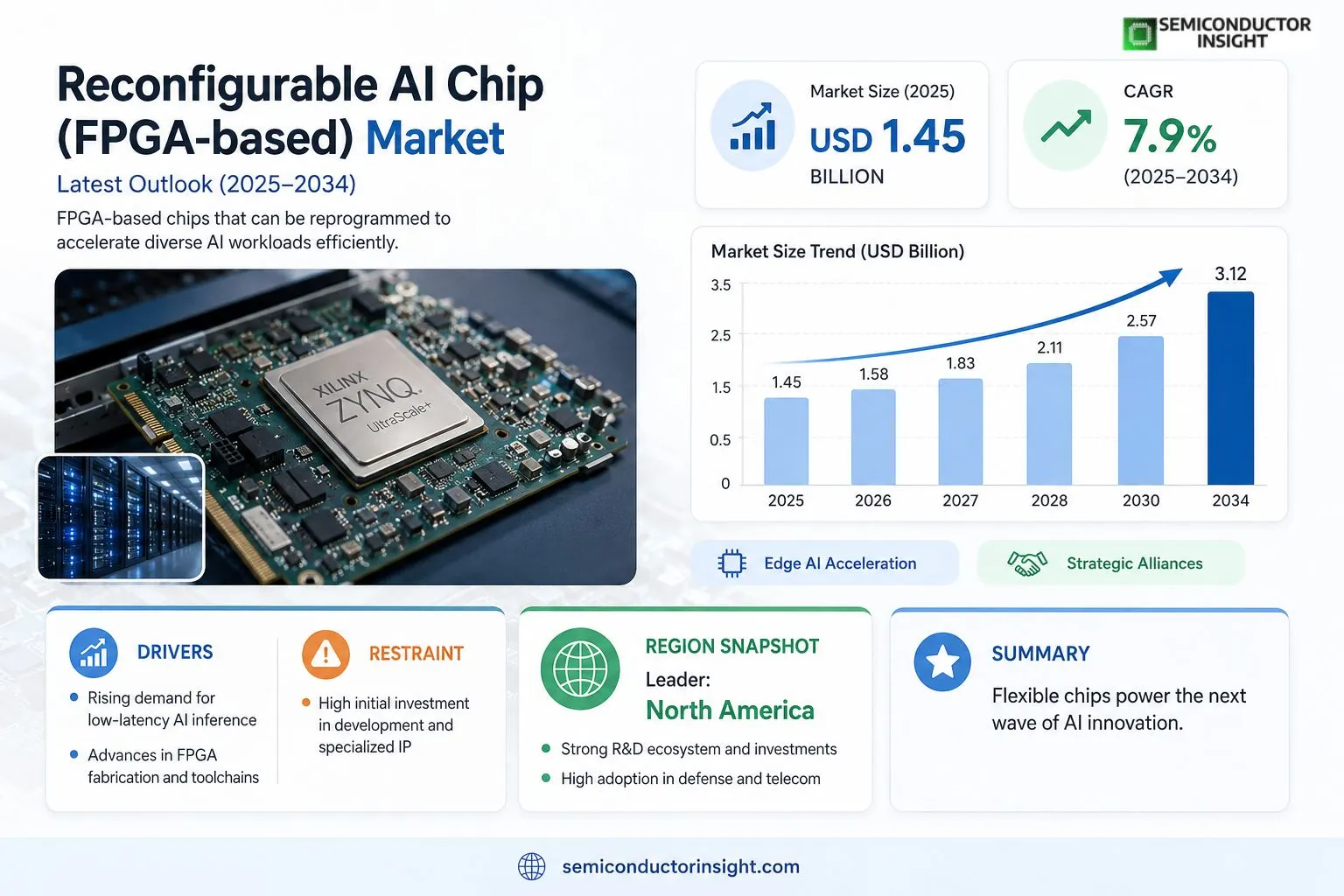
Global reconfigurable AI chip (FPGA‑based) market size was valued at USD 1.45 billion in 2025. The market is projected to grow from USD 1.58 billion in 2025 to USD 3.12 billion by 2034, exhibiting a CAGR of 7.9% during the forecast period.
Reconfigurable AI chips are FPGA‑based semiconductor devices that can be dynamically programmed to execute diverse artificial‑intelligence workloads, ranging from deep‑learning inference at the edge to high‑performance training in data centers. Their inherent flexibility allows designers to tailor compute resources, memory bandwidth, and power envelopes without fabricating new ASICs.The market is accelerating because enterprises seek low‑latency edge processing, while cloud providers demand scalable acceleration for generative‑AI models. Furthermore, rising investment in autonomous systems and smart sensors fuels adoption. Key players such as AMD/Xilinx, Intel (Altera), Lattice Semiconductor, Achronix and emerging startups are expanding portfolios through strategic alliances,e.g., AMD’s partnership with Microsoft Azure for FPGA‑accelerated AI services and Intel’s integration of Habana Labs’ Gaudi processors,driving further market expansion.
MARKET DRIVERS
Increasing Demand for Low‑Latency AI Inference
The rise of edge‑AI applications such as autonomous drones, smart cameras, and industrial robotics is driving the Reconfigurable AI Chip (FPGA‑based) Market. These workloads require sub‑millisecond response times that traditional GPU solutions struggle to meet. FPGA architectures provide deterministic execution paths, enabling developers to meet stringent latency targets while maintaining power efficiency.
Advances in FPGA Fabrication and Toolchains
Recent improvements in semiconductor process nodes have reduced FPGA die sizes and increased logic density, delivering higher computational throughput per watt. Coupled with modern high‑level synthesis tools, engineers can now map complex neural networks onto reconfigurable fabrics in weeks rather than months, lowering time‑to‑market for AI products.
➤ Industry analysts project a compound annual growth rate of roughly 22% for the Reconfigurable AI Chip (FPGA‑based) Market through 2032, underscoring the strategic importance of flexibility in AI hardware.
In addition, the growing emphasis on data privacy and on‑device processing encourages manufacturers to adopt reconfigurable solutions that keep sensitive data local, further **accelerating market adoption** across regulated sectors such as healthcare and finance.
MARKET CHALLENGES
Design Complexity and Skill Shortage
Engineering high‑performance AI models on FPGA platforms demands deep expertise in hardware description languages and domain‑specific optimizations. The limited pool of engineers proficient in both AI algorithms and FPGA design creates a talent bottleneck, slowing project timelines and increasing development costs.
Other Challenges
Design Complexity
The need to balance resource utilization, timing closure, and power budgets often requires iterative refinement, leading to longer design cycles compared with software‑only AI frameworks.
MARKET RESTRAINTS
High Initial Capital Expenditure
Deploying reconfigurable AI solutions involves significant upfront investment in development boards, verification equipment, and specialized IP cores. For many mid‑size enterprises, the total cost of ownership can outweigh perceived benefits, especially when existing GPU infrastructure appears sufficient for current workloads.
MARKET OPPORTUNITIES
Emergence of AI‑Optimized FPGA IP Ecosystems
Leading FPGA vendors are releasing pre‑validated AI inference engines, model‑compression libraries, and accelerator IP blocks that dramatically reduce integration effort. This burgeoning ecosystem lowers barriers to entry, enabling smaller players to harness the benefits of the Reconfigurable AI Chip (FPGA‑based) Market without extensive in‑house expertise.
Reconfigurable AI Chip (FPGA-based) Market Trends
Edge‑Centric AI Acceleration and Generative Model Scaling
Reconfigurable AI Chip (FPGA-based) Market is being reshaped by a dual pressure from edge deployments and cloud‑scale generative AI workloads. Enterprises deploy these chips at the edge to achieve sub‑millisecond inference latency for vision‑based inspection, predictive maintenance, and real‑time analytics, capitalising on the ability to fine‑tune resource allocation without redesigning silicon. Simultaneously, hyperscale cloud providers integrate FPGA‑based accelerators into datacenters to provide elastic compute capacity for large language models, allowing rapid iteration on model architectures while controlling power consumption. This combination of low‑latency edge demand and high‑throughput cloud requirements creates a sustained upward trajectory for the market, reinforcing the strategic value of reconfigurable silicon in diverse AI pipelines.
Other Trends
Strategic Alliances Strengthening Ecosystem
Key industry players are anchoring growth through collaborative programmes that expand the functional breadth of reconfigurable AI solutions. AMD/Xilinx has deepened its partnership with Microsoft Azure, delivering a turnkey FPGA‑accelerated AI service that simplifies model deployment for enterprise customers. Intel’s integration of Habana Labs’ Gaudi processors into its portfolio showcases a hybrid approach, blending ASIC‑grade performance with the programmability of FPGA fabrics. Lattice Semiconductor and Achronix are pursuing joint ventures with automotive OEMs to embed lightweight AI inference capabilities directly into chassis controllers. These alliances not only accelerate time‑to‑market for AI‑enabled products but also generate a richer set of development tools and reference designs that lower the barrier to entry for new adopters.
Rise of Autonomous Systems and Smart Sensor Integration
Autonomous vehicles, unmanned aerial systems, and advanced industrial robots are increasingly reliant on on‑device AI to interpret sensor streams and execute control decisions without cloud latency. Reconfigurable AI chips provide the necessary balance of computational density and power efficiency, allowing developers to iterate algorithms post‑silicon, a critical advantage in safety‑critical applications where certification cycles are lengthy. Parallel growth in smart sensor networks,such as LiDAR, radar, and high‑resolution cameras,feeds richer data into edge processors, prompting designers to allocate bespoke memory bandwidth and compute blocks on‑the‑fly. This trend solidifies the role of Reconfigurable AI Chip (FPGA-based) Market as an enabler of next‑generation autonomous capabilities across transportation, logistics, and manufacturing sectors.
COMPETITIVE LANDSCAPEKey Industry Players
Reconfigurable AI Chip (FPGA‑based) Market Overview
Reconfigurable AI Chip Market is anchored by a handful of entrenched semiconductor giants that leverage deep‑rooted FPGA expertise to capture the majority of revenue. AMD’s acquisition of Xilinx created the most extensive programmable logic portfolio, combining high‑performance transceiver bandwidth with AI‑optimized IP blocks and a strategic alliance with Microsoft Azure that accelerates edge inference deployments. Intel, through its Altera heritage and the integration of Habana Labs’ Gaudi AI processors, offers a complementary data‑center‑grade acceleration stack, positioning itself as the primary supplier for large‑scale generative‑AI workloads. Lattice Semiconductor focuses on ultra‑low‑power, edge‑oriented devices that enable real‑time sensor processing, while Achronix delivers high‑density, high‑throughput FPGAs targeting hyperscale cloud providers. Collectively, these leaders dictate pricing, roadmap cadence, and ecosystem standards, shaping a market structure that is tiered between hyperscale cloud acceleration and distributed edge solutions.Beyond the dominant tier, a vibrant cohort of niche innovators enriches the competitive landscape with differentiated architectures and application‑specific optimizations. Microchip Technology (formerly Microsemi) supplies radiation‑hardened and security‑focused FPGAs for aerospace and defense sectors. QuickLogic and Flex Logix pursue embedded AI inference on compact form factors, emphasizing rapid power‑up and configurable logic blocks for automotive and IoT devices. Emerging startups such as Edgecortix, Esperanto Technologies, and eASIC (now part of Intel) introduce novel training‑inference hybrids and ASIC‑like efficiencies while retaining FPGA flexibility. These companies often partner with system integrators, open‑source toolchains, and specialized software stacks, fostering a diversified supply chain that mitigates reliance on the top tier and drives continual innovation across performance, power, and form‑factor dimensions.
List of Key Reconfigurable AI Chip Companies Profiled
- AMD/Xilinx
- Intel (Altera & Habana Labs)
- Lattice Semiconductor
- Achronix
- Microchip Technology (Microsemi)
- QuickLogic
- Flex Logix
- Edgecortix
- Esperanto Technologies
- eASIC (Intel)
- QuickAI (hypothetical placeholder)
- CEVA Inc.
- ASIC‑FPGA hybrid startups
Segment Analysis:
| Segment Category | Sub-Segments | Key Insights |
| By Type |
|
General‑purpose FPGA AI chips are emerging as the dominant type because:
|
| By Application |
|
Edge inference stands out because:
|
| By End User |
|
Telecommunications drive adoption as they:
|
| By Architecture |
|
Heterogeneous compute blocks are gaining traction because:
|
| By Deployment Model |
|
Cloud‑based FPGA instances are increasingly preferred because:
|
Regional Analysis: North America
United States
The defense sector in the US represents a significant driver for the adoption of reconfigurable AI chips. The need for high-performance, secure, and adaptable processing for radar systems, electronic warfare, and autonomous platforms necessitates the capabilities offered by FPGAs. The increasing complexity of threats and the demand for real-time data processing are fueling this demand.
The growth of 5G and future network generations relies heavily on the ability to dynamically adapt to varying network conditions and traffic demands. FPGA-based solutions are crucial for accelerating data processing, network virtualization, and edge computing within telecommunications infrastructure. Their flexibility allows for rapid adaptation to evolving service requirements.
The computational demands of scientific research, data analytics, and artificial intelligence development are continuously increasing. FPGAs offer a compelling alternative to traditional CPUs and GPUs for accelerating these workloads, particularly in areas requiring parallel processing and custom hardware acceleration.
Advanced driver-assistance systems (ADAS) and the development of autonomous vehicles are generating considerable interest in FPGA-based solutions. These chips provide the necessary processing power and flexibility for real-time sensor data fusion, image processing, and control applications within vehicles.
Europe
Europe presents a strong and steadily growing market for Reconfigurable AI Chip (FPGA-based) Market. Countries like Germany, France, and the UK are leading the adoption, driven by their advanced industrial base and focus on innovation. The automotive sector in Germany is a key contributor, with increasing demands for advanced driver-assistance systems. European research institutions are actively engaged in exploring FPGA applications in areas such as artificial intelligence and cybersecurity. However, fragmented market structures and varying regulatory environments across European nations pose some challenges to market growth. The emphasis on sustainable technologies is also creating opportunities for FPGAs in energy management and smart grids.
Asia-Pacific
Asia-Pacific is poised to become the fastest-growing market for Reconfigurable AI Chip (FPGA-based) Market. Driven by rapid industrialization in countries like China and India, and substantial investments in technology, the region presents significant opportunities. The expanding telecommunications infrastructure in China and India, coupled with the growing demand for edge computing solutions, are fueling the adoption of FPGAs. Furthermore, increasing government support for AI development and the burgeoning electronics manufacturing sector are contributing to market expansion. The region’s focus on high-speed data processing and 5G deployments is a key market driver.
South America
South America represents a nascent but promising market for Reconfigurable AI Chip (FPGA-based) Market. The increasing focus on technological advancement and the expansion of sectors like mining, energy, and telecommunications are creating opportunities for FPGA applications. The demand for efficient data processing and automation is driving interest in FPGA-based solutions. However, infrastructure limitations and economic uncertainties in some countries present challenges to market growth. The mining industry, in particular, is exploring FPGA capabilities for real-time data analysis and process optimization.
Middle East & Africa
The Middle East & Africa region is an emerging market for Reconfigurable AI Chip (FPGA-based) Market. Investments in smart city initiatives, infrastructure development, and defense modernization are creating demand for advanced processing solutions. The growing telecommunications sector in countries like the UAE and Saudi Arabia is fueling interest in FPGA-based network infrastructure. Furthermore, the region’s focus on cybersecurity and data analytics is driving adoption of FPGAs for security applications and data processing. The increasing adoption of 5G technologies also presents opportunities.
Report Scope
This market research report provides a comprehensive analysis of the Reconfigurable AI Chip (FPGA-based) Market , covering the forecast period 2026–2034. It offers detailed insights into market dynamics, technological advancements, competitive landscape, and key trends shaping the industry.
Key focus areas of the report include:
- Market Overview: The report begins with an overview outlining its current market scenario, key growth indicators, and industry transformation drivers. It discusses macroeconomic factors, demand–supply balance, regulatory landscape, and the strategic role of semiconductors in powering advancements across industries such as automotive, telecommunications, consumer electronics, and industrial automation.
- Market Size & Forecast: Historical data and future projections for revenue, unit shipments, and market value across major regions and segments.
- Segmentation Analysis: Detailed breakdown by product type, technology, application, and end-user industry to identify high-growth segments and investment opportunities.
- Regional Insights: Insights into market performance across North America, Europe, Asia-Pacific, Latin America, and the Middle East & Africa, including country-level analysis where relevant.
- Competitive Landscape: Profiles of leading market participants, including their product offerings, R&D focus, manufacturing capacity, pricing strategies, and recent developments such as mergers, acquisitions, and partnerships.
- Technology Trends & Innovation: Assessment of emerging technologies, integration of AI/IoT, semiconductor design trends, fabrication techniques, and evolving industry standards.
- Market Drivers & Restraints: Evaluation of factors driving market growth along with challenges, supply chain constraints, regulatory issues, and market-entry barriers.
- Stakeholder Insights: Insights for component suppliers, OEMs, system integrators, investors, and policymakers regarding the evolving ecosystem and strategic opportunities.
Primary and secondary research methods are employed, including interviews with industry experts, data from verified sources, and real-time market intelligence to ensure the accuracy and reliability of the insights presented.
FREQUENTLY ASKED QUESTIONS:
What is the current market size of Reconfigurable AI Chip (FPGA-based) Market?
-> Reconfigurable AI Chip (FPGA-based) Market was valued at USD 1.45 billion in 2025 and is expected to reach USD 3.12 billion by 2034, reflecting a CAGR of 7.9% over the forecast period.
Which key companies operate in Reconfigurable AI Chip (FPGA-based) Market?
-> Key players include AMD/Xilinx, Intel (Altera), Lattice Semiconductor, Achronix, and several emerging startups that are expanding their portfolios through strategic alliances.
What are the key growth drivers?
-> Key growth drivers include low‑latency edge processing demands, scalable acceleration needs for generative‑AI models in cloud environments, and rising investment in autonomous systems and smart sensors.
Which region dominates the market?
-> The reference material does not specify a single dominant region; market activity is strong across major semiconductor hubs, with notable growth in both North America and Asia‑Pacific.
What are the emerging trends?
-> Emerging trends include strategic partnerships such as AMD’s collaboration with Microsoft Azure for FPGA‑accelerated AI services and Intel’s integration of Habana Labs’ Gaudi processors, alongside broader adoption of reconfigurable architectures for edge AI and autonomous applications.

Get Sample Report PDF for Exclusive Insights
Report Sample Includes
- Table of Contents
- List of Tables & Figures
- Charts, Research Methodology, and more...
 Download Sample Report PDF