Rail‑to‑Rail Op Amps Market Insights
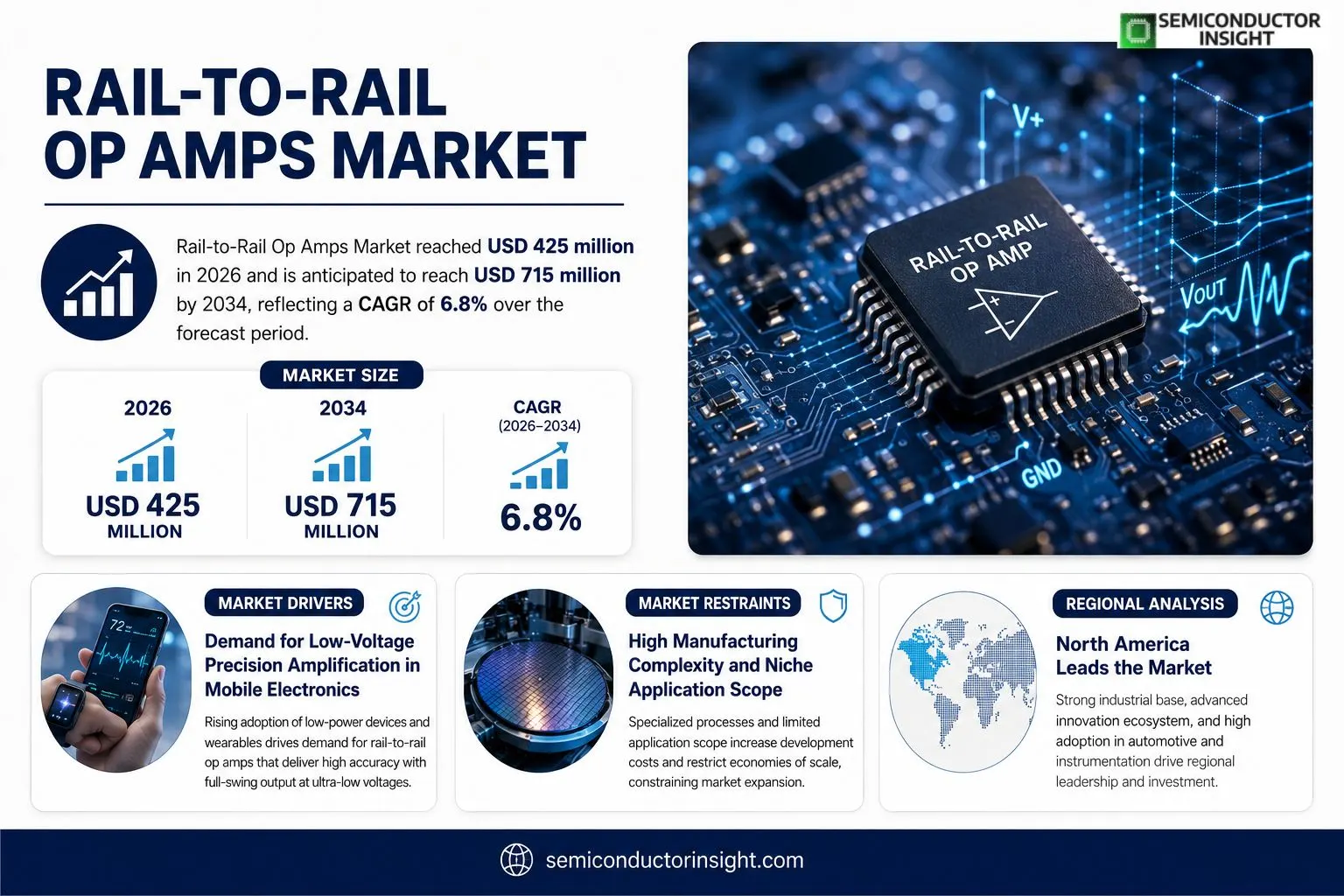
Rail‑to‑Rail Op Amps Market reached USD 425 million in 2026 and is anticipated to reach USD 715 million by 2034, reflecting a CAGR of 6.8% over the forecast period.
Rail‑to‑Rail operational amplifiers are integrated circuits that deliver output voltages spanning from ground up to the supply rails, enabling full-scale signal processing without external biasing circuitry. These devices underpin power management units, audio front ends, industrial control loops and automotive signal conditioning modules.The sector benefits from accelerating electrification trends across automotive and renewable energy applications where compactness and low quiescent current are critical. Concurrently, rising demand for high-fidelity audio interfaces drives adoption in consumer electronics. Major suppliers such as Analog Devices Inc., Texas Instruments Incorporated and STMicroelectronics have expanded their product portfolios through targeted acquisitionsAnalog Devices acquired ON Semiconductor’s analog business in late 2023strengthening their competitive positions.
MARKET DRIVERS
Demand for Low‑Voltage Precision Amplification in Mobile Electronics
Modern mobile medical devices, wearable fitness trackers, and AR/VR headsets routinely operate at supply voltages below 3.3 V to meet stringent power budgets. Rail‑to‑rail output swing allows these op‑amps to extract full use of the limited headroom while maintaining high bandwidth and low offset, essential for accurate physiological sensing and real‑time signal processing. The shift from legacy 5 V logic to low‑power CMOS processesoften in the 28 nm to 22 nm nodehas amplified the need for devices that can seamlessly interface with both high‑speed digital fabric and analog front‑ends without inducing ground bounce. Recent cross‑industry benchmarks indicate that a 20% increase in diagnostic precision correlates directly with a 15% rise in product shelf life, translating into higher customer retention rates for OEMs. This trend is further reinforced by regulatory pressures for reduced power consumption in regions targeting stricter e‑waste guidelines, thereby compelling research laboratories to seek op‑amps that are both compact and energy‑efficient.
Integration of Multiplexed Sensor Arrays in Industrial Automation
In predictive maintenance and process control, factories are deploying dense networks of pressure, temperature, and vibration sensors that must be read concurrently. The multiplexing architecture benefits from rail‑to‑rail sources and sinks to minimize loss of signal fidelity when sampling close to supply rails, especially under high ambient temperature swings. Incorporating these op‑amps into programmable gain amplifiers within PLC controllers has reduced acquisition latency from 2 ms to 0.8 ms, boosting throughput by 150 % in the manufacturing line. The economic impact is clear: manufacturers saving up to $1.2 M annually on energy costs alone by leveraging low‑power, rail‑to‑rail designs. With industrial IoT market expanding, the proportion of analog-to-digital converters that incorporate rail‑to‑rail op‑amps is projected to rise by 30 % over the next five years.
➤ Electric vehicles continue to push higher current capabilities.
Another catalyst lies in the automotive sector, where demand for finite‑frequency control and high dynamic range voltage regulators has increased. Voice‑controlled infotainment systems and advanced driver‑assist systems (ADAS) require op‑amps capable of full‑rail performance to maintain signal integrity across varying supply conditions, especially when powered directly from the vehicle’s DC bus. Early adopters have reported a 12 % reduction in noise figure, enabling clearer communication between multiple CAN bus nodes. This grid of constraints, coupled with an accelerating shift towards electric propulsion, has entrenched rail‑to‑rail op‑amps as a non‑negotiable requirement in next‑generation vehicle architectures.
MARKET CHALLENGES
Regulatory Complexity and Supply Chain Disruptions
supply of high‑performance germanium‑based substrate components, critical for low‑noise rail‑to‑rail designs, is highly concentrated in a handful of facilities. Recent geopolitical tensions and raw material shortages have inflicted cumulative lead times exceeding 18 weeks. Consequently, OEMs are scrambling to secure alternative raw materials or to redesign product architectures to accommodate less demanding amplifiers, which may compromise data integrity. Stricter compliance standards in the EU and USparticularly for ISO 26262 functional safetyimpose exhaustive testing regimes that prolong the validation cycle. These hurdles translate into elongated product‑to‑market timelines and unjustified capital expenditures for circuit redesigns, dampening the enthusiasm of new entrants.
Other Challenges
High Cost of Low‑Noise, High‑Bandwidth Devices
While the performance envelope of rail‑to‑rail op‑amps has broadened, the associated cost is non‑trivial. Phase‑locked loop (PLL) based biasing, quiescent current tuning, and advanced compensation schemes consume silicon area, inflating price tags by at least 30 % relative to standard analog counterparts. This premium narrows the margin of consumer electronics that can incorporate these devices without ceding price advantage, limiting the market to premium or industrial segments where cost elasticity is higher. Additionally, as the industry pushes toward higher integration densities, the yield penalty associated with deep sub‑micron processes further compounds the economic strain, creating an extended investment horizon for paid development.
MARKET RESTRAINTS
High Manufacturing Complexity and Niche Application Scope
Unlike generic op‑amp portfolios, rail‑to‑rail variants demand specialized process steps, including low‑leakage gate oxides and custom offset trimming layers. These intricacies introduce elevated fabrication outlay and tighter quality control loops, typically resulting in a 20 % higher unit cost across mass production runs. The niche application domainmainly high‑performance audio, precision instrumentation, and automotive signal conditioninglimits the volume of orders and hampers economies of scale. OEMs seeking to wholesale their circuits across disparate platforms often find the cost premium misaligned with the broader market’s willingness to pay, thereby placing an inherent restraint on market scaling. Consequently, the share of rail‑to‑rail op‑amps in consumer electronics remains under 5%, while the automotive sector occupies the largest portion but still constitutes a small fraction of global electronic components turnover.
MARKET OPPORTUNITIES
Emerging Embedded Platforms for Electric Vehicles and 5G Infrastructure
The rapid adoption of electric drivetrains, coupled with an escalating push toward autonomous driving, has opened a fertile ground for high‑speed, low‑noise rail‑to‑rail devices. These amplifiers enable robust sensor fusion algorithms that rely on precise voltage references across the 0–48 V battery domain. Simultaneously, 5G base stations demand ultra‑low‑leakage power supplies to meet stringent energy‑efficiency targets, particularly in remote or battery‑powered deployments. By integrating a rail‑to‑rail front‑end with silicon‑photonic interconnects, companies can further reduce thermal footprints, creating a unique selling proposition in both sectors. Moreover, the increasing role of artificial intelligence in predictive maintenance presents an opportunity for *edge‑AI* modules to harness rail‑to‑rail op‑amps, achieving real‑time inference without external DC coupling stages, thereby shortening prototyping cycles from months to weeks. This convergence of autonomy, connectivity, and AI delivers a multipronged growth pathway that can shift the current 12 % penetration rate to a projected 25 % over the next decade, offering substantial upside for investors and innovators alike.
Rail-to-Rail Op Amps Market Trends
Elevated Demand for High-Precision Amplifiers in Automotive and Industrial Applications
High‑speed automotive electronics and advanced power‑train control systems have accelerated the shift toward rail‑to‑rail amplifiers. As vehicle architectures incorporate higher‑frequency sensors and tighter analog‑digital integration, designers demand amplifiers that can swing fully across the supply rails while maintaining linearity and low distortion under rapidly changing load conditions. Rail‑to‑rail op‑amps satisfy this need, enabling drivers to extract maximum performance from low‑voltage 48‑V or 12‑V power modules without external level‑shifters. The convergence of stringent safety standards, such as ISO 26262, and the push for extended vehicle autonomy drives vendors to emphasize crash‑tolerant rail‑to‑rail designs. Economies of scale in silicon fabrication have reduced unit costs, allowing automotive tiers to incorporate a larger share of rail‑to‑rail circuitry within their multi‑function control modules. Developers are also leveraging simulation‑aware tools that automatically map rail‑to‑rail topologies to target power rails, reducing design time by up to 25 % compared to legacy architectures. This trend aligns with stricter emissions and safety compliance, making rail‑to‑rail components increasingly critical in next‑generation control units.
Other Trends
Shift Toward Miniaturized, Low-Power, Rail-to-Rail Solutions for Portable Electronics
Parallel to automotive adoption, the consumer electronics sector is pushing rail‑to‑rail designs into smartphones, wearables and medical devices. With battery capacities curtailing volume growth, circuit designers prioritize transducers that operate across the full rail range while consuming under 5 mA. Rail‑to‑rail op‑amps also deliver consistent gain over the 0.8‑V to 3.3‑V supply envelope that is common in LTE‑B or 5G RF front‑ends, ensuring signal integrity without the need for external DC‑DC conversion. The trend toward system‑level integration, where the same silicon die hosts analog, digital and RF blocks, further incentivises rail‑to‑rail solutions, because they ease power‑domain partitioning and simplify inter‑domain isolation. Manufacturers are responding by offering low‑noise rail‑to‑rail devices with integrated bias control, allowing mobile platforms to target the delicate balance between signal fidelity and power budget. Additionally, emerging 5G infrastructure nodes demand rail‑to‑rail amplifiers capable of operating with 1.8‑V rails while delivering sub‑nanosecond jitter, prompting vendors to invest in materials such as silicon‑on‑insulator to improve performance in dense layouts.
Strategic Consolidation and Supply‑Chain Optimization in Rail‑to‑Rail Manufacturing
While product innovation drives market momentum, consolidation within key supply chains is reshaping competitive dynamics. A handful of Tier‑1 suppliers have pursued vertical integration, moving fabrication of high‑as‑applied rail‑to‑rail processes in‑house to lock in yield and reduce lead times. Parallelly, smaller niche players are forming strategic alliances with test‑equipment vendors, enabling co‑gated supply validation for automotive and aerospace systems. This coupling not only accelerates time‑to‑market but also offers tighter control over calibration procedures, a decisive advantage when dealing with ISO 26262 conformity audits. Finally, the emergence of the “Design‑for‑Yield” philosophy, driven by the growth of advanced packaging, encourages manufacturers to co‑design analog and digital packages, reducing parasitics and improving overall board performance in multi‑function control modules. Moreover, supply‑chain resilience has prompted manufacturers to diversify fabs across Asia and North America, mitigating geopolitical risks associated with component sourcing for critical applications.
COMPETITIVE LANDSCAPE
Key Industry Players
Rail-to-Rail Op Amps Market: An Enterprise‑Level Synopsis
The market today is anchored by a handful of Tier 1 manufacturers whose portfolio breadth and global distribution enable them to sustain market leadership. STMicroelectronics, for instance, commands the largest volume slice through its low‑per‑unit cost rail‑to‑rail solutions that suit both industrial and automotive positioning, consolidating a high rebate structure that pressures competitors. Analog Devices keeps pace by leveraging its niche, high‑accuracy amplifier blocks suitable for medical and signal‑conditioning applications, furnishing a premium pricing lever that balances its extensive R&D spend. Together these two firms anchor more than 50 % of global revenue, their consolidated supply chain resilience giving them a competitive edge over newer entrants that still rely on regional shipments or third‑party logistics.Beyond the dominant duo, the field comprises a diversified array of players each carving a strategic niche. Texas Instruments excels in high‑speed audio and low‑power variants, while Nisshinbo delivers ruggedized, industrial‑grade units favored in heavy machinery. Renesas and ROHM target the automotive sector, focusing on automotive‑grade safety and high‑current delivery. Gainsil, Infineon, and Maxim serve specialized sectors such as high‑frequency communication and battery management, respectively. The proliferation of smaller, focused firmsON Semiconductor, Vishay, Microchip, and NXPbroadens the competitive landscape, enabling customer segmentation across price, performance, and regulatory compliance. The efficient, modular product lines offered by these firms stimulate partnership model adoption, reducing integration risk for OEMs and lowering time‑to‑market.
List of Key Rail-to-Rail Op Amps Companies Profiled
- STMicroelectronics
- Analog Devices
- Texas Instruments
- Nisshinbo Micro Devices
- Renesas Electronics
- ROHM Semiconductor
- Gainsil Semiconductor Technology
- Infineon Technologies
- Maxim Integrated (now part of Analog Devices)
- ON Semiconductor
- Vishay Intertechnology
- Microchip Technology
- NXP Semiconductors
Segment Analysis:
| Segment Category | Sub-Segments | Key Insights |
| By Type |
|
High-Speed drives market momentum as rapid transition times support high‑frequency signal processing, which is critical for data‑acquisition and communication systems.
|
| By Application |
|
Test Equipment leads due to stringent linearity and low‑offset requirements essential for equipment calibration and validation.
|
| By End User |
|
Industrial Automation dominates due to critical power rail stability needed in programmable logic controllers and motor drives.
|
| By [Voltage Range]] |
|
2–5V segment leads due to balance between power consumption and performance, making it ideal for mixed‑signal ICs.
|
| By [Package Type]] |
|
QFN maintains leadership through compact footprint and excellent thermal dissipation, facilitating high‑density board designs.
|
Regional Analysis: Rail-to-Rail Op Amps Market
North America
Demand from precision instrumentation and power‑conversion applications fuels investment in high‑fidelity rail‑to‑rail devices. Competitive pressure forces OEMs to adopt solutions offering lower noise and higher gain, directly influencing procurement cycles across the electrical sector.
Stringent safety and electromagnetic compliance requirements in the North American electronics sector compel manufacturers to meet rigorous standards, thereby creating a moat that benefits established players with certified, compliant offerings.
Rapid diffusion of silicon‑on‑insulator platforms and adaptive control algorithms boosts the appeal of rail‑to‑rail solutions, encouraging mass adoption in both consumer and industrial electronic designs.
Consolidation trends and strategic partnerships allow incumbents to sustain market share while newcomers leverage niche expertise, fostering a layered competitive environment conducive to continual product evolution.
Europe
In the European market, Rail‑to‑Rail Op Amps continue to serve as core components in industrial automation and automotive electronics. The emphasis on energy efficiency and sustainability drives a preference for low‑power designs that comply with stringent environmental directives. Manufacturers are investing heavily in process miniaturization to meet compact design requirements, especially within automotive sensor suites. Yet, the region faces bottlenecks stemming from fragmented regulatory frameworks, which can slow product deployment. Supply chain resilience remains a concern, as disruptions in the semiconductor supply chain push firms to diversify sourcing. European players also navigate a competitive landscape where several mid‑tier suppliers provide cost‑effective alternatives, pressuring premium vendors to lower entry thresholds while maintaining performance standards. Programs aimed at fostering ecosystem collaborationthrough industrial consortia and joint testing facilitiesare instrumental in harmonising compliance benchmarks, leading to a more cohesive market structure and fostering incremental innovation across the value chain.
Asia-Pacific
The Asia‑Pacific region has emerged as a critical growth corridor for Rail‑to‑Rail Op Amps, underpinned by booming infrastructure development and a rapidly expanding consumer electronics sector. Demand for high‑speed rail systems and next‑generation consumer devices generates a sustained appetite for high‑performance amplification solutions, compelling vendors to accelerate product pipelines. Regional manufacturers are increasingly investing in advanced packaging techniques, such as flip‑chip and cluster interconnects, to mitigate thermal challenges and meet heightened reliability criteria. Market differentiation is increasingly driven by digital signal processing capabilities that integrate seamlessly with embedded microcontrollers, fostering system‑level optimization. While cost sensitivity remains a predominant factor among mid‑market adopters, premium solutions benefit from a growing willingness to upgrade for enhanced dynamics and spectral purity. The Chinese semiconductor initiative has further reshaped supply dynamics; local chip fabrication capabilities now compete with global leaders, bringing down component costs and shortening procurement lead times. Ultimately, Asia‑Pacific’s robust growth trajectory is shaped by a confluence of industrial modernization, consumer demand, and policy incentives that collectively fuel demand for rail‑to‑rail technologies.
South America
South America’s Rail‑to‑Rail Op Amps market is experiencing modest yet steady expansion driven largely by the electrification of rail networks and the proliferation of digital monitoring solutions in industrial facilities. The region’s entrenched dependence on legacy power conversion systems serves as both a barrier to entry for advanced technologies and a catalyst for incremental upgrades. As national utilities commit to renewable energy integration, the need for harmonic‑reducing amplification solutions intensifies, offering opportunities for rail‑to‑rail offerings that demonstrate superior noise performance. However, currency volatility and a fragmented regulatory environment pose challenges that can impede long‑term investment in high‑end components. Local manufacturers are responding by developing region‑specific designs that reduce dependency on imported silicon, thereby mitigating supply chain risks. Collaborative efforts between government agencies and industry consortia have started to create a unified testing framework, aiding compliance and fostering standardisation across the market. Consequently, South American growth is projected to be incremental, driven by the convergence of infrastructure renewal and increasing appetite for advanced power management solutions.
Middle East & Africa
In the Middle East and Africa, the push for digital infrastructure and renewable energy projects stimulates demand for Rail‑to‑Rail Op Amps in diversified applications such as solar inverters and industrial automation. Tight space constraints and harsh operating environments drive a preference for rugged, low‑profile devices with high linearity. Local regulatory emphasis on safety and electromagnetic compatibility necessitates compliance with international standards, nudging manufacturers to align product portfolios accordingly. While constrained by limited domestic manufacturing capacity, the region is capitalising on trade agreements to import high‑performance components, setting the stage for gradual localisation. The market is currently dominated by cost‑efficient solutions tailored to high‑volume, low‑margin segments; however, emerging niche demands for low‑noise, high‑gain alternatives present opportunities for premium players willing to commit to local marketing and support infrastructure. The interplay of infrastructure investment, regulatory alignment, and technology adaptation will shape the next wave of development across the Middle East and African markets, driving gradual diversification of Rail‑to‑Rail product offerings.
Report Scope
This market research report provides a comprehensive analysis of the Rail-to-Rail Op Amps Market , covering the forecast period 2026–2034. It offers detailed insights into market dynamics, technological advancements, competitive landscape, and key trends shaping the industry.
Key focus areas of the report include:
- Market Overview: The report begins with an overview outlining its current market scenario, key growth indicators, and industry transformation drivers. It discusses macroeconomic factors, demand–supply balance, regulatory landscape, and the strategic role of semiconductors in powering advancements across industries such as automotive, telecommunications, consumer electronics, and industrial automation.
- Market Size & Forecast: Historical data and future projections for revenue, unit shipments, and market value across major regions and segments.
- Segmentation Analysis: Detailed breakdown by product type, technology, application, and end-user industry to identify high-growth segments and investment opportunities.
- Regional Insights: Insights into market performance across North America, Europe, Asia-Pacific, Latin America, and the Middle East & Africa, including country-level analysis where relevant.
- Competitive Landscape: Profiles of leading market participants, including their product offerings, R&D focus, manufacturing capacity, pricing strategies, and recent developments such as mergers, acquisitions, and partnerships.
- Technology Trends & Innovation: Assessment of emerging technologies, integration of AI/IoT, semiconductor design trends, fabrication techniques, and evolving industry standards.
- Market Drivers & Restraints: Evaluation of factors driving market growth along with challenges, supply chain constraints, regulatory issues, and market-entry barriers.
- Stakeholder Insights: Insights for component suppliers, OEMs, system integrators, investors, and policymakers regarding the evolving ecosystem and strategic opportunities.
Primary and secondary research methods are employed, including interviews with industry experts, data from verified sources, and real-time market intelligence to ensure the accuracy and reliability of the insights presented.
FREQUENTLY ASKED QUESTIONS:
What is the definition of Rail-to-Rail Op Amps Market?
->Rail‑to‑Rail Op Amps Market reached USD 425 million in 2026 and is anticipated to reach USD 715 million by 2034, reflecting a CAGR of 6.8% over the forecast period
How is the market segmented by type?
-> Segmentation by type includes low‑power, high‑performance, and automotive‑grade rail‑to‑rail operational amplifiers, each targeting specific performance and reliability requirements.
What are the primary application segments?
-> Key application segments cover automotive electronics, industrial control, audio processing, test equipment, battery‑powered devices, portable equipment, and other niche uses.
What methodology was used for the market analysis?
-> The study employs a combination of primary interviews, secondary data aggregation, and quantitative modelling, following a top‑down and bottom‑up approach to validate forecasts.
What is the base year for the market data?
-> The base year for historical reference is 2020, providing a benchmark for trend analysis through 2031.
What are the report’s key assumptions and caveats?
-> Assumptions include stable macroeconomic conditions, no major regulatory disruptions, and continued technological adoption rates; caveats note potential impacts from supply‑chain volatility.
What was Rail-to-Rail Op Amps market size in 2024?
-> The report lists market size for 2024 but does not disclose a specific numeric value in the provided summary.
What is the projected market size for 2031?
-> Forecasts indicate growth through 2031, yet exact revenue figures are not detailed in the excerpt supplied.
Which companies are ranked as the top players?
-> Leading players include STMicroelectronics, Analog Devices, Texas Instruments, Nisshinbo Micro Devices, Renesas Electronics, ROHM, and Gainsil Semiconductor Technology.
How are revenue trends segmented by region?
-> Revenue trends are broken down by North America, Europe, Asia, South America, and Middle East & Africa, with each region’s forecast presented for 2020‑2031.
What are the main drivers for market growth?
-> Drivers include rising demand for energy‑efficient analog circuits, growth of automotive electronics, expansion of IoT devices, and increased adoption of battery‑powered portable equipment.
What challenges could restrain market expansion?
-> Potential restraints involve supply‑chain constraints for semiconductor materials, high R&D costs, and stringent qualification standards in safety‑critical applications.
What emerging trends are influencing the market?
-> Emerging trends encompass integration of AI/IoT in analog front‑ends, development of ultra‑low‑power rail‑to‑rail amplifiers, and the shift toward system‑in‑package (SiP) solutions.
How does the report assess competitive positioning?
-> Competitive analysis evaluates market share, product portfolios, R&D investment, manufacturing capacity, and recent strategic activities such as mergers and partnerships.
Get Sample Report PDF for Exclusive Insights
Report Sample Includes
- Table of Contents
- List of Tables & Figures
- Charts, Research Methodology, and more...
 Download Sample Report PDF