Key Statistics
Key Takeaways
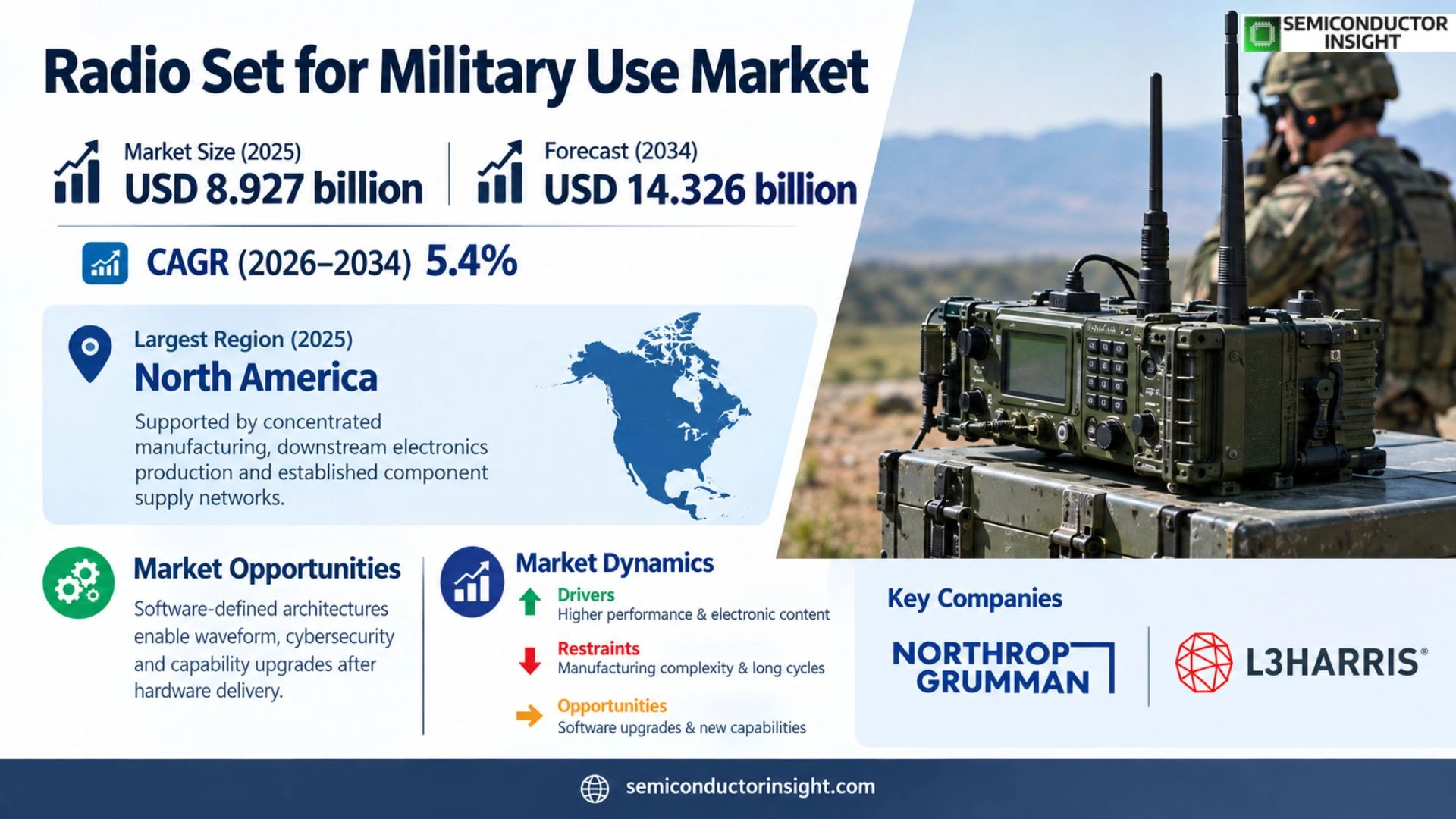
- The Radio Set for Military Use Market was valued at USD 8.927 billion in the 2025 base year and is projected to reach USD 14.326 billion by 2034, expanding at a 5.4% CAGR during 2026–2034.
- Portable radios lead by type because dismounted forces and small units require secure handheld and manpack communications while modernization shifts toward multichannel software-defined equipment.
- Ground forces remain the largest application, although air and naval platforms command high unit values through integration, certification, specialized waveforms, and long sustainment requirements.
- North America leads through the scale of U.S. tactical-network procurement, advanced waveform programs, cryptographic requirements, extensive installed equipment, and major domestic suppliers.
- Software and interoperability drive lifetime value. Waveforms, encryption, network management, cybersecurity updates, training, integration, accessories, spares, and depot support extend revenue beyond initial hardware deliveries.
Radio Set for Military Use Market Overview
Radio Set for Military Use Market was valued at USD 8.927 billion in 2025 and is projected to reach USD 14.326 billion by 2034, growing at a CAGR of 5.4% during 2026–2034. North America held the largest regional position in 2025, supported by concentrated manufacturing, downstream electronics production and established component supply networks.
Military radio sets provide secure voice and data communications for dismounted personnel, vehicles, aircraft, ships, command posts, and distributed sensors. The category includes handheld, manpack, vehicular, fixed, airborne, and maritime systems operating across HF, VHF, UHF, and satellite links. Modern products increasingly use software-defined architectures, networked waveforms, encryption, frequency agility, and mobile ad hoc networking to maintain communications in congested or contested electromagnetic environments.
The market enters the 2026 estimated year with active modernization programs focused on secure, resilient, and interoperable tactical communications. Growth through 2034 will be supported by replacement of legacy radios, wider deployment of software-defined architectures, increased battlefield data traffic, multi-domain networking, and continuous waveform upgrades. Procurement value will also expand through encryption, integration, accessories, training, cybersecurity maintenance, spares, and long-term fleet sustainment services.
Procurement is shaped by mission needs, spectrum authorization, cryptographic approval, waveform interoperability, electronic-warfare resilience, ruggedization, size and weight, battery endurance, network planning, training, maintenance, and integration with battle-management systems. Contract awards can be large and multi-year, but qualification and security requirements lengthen sales cycles. Revenue includes equipment, waveforms, accessories, spares, vehicle integration, software upgrades, support, and depot services rather than radio hardware alone.
Segment Analysis: By Type
By type, the Military Radio Set market is segmented into Portable Radios · Fixed or Vehicular Stations · Other Military Radio Sets. Each category represents a different degree of integration, qualification burden and value capture, so suppliers compete through a combination of material performance, design support, manufacturing consistency, package architecture and application-specific testing rather than through unit price alone. Procurement also reflects lifecycle support, interoperability, compliance evidence, warranty exposure, and the cost of unsuccessful qualification.
| Type | Market relevance |
|---|---|
| Portable Radios | Distinct performance, condition, integration, and qualification requirements shape demand and supplier positioning. |
| Fixed or Vehicular Stations | Distinct performance, condition, integration, and qualification requirements shape demand and supplier positioning. |
| Other Military Radio Sets | Distinct performance, condition, integration, and qualification requirements shape demand and supplier positioning. |
Segment Analysis: By Application
By application, the market covers Ground Force · Air Force · Navy · Other Defense Applications. Demand varies by production volume and qualification intensity: consumer programmes reward scale and miniaturisation, while automotive, industrial, aerospace, medical or security designs place greater weight on reliability evidence, long product availability and system-level performance under demanding operating conditions. Channel design, documentation, service coverage, and total ownership economics further determine which application converts technical interest into repeat purchasing.
| Application | Market relevance |
|---|---|
| Ground Force | Purchasing criteria reflect use-case economics, technical requirements, warranty expectations, and channel support. |
| Air Force | Purchasing criteria reflect use-case economics, technical requirements, warranty expectations, and channel support. |
| Navy | Purchasing criteria reflect use-case economics, technical requirements, warranty expectations, and channel support. |
| Other Defense Applications | Purchasing criteria reflect use-case economics, technical requirements, warranty expectations, and channel support. |
Regional Analysis
North America is the largest regional market for Military Radio Set products, combining an established component-production ecosystem with major downstream customers. North America and Europe are strategically important for premium, automotive, aerospace, industrial and specialised applications, while South America and Middle East & Africa are primarily import- and project-led markets where distributor reach, local support and supply continuity shape vendor selection.
How does regional demand differ across this market?
For Military Radio Set, North America holds the largest position, supported by an established customer base, supplier presence, and mature purchasing channels. Europe contributes regulation, industrial demand, and technical expertise, while Asia Pacific combines electronics manufacturing, large device populations, and expanding engineering capability. South America and the Middle East and Africa develop through targeted infrastructure, enterprise, research, consumer, or public-sector programs rather than uniform adoption.
| Region | Position |
|---|---|
| North America | Largest and most established demand base |
| Europe | Developing demand shaped by local applications, channels, and qualification conditions |
| Asia Pacific | Developing demand shaped by local applications, channels, and qualification conditions |
| South America | Developing demand shaped by local applications, channels, and qualification conditions |
| Middle East & Africa | Developing demand shaped by local applications, channels, and qualification conditions |
Key Military Radio Set Manufacturers and Competitive Landscape
The Military Radio Set competitive landscape includes global technology leaders, diversified semiconductor or component groups, RF and imaging specialists, and regional manufacturers. The report profiles every named company across product positioning, manufacturing footprint, application exposure, recent development activity and strategic strengths; the complete coverage list is reproduced below so the intended company universe is explicit.
The report covers L3Harris Technologies, Thales Group, Barrett Communications, Datron World Communications, Sapura Thales Electronics, Leonardo, Eylex, Rohde & Schwarz, Codan Communications, and Sat-Com Communications Systems. Competition spans large defense primes, secure-communications specialists, regional joint ventures, and suppliers focused on HF or tactical radio niches. Programs are often decided through government evaluation, classified requirements, local-industry policy, export approvals, and demonstrated interoperability with fielded systems.
Vendors differentiate through waveform portfolios, anti-jam performance, encryption accreditation, simultaneous channels, throughput, range, spectrum efficiency, MANET behavior, SATCOM access, ruggedness, battery life, weight, accessories, vehicle and platform integration, and network-management tools. Installed base matters because forces value interoperability and existing training. Suppliers also compete on sovereign control, local production, technology transfer, cybersecurity maintenance, configuration management, repair turnaround, and the ability to update radios against evolving threats.
Key companies profiled
- L3Harris Technologies
- Thales Group
- Barrett Communications
- Datron World Communications Incorporated
- Sapura Thales Electronics
- Leonardo S.p.A.
- Eylex Pty Ltd
- Rohde & Schwarz
- Codan Communications
- Sat-Com Communications Systems
Military Radio Set Production Capacity Analysis
Production capacity is a material competitive factor in the Military Radio Set market because electrical performance depends on specialised processes, qualified materials, repeatable yields and application-specific test capability. Capacity cannot be assessed only by nominal factory floor area: effective supply is the output that passes dimensional, electrical, reliability and customer qualification requirements at the required product mix.
Effective military-radio capacity is the number of fully configured and accepted systems that can be delivered with approved cryptography, waveforms, accessories, batteries, antennas, test equipment, documentation, and spares. Nominal electronics assembly capacity can overstate usable output when secure modules, specialized RF components, rugged enclosures, or customer-furnished cryptographic items are constrained. Each configuration may require environmental, electromagnetic, security, and interoperability verification before government acceptance.
Production combines high-reliability circuit assembly, RF alignment, secure software loading, key-management preparation, enclosure sealing, environmental screening, burn-in, automated test, and serialization. Portable radios additionally demand stringent size, weight, power, and thermal control, while vehicular and fixed systems require amplifiers, mounts, power conditioning, filters, and platform-specific harnesses. Capacity expansion therefore needs qualified technicians, protected facilities, controlled software baselines, test assets, and cleared supply chains as well as assembly lines.
Long-term programs require surge planning and sustainment capacity. Armed forces expect spare units, batteries, accessories, repair parts, depot services, waveform updates, cybersecurity patches, training, and obsolescence management for many years. Suppliers that standardize modules across handheld, manpack, and vehicular families can improve purchasing leverage and repair efficiency. Local assembly or maintenance partnerships may also be contract requirements, particularly when governments seek sovereign support and faster operational availability.
Military Radio Set Market Dynamics: Drivers, Restraints and Opportunities
Military Radio Set market growth reflects expanding electronic content and higher performance requirements, moderated by manufacturing complexity, long qualification cycles and competing technologies. The impact ranges below are directional analytical estimates rather than additive forecasts; they show the relative pressure each factor can place on the baseline CAGR when other assumptions remain broadly stable.
Growth is driven by defense modernization, replacement of legacy analog equipment, distributed operations, demand for resilient command and control, and higher data requirements at the tactical edge. Software-defined radios allow waveforms and security functions to evolve without replacing every hardware platform. Market timing remains procurement-led: budgets, trials, export approvals, coalition priorities, and conflict-driven urgent requirements can shift awards between years and create concentrated revenue for successful suppliers.
The baseline is constrained by long certification cycles, spectrum congestion, cryptographic controls, high development expense, and integration risk across diverse national systems. Electronic warfare raises performance requirements while shortening the useful life of unmodified waveforms. Customers must balance advanced capability with soldier load, battery logistics, usability, and training. A technically sophisticated radio can underperform operationally if network planning, antennas, spectrum coordination, or software configuration are inadequate.
MARKET DRIVERS
Drivers Impact Analysis*
| Driver | (~) % impact on CAGR forecast | Geographic relevance | Impact timeline |
|---|---|---|---|
| Replacement of legacy tactical radio fleets | +1.4% | North America, Europe, Asia Pacific | Medium term (2–4 years) |
| Contested-spectrum and anti-jam requirements | +1.1% | NATO, Indo-Pacific, Middle East | Short term (≤2 years) |
| Software-defined multichannel architectures | +0.9% | Global modernization programs | Medium term (2–4 years) |
| Multi-domain networking and battlefield data | +0.8% | North America and allied forces | Long term (≥4 years) |
| Coalition interoperability and common waveforms | +0.6% | Europe, North America, partner nations | Long term (≥4 years) |
| Sovereign communications and local production | +0.5% | Europe, Middle East, Asia Pacific | Medium term (2–4 years) |
Military modernization programs are replacing narrowband and platform-specific radios with multiband, multichannel, software-defined systems. Forces want one device to support voice, data, position, and multiple networks while remaining interoperable with allies and legacy equipment. Large programs such as the U.S. Handheld, Manpack and Small Form Fit initiative demonstrate continuing production demand, while European and Asia-Pacific governments are funding national tactical-network upgrades and sovereign communications capability.
Contested electromagnetic environments increase demand for frequency agility, anti-jam waveforms, low-probability-of-detection operation, encryption, and resilient mobile ad hoc networks. Radios must maintain useful communications while spectrum conditions and network topology change rapidly. This shifts spending toward software, waveform development, spectrum monitoring, and upgradeable hardware. Suppliers with proven operational performance and controlled cryptographic architectures can command stronger positions than vendors offering ordinary rugged voice radios.
Multi-domain operations require tactical users to exchange data with aircraft, ships, unmanned systems, sensors, satellites, and command networks. This creates demand for simultaneous channels, gateways, cross-banding, IP routing, SATCOM compatibility, and battle-management integration. The radio increasingly acts as a network node rather than a standalone voice device. Procurement therefore expands toward amplifiers, antennas, vehicle kits, planning software, waveform licenses, integration, cybersecurity, and lifecycle support.
MARKET RESTRAINTS
Restraints Impact Analysis*
| Restraint | (~) % impact on CAGR forecast | Geographic relevance | Impact timeline |
|---|---|---|---|
| Long certification and government procurement cycles | −1.2% | Global defense programs | Persistent |
| Cryptographic, export-control and security restrictions | −0.9% | Cross-border procurements | Persistent |
| Spectrum congestion and interoperability complexity | −0.7% | Coalition and urban operations | Medium term (2–4 years) |
| High integration, training and sustainment cost | −0.6% | Budget-constrained armed forces | Long term (≥4 years) |
| Secure-component and electronics obsolescence risk | −0.4% | Multi-year production programs | Medium term (2–4 years) |
Certification, security accreditation, environmental qualification, and operational testing make development cycles long and expensive. Products may need to meet national cryptographic rules, NATO or coalition interoperability requirements, electromagnetic compatibility, ruggedization standards, and platform-specific airworthiness or naval acceptance. Smaller suppliers can struggle to finance these processes. Even established vendors face delayed revenue when test findings, software baselines, export approvals, or government-furnished equipment postpone production decisions.
Spectrum is congested and operationally contested. Multinational forces must coordinate frequencies, waveforms, cryptographic keys, and network plans across different national policies and equipment generations. Higher data rates consume bandwidth and may increase detectability or power demand. Cognitive and adaptive techniques can improve performance, but automation must remain predictable and secure. Regulatory assignments and host-nation restrictions can also limit how a radio is configured or exported.
Cost, logistics, and human factors restrain deployment. Advanced multichannel radios require batteries, antennas, cables, mounts, chargers, key loaders, training, software support, and repair infrastructure. Dismounted forces face strict weight and endurance limits, while vehicle installations can require costly integration and electromagnetic testing. Procurement agencies may therefore phase upgrades, retain legacy radios, or prioritize selected formations, reducing the speed at which sophisticated networked systems reach the entire force.
MARKET OPPORTUNITIES
Software-defined architectures create recurring opportunities for waveform, cybersecurity, and capability upgrades after hardware delivery. New anti-jam modes, coalition waveforms, networking features, satellite access, and threat-response changes can be distributed through controlled software releases. Vendors can build long-lived revenue through licenses, support, test tools, and configuration management, provided upgrade processes preserve accreditation, backward compatibility, and operational availability across large installed fleets.
Tactical edge networking offers opportunity beyond the radio chassis. Forces require network planners, identity and key management, gateways, spectrum awareness, analytics, remote management, battle-management interfaces, and training environments. Suppliers that integrate handheld, manpack, vehicular, airborne, and maritime nodes into a coherent architecture can capture a larger program share. Open interfaces and coalition interoperability remain important because governments seek resilience without creating dependence on one closed waveform ecosystem.
Regional production, sovereign encryption, and local sustainment partnerships are increasingly important. Governments want control over sensitive communications, assured repair during conflict, and domestic industrial participation. Joint ventures, technology transfer, local assembly, software customization, and national waveform integration can unlock programs that an export-only model cannot address. Suppliers must balance localization with security, intellectual-property protection, configuration control, and the economics of supporting multiple national variants.
Military Radio Set Supply Chain Analysis
The Military Radio Set supply chain links specialty materials and wafer or ceramic processing equipment to high-precision manufacturing, packaging, distribution and downstream system integration. Commercial resilience depends on qualified alternate materials, realistic yield assumptions, geographic redundancy and traceable process controls because a nominal second source is not interchangeable until the customer has validated electrical behaviour, reliability and package compatibility.
The supply chain begins with RF semiconductors, processors, FPGAs, memories, secure elements, frequency references, filters, amplifiers, power devices, displays, connectors, batteries, antennas, rugged housings, printed circuit boards, and cryptographic components. Prime contractors integrate these inputs with waveforms, encryption, networking, test software, vehicle kits, and platform interfaces. Governments, system integrators, depots, training organizations, and field units then sustain the equipment throughout its operational life.
Resilience depends on trusted sourcing, export control, cybersecurity, and long-term component availability. Substituting an RF device, processor, memory, battery cell, or cryptographic module can trigger redesign and requalification. Strong programs maintain traceability, counterfeit prevention, approved alternates, lifetime buys, software bills of materials, vulnerability response, protected signing keys, and repair capability. Geographic redundancy is valuable only when alternate sites preserve security accreditation and identical configuration control.
Recent Developments in the Military Radio Set Market
Developments tracked to September 2026 and linked to official company or industry sources.
- November 2025 Published
A4ESSOR and OCCAR signed a procurement contract to advance interoperable tactical communications, extending work on secure wideband waveforms for multinational European operations. Source - June 2025 Published
Thales and Kongsberg announced a planned Norwegian joint venture in secure communications, combining technology, production, and market access for sovereign defense-network requirements. Source - January 2025 Published
The U.S. Army awarded L3Harris nearly USD 300 million in full-rate Manpack and Leader radio production orders under the Handheld, Manpack and Small Form Fit program. Source - September 2025 Published
Thales and its Malaysian partner secured the first export contract for the HF XL system, covering more than 100 complete vehicle-mounted high-frequency radio stations. Source - March 2025 Published
L3Harris signed a long-term agreement valued at up to EUR 1 billion to deliver Falcon IV radios for the Dutch FOXTROT program and improve interoperability with European and NATO forces. Source
REPORT SCOPE & SEGMENTATION
| Attribute | Details |
|---|---|
| Study Period | 2021–2034 |
| Base Year | 2025 |
| Estimated Year | 2026 |
| Forecast Year | 2034 |
| Historical Period | 2021–2025 |
| Market Size 2025 | USD 8.927 billion |
| Market Size 2034 | USD 14.326 billion |
| Growth Rate | CAGR of 5.4% from 2026–2034 |
| Unit | Value in USD billion and shipment or production volume where disclosed |
| Segmentation | By Type, By Application, additional technology axis and By Region |
| By Type | Portable Radios · Fixed or Vehicular Stations · Other Military Radio Sets |
| By Application | Ground Force · Air Force · Navy · Other Defense Applications |
| By Technology and Frequency Range | Software-Defined Radio · Tactical Communication Systems · HF/VHF/UHF Radios · Satellite Communication Systems · HF Band · VHF Band · UHF Band · Other Frequencies |
| By Region | Each region analysed by type, application and countryNorth AmericaU.S., Canada, MexicoEuropeGermany, France, U.K., Italy, Nordic Countries, BeneluxAsia PacificChina, Japan, South Korea, India, Southeast AsiaSouth AmericaBrazil, Argentina, Rest of South AmericaMiddle East & AfricaTurkey, Israel, Saudi Arabia, UAE, Rest of MEA |
| Key Companies Profiled | L3Harris Technologies; Thales Group; Barrett Communications; Datron World Communications Incorporated; Sapura Thales Electronics; Leonardo S.p.A.; Eylex Pty Ltd; Rohde & Schwarz; Codan Communications; Sat-Com Communications Systems |
| Customization Scope | Free report customization equivalent to up to four analyst working days with purchase, including additions or alterations to country, regional and segment coverage. |
Frequently Asked Questions
What is a military radio set?
The Radio Set for Military Use Market is valued at USD 8.927 billion in the 2025 base year and is projected to reach USD 14.326 billion by 2034, expanding at a CAGR of 5.4% during 2026–2034. The outlook covers portable, fixed, and vehicular systems used by ground, air, and naval forces, with software-defined radios, secure waveforms, resilient networking, and interoperability shaping procurement across North America and other major defense markets.
What is the market outlook through 2034?
Market demand is expected to rise through 2034 as armed forces replace legacy radios and deploy secure multichannel communications across land, air, maritime, and unmanned platforms. Growth will be supported by contested-spectrum requirements, anti-jam waveforms, mobile ad hoc networking, tactical satellite connectivity, coalition interoperability, and multi-domain command systems. Long-term opportunities also include software upgrades, cryptographic support, accessories, vehicle integration, training, repair, and fleet sustainment.
Which product type leads?
Portable radios lead because dismounted soldiers and small units need secure communications while moving, and modernization programs are replacing legacy handheld and manpack equipment with multichannel software-defined systems. Fixed and vehicular stations remain high-value categories because they can support greater power, larger antennas, gateways, and platform integration. The revenue mix varies with procurement cycles, accessories, waveform licenses, and sustainment scope.
Which end user generates the most demand?
Ground forces generate the largest demand because infantry, armored units, artillery, logistics, command posts, and special operations require numerous radios across echelons. Air forces and navies purchase fewer but often higher-value platform-integrated systems with demanding certification and long support lives. Joint and multi-domain operations increasingly connect every service, making interoperability, gateways, SATCOM, and common network management central purchasing considerations.
Why does North America lead?
North America leads through the scale of U.S. defense procurement, continuing tactical-network modernization, a large installed radio base, advanced waveform and cryptographic programs, and major suppliers such as L3Harris. Canada also participates in allied modernization. Europe and Asia Pacific are expanding sovereign and coalition communications programs, while Middle Eastern demand is concentrated in high-value modernization and South American procurement is more budget-sensitive and project-led.
What drives market growth?
Growth comes from replacement of legacy radios, higher defense budgets, contested-spectrum requirements, software-defined architectures, multichannel networking, allied interoperability, satellite connectivity, and multi-domain command and control. Modern radios carry data, position, video, sensor, and battle-management traffic as well as voice. Contracts also include waveform licenses, accessories, vehicle installation, network planning, cybersecurity updates, training, spares, and long-term depot support.
What are the main restraints?
Long certification and procurement cycles, cryptographic restrictions, export controls, spectrum congestion, high development cost, platform-integration risk, battery burden, and interoperability challenges restrain growth. Secure radios require controlled software and component supply, and substitutions can trigger requalification. Government budget timing can move revenue between years, while user training and network planning determine whether advanced technical capability delivers reliable field performance.
How do vendors compete?
Vendors compete through waveform breadth, encryption accreditation, anti-jam resilience, simultaneous channels, throughput, range, MANET performance, SATCOM access, size, weight, battery life, ruggedness, platform integration, and network-management tools. Installed base, coalition interoperability, production capacity, local industry participation, sovereign support, repair turnaround, cybersecurity response, and long-term configuration management can be as decisive as the radio’s published RF specifications.
Where are the best opportunities?
Opportunities include software and waveform upgrades, resilient mobile ad hoc networking, cognitive spectrum tools, tactical SATCOM, unmanned-system connectivity, cross-domain gateways, sovereign encryption, and regional production or sustainment partnerships. Vendors can expand lifetime value by integrating radios with planning software, identity and key management, battle-management systems, training, test equipment, cybersecurity services, and modular accessories across handheld, manpack, vehicular, airborne, and naval fleets.
Which companies are covered?
The report covers L3Harris Technologies, Thales Group, Barrett Communications, Datron World Communications Incorporated, Sapura Thales Electronics, Leonardo S.p.A., Eylex Pty Ltd, Rohde & Schwarz, Codan Communications, and Sat-Com Communications Systems. Profiles examine product families, waveforms, applications, contract activity, production and sustainment footprint, regional reach, partnerships, technology strategy, and recent developments for every company included in the report.

Get Sample Report PDF for Exclusive Insights
Report Sample Includes
- Table of Contents
- List of Tables & Figures
- Charts, Research Methodology, and more...
 Download Sample Report PDF