Market Insights
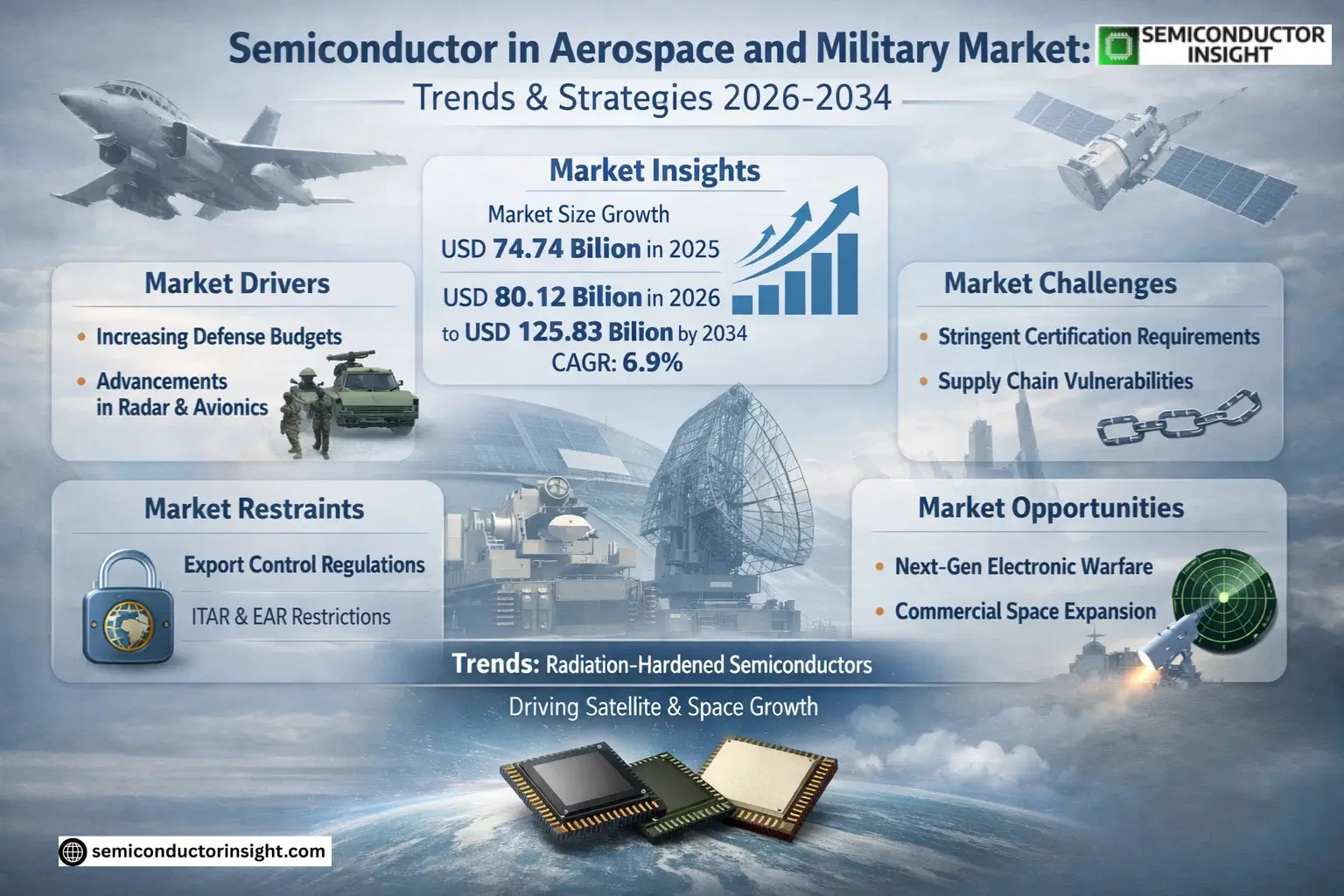
Global Semiconductor in Aerospace and Military Market size was valued at USD 74.74 billion in 2025. The market is projected to grow from USD 80.12 billion in 2026 to USD 125.83 billion by 2034, exhibiting a CAGR of 6.9% during the forecast period.
Semiconductors in aerospace and military applications are specialized components designed for extreme environments, requiring high reliability, radiation resistance, and thermal stability. These include integrated circuits (ICs), discrete devices, optoelectronics, RF/microwave components, and hybrid modules manufactured using materials like silicon (Si), silicon carbide (SiC), and gallium nitride (GaN). They undergo stringent MIL-STD or ESA/NASA certifications to ensure performance under harsh conditions such as space radiation, high-altitude operations, or battlefield scenarios.
The market growth is driven by increasing defense budgets globally particularly for satellite constellations, unmanned systems, and next-gen avionics alongside advancements in wide-bandgap semiconductors enabling higher power efficiency. For instance, the U.S. Department of Defense allocated USD 145 billion for R&D in FY2023, accelerating adoption of GaN-based radar systems and radiation-hardened FPGAs. Key players like BAE Systems, Texas Instruments, and Infineon Technologies are expanding production capacities to meet demand from defense contractors such as Lockheed Martin and Northrop Grumman.
MARKET DRIVERS
Increasing Defense Budgets Worldwide
Semiconductor in Aerospace and Military Market is experiencing strong growth due to rising defense expenditures across major economies. Governments are allocating higher budgets for advanced military technologies, directly increasing demand for specialized semiconductors. The U.S. defense budget alone allocated over USD 50 billion for advanced electronics in the latest fiscal year.
Advancements in Radar and Avionics Systems
Modern warfare and aerospace systems require high-performance semiconductors for next-generation radar, communication, and navigation systems. The shift toward phased array radars and AI-powered avionics is creating unprecedented demand for radiation-hardened ICs and high-frequency GaN components.
Space programs and satellite deployments are further accelerating semiconductor needs, with radiation-tolerant chips becoming essential for orbital and deep-space applications.
MARKET CHALLENGES
Stringent Certification Requirements
Semiconductor in Aerospace and Military Market faces rigorous qualification standards including MIL-STD-883 and DO-254 certifications. These processes significantly increase development timelines, with some components requiring 18-24 months for full qualification. Small-mid size suppliers often struggle with compliance costs exceeding USD 5 million per product line.
Other Challenges
Supply Chain Vulnerabilities
Geopolitical tensions have exposed critical dependencies on foreign semiconductor manufacturing. The aerospace sector reports 60% of defense-grade chips rely on fabs outside NATO countries, creating strategic vulnerabilities.
Technology Obsolescence
Military programs lasting 20+ years face component discontinuation issues, with 32% of systems requiring expensive redesigns mid-program due to obsolete semiconductors.
MARKET RESTRAINTS
Export Control Regulations
ITAR and EAR restrictions severely limit technology transfers in the Semiconductor in Aerospace and Military Market. These regulations affect 28% of global semiconductor trade related to defense applications, creating artificial market barriers and supply constraints.
MARKET OPPORTUNITIES
Next-Gen Electronic Warfare Systems
The development of cognitive EW and directed energy weapons presents a USD 12 billion opportunity for semiconductor manufacturers. These systems require advanced MMICs, FPGA solutions, and ultra-wideband components with processing speeds exceeding 100GHz.
Commercial Space Expansion
With private space companies launching over 1,200 satellites annually, demand for radiation-tolerant semiconductors has grown 300% since 2020. This creates parallel opportunities for military-aerospace suppliers to adapt space-grade components.
Semiconductor in Aerospace and Military Market Trends
Radiation-Hardened Semiconductors Drive Satellite Expansion
The demand for radiation-hardened semiconductor devices is accelerating with rapid growth in satellite constellations and space systems. Radiation-tolerant FPGAs, GaN/SiC power devices, and optoelectronic semiconductors are critical for LEO/MEO satellites, Earth-observation payloads, and propulsion systems. These components must withstand extreme space environments while maintaining high reliability over extended mission durations.
Other Trends
Military UAVs Fuel Navigation and MEMS Sensor Demand
Large-scale deployment of military drones is increasing requirements for high-precision navigation chips, MEMS inertial sensors, and secure communication ICs. These semiconductor solutions enable autonomous operations, real-time data processing, and electronic warfare capabilities in unmanned aerial systems.
Wide Bandgap Materials Transform Power Electronics
SiC and GaN semiconductors are revolutionizing aerospace power systems with superior thermal performance and energy efficiency compared to traditional silicon. These materials enable compact, lightweight power converters for electric aircraft propulsion, directed energy weapons, and next-generation radar systems while meeting stringent military thermal management requirements.
Secure Chip Architectures Address Cybersecurity Threats
Military applications are driving adoption of tamper-resistant semiconductor designs with hardware-based security features. Trusted foundry programs and anti-tamper technologies are becoming standard for processors and FPGAs used in sensitive defense electronics, protecting against reverse engineering and cyber threats.
Modular Electronics Enable Faster System Upgrades
The shift towards open architecture standards like SOSA and CMOSS is accelerating adoption of modular semiconductor solutions in military platforms. These standards facilitate rapid technology insertion through standardized interfaces while maintaining the ruggedness required for harsh operational environments.
COMPETITIVE LANDSCAPE
Key Industry Players
Aerospace & Military Semiconductors: High-Reliability Solutions for Extreme Environments
Semiconductor in Aerospace and Military Market is dominated by established players with specialized expertise in radiation-hardened, high-reliability components. Texas Instruments and Analog Devices lead with comprehensive portfolios of MIL-STD certified analog and mixed-signal ICs for avionics and defense systems. Microchip Technology and Infineon Technologies have strengthened their positions through strategic acquisitions of radiation-hardened FPGA and power semiconductor manufacturers.
Niche specialists like BAE Systems and Northrop Grumman provide mission-specific semiconductor solutions for satellite systems and electronic warfare applications. Emerging Chinese players including CETC and Guoxin Micro are gaining traction through government-funded defense modernization programs, while GaN/SiC innovators like Qorvo and Skyworks enable next-generation radar and communication systems.
List of Key Semiconductor in Aerospace and Military Companies Profiled
- Texas Instruments (TI)
- Analog Devices
- Microchip Technology
- Intel
- Infineon Technologies
- AMD
- ON Semiconductor
- BAE Systems
- NXP Semiconductors
- Skyworks Solutions
- Broadcom
- Northrop Grumman
- Qorvo
- CETC
- Guoxin Micro
Segment Analysis:
| Segment Category | Sub-Segments | Key Insights |
| By Type |
|
Integrated Circuits
|
| By Application |
|
Aerospace
|
| By End User |
|
Defense Contractors
|
| By Material |
|
Silicon Carbide (SiC)
|
| By Platform |
|
Space
|
Regional Analysis: Semiconductor in Aerospace and Military Market
The CHIPS Act and national security concerns are reshaping North America’s semiconductor supply chains for aerospace/military applications. Domestic foundries are expanding production of specialized components to reduce reliance on overseas suppliers, particularly for radiation-tolerant ICs and trusted microprocessors used in classified systems.
Development focuses on AI-enabled processors for autonomous defense systems and quantum-resistant encryption chips. Hypersonic missile guidance systems demand ultra-high-speed signal processing semiconductors that can operate in extreme thermal and vibrational environments unique to aerospace applications.
Rigorous MIL-SPEC and NASA-grade testing protocols ensure semiconductor reliability for aerospace applications. Specialized packaging technologies are being developed to protect chips from space radiation and prolonged thermal cycling while maintaining signal integrity in communication satellites.
Commercial semiconductor innovations are being adapted for military use through programs like DARPA’s ERI, with advanced node technologies being modified for radiation hardening and extended temperature-range operation in aerospace environments.
Europe
European aerospace and military semiconductor market benefits from strong collaborative programs like the European Defence Fund and PESCO initiatives. The region specializes in secure communication chips for NATO systems and radiation-hardened components for space applications. Airbus and Thales drive demand for avionics-grade semiconductors with long lifecycle support. Strict export controls on dual-use technologies create specialized supply chains prioritizing sovereign capabilities in secure microelectronics. Environmental regulations are pushing development of more energy-efficient defense semiconductors without compromising performance.
Asia-Pacific
Asia-Pacific shows rapid growth in aerospace semiconductor demand due to increasing defense modernization programs. China’s military-civil fusion strategy accelerates semiconductor self-sufficiency for radar and missile systems. Japan and South Korea focus on high-reliability components for space applications. Regional manufacturers are developing radiation-tolerant FPGAs and ASICs tailored for indigenous fifth-generation fighter programs. Geopolitical tensions are driving separate supply chains for commercial and military-grade semiconductors across the region.
Middle East
Gulf nations are investing heavily in semiconductor-dependent defense systems through offset programs with foreign suppliers. Focus areas include electronic warfare systems for desert environments and secure communication chips for UAV operations. Regional military modernization creates demand for temperature-resistant semiconductors capable of reliable performance in extreme heat conditions. Local assembly of defense electronics is increasing but core semiconductor components remain imported.
Rest of World
Other regions show growing interest in aerospace semiconductors through technology transfer agreements and licensed production. Emerging defense industrial bases in countries like Brazil and South Africa drive demand for ruggedized chips suitable for indigenous military platforms. Limited domestic fabrication capabilities create dependence on imported radiation-hardened and mil-spec components for critical defense applications.
Report Scope
This market research report provides a comprehensive analysis of the Semiconductor in Aerospace and Military Market, covering the forecast period 2025–2032. It offers detailed insights into market dynamics, technological advancements, competitive landscape, and key trends shaping the industry.
Key focus areas of the report include:
- Market Overview: The report begins with an overview outlining its current market scenario, key growth indicators, and industry transformation drivers. It discusses macroeconomic factors, demand–supply balance, regulatory landscape, and the strategic role of semiconductors in powering advancements across aerospace, defense, and military applications.
- Market Size & Forecast: Historical data and future projections for revenue, unit shipments, and market value across major regions and segments.
- Segmentation Analysis: Detailed breakdown by product type, materials, platform, and application to identify high-growth segments and investment opportunities.
- Regional Insights: Insights into market performance across North America, Europe, Asia, South America, and Middle East & Africa, including country-level analysis.
- Competitive Landscape: Profiles of leading market participants, including their product offerings, R&D focus, manufacturing capacity, and recent developments.
- Technology Trends & Innovation: Assessment of emerging technologies, material advancements, and evolving industry standards.
- Market Drivers & Restraints: Evaluation of factors driving market growth along with challenges, supply chain constraints, and regulatory issues.
- Stakeholder Insights: Strategic opportunities for component suppliers, OEMs, system integrators, and investors.
Primary and secondary research methods are employed, including interviews with industry experts and data from verified sources to ensure accuracy and reliability.
FREQUENTLY ASKED QUESTIONS:
What is the current market size of Semiconductor in Aerospace and Military Market?
-> Semiconductor in Aerospace and Military Market size was valued at USD 74.74 billion in 2025. The market is projected to grow from USD 80.12 billion in 2026 to USD 125.83 billion by 2034, exhibiting a CAGR of 6.9% during the forecast period.
What is the growth rate of Semiconductor in Aerospace and Military Market?
-> The market is expected to grow at a CAGR of 6.9% during the forecast period 2025-2032.
What are the key product types in Semiconductor in Aerospace and Military Market?
-> Key product types include Integrated Circuits, Discrete Devices, Optoelectronics and Isolation, Hybrids and Modules, RF and Microwave Devices, among others.
Which companies lead the Semiconductor in Aerospace and Military Market?
-> Key players include CETC, Texas Instruments, Analog Devices, Microchip, Intel, CASC, Infineon Technologies, AMD, Guoxin Micro, ON Semiconductor, BAE Systems, among others.
What are the major applications of aerospace and military semiconductors?
-> Major applications include Aerospace, Weapons, Ship, Communication, and other defense systems requiring high-reliability components.
Get Sample Report PDF for Exclusive Insights
Report Sample Includes
- Table of Contents
- List of Tables & Figures
- Charts, Research Methodology, and more...
 Download Sample Report PDF